


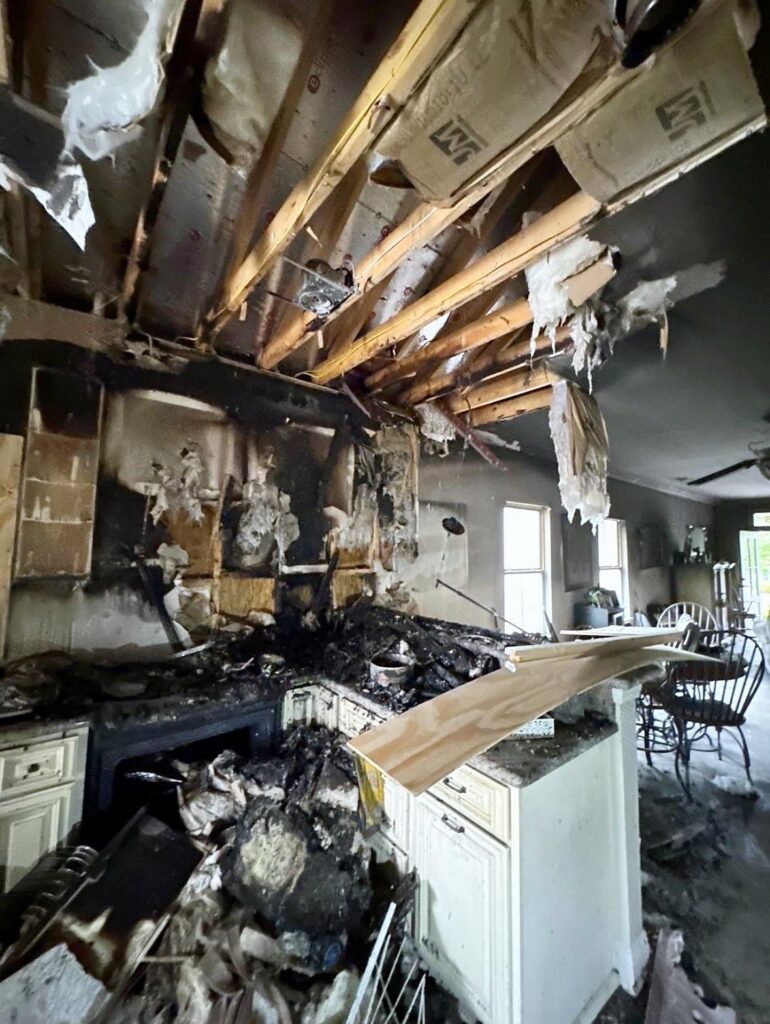
A pan of oil flares while you’re carving, or a casserole forgets it’s in the oven while the house fills with guests. The flames may be out in a minute, but in a townhome the smoke rarely stays in the kitchen. It climbs the stairwell, settles on bedroom ceilings, and leaves a smell that lingers in curtains and carpet. Cooking fire cleanup in Bowie townhomes often means soot on two or three floors at once. There may also be a wall you share with a neighbor. This guide walks you through what to do first, how soot and odor are removed, and what to ask your insurer.
From PuroClean’s shared photo library: a kitchen after a fire, with cabinets charred and part of the ceiling opened. It’s a general example, not a Bowie job.
Why Cooking Fires Spike in Winter
Answer first: more meals, more guests, and more distractions put more pans on the stove at once.
The National Fire Protection Association’s cooking safety page names cooking as a top source of home fires and fire injuries. Its figures for 2020 to 2024 show ranges and cooktops in about 51 percent of home cooking fire incidents. Unattended equipment plays a part in about a quarter of them. The page also lists Christmas Day and Christmas Eve among the peak days for home cooking fires.
Winter gatherings stack up the same risk factors. Burners run for hours, the oven door opens and closes, and the cook keeps stepping away to greet people. A grease flare or a dish left too long can happen to anyone.
Why Townhomes Spread Smoke Differently
Answer first: stacked floors and an open stairwell act like a chimney, carrying smoke up and away from the kitchen.
In a single-level house, smoke spreads mostly across one floor. In a townhome, the kitchen is often on the main level with the stairs nearby. Warm smoke rises up that stairwell and collects on upper ceilings, in closets, and in bedrooms that were never near the flames.
A few traits of townhome layouts matter for cleanup:
- Soot often shows up heaviest at the top of the stairs and on upper-floor ceilings.
- Shared walls can carry odor along outlets, plumbing chases and gaps around pipes.
- Return-air vents can pull smoke into the duct system and spread it to every room.
- Smaller rooms mean soft goods like bedding and clothes sit closer to the smoke path.
You don’t need to know the building science. It just helps to understand why your bedroom smells like smoke when the fire was two floors down. It also explains why cooking fire cleanup in Bowie townhomes often starts high and works down. That way, loosened soot doesn’t fall onto areas that were already cleaned.
Bowie Housing at a Glance
Bowie has a sizable townhome stock alongside its detached houses. The Census Bureau’s American Community Survey (2020–2024 five-year estimates, table B25024) counts about 22,070 housing units (±581) in Bowie city. Roughly 17.9 percent are single-unit attached homes, the category that includes townhomes. About 72 percent are detached houses.
Table B25035 puts Bowie’s median year built at 1982 (±2), and table B25034 places a little under half of its homes before 1980. That mix matters. An older kitchen may have paint layers that need testing, while a newer one may have more synthetic finishes that hold odor.
What to Do in the First Hour
Answer first: make sure everyone is out of the smoke, then limit how far soot travels.
1. If anyone is coughing or the fire may not be fully out, leave and call 911.
2. Once it’s safe, open windows on the kitchen level if the weather allows.
3. Turn off the HVAC system so it stops pulling smoke into the ducts.
4. Keep pets and kids out of the kitchen and upstairs halls.
5. Don’t wipe soot with a damp cloth. Moisture can smear it into paint and grout.
6. Take photos of every affected room before anything is moved.
7. Set a damp towel along the bottom of a door to a room you want to protect.
Hold off on cooking again until the stove, hood and nearby outlets have been checked.
If you share a wall with a neighbor, it’s worth telling them. Odor can reach their side, and they may want to check their own rooms.
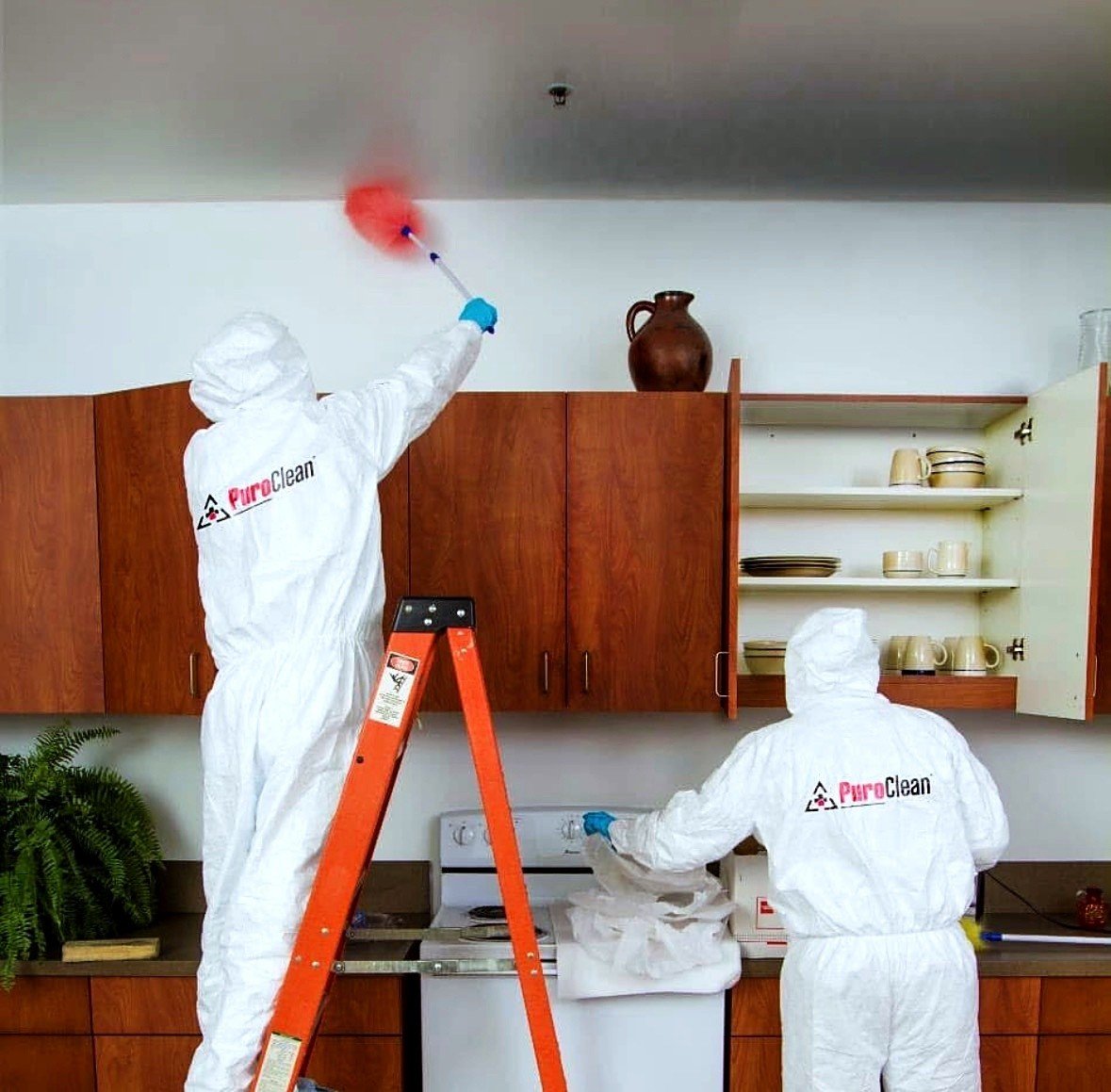
How Soot and Smoke Odor Are Removed
Answer first: the job moves from assessment, to dry soot removal, to cleaning, to odor control.
Cooking fires often produce a mix of residues. Burned food and grease can leave a sticky film that’s harder to see than black soot, but it carries a strong smell. Our fire team at PuroClean Restoration Services in Lanham plans cleaning around that mix.
A typical job includes:
- Walking each floor to map where soot and odor reached
- Dry-sponging walls and ceilings before any wet cleaning
- Cleaning cabinets, counters and appliances with products chosen for the residue
- Cleaning or sealing upper-floor ceilings and stairwell walls
- Inspecting and cleaning ductwork, filters and return vents
- Packing out or cleaning soft goods, dishes and small appliances
- Using odor-control methods once surfaces are clean
Charred cabinets or drywall usually come out. In homes built before 1978, test paint for lead before sanding or demolition. Our technicians hold WRT, ASD and FRT certifications, and the company is EPA Lead Safe Certified.
Signs Smoke Reached More Than the Kitchen
Answer first: check the high spots, the soft goods, and anything with a fan.
Look for:
- Gray film on ceilings at the top of the stairs
- Dark streaks around ceiling vents and light fixtures
- Smoke smell in closets or on clothes that were behind closed doors
- Soot lines on the edges of carpet near walls
- A smell that returns every time the heat kicks on
If the odor seems strongest when the system runs, the ducts likely need attention. Cleaning surfaces alone won’t fix it. Replace the furnace filter after the fire, too, since it may have trapped a lot of fine soot.
What Not to Do
A few common moves can make cooking fire cleanup in Bowie homes harder:
- Don’t use scented sprays to cover odor. They mix with the smoke smell.
- Don’t run the HVAC to “air things out” before the ducts are checked.
- Don’t throw away damaged items before you’ve photographed them for a claim.
- Don’t scrub greasy soot with a household cleaner, which can spread it.
- Don’t repaint until surfaces are cleaned and sealed, or stains may bleed through.
Will Insurance Cover It?
Answer first: smoke is a commonly covered peril, but your policy wording decides.
The Insurance Information Institute’s guide to which disasters homeowners insurance covers lists fire and smoke among the perils on standard homeowners forms. Your deductible, policy type and any HOA policy can all affect how a townhome claim works. Ask your agent or adjuster before major work begins, and keep receipts for any hotel stay or meals.
If your community has an HOA, check whether shared walls or roofs fall under the association’s policy. That can change who files what.
Cutting the Risk Before Your Next Gathering
Answer first: stay at the stove, keep a lid nearby, and give the cooktop room.
- Stay in the kitchen while anything is frying, broiling or simmering on high.
- Keep a lid close by to smother a pan flare. Don’t use water on grease.
- Clear towels, oven mitts and paper packaging away from burners.
- Clean grease from the range hood filter before a big cooking day.
- Test smoke alarms on every floor, including the top of the stairs.
Example: A Bowie family’s oil pan flares while they’re cooking for a crowd. The flames are out fast, but by evening the upstairs bedrooms smell of smoke and the hallway ceiling looks gray. This scenario is invented to show the steps.
Frequently Asked Questions
How Long Does Cooking Fire Cleanup in Bowie Take?
It depends on how far the smoke traveled. A small kitchen job may take a few days, while a full townhome with duct cleaning can take longer.
Can I Stay in My Home During Cleanup?
Sometimes. If smoke odor is strong in bedrooms or the kitchen is unusable, a short stay elsewhere may be easier. Your adjuster can say whether that’s covered.
Will the Smell Come Back?
It can if residue is left in ducts, insulation or soft goods. Cleaning the source before using odor-control methods gives the best chance it stays gone.
Do I Need to Replace My Cabinets?
Not always. Lightly soiled cabinets can often be cleaned. Charred or warped ones usually need replacement.
Do You Serve Bowie and Nearby Areas?
Yes. We work with homeowners in Bowie, Lanham, Upper Marlboro, Washington, DC, and across Prince George’s County.
Get Help With Cooking Fire Cleanup in Bowie
PuroClean Restoration Services in Lanham is led by owner Ted Porter. We’re IICRC Certified and EPA Lead Safe Certified, and our technicians hold WRT, ASD and FRT certifications. Call us 24/7 at (301) 277-2755. Our office is at 4720 Boston Way, Unit L, Lanham, MD 20706. We also serve Lanham, Upper Marlboro, Washington, DC, and Prince George’s County.