When police release a scene, they hand the property back as it is, and the cleanup becomes the owner’s responsibility. What’s left usually goes deeper than it looks: blood and other body fluids seep into carpet pad, subfloor, grout, and the gaps behind trim, well past what a mop can reach. That hidden material is what keeps a room unsafe, not the stain you can see. This is what professionals do between the release and the day the room is used again, what you should leave alone, and how to arrange the work without making a hard week harder.
TL;DR
- Keep everyone away from blood and body fluids; OSHA treats them as potentially infectious material, not ordinary dirt.
- Once police release the property, book trauma and crime scene cleanup before family, tenants, or staff go back in.
- Cleaning comes before disinfecting; OSHA notes blood must be cleaned up thoroughly before the disinfectant goes on.
- Expect removal, not just wiping: soaked carpet pad, drywall and subfloor usually have to be cut out.
- Call your insurer before work starts; whether cleanup is covered depends on your policy and what happened.
- Eligible Virginia crime victims can claim up to $1,000 toward cleanup from the Virginia Victims Fund (2026).
Why a room that looks clean is not a disinfected room
Cleaning and disinfecting are two different jobs, and crime scene disinfection depends on doing them in the right order. Cleaning removes the blood, tissue, and residue you can see. Disinfecting kills the pathogens you can’t see, and it only works on a surface that has already been cleaned.
The product matters as much as the order. In OSHA’s guidance on blood decontamination, the agency says soap and water may be fine for general cleaning but isn’t appropriate for decontaminating blood. What qualifies is an EPA-registered disinfectant with the right label claims, such as a tuberculocidal product, or household bleach diluted between 1:10 and 1:100, used exactly as directed.
Waiting doesn’t make a room safe either. According to the CDC, the hepatitis B virus can survive outside the body and remain infectious for at least 7 days, so a room that has been shut for a week still needs proper treatment.
The bigger problem is what can’t be reached from the surface. Blood travels through carpet into the pad, between floorboards, under baseboards, and into the bottom of drywall. Porous material that has absorbed fluids usually can’t be disinfected in place, which is why much of a professional job is careful removal rather than scrubbing. The health risks of biohazard exposure come from that hidden material as much as from the stain on top.
Decide what to touch, and what to leave alone
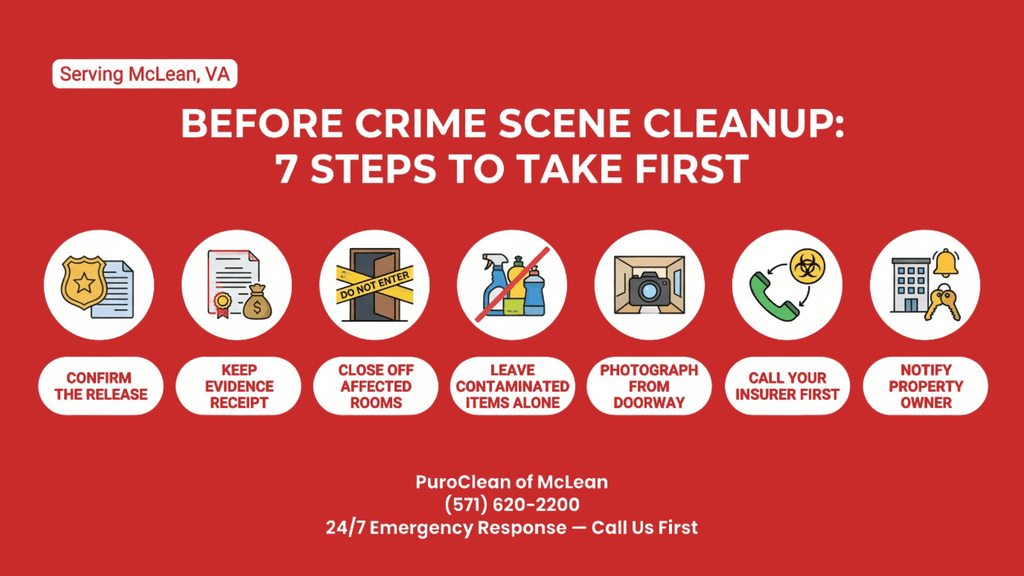
Touch nothing with blood or fluids on it, and keep the affected rooms closed until a trained crew has assessed them. The first day is mostly calls and records, and getting them right makes both the cleanup and any claim easier.
- Confirm with the investigating officer that the property has been released, and ask what is still held as evidence.
- Keep any evidence receipt police leave you; the Virginia Victims Fund asks for it before paying to replace certain items.
- Close off affected rooms and keep children, pets, and visitors out of them.
- Don’t wipe, vacuum, wash, or throw out anything with fluids on it, including bedding and clothing.
- Photograph each affected room from the doorway, without stepping into contaminated areas.
- Call your insurer, then a biohazard cleanup company, and write down claim numbers and names.
- In a rental or a business, tell the landlord, property manager, or building owner the same day.
Check that the crime scene cleanup process covers every stage
A sound crime scene cleanup process runs in one direction, from assessment to a final walkthrough, and any company you hire should be able to explain each stage before it starts.
Assessment and protective gear come first
The first visit maps where fluids went, including places they can’t be seen yet. At PuroClean of McLean and West Falls Church, our crews start by identifying affected areas, completing a health and safety evaluation, and sizing the job before anything is moved. Our IICRC-certified technicians follow OSHA guidelines and wear protective equipment throughout, and a properly run job seals off the work area so contamination isn’t tracked through the rest of the property.
If the scene also involves water from a sprinkler, a broken pipe, or firefighting, the plan has to cover drying too, because water damage mitigation can’t wait until the biohazard work is finished.
Contaminated porous materials are removed
Carpet, pad, mattresses, upholstered furniture, and sections of drywall or subfloor that absorbed fluids are usually cut out, bagged, and disposed of under the rules that apply to biohazard waste. Removal continues until the crew reaches clean, unaffected material, which can mean opening a wall or lifting a section of floor.
Disinfectant choice and contact time decide whether it works
This is the step most people mean by crime scene disinfection, and it depends on everything before it. Once surfaces are clean, the crew applies a disinfectant that meets OSHA’s standard for blood and leaves it wet for the full contact time on the label. A product that’s wiped off early, or used on a surface that wasn’t cleaned first, hasn’t done its job, however fresh the room smells.
Odor control and a final walkthrough close the job
Deodorizing deals with odor that has moved into air, fabrics, and building materials. Before you use the space again, you should get a walkthrough of the finished area, a list of what was removed, and a clear note of anything that still needs repair.
Why bleach and a mop don’t make a room safe
Because household cleaning reaches the surface, and the contamination that matters is usually underneath it. A mop pushes fluid into grout lines and seams. A vacuum can spread contaminated material through the room. Bleach poured on carpet discolors the fibers and stops short of the pad and subfloor, where fluid often ends up.
There’s the exposure, too. Without gloves, eye protection, and the right disposal, the person cleaning is the one most at risk. And there’s a cost that doesn’t show up on a bill: family members who clean a scene involving someone they love can carry it for a long time. Handing the job to people trained for it is a reasonable choice, not a failure of duty.
Who pays for cleanup after a crime in Virginia?
Usually it’s insurance first, then the owner, with help for eligible victims from a state fund that pays last. Some homeowners and renters policies cover this kind of cleanup, and some don’t, and only your insurer can say which applies to you. Ask what documentation they want before work starts; we keep your insurance agent informed at every step and document the work for your claim.
For crimes in a home or vehicle, the Virginia Victims Fund lists crime scene cleanup as a covered expense and, as of 2026, may reimburse up to $1,000 of it. The fund is the payer of last resort, so it pays only after insurance and other sources, and claims generally must be filed within a year of the crime. A local victim/witness program can help you apply.
In a rental, the landlord’s policy and the tenant’s renters policy may each cover different parts of the loss. For offices, shops and multi-unit buildings, cleanup for commercial properties follows the same stages but usually runs through the building owner or property manager and their insurer.
Four ways to handle cleanup after a crime, compared
| Option | Protection for the people cleaning | Reaches contamination below the surface | Waste handling | What it costs you |
|---|---|---|---|---|
| Family, friends or staff | Household gloves at most | No; surface wiping only | Household trash | Exposure risk and a heavy emotional toll |
| A house cleaning or janitorial service | Varies; often not trained for blood | Rarely; no removal of materials | Often outside their scope | Contamination left under the surface |
| A general contractor | Construction gear, not bloodborne training | Removes materials but doesn’t disinfect | Construction debris rules | Rebuilding over untreated framing |
| A biohazard cleanup company | Trained and equipped for bloodborne pathogens | Yes; removes and treats affected materials | Handled as biohazard waste | A professional bill, which insurance may cover |
Where this does not apply
The steps above don’t fit four situations.
- Police haven’t released the property; until they do, nothing should be cleaned, moved or thrown out.
- Someone is hurt or in danger; the first call is 911, not a cleanup company.
- The blood came from an everyday injury, such as a kitchen cut; that’s household cleaning, done with gloves and a disinfectant used as its label directs.
- The scene involved drug production, such as a meth lab; chemical residue needs its own assessment before anyone goes in.
Final Verdict
If fluids reach anything soft or porous, such as carpet, a mattress, or upholstery, treat the cleanup as a professional job and keep the rooms closed until it’s done. If the affected area is small and limited to a sealed hard surface, the crime scene cleanup process is shorter, but crime scene disinfection still needs a disinfectant that meets OSHA’s standard and the full contact time on its label. If you can’t tell how far fluids traveled, that uncertainty is the reason to have the space assessed before anyone cleans. The full list of situations we work on is on our biohazard cleanup services page.
When you’re ready, our team can walk you through the options before any work starts. Call (571) 620-2200 or send our team a message.
FAQs
Q: Do police clean up after a crime scene?
A: No. Police and investigators document the scene and collect evidence, then release the property back to the owner or tenant, and the cleanup becomes the owner’s responsibility. Investigators may also leave fingerprint powder and other residue on surfaces. Leave it for the cleanup crew; it smears and spreads when wiped with household cloths.
Q: How long does crime scene cleanup take?
A: It depends on how far fluids spread, how much material has to come out, and whether other damage, such as water, is involved. A small area on sealed flooring is a much shorter job than a scene that reached carpet pad, subfloor, and walls. Ask for a written scope that lists each stage, so you know where the work stands.
Q: Can I stay in my home during the cleanup?
A: Often you can stay in unaffected parts of the home, as long as the work area is sealed off and nobody walks through it. Many families still choose to stay elsewhere until the work is done. Eligible victims can ask the Virginia Victims Fund about temporary housing, which it lists among the expenses it may cover.
Q: What happens to items that can’t be cleaned?
A: Porous items that absorbed blood or other fluids, such as mattresses, carpet, pad, and some upholstered furniture, are usually removed, bagged, and disposed of as biohazard waste. Before anything leaves the property, it should be photographed and listed for your insurer. If an item has sentimental value, say so early; sometimes the affected part can be removed, and the rest kept, and the crew can tell you when that’s possible.
Q: How much does crime scene cleanup cost?
A: There’s no reliable flat price. The cost depends on the size of the affected area, how much material has to be removed, disposal of biohazard waste, odor treatment, and any water damage involved. Ask for an itemized scope before work starts and share it with your insurer. If the crime happened in your home, the Virginia Victims Fund may cover part of the cleanup cost that insurance doesn’t.