


Introduction
Biohazard cleanup is one of those services people don’t think about until they urgently need it. Whether it’s after an accident, unattended death, crime scene, or hazardous contamination, the timeline matters, especially when safety, property access, and emotional closure are involved.
A common question people ask is how long does biohazard cleanup take, and the honest answer is, it depends. Some jobs are completed in hours, while others can take several days. The difference comes down to the size of the affected area, the type of contamination, and how quickly professionals can safely remediate the space.
This blog breaks down realistic timelines, what influences them, and what you should expect if you’re arranging or waiting on cleanup services.
What Biohazard Cleanup Actually Involves
Before talking timelines, it helps to understand what’s happening behind the scenes. Biohazard cleanup is not just “cleaning.” It’s a regulated, step-by-step process designed to eliminate health risks completely.
Professionals assess the site, contain the affected area, remove contaminated materials, disinfect surfaces, neutralize odors, and safely dispose of hazardous waste. Depending on the situation, structural materials like flooring or drywall may also need removal and replacement.
Each of these steps takes time, and skipping any of them would create serious health risks.
Average Biohazard Cleanup Timeframes
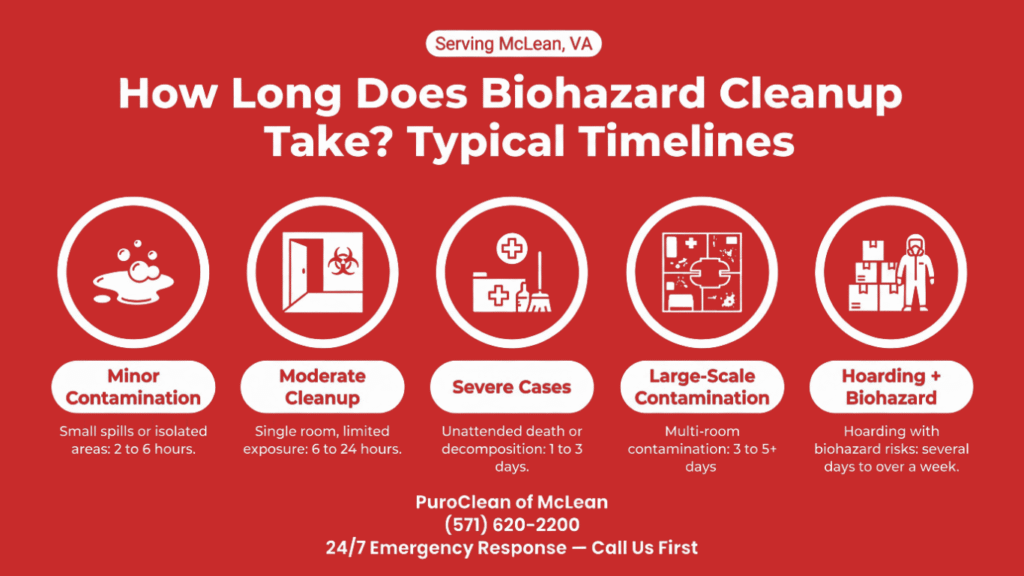
The duration varies widely depending on the situation, but there are general ranges you can expect. Here’s a realistic breakdown of common scenarios and how long they typically take.
– Minor contamination (small spills or isolated areas): 2 to 6 hours
– Moderate cleanup (single room, limited exposure): 6 to 24 hours
– Severe cases (unattended death, decomposition): 1 to 3 days
– Large-scale or multi-room contamination: 3 to 5+ days
– Hoarding with biohazard risks: several days to over a week
These estimates give a baseline, but real timelines shift based on specific conditions at the site.
Key Factors That Affect Cleanup Duration
No two cleanup jobs are identical, and several variables can significantly extend or shorten the timeline. These are the main factors professionals evaluate before estimating how long the job will take.
– Size of the affected area: Larger spaces require more labor, materials, and time
– Type of biohazard: Blood, bodily fluids, decomposition, and chemicals all require different treatments
– Level of contamination: Surface-level contamination is faster than deep saturation into materials
– Time since incident: Older scenes often involve odor, bacteria growth, and structural damage
– Materials affected: Porous materials like carpet and wood take longer than non-porous surfaces
– Accessibility: Tight spaces or clutter slow down equipment use and movement
– Local regulations: Disposal and compliance requirements can add time
The more complex the environment and contamination, the longer the cleanup will realistically take.
Step-By-Step Timeline of a Typical Cleanup
Understanding the process helps explain where the time goes and why it can’t be rushed. Most professional biohazard cleanups follow a structured workflow to ensure safety and compliance.
– Initial assessment: Inspect site, identify hazards, and create a remediation plan
– Containment setup: Isolate affected areas to prevent cross-contamination
– Removal of biohazards: Extract fluids, remove waste, and dispose of contaminated materials
– Deep cleaning and disinfection: Apply hospital-grade disinfectants and specialized treatments
– Odor neutralization: Use fogging, ozone, or hydroxyl generators if needed
– Final inspection: Verify the area is safe and fully decontaminated
Each step must be completed thoroughly, which is why timelines are measured in hours or days, not minutes.
Why Some Cleanups Take Longer Than Expected
People often assume cleanup should be quick, especially for smaller spaces, but several hidden factors can extend the process.
Decomposition is a major one. When a body has been undiscovered for days or weeks, fluids can seep into subflooring, walls, and even structural supports. This requires partial demolition and reconstruction, not just cleaning.
Odor removal is another time-intensive step. Smells caused by biohazards are not surface-level; they can linger in HVAC systems, insulation, and porous materials. Eliminating them fully takes specialized equipment and repeated treatments.
There’s also the human factor. Technicians work carefully to avoid exposure, cross-contamination, and mistakes. Speed is never prioritized over safety in this type of work.
Emergency vs Scheduled Cleanup Timing
Not all biohazard cleanup happens under the same urgency. Some jobs begin within hours, while others are scheduled days later.
Here’s how response timing differs depending on the situation.
– Emergency response: Teams can often arrive within 1 to 4 hours
– Law enforcement clearance: Cleanup cannot begin until authorities release the scene
– Insurance coordination: Delays can happen if approvals are required
– Property access: Gaining entry or permissions may slow the start time
The clock doesn’t always start immediately after an incident; it starts when cleanup is legally and logistically allowed to begin.
Can Biohazard Cleanup Be Done Faster?
It’s natural to want the process finished as quickly as possible, especially in emotionally difficult situations. But speeding it up isn’t always the right approach.
Professional crews already work efficiently using industrial-grade equipment and trained protocols. Trying to rush the job can lead to incomplete disinfection, lingering health risks, and recurring odors.
In some cases, additional technicians can be deployed to large jobs to reduce total time. However, this depends on space, safety constraints, and the complexity of the contamination.
The priority is always thoroughness. A properly completed cleanup ensures the space is truly safe to return to.
Signs the Cleanup May Take Longer
Some indicators suggest a job will fall on the longer end of the timeline spectrum. If you notice any of these conditions, expect a more involved cleanup process.
– Strong, persistent odors upon entry
– Visible staining beyond surface level
– Fluids that have seeped under the flooring or into the walls
– Insect activity or advanced decomposition
– Multiple rooms or areas affected
These signs usually mean deeper contamination that requires more time and specialized treatment.
What You Can Do to Help the Process Move Smoothly
While most of the work is handled by professionals, there are a few ways you can avoid unnecessary delays.
These simple steps can help keep the cleanup timeline on track.
– Provide clear access to the affected area
– Share accurate details about the incident
– Avoid attempting DIY cleaning beforehand
– Confirm insurance information early if applicable
– Stay available for approvals or decisions
Small actions on your end can prevent delays and help the team work more efficiently.
Cost vs Time: Are Faster Cleanups More Expensive?
There’s often a connection between time and cost, but it’s not as straightforward as “faster equals more expensive.”
More complex jobs cost more because they require additional labor, equipment, and disposal, not simply because they take longer. In some cases, accelerating a job by adding more technicians can increase costs slightly, but it may reduce downtime for a property.
If timing is critical, it’s worth discussing priorities with the cleanup provider. They can explain what’s realistically possible without compromising safety or compliance.
Conclusion
Biohazard cleanup timelines vary because no two situations are the same. While minor cases can be resolved in a few hours, more complex scenarios can take several days or longer. The key factors: size, contamination level, materials, and safety requirements, all play a role in determining the final timeline.
Understanding biohazard cleanup duration helps set realistic expectations and reduces stress during an already difficult situation. If you need professional help, reach out to a certified cleanup service as soon as possible; they can assess the situation quickly and give you a clear, accurate estimate based on your specific circumstances.
FAQs
Q: How long does biohazard cleanup take for a single room?
A: Most single-room cleanups take between 6 and 24 hours, depending on contamination severity and materials involved.
Q: Can I stay in my home during the cleanup?
A: In many cases, no. For safety reasons, affected areas are isolated, and it’s often recommended to leave until the cleanup is complete.
Q: Does insurance cover biohazard cleanup time and cost?
A: Many homeowners and property insurance policies cover biohazard cleanup, but approval timelines can vary and may affect how quickly work begins.