


Managing residential communities, commercial office spaces, industrial facilities, and retail centers in Melbourne and West Melbourne comes with a wide spectrum of operational responsibilities. While routine property maintenance, tenant communications, and leasing agreements account for the vast majority of a property manager’s workload, unexpected emergencies can strike without warning. Among the most challenging, sensitive, and hazardous crises a property manager can encounter are biohazard incidents.
A biohazard event can range from a severe sewage backup inundating a multi-family apartment building off Wickham Road to a traumatic injury, medical emergency, unattended death, or gross filth hoarding situation in a West Melbourne rental property. In these intense situations, property managers face dual responsibilities: protecting the physical health and safety of tenants, visitors, and staff, while simultaneously managing legal liability, regulatory compliance, and property values.
Handling biological contaminants requires far more than standard janitorial cleaning products or routine maintenance sweeps. Biological materials carry microscopic pathogens capable of causing severe illness or permanent structural damage if improperly handled. This comprehensive guide outlines the essential emergency biohazard cleanup protocols every property manager in Melbourne and West Melbourne, FL, must establish to ensure safety, legal compliance, and rapid property restoration.
1. Understanding Biohazardous Material in Property Management
In the context of property management and building operations, a biohazard is defined as any biological substance that poses a threat to human health or the environment. Because microscopic viral, bacterial, and fungal pathogens can survive on porous and non-porous structural surfaces for days or even weeks, proper identification and classification are critical.
Common biohazard incidents in Brevard County commercial and residential properties include:
• Bloodborne Pathogens and Bodily Fluids: Resulting from traumatic injuries, violent crimes, industrial accidents, or medical emergencies. Exposure carries serious risks of infectious diseases including Hepatitis B (HBV), Hepatitis C (HCV), and Human Immunodeficiency Virus (HIV).
• Unattended Deaths and Decomposition Fluids: When an individual passes away unnoticed, natural decomposition begins rapidly—especially in Florida’s sub-tropical heat. Biological fluids seep deep into carpet padding, subfloors, drywall, and HVAC ductwork, releasing volatile organic compounds (VOCs) and intense odors.
• Sewage Backups and Black Water (Category 3 Water): Main sewer line blockages or septic overflows dump millions of dangerous micro-organisms—including E. coli, Salmonella, Norovirus, and parasites—into living spaces.
• Hoarding and Gross Filth Situations: Properties impacted by severe hoarding often contain accumulated animal or human waste, decayed food, pest infestations, and discarded medical sharps, creating severe indoor air toxicity.
• Animal Contamination: Significant accumulations of bat guano, rodent droppings, or raccoon waste inside attics or wall voids, which harbor respiratory hazards such as Histoplasma capsulatum.
2. Why Standard Maintenance Staff Must Never Handle Biohazards
One of the most frequent mistakes property managers make during a crisis is instructing in-house maintenance personnel or regular janitorial staff to clean up a biohazard scene. While well-intentioned, this action exposes workers to severe health risks and creates massive legal liabilities for the property owner and management firm.
Under the Occupational Safety and Health Administration (OSHA) Bloodborne Pathogens Standard (29 CFR 1910.1030), employers are strictly prohibited from requiring employees to handle blood or potentially infectious materials unless specific prerequisite mandates are fulfilled:
- • Comprehensive, documented Bloodborne Pathogen training programs.
- • Formal Exposure Control Plans tailored to the specific worksite.
- • Employer-provided Hepatitis B vaccination series at no cost to the employee.
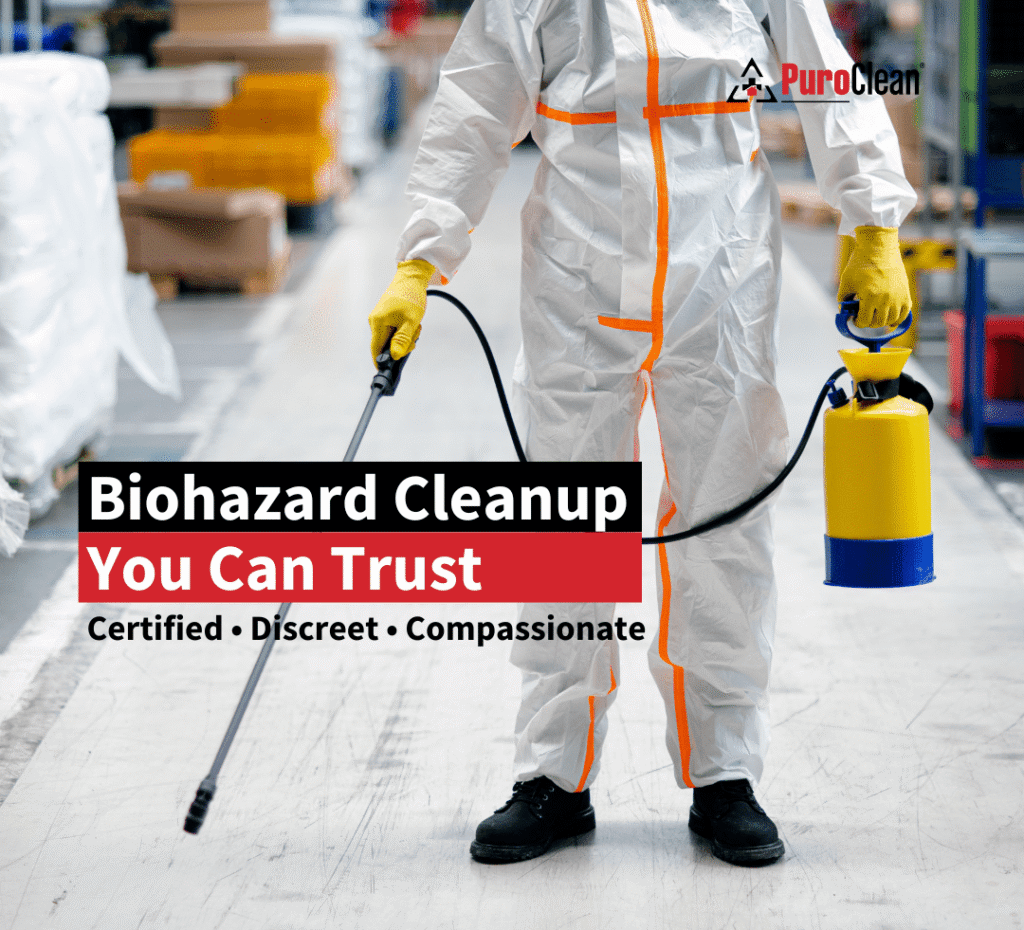
- • specialized Personal Protective Equipment (PPE) including full-body Tyvek suits, respirator masks, eye protection, and heavy-duty nitrile gloves.
- • Licensed biohazardous waste transport agreements and regulated disposal containers.
Directing an untrained maintenance employee to mop up blood or clear a sewage backup using household bleach violates federal safety standards and exposes management to severe OSHA citations, workers’ compensation claims, and personal injury lawsuits. Furthermore, improper cleaning techniques—such as using household mops or standard vacuum cleaners—spread microscopic pathogens across wider surface areas and drive contamination deeper into subfloors.
3. Step-by-Step Emergency Biohazard Response Protocol
When a biohazard incident occurs on your property in Melbourne or West Melbourne, having an established Standard Operating Procedure (SOP) reduces chaos and guarantees a safe, compliant response. Property managers should implement the following six-step emergency protocol immediately:
Step 1: Immediate Scene Securing and Evacuation
As soon as a biohazard is reported, your first priority must be human safety. Evacuate all tenants, guests, and non-essential personnel from the immediate vicinity. Lock entry doors, seal off affected hallways, and post clear ‘Do Not Enter / Danger’ warning signs to prevent unauthorized access. If the incident involves sewage or chemical off-gassing, turn off the localized HVAC system immediately to stop air currents from dispersing airborne pathogens throughout the building’s ductwork.
Step 2: Law Enforcement and Emergency Coordination
If the biohazard is the result of a crime, violent act, self-harm, or unattended death, immediately contact local emergency services. In Melbourne, notify the Melbourne Police Department or Brevard County Sheriff’s Office. In West Melbourne, contact the West Melbourne Police Department. Property managers must not enter, touch, or alter the scene until investigating officers officially complete their investigation and grant formal authorization to release the property for cleanup.
Step 3: Dispatch Certified Biohazard Remediation Specialists
Once the scene is secure or released by authorities, call a professional, licensed biohazard restoration contractor immediately. PuroClean of Melbourne offers 24/7 emergency response across Brevard County. Dispatched restoration teams arrive equipped with hospital-grade PPE, specialized containment equipment, and EPA-registered disinfectants required to handle high-risk biohazard environments.
Step 4: Comprehensive Documentation for Insurance and Records
Thorough documentation is vital for insurance claims processing and legal defense. Log the exact date, time, and nature of the incident report. Once granted access by police (or from outside the secure containment perimeter), take photographs or video of affected exterior or structural areas without disturbing physical biological evidence. Provide your restoration contractor with property access codes and insurance policy details to streamline the claims process.
Step 5: Professional Remediation, Decontamination, and Waste Disposal
Certified restoration professionals execute the technical cleanup using multi-stage containment procedures:
- • Engineering Controls & Containment: Erecting negative air pressure enclosures with HEPA air scrubbers to trap airborne pathogens and prevent cross-contamination.
- • Physical Bio-Material Removal: Safely extracting and containerizing all biological fluids, contaminated porous materials (carpet, padding, drywall), and hazardous debris.
- • EPA-Registered Hospital-Grade Disinfection: Applying specialized broad-spectrum virucides and bactericides to destroy microscopic pathogens on all structural surfaces.
- • Deep Deodorization & Thermal Fogging: Eliminating foul odors at the molecular level using hydroxyl generators and ozone treatment rather than masking smells with fragrances.
- • Regulated Biohazard Waste Disposal: Bagging hazardous material in red biohazard bags, locking it in rigid biohazard containers, and transporting it via licensed medical waste haulers in accordance with Florida Department of Health regulations (Chapter 64E-16, F.A.C.).
Step 6: Post-Remediation Verification and Tenant Clearance
Before reopening a commercial suite or re-leasing a residential apartment, verify that the area has achieved complete sanitation. Professional restoration contractors provide property managers with a formal Certificate of Completion and Decontamination. This document confirms that all biohazardous materials were safely removed and disposed of in full compliance with state and federal laws, providing essential peace of mind to incoming tenants and property owners.
4. Specific Biohazard Scenarios Common to Melbourne & West Melbourne
Property managers in Brevard County face unique environmental factors that accelerate the severity of biohazard contamination:
A. Sewage Backups in Coastal & Sub-Tropical Climates
Heavy summer downpours, tropical storms, and localized flooding in Melbourne and West Melbourne regularly overload municipal sewer systems and aging private septic lines. When raw sewage backs up into a property, high ambient humidity acts as an accelerator, allowing bacteria to multiply exponentially within hours. Simultaneously, the excess moisture creates secondary mold growth risks. A fast response combining Emergency Water Extraction, structural Drying & Dehumidification, and biological disinfection is necessary to prevent total building loss.
B. Unattended Deaths and Heat Acceleration
With a high demographic of elderly residents and retirees in Space Coast communities, unattended deaths are an unfortunate reality for local property managers. If a resident passes away inside an apartment where air conditioning is turned off or malfunctions, indoor temperatures can easily top 90°F. Heat rapidly accelerates human decomposition, forcing biological fluids deep into concrete slabs, subflooring, and wall frames. Remediating these situations requires structural tear-out of affected subfloors, specialized enzymatic cleaners, and extensive deodorization.
C. Hoarding and Gross Filth in Rental Properties
Discovering a severe hoarding situation upon tenant eviction or lease termination presents property managers with major remediation hurdles. Deeply cluttered units frequently hide rotten food, animal feces, dead pests, and biohazardous waste buried under stacks of belongings. PuroClean of Melbourne provides compassionate, systematic hoarding and gross filth cleanup, restoring severely damaged units to clean, rentable conditions.
5. Why Property Managers Trust PuroClean of Melbourne
When an emergency strikes your commercial or multi-family property, having a reliable, pre-established restoration partner saves critical hours. Located at 739 North Dr in the Coastal Technology Center, PuroClean of Melbourne is the trusted property damage restoration company for landlords and property managers throughout Melbourne, West Melbourne, Palm Bay, Viera, and Brevard County.
Property managers choose PuroClean of Melbourne because we deliver:
- • 24/7 Rapid Emergency Response: Our certified technicians are on call 365 days a year to respond immediately to biohazard, water, or fire emergencies.
- • Discreet and Professional Execution: We understand the sensitive nature of biohazard and trauma scenes. We conduct operations with maximum discretion, respect, and professionalism to protect tenant privacy and property reputation.
- • Full-Service Restoration Capabilities: Beyond Biohazard and Trauma scene cleaning, our team seamlessly handles Water Removal, Emergency Water Extraction, Drying & Dehumidification, Mold & Odor Removal, Carpet Cleaning & Restoration, and complete structural Reconstruction.
- • Direct Insurance Coordination: We work directly with commercial and property insurance carriers, providing detailed photo documentation, scope estimates, and compliance paperwork to simplify claims approval.
Do not leave your property’s safety and legal compliance to chance. Incorporate PuroClean of Melbourne into your emergency preparedness plan today.

24/7 EMERGENCY BIOHAZARD & TRAUMA CLEANUP IN MELBOURNE & WEST MELBOURNE
Protect your tenants, workers, and property with certified, OSHA-compliant restoration.
Call PuroClean of Melbourne right now at (321) 378-2400 for immediate assistance!