


When property owners in Melbourne, Florida suspect hidden indoor mold growth, time is always of the essence. Central Florida’s persistent warmth, high relative humidity, and frequent coastal rainfall create ideal environmental conditions for organic fungal spores to germinate and amplify. Whether caused by a slow plumbing drip, air conditioning condensation overflow, or storm damage, discovering a potential mold issue creates immediate urgency for clear answers.
A common question homeowners and commercial property managers ask when scheduling an evaluation is: ‘How long does mold testing take, and when will I actually receive the laboratory results?’
Understanding the full timeline of the mold testing process from initial site inspection to final lab analysis and protocol creation helps property owners make informed decisions without delay. In this guide, we break down each phase of the testing timeline and explain what happens once your results are delivered.
Phase 1: The On-Site Assessment and Sample Collection (1 to 3 Hours)
The first stage of mold testing involves an physical, on-site evaluation conducted by a licensed indoor environmental assessor. For an average residential home in Brevard County (ranging from 1,500 to 3,000 square feet), the initial inspection and sampling process typically takes between 1 and 3 hours.
Read Also: Are mold test kits accurate?
During this time, the licensed assessor performs several comprehensive diagnostic tasks:
- • Physical Property Walkthrough: Examining visible surfaces, baseboards, ceilings, window tracks, and attic access points for visual discoloration, water staining, or physical swelling.
- • Non-Invasive Moisture Mapping: Using thermal imaging infrared cameras to identify hidden thermal anomalies and moisture pockets behind drywall, under subfloors, or inside ceilings.
- • Moisture Content Testing: Utilizing pin and pinless moisture meters to measure exact saturation levels inside building materials.
- • Ambient Climate Monitoring: Recording relative humidity, dew point, and temperature readings across various indoor zones.
- • Air and Surface Sampling: Collecting calibrated volumetric air samples via spore trap cassettes and taking surface swab or tape lift samples from suspicious structural materials.
Phase 2: Laboratory Analysis and Turnaround Times (24 to 72 Hours)
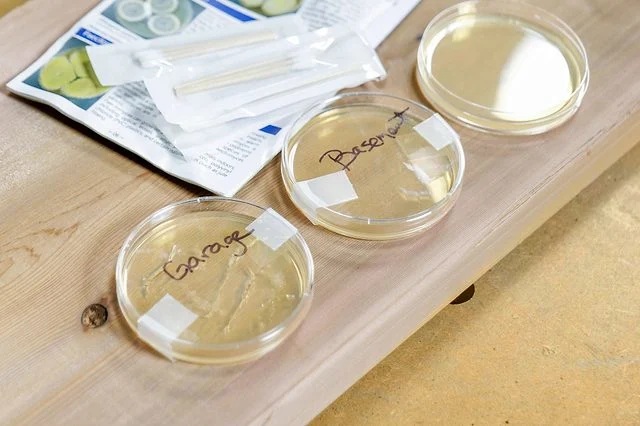
Once samples are secured on-site, they are logged, chain-of-custody sealed, and sent directly to an independent, accredited microbiological laboratory. The turnaround time for receiving lab results depends heavily on the specific testing method requested:
1. Direct Microscopy Air Spore Traps & Surface Samples (24 to 48 Hours): This is the standard and most common form of testing. Technicians analyze spore trap cassettes and surface tape lifts directly under high-powered magnification to identify fungal genera (e.g., Aspergillus, Penicillium, Stachybotrys, Cladosporium) and calculate total spore counts per cubic meter. Standard lab results are typically available within 24 to 48 business hours. Expedited same-day or 24-hour express processing is often available for urgent situations.
2. Cultured/Viable Mold Sampling (5 to 14 Days): If specific medical or environmental concerns require identifying living, viable fungal species down to the exact species level, samples must be placed on agar plates and incubated. Because living organisms take time to grow into identifiable colonies, cultured results take between 5 and 14 days.
Key Factors Influencing Testing Turnaround Times in Melbourne, FL
While standard direct microscopy results are usually delivered within 1 to 3 business days, several local factors in Brevard County can influence the total timeline:
- • Weekend and Holiday Schedules: Most independent accredited laboratories operate on standard business days. Samples collected late Friday afternoon may not undergo analysis until Monday morning unless emergency weekend lab processing is requested.
- • Major Storm Events: Following severe weather, tropical storms, or hurricanes, the volume of samples submitted to regional environmental labs spikes significantly, which can occasionally extend turnaround times.
- • Complexity and Property Size: Large commercial facilities or multi-story structures requiring dozens of indoor and outdoor baseline samples take longer to analyze than single-family homes.
Phase 3: The Environmental Assessor’s Report and Protocol (24 Hours Post-Lab)
Receiving raw laboratory data is only part of the process. A certified lab report contains scientific numbers and spore counts that must be interpreted in context. Within 24 hours of receiving lab data, the licensed environmental assessor compiles a comprehensive final report.
This report outlines whether indoor spore levels represent a Normal Fungal Ecology or abnormal amplification. If elevated levels or toxic species are identified, the assessor writes a detailed Remediation Protocol. This protocol serves as a step-by-step technical blueprint outlining exact containment areas, engineering controls, and safety guidelines for the restoration contractor.
What Happens After Results Confirm Mold Amplification?
Once you receive your official environmental report and remediation protocol, swift physical restoration is critical. In Florida’s climate, waiting to act allows airborne spores to continue settling and spreading into HVAC systems and unaffected building materials.
Per Florida Statute Section 468.8419, the testing assessor and the remediation contractor must be independent companies to prevent conflicts of interest. Once your assessor provides the protocol, you can immediately hand it over to a certified restoration specialist like PuroClean of Melbourne.
Fast, Expert Remediation with PuroClean of Melbourne
Located at 739 North Dr in the Coastal Technology Center, PuroClean of Melbourne is available 24/7 to execute complete, certified property damage restoration based on your environmental report.
Our highly trained restoration technicians follow strict IICRC S520 industry standards to isolate contaminated areas and protect indoor air quality:
- • Containment & Air Scrubbing: Building plastic containment zones under negative air pressure and deploying industrial HEPA air scrubbers to capture airborne particles.
- • Safe Removal & HEPA Vacuuming: Carefully removing unsalvageable wet materials and performing detailed mechanical abrasive cleaning on exposed framing.
- • Emergency Water Extraction & Dehumidification: Removing standing water and operating commercial LGR dehumidifiers to dry structural components below threshold moisture limits.
- • Full Reconstruction & Restoration: Rebuilding drywall, flooring, and finishes to return your residential or commercial space to pre-loss condition.
Whether you are dealing with active Water Removal, Emergency Water Extraction, Mold & Odor Removal, or complete Reconstruction, our team delivers immediate, reliable assistance across Brevard County.
GOT MOLD TEST RESULTS AND NEED IMMEDIATE REMEDIATION IN MELBOURNE, FL?
Call PuroClean of Melbourne at (321) 378-2400 for 24/7 expert property restoration!