


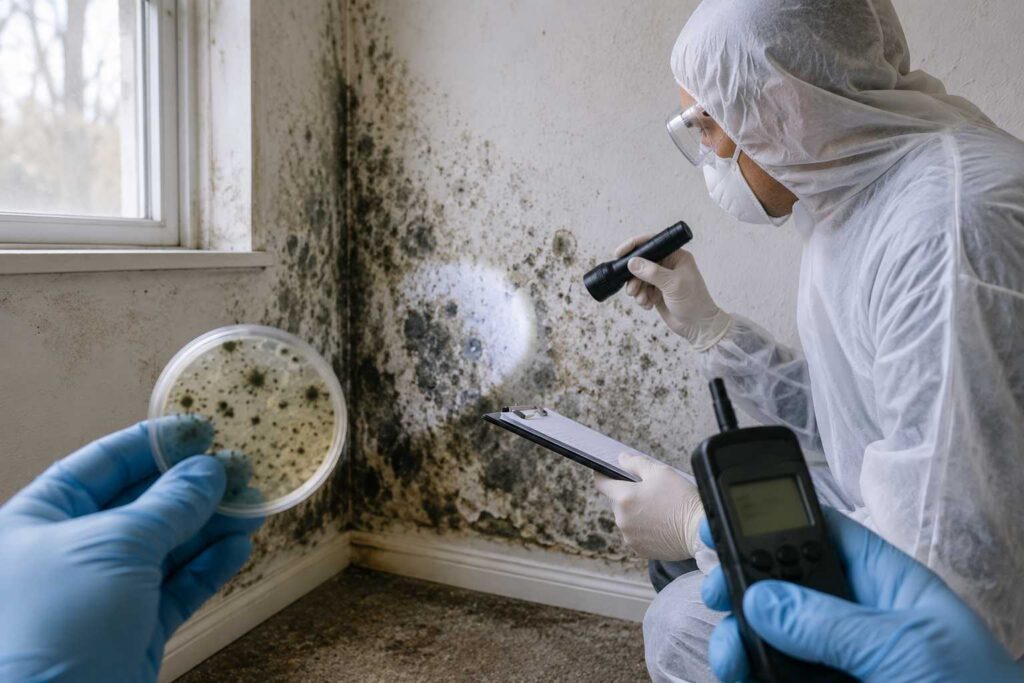
For property owners across Melbourne, FL, managing indoor moisture levels is an ongoing responsibility. High sub-tropical humidity, seasonal storm surges, and hidden plumbing leaks can quickly turn a clean residential or commercial building into a prime environment for organic growth.
When home or business owners suspect an indoor air quality issue, they often search for both mold testing and mold inspection, assuming the two terms mean the exact same thing.
While they are closely related and frequently performed during the same visit, mold testing and mold inspection serve entirely different purposes within the property damage restoration process. Knowing how each procedure works equips you to make informed decisions when protecting your home, your health, and your property value.
Understanding a Professional Mold Inspection
A mold inspection is a thorough, hands-on physical investigation of your property. The primary goal of an inspection is to locate visual evidence of organic growth and, most importantly, identify the active water or moisture source that is enabling it to grow.
During an inspection in Melbourne, FL, a licensed environmental assessor thoroughly evaluates vulnerable areas throughout the building. This includes inspecting attics, crawlspaces, air handling units, plumbing connections, windows, and perimeter walls. To perform a comprehensive check, assessors use specialized equipment:
- • Thermal Imaging Cameras: Infrared technology detects subtle surface temperature variations behind drywall and ceilings, uncovering hidden water pockets or leaking pipes without non-invasive wall removal.
- • Moisture Meters: Pin and pinless moisture meters measure exact saturation levels inside building materials like drywall, plaster, baseboards, and subflooring.
- • Hygrometers: Devices that measure ambient relative humidity and dew points to determine if indoor air conditions are promoting spore germination.
Understanding Scientific Mold Testing
While a physical inspection focuses on finding the moisture source and visible damage, mold testing focuses on analyzing the air and physical samples in a laboratory setting. Testing answers two specific questions: what types of fungal spores are present, and in what quantities are they suspended in the air?
Read Also: The Cost of Mold Inspection: What Homeowners Should Know
Professional mold testing Melbourne FL involves precise scientific methodologies:
- • Volumetric Air Sampling: Calibrated air pumps draw a fixed quantity of indoor air through a specialized spore trap cassette. A control sample is always gathered outdoors on the same day to establish a baseline for normal environmental conditions in Brevard County.
- • Surface Swab or Tape Lift Sampling: Direct samples are collected from visible growth on structural components to confirm the exact species present.
- • Laboratory Analysis: Independent accredited mycologists analyze the samples under high magnification to count spore concentrations per cubic meter and classify specific genus groups.
Key Differences at a Glance
To clearly understand how these two diagnostic phases complement each other, consider their distinct core objectives:
- • Focus of Inspection: Physical evaluation, moisture tracing, structural mapping, and thermal leak detection.
- • Focus of Testing: Biological identification, airborne spore concentration measurement, and scientific data collection.
- • Inspection Deliverable: Detailed physical findings report pinpointing water leaks and affected building materials.
- • Testing Deliverable: Certified laboratory report comparing indoor air samples against outdoor ambient baselines.
Why Both Steps Are Essential for Effective Remediation
Relying solely on air testing without a visual inspection might confirm that spore levels are elevated, but it will not reveal where the water is coming from or which walls need attention. Conversely, performing a visual inspection without testing might identify a leak, but it leaves you unaware of whether dangerous airborne particulates have spread into your HVAC system or living areas.
Combining an inspection with scientific testing provides a complete diagnostic picture. Licensed assessors use this comprehensive data to author a formal remediation protocol. This protocol serves as a clear, legally sound guide for restoration contractors, outlining exact containment specifications, engineering controls, and safety precautions.
Expert Remediation with PuroClean of Melbourne
Once an independent assessor completes the inspection and testing protocol, PuroClean of Melbourne provides the professional expertise required to safely restore your property. Located at 739 North Dr in the Coastal Technology Center, our certified team specializes in full-scope property damage restoration throughout Melbourne, FL.
We handle all aspects of recovery, including Mold & Odor Removal, Water Removal, Emergency Water Extraction, Drying & Dehumidification, and complete Reconstruction. Our technicians establish negative pressure containment barriers and deploy industrial HEPA air scrubbers to isolate affected zones, thoroughly removing compromised materials without contaminating surrounding spaces. Whether you are managing long-term moisture accumulation or sudden storm damage, our team is available 24/7 to return your home or business to pre-loss conditions.

NEED CERTIFIED PROPERTY DAMAGE RESTORATION IN MELBOURNE, FL? CALL (321) 378-2400
PuroClean of Melbourne is available 24/7 to protect your property and air quality.