In Brevard County’s humid subtropical climate, mold growth is one of the most common and costly property challenges facing real estate owners and occupants.
High ambient relative humidity, summer thunderstorms, coastal sea breezes, and constant central air conditioning usage create an environment where microscopic mold spores quickly colonize damp drywall, carpet backing, and structural framing.
When professional mold remediation becomes necessary, costs can escalate quickly depending on the square footage involved, the extent of structural demolition required, and the duration of containment and HEPA air scrubbing.

The central question that emerges during a mold loss is straightforward: Who pays for the cleanup?
In Florida, liability is rarely governed by a single blanket rule. Instead, determining financial responsibility requires analyzing four distinct factors:
[ DETERMINING MOLD REMEDIATION LIABILITY ]
│
┌───────────────────┬────────────┴────────────┬───────────────────┐
▼ ▼ ▼ ▼
[ 1. Property Ownership ] [ 2. Proximate Cause ] [ 3. Lease Terms ] [ 4. Policy Caps ]
Single-family owner vs. Sudden burst pipe vs. Landlord duties vs. Standard $10,000
landlord/tenant relationship deferred maintenance tenant negligence mold sub-limits
Property Ownership Structure: Is the building an owner-occupied single-family residence, a condominium governed by an HOA board, or a residential rental property?- The Proximate Cause of Moisture: Did the mold stem from a sudden, accidental water loss (such as a burst supply line) or long-term deferred maintenance (such as an unaddressed roof drip or chronic high indoor humidity)?
- Statutory Landlord-Tenant Obligations: Does Florida Residential Landlord and Tenant Law (Florida Statute Chapter 83) assign liability to the property owner or the tenant based on habitability standards or user negligence?
- Insurance Policy Endorsements and Caps: Does the applicable homeowners, landlord, or renters insurance policy include mold coverage endorsements, and what are the specific policy sub-limits?
This comprehensive guide analyzes the legal, contractual, and insurance frameworks that dictate who pays for mold remediation across Melbourne, Palm Bay, Viera, and surrounding Space Coast communities.
2. Scenario A: Owner-Occupied Homeowners vs. Insurance Companies
For single-family homeowners in Melbourne, determining whether your homeowners insurance policy will cover mold remediation depends almost entirely on the proximate cause of the water intrusion that triggered the fungal growth.
+———————————————————————————–+
| HOMEOWNERS INSURANCE MOLD COVERAGE MATRIX |
+———————————————————————————–+
| COVERAGE STATUS | PROXIMATE WATER CAUSE |
+—————————-+—————-──────────────────────────────────────+
| GENERALLY COVERED | • Sudden & accidental plumbing pipe bursts |
| (Subject to Mold Cap) | • Hot water heater tank ruptures |
| | • Washing machine hose discharges |
| | • Wind-driven rain entering via storm roof damage |
+—————————-+—————-──────────────────────────────────────+
| GENERALLY EXCLUDED | • Long-term, slow plumbing drips (deferred maintenance)|
| (Out-of-Pocket Expense) | • Rising groundwater / storm surge (requires NFIP) |
| | • Chronic high ambient indoor humidity (>60% RH) |
| | • Mold resulting from unaddressed roof aging |
+———————————————————————————–+
1. Covered Claims: Sudden and Accidental Losses
Standard Florida homeowners insurance policies (such as HO-3 policies) generally cover mold remediation if the mold directly resulted from a covered, sudden, and accidental water loss.
For example, if a copper pipe beneath your vanity bursts, or if a storm tears shingles off your roof allowing rainwater to soak ceiling drywall, and mold begins growing within 24 to 48 hours, the insurance carrier is typically obligated to cover both the water damage drying and the resulting mold remediation.
2. The Florida $10,000 Mold Sub-Limit (Cap)
Homeowners must understand that even when mold remediation is covered, standard Florida insurance policies almost always impose a strict mold sub-limit cap (typically $10,000).
This sub-limit caps the total amount the insurer will pay for testing, poly containment, HEPA air scrubbing, material extraction, and antimicrobial washing combined. If the mold remediation scope exceeds $10,000, the homeowner is responsible for paying the remaining balance out-of-pocket, unless an optional higher endorsement rider (such as $25,000 or $50,000) was purchased prior to the loss.
3. Excluded Claims: Maintenance and Gradual Leaks
Insurance carriers will deny mold remediation claims if the adjuster determines that the underlying moisture problem resulted from:
- Deferred Maintenance: Allowing a slow shower valve drip or toilet base leak to continue unaddressed for weeks or months.
- Failure to Mitigate: Failing to hire professional water extraction crews promptly following a flood, allowing mold to spread due to neglect.
- Rising Floodwaters: Damage caused by rising surface water, canal overflows, or coastal storm surge is explicitly excluded under standard homeowners policies and requires a separate National Flood Insurance Program (NFIP) policy.
3. Scenario B: Landlords vs. Tenants in Florida Rental Properties
In rental single-family homes, townhouses, and apartment complexes across Brevard County, disputes over who pays for mold remediation frequently lead to legal conflict. Resolving these disputes requires referencing Florida Statute Section 83.51 (Landlord’s obligation to maintain premises) alongside the specific lease agreement.
[ Water Intrusion Event in Rental Unit ]
│
┌───────────────┴───────────────┐
▼ ▼
[ Caused by Structural Defect ] [ Caused by Tenant Negligence ]
• Roof leak, plumbing, AC fail • Windows left open during rain
• Landlord Pays Remediation • Disabling AC unit for weeks
• Must Maintain Habitability • Tenant Pays / Renters Policy
1. When the Landlord Pays
Under Florida Statute § 83.51(1)(a), a landlord is legally obligated to comply with all applicable building, housing, and health codes. Landlords are required to maintain roofs, windows, doors, floors, steps, porches, exterior walls, foundations, and all structural components in good repair.
The landlord is financially responsible for paying for professional mold remediation if the mold was caused by:
- A leaking roof, compromised flashing, or damaged window seals.
- Failed plumbing lines, leaking water heaters, or broken building sewer stacks.
- A malfunctioning central air conditioning system supplied by the landlord.
- Structural water intrusion resulting from storm damage or building wear.
Furthermore, under the legal doctrine of the Implied Warranty of Habitability, if severe mold growth renders the rental property unsafe or unhealthy for human occupancy, the landlord must pay for professional remediation. In severe cases, the landlord may also be responsible for paying temporary tenant relocation expenses or allowing the tenant to terminate the lease agreement without penalty under Florida Statute § 83.56.
2. When the Tenant Pays
A tenant can be held financially liable for paying for mold remediation if the landlord proves that the fungal growth resulted directly from the tenant’s negligence or violation of lease terms.
Examples of tenant negligence causing mold liability include:
- Turning Off the AC System: Turning off the air conditioner completely while away on vacation during hot summer months, allowing indoor relative humidity to spike past 80% and triggering widespread mold amplification.
- Leaving Windows Open: Leaving windows or sliding glass doors open during severe summer rainstorms, allowing wind-driven rain to saturate drywall and carpets.
- Failing to Report Leaks Promptly: Notifying the landlord about a visible plumbing leak weeks or months after it began, allowing localized moisture to turn into a widespread mold infestation.
- Blocking Ventilation: Operating high-moisture appliances (like unvented clothes dryers) or blocking HVAC return registers with furniture.
In these instances, the landlord can deduct remediation costs from the tenant’s security deposit, bill the tenant directly, or file a claim against the tenant’s Renters Insurance Policy (Personal Liability coverage).
4. Demonstrations and Visual Techniques
The video below demonstrates how professionals conduct indoor mold inspections and air sampling to identify moisture sources and establish liability context.
2:31
Mold Inspection vs. Mold Testing | Metro Property Inspection – Mold Series Ep 4
YouTube · Metro Property Inspection
5. Florida Legal Protections: The Separated Assessor and Remediator Law
Regardless of whether a homeowner, landlord, insurance carrier, or tenant is paying for mold cleanup, all parties in Melbourne must adhere to Florida consumer protection laws governing the restoration industry.
Under Florida Statute Section 468.8419, it is illegal for a single business entity or individual to perform both professional mold assessment (testing) and physical mold remediation on the same property within a 12-month period.
[ Step 1: Independent Assessor Conducts Testing & Writes Protocol ]
│
▼
[ Step 2: Florida Law (FS 468.8419) Mandates Independent Remediator ]
│
▼
[ Step 3: PuroClean Executes 7-Step IICRC S520 Remediation ]
│
▼
[ Step 4: Assessor Returns for Independent Clearance Testing (PRV) ]
This legal separation protects the party paying the bill:
- Objective Scope: The independent, licensed Florida Mold Assessor writes an unbiased Remediation Protocol detailing exact containment requirements and material disposal rules.
- Accurate Invoicing: The certified remediation contractor (such as PuroClean of Melbourne) executes the physical cleanup strictly according to that protocol, eliminating inflated scopes.
- Guaranteed Clearance: The independent assessor returns after cleanup to perform Post-Remediation Verification (PRV) clearance testing, certifying the property is clean before final payments are released.
6. The PuroClean 7-Step Certified Remediation Protocol
When diagnostic testing confirms active indoor mold amplification (Condition 3), PuroClean of Melbourne executes a standardized 7-step remediation workflow compliant with Institute of Inspection, Cleaning and Restoration Certification (IICRC) S520 guidelines.
Operating from our central commercial facility at 739 North Dr in the Coastal Technology Center, our certified technicians provide transparent line-item estimates accepted by all major insurance carriers and property managers.
[ Step 1: Protocol Review & Pre-Remediation Walkthrough ]
│
▼
[ Step 2: Critical Poly Containment & Negative Air Setup ]
│
▼
[ Step 3: Continuous Industrial HEPA Air Scrubbing ]
│
▼
[ Step 4: Controlled Material Extraction & HEPA Vacuuming ]
│
▼
[ Step 5: Mechanical Cleaning & EPA Antimicrobial Wash ]
│
▼
[ Step 6: Structural Moisture Control & LGR Dehumidification ]
│
▼
[ Step 7: Independent Clearance Support & Rebuilding ]
1. Protocol Review and Pre-Remediation Walkthrough
Technicians review the independent mold assessor’s written scope of work, verify moisture boundaries using FLIR thermal imaging cameras, and establish site safety controls.
2. Critical Engineering Containment and Negative Pressure
Technicians build heavy-duty 6-mil polyethylene containment chambers around the affected work zone. Industrial HEPA air scrubbers equipped with specialized ducting are deployed to establish negative air pressure, ensuring that disturbed mold spores, dust, and microscopic fragments cannot escape into clean living areas during cleanup.
3. Continuous Industrial HEPA Air Scrubbing
High-efficiency particulate air (HEPA) filtration units run continuously throughout the project, scrubbing indoor air to capture 99.97% of airborne biological particulates down to 0.3 microns.
4. Controlled Removal of Contaminated Porous Materials
Building materials that have suffered deep, unsalvageable fungal penetration (such as saturated paper-faced drywall, ceiling tiles, carpet padding, and tack strips) are carefully cut away, double-bagged in 6-mil biohazard bags, wiped down, and safely removed from the property.
5. Mechanical Cleaning and EPA-Registered Antimicrobials
Exposed structural studs, wood framing, and concrete masonry undergo detailed mechanical cleaning, including hand-scrubbing with specialized abrasive pads and HEPA vacuuming. Technicians then apply EPA-registered, hospital-grade broad-spectrum antimicrobial and fungicidal treatments to eliminate residual micro-flora.
6. Structural Moisture Control and Dehumidification
Remediation is temporary if structural framing remains damp. PuroClean deploys commercial Low-Grain Refrigerant (LGR) dehumidifiers and high-velocity air movers to dry framing below 15% wood moisture content, ensuring mold cannot return.
7. Independent Clearance Verification and Turnkey Reconstruction
Once physical cleanup is complete, the original independent licensed mold assessor returns to perform final visual inspections and Post-Remediation Verification (PRV) air testing. Once lab results confirm normal indoor air quality, containment is removed. As a licensed Florida General Contractor, our in-house Reconstruction team then rebuilds drywall, flooring, trim, and finishes, returning your property to pre-loss condition under one roof.
7. Responsibility & Coverage Comparison Matrix
The following matrix summarizes financial responsibility across common Florida property scenarios:
| Property & Loss Scenario | Responsible Party for Payment | Applicable Policy or Statute | Key Coverage Condition |
| Homeowner: Burst Supply Line | Homeowners Insurance Carrier | Standard HO-3 Policy (Covered Loss) | Subject to policy $10,000 mold sub-limit cap. |
| Homeowner: Unaddressed Roof Drip | Homeowner (Out-of-Pocket) | Policy Exclusion (Deferred Maintenance) | Denied due to lack of timely maintenance. |
| Rental: AC Failure / Roof Leak | Landlord / Property Owner | Florida Statute § 83.51 (Habitability) | Landlord must maintain building envelope & AC. |
| Rental: Tenant Disabled AC System | Tenant / Renters Liability | Lease Agreement & Renters Insurance | Tenant negligence caused humidity spike. |
| Condo: In-Wall Common Pipe Burst | HOA / Condo Association Ins. | Florida Statute § 718 / Master Policy | Depends on condo declaration boundary definitions. |
8. Frequently Asked Questions (FAQ)
1. Does homeowners insurance cover mold remediation in Florida?
Yes, but only if the mold directly resulted from a covered, sudden, and accidental water loss (such as a burst supply pipe or storm damage that punctures a roof). Standard Florida policies generally impose a $10,000 mold sub-limit cap for remediation. Insurance will not cover mold caused by long-term slow leaks, deferred maintenance, high ambient humidity, or rising floodwaters (which require separate flood insurance).
2. Is a landlord required by Florida law to remove mold in a rental unit?
Yes, under Florida Statute § 83.51, landlords must comply with all health and building codes and maintain structural components, plumbing, and roof systems in good repair. If mold forms due to a structural leak, roof failure, or landlord-supplied AC malfunction that compromises habitability, the landlord is legally obligated to pay for professional remediation.
3. Can a tenant withhold rent in Florida if there is mold in the apartment?
Under Florida Statute § 83.56, a tenant cannot simply stop paying rent unilaterally. To legally withhold rent or terminate a lease due to mold, the tenant must deliver a formal 7-day written notice to the landlord detailing the unhabitable conditions and giving the landlord 7 days to initiate repairs. If the landlord fails to act within 7 days, the tenant may withhold rent or vacate. Tenants should consult legal counsel before withholding rent.
4. Can a landlord make a tenant pay for mold cleanup?
A landlord can make a tenant pay for mold remediation only if the landlord can prove the mold resulted directly from tenant negligence or lease violations—such as turning off the central AC for weeks during summer, leaving windows open during heavy rainstorms, or failing to report a visible plumbing leak promptly.
5. Why do insurance carriers require Xactimate pricing for mold claims?
Insurance adjusters across North America rely on Xactimate®, the industry-standard line-item estimating software. Xactimate provides regional, pre-approved pricing for equipment hours, containment setup, and material disposal. PuroClean of Melbourne writes all estimates in Xactimate format, ensuring smooth claim approvals and preventing pricing disputes between property owners and insurers.
6. Where is PuroClean of Melbourne located, and how fast can you respond to a loss?
Our central commercial facility is located at 739 North Dr in the Coastal Technology Center, Melbourne, FL 32934. Because our facility is centrally positioned near major Brevard County thoroughfares like Interstate 95 and US Highway 1, our certified response teams can reach residential and commercial properties across Melbourne, Viera, Palm Bay, Indialantic, and surrounding Space Coast communities within 60 minutes or less, 24 hours a day, 7 days a week.
9. Partner with Melbourne’s Trusted Mold Remediation Experts
Whether you are a homeowner filing an insurance claim, a landlord fulfilling statutory habitability obligations, or a tenant dealing with property damage in Melbourne, Viera, Palm Bay, or the Space Coast, don’t let mold compromise your health or financial security.
PuroClean of Melbourne is your trusted single-source solution for complete property recovery. From FLIR thermal moisture mapping and psychrometric structural drying to certified mold remediation and turnkey reconstruction, One Call Does It All.
Our comprehensive property damage restoration services include:
- 24/7 Emergency Water Extraction & Structural Drying
- Advanced FLIR Thermal Imaging & Moisture Diagnostics
- IICRC Certified Mold & Odor Remediation
- Fire, Smoke & Soot Damage Restoration
- OSHA & FDOH Compliant Biohazard, Sewage & Trauma Cleanup
- Turnkey Structural Reconstruction & General Contracting
CERTIFIED MOLD REMEDIATION & RESTORATION IN MELBOURNE, FL
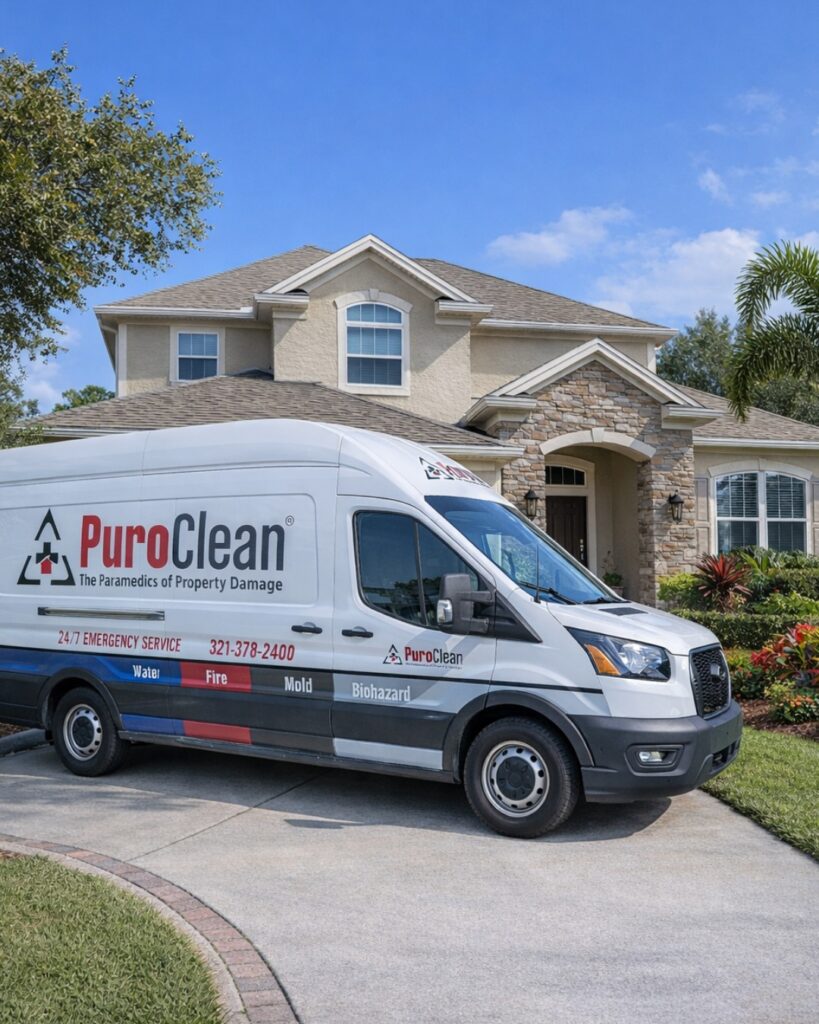
Clarify liability and restore your property with confidence. Contact the certified, compassionate experts at PuroClean of Melbourne today for professional guidance and immediate 24/7 assistance.
- 24/7 Direct Emergency Line: (321) 378-2400
- Facility Location: 739 North Dr, Melbourne, FL 32934 (Coastal Technology Center)
- Service Area: Serving Melbourne, Viera, Palm Bay, Indialantic, Melbourne Beach, West Melbourne, Suntree, Eau Gallie, Melbourne Village, and all surrounding Brevard County communities.