


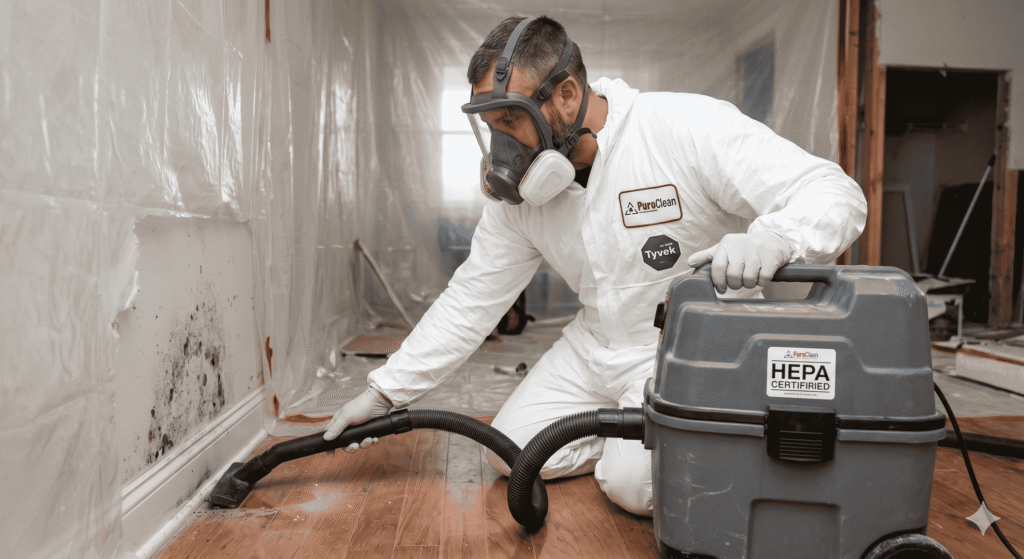
You found something pale and fuzzy growing in your Santa Maria home, and the question hits fast: is white mold dangerous? It’s one of the most common questions our technicians hear, usually from someone standing in front of a closet or windowsill, phone in hand, trying to decide whether to panic or shrug it off. The honest answer sits in between. This guide draws on guidance from the CDC, EPA, and NIOSH to walk through what the science actually says, so you can respond based on facts rather than fear.
Is White Mold Dangerous? The Direct Answer
Is white mold dangerous? For most healthy people, brief exposure typically causes mild, temporary irritation — a stuffy nose, sore throat, coughing, or itchy eyes. According to the CDC, mold can cause a range of effects including nasal and sinus congestion, throat irritation, and skin or eye irritation, and people with asthma or mold allergies may have more severe reactions.¹ The CDC also notes that research published by the Institute of Medicine found sufficient evidence linking indoor mold exposure to upper respiratory symptoms, cough, and wheeze in otherwise healthy people, and to worsened asthma symptoms in people who already have asthma.² So is white mold dangerous in every case? Not usually — but it becomes more serious with prolonged exposure, larger growth areas, or in people who are immunocompromised, which is why the color alone shouldn’t determine how seriously you take it.
Does the Color of Mold Actually Indicate Danger?
This is the myth at the center of the is white mold dangerous question, and it’s worth addressing directly: color does not reliably indicate danger. The EPA states plainly that molds come in many colors, including both white and black, and that indoor mold should be addressed the same way regardless of its color or species.³ Mold color comes primarily from pigments tied to species, surface, moisture level, and life stage — not toxicity. In other words, a homeowner who dismisses white growth as “just mildew” while treating black growth as an emergency is working from a myth the EPA has already corrected.
What Does “White Mold Health Effects” Actually Mean for Your Household?
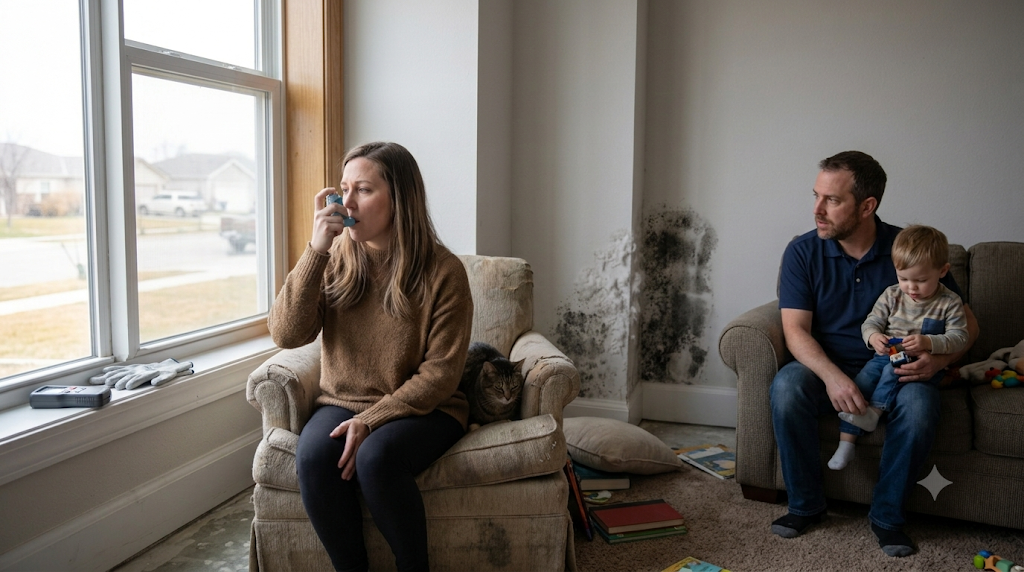
When people search for white mold health effects, they’re usually trying to understand who’s at real risk. NIOSH research confirms that people spending time in damp buildings report more respiratory symptoms and infections, worsening asthma, allergic rhinitis, and skin conditions like eczema.⁴ The people most likely to experience these white mold health effects include those with asthma, mold allergies, chronic lung disease, or a suppressed immune system — for this group, even moderate exposure can trigger a more pronounced reaction than it would in a healthy adult.
Are Mold Exposure Symptoms the Same for Everyone?
No — mold exposure symptoms vary significantly from person to person, which is part of why the CDC does not recommend routine mold testing. Per CDC guidance, health effects differ so much between individuals that lab sampling can’t reliably predict whether a specific person will get sick from a specific mold sample.⁵ Practically, this means the presence of any visible mold — regardless of test results — is reason enough to clean it up and fix the moisture source, rather than waiting on lab confirmation.
Is White Mold Dangerous Enough to Require Professional Remediation?
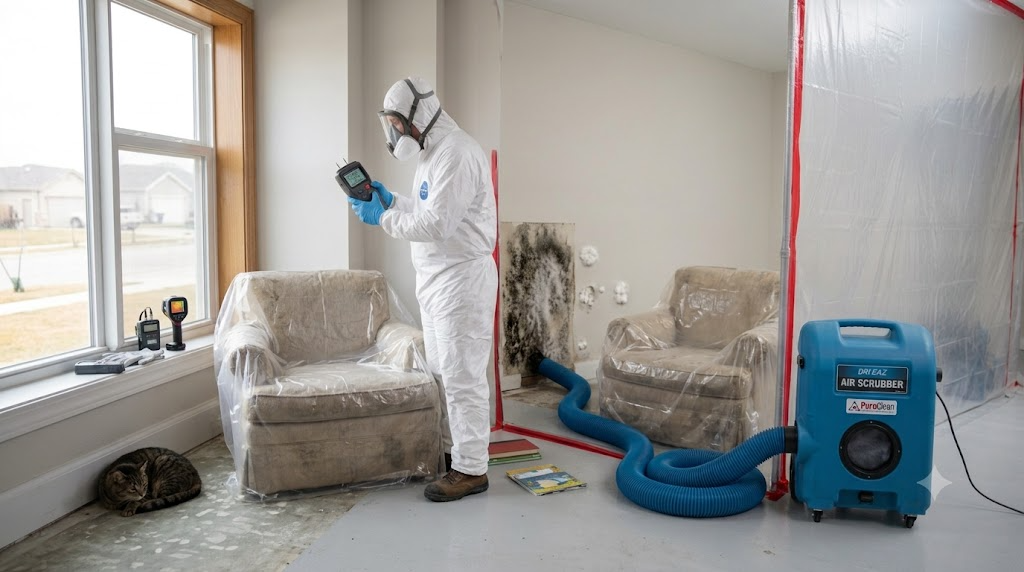
Whether professional remediation is necessary comes down to scale and location more than color. The EPA’s long-standing guidance is that mold growth covering less than about 10 square feet — roughly a 3-by-3-foot patch — can often be handled by a homeowner following basic cleanup steps, while larger areas warrant a professional.⁶ IICRC S520, the industry standard for professional mold remediation, builds on this by classifying jobs from Class 1 (small, contained) through Class 4 (extensive, structural), with containment and HEPA filtration required as the class increases. If you’re trying to compare what you’re looking at to another common household concern, our post on white fuzzy mold breaks down early-stage identification in more detail.
White Mold vs. Black Mold: Does the Danger Comparison Hold Up?
The white mold vs black mold comparison is one of the most persistent myths in residential mold conversations, and it doesn’t hold up under scrutiny. Neither term refers to a single species — both are color descriptions that can cover a wide range of fungi with varying characteristics.⁷ The practical guidance from health and environmental authorities is the same regardless of which color you’re looking at: address the moisture, remove the growth, and don’t assume one color is automatically safer than the other. For a deeper side-by-side breakdown, see our post on black mold vs. white mold in Santa Maria homes.
What Are the Broader Signs of Mold in the Home Beyond Color?
Since color isn’t the reliable signal, it helps to know the other signs of mold in the home worth watching for: a persistent musty odor, visible discoloration on walls or ceilings, condensation on windows, and household members experiencing symptoms that ease when they’re away from the house. Our post on signs of mold in the home covers these indicators in more depth, including where they tend to show up first.
Get Answers, Not Assumptions — Call PuroClean of Santa Maria
Is white mold dangerous in your specific home? That’s a question worth answering with an inspection, not a guess based on color. PuroClean of Santa Maria brings IICRC-certified expertise and 24/7 emergency availability to homeowners throughout Santa Maria, Nipomo, Orcutt, and Guadalupe. We follow the same evidence-based standards referenced throughout this guide — EPA cleanup guidance, CDC health information, and IICRC S520 remediation protocols — so you get a response grounded in facts, not fear.
Mold rarely gets better on its own, and the sooner it’s addressed, the less it costs — in repairs, in stress, and in peace of mind. Whether you’re just starting to notice something off in your home or you’re ready to have it professionally handled, PuroClean of Santa Maria is here to help every step of the way.
Reach out today, and let’s get your home back to feeling clean, dry, and worry-free — call now for a free mold assessment or contact us to schedule a professional inspection.
Frequently Asked Questions
Is white mold dangerous to breathe in on a daily basis? For most healthy people, brief or occasional exposure causes mild, temporary irritation. Daily, prolonged exposure in an enclosed space raises the risk of more persistent respiratory symptoms, especially for people with asthma or mold allergies, according to CDC guidance.⁸
Is white mold dangerous for pets? Pets can experience similar respiratory and skin irritation to humans when exposed to indoor mold, and animals with pre-existing respiratory conditions may be more sensitive. If you notice unusual symptoms in a pet alongside visible mold, it’s worth mentioning to your veterinarian.
Can white mold cause permanent health damage? For most healthy individuals, symptoms typically resolve once exposure stops and the mold is removed. Vulnerable populations — including those who are immunocompromised — face higher risk of more serious complications, which is why the CDC advises prompt removal for anyone showing symptoms.⁹
Should I get my home tested to confirm if white mold is dangerous? The CDC does not generally recommend mold testing, since health effects vary too much between individuals for sampling to be predictive.¹⁰ The more actionable step is addressing any visible mold and fixing the moisture source regardless of test results.
Sources Cited
- Centers for Disease Control and Prevention (CDC), Mold and Health — https://www.cdc.gov/mold-health/about/index.html
- Centers for Disease Control and Prevention (CDC), citing the Institute of Medicine (2004) — https://www.cdc.gov/mold-health/about/index.html
- U.S. Environmental Protection Agency (EPA), A Brief Guide to Mold, Moisture and Your Home — https://www.epa.gov/mold/brief-guide-mold-moisture-and-your-home
- National Institute for Occupational Safety and Health (NIOSH), Mold: Health Problems — https://www.cdc.gov/niosh/mold/health-problems/index.html
- Centers for Disease Control and Prevention (CDC), Mold Cleanup Guidelines — https://www.cdc.gov/mold-health/about/clean-up.html
- U.S. Environmental Protection Agency (EPA), Mold Cleanup in Your Home — https://www.epa.gov/mold/mold-cleanup-your-home
- U.S. Environmental Protection Agency (EPA), A Brief Guide to Mold, Moisture and Your Home — https://www.epa.gov/mold/brief-guide-mold-moisture-and-your-home
- Centers for Disease Control and Prevention (CDC), Mold and Health — https://www.cdc.gov/mold-health/about/index.html
- Centers for Disease Control and Prevention (CDC), Mold Cleanup Guidelines — https://www.cdc.gov/mold-health/about/clean-up.html
- Centers for Disease Control and Prevention (CDC), Mold Cleanup Guidelines — https://www.cdc.gov/mold-health/about/clean-up.html
Available 24/7/365 | IICRC Certified | (805) 975-0800 | Contact Us Online | Google Business Profile