


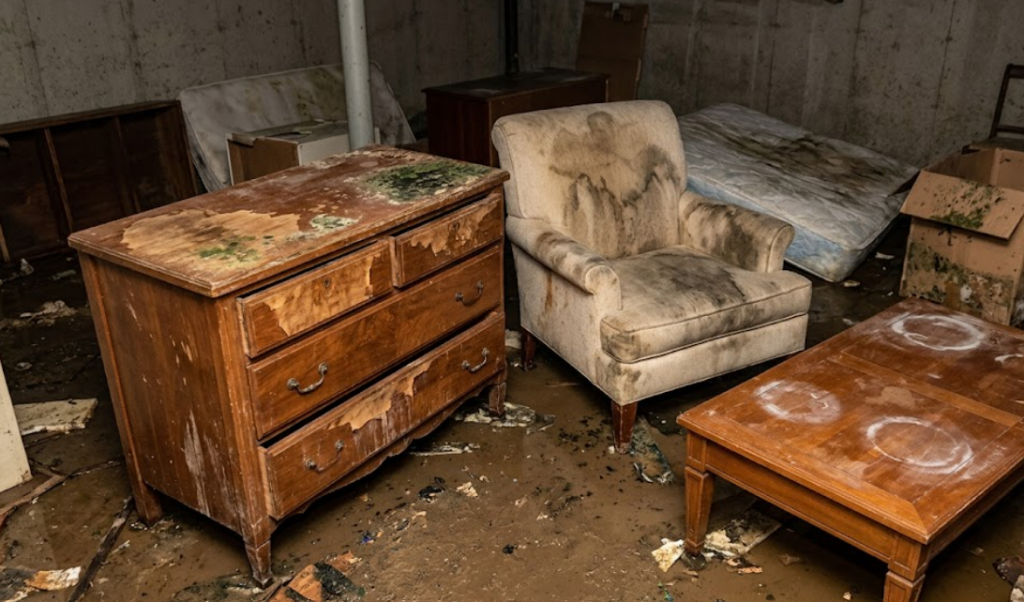
When water floods a home, the floors and walls get most of the attention – but for many homeowners, the more immediate and emotionally charged question is about their furniture. A family dining table that has been in the home for generations, a custom upholstered sofa, a solid wood bedroom set, a leather armchair – these are not just items on an insurance spreadsheet. They are investments and heirlooms, and losing them adds a personal dimension to an already stressful water damage event.
So can water damaged furniture be saved? The honest answer is: sometimes yes, sometimes no, and always it depends. The variables that determine whether water damaged furniture can be restored include the material the piece is made from, how long it has been wet, the contamination level of the water it was exposed to, and whether the right steps were taken in the critical first hours after the damage occurred.
This guide gives you a clear and practical breakdown of what happens to different furniture materials when they are exposed to water, what restoration is genuinely possible for each type, what the professional content restoration process involves, and what homeowners can do immediately to give their furniture the best possible chance of survival.
The Four Factors That Determine Whether Water Damaged Furniture Can Be Saved
Before looking at individual material types, it helps to understand the four core variables that apply across all furniture categories. These factors interact with each other and with the material type to determine the realistic restoration outcome.
Factor 1: Time
Time is the most critical factor in water damaged furniture restoration. Wood begins to warp and swell within the first few hours of water exposure. Upholstered furniture begins to develop mold in its foam core within 24 to 48 hours. Particleboard and MDF begin to dissolve and lose structural integrity almost immediately. The longer furniture remains wet without professional intervention, the narrower the restoration window becomes and the higher the probability that the piece will need to be replaced rather than restored.
Factor 2: Water Contamination Category
Water damage restoration professionals classify water into three categories based on contamination level. Category 1 is clean water from supply lines, appliances, or rain – the most favorable condition for furniture restoration. Category 2 is gray water from appliance drainage, toilet overflow without feces, or other mildly contaminated sources. Category 3 is black water from sewage backup, rising floodwater, or heavily contaminated sources.
Furniture that has been exposed to Category 3 black water is generally not a restoration candidate regardless of its material or condition. The biological and chemical contamination in black water penetrates porous materials to a depth that cannot be adequately decontaminated, and health risks associated with retaining contaminated porous items in an occupied home are not acceptable. For Category 1 and Category 2 water exposure, restoration is a legitimate consideration depending on the material and the response timeline.
Factor 3: Material Type and Construction
The material from which a piece of furniture is made is the primary determinant of its restoration potential. Solid wood responds very differently to water exposure than particleboard. Genuine leather responds differently than bonded leather. Natural fiber upholstery responds differently than synthetic. The construction method also matters – dovetail joinery in solid wood holds up far better to water exposure than staple-and-glue construction in lower-cost pieces.
Factor 4: What Was Done in the First Hours
Whether the furniture was moved out of standing water quickly, whether surface water was removed promptly, and whether professional drying equipment was deployed in a timely manner all have a significant impact on restoration outcomes. Water damaged furniture that has been sitting in standing water for 48 hours presents a very different restoration challenge than furniture that was moved to a dry area and had surface moisture removed within the first few hours of the event.
Solid Wood Furniture: The Best Restoration Candidate
Solid wood furniture is the most restorable of all furniture categories when water exposure is addressed promptly and the water source was clean. Solid wood has a long history of being refinished, repaired, and restored precisely because it is a natural material with depth and resilience. The same properties that make it susceptible to warping and swelling are the properties that allow it to be dried, reshaped, and refinished.
What Happens to Solid Wood in Water
When solid wood absorbs water, the wood fibers swell perpendicular to the grain. This causes individual boards to expand in width, which can cause joints to separate, drawers to stick, tabletops to cup or warp, and veneer surfaces to bubble and lift. If the wood dries too quickly or unevenly, cracking and splitting can occur. These responses are serious but are often reversible if the drying process is properly managed.
What Restoration Is Possible
Solid wood furniture that has been wet for a limited time with clean water and dried properly can often be fully restored. Mild warping in tabletops and panel components can be corrected by controlled drying with weighted clamping. Separated joints can be reglued after drying. Bubbled or lifted veneer can be reglued with appropriate veneer adhesive. Swollen drawers return to acceptable tolerances as moisture content normalizes. Stained, clouded, or peeling finishes can be stripped and refinished after the piece has fully dried – which can take several weeks for solid wood.
The most important caution for water damaged solid wood furniture is patience: refinishing or repairing structural issues before the wood has fully and uniformly dried will result in continued movement and further damage as the wood continues to change. Professional moisture meters can confirm when the wood has reached its equilibrium moisture content and is ready for refinishing.
When Solid Wood May Not Be Salvageable
Severe and prolonged warping that has created a permanent set in the wood fibers may not reverse through drying alone. Solid wood pieces with structural joinery failures in multiple locations simultaneously may not be economically repairable. And antique or highly figured wood pieces that have developed severe surface checks or splits during the water event may have sustained damage that is beyond practical restoration.
Engineered Wood, Particleboard, and MDF: Difficult to Impossible
The honest assessment of particleboard and MDF furniture is blunt: once significantly wet, these materials are very rarely worth attempting to restore, and attempting to do so produces frustrating results in most cases.
Why These Materials Fail When Wet
Particleboard and MDF are manufactured from wood fibers or particles bonded with resin adhesives and compressed into panels. When these materials absorb water, the resin bonds begin to fail and the panel swells, delaminates, and crumbles. Unlike solid wood, which maintains its structural integrity as it absorbs and releases moisture, particleboard and MDF undergo permanent structural changes when wet. The panel does not return to its original dimensions or strength when dried. Swollen particleboard components remain swollen. Delaminated surfaces cannot be re-bonded to their original condition.
Most lower-cost and mid-range furniture manufactured in the last 30 years – including the majority of flat-pack furniture sold by mass-market furniture retailers – uses particleboard or MDF for case components, drawer bottoms, shelving, and backs. This construction is economical and performs well in dry conditions but is essentially a total loss when exposed to significant water damage.
The Limited Exception
Particleboard and MDF furniture with hardwood solid wood face frames, doors, and drawer fronts may have those components successfully salvaged even when the case components are not restorable. In some cases, drawer fronts and door panels in solid wood can be preserved and potentially incorporated into a rebuilt or replacement piece.
Upholstered Furniture: The Hardest Judgment Call
Upholstered furniture – sofas, armchairs, sectionals, ottomans, and upholstered beds – presents the most complex and nuanced restoration assessment. The answer to whether water damaged upholstered furniture can be saved depends heavily on the construction of the specific piece, the speed of response, and the category of water involved.
The Core Problem With Wet Upholstered Furniture
Upholstered furniture consists of multiple layers: the outer fabric, the batting or padding layer, and the foam or spring interior. Water infiltrates all of these layers at different rates, with the foam core often absorbing the most water and releasing it most slowly. Foam that has been saturated with water provides an ideal environment for mold growth – dark, moist, warm, and rich in organic material. Mold can begin colonizing wet furniture foam within 24 to 48 hours, and once established, the mold growth is essentially impossible to fully eradicate from within the foam core without complete foam replacement.
What Determines Upholstery Restoration Potential
Upholstered furniture that was exposed to clean water, moved out of contact with the water within a few hours, and placed in a warm, well-ventilated area where professional drying equipment can be deployed rapidly has a reasonable restoration opportunity. The outer fabric covering can often be cleaned or replaced. If the foam core can be dried to below the mold threshold moisture level within the critical 24 to 48 hour window – which requires professional drying equipment, not just ambient air drying – the piece may be salvageable.
High-quality furniture with removable cushion covers, replaceable cushion inserts, and solid wood or metal frame construction offers the best upholstery restoration opportunities because the component most at risk – the foam insert – can be removed, assessed, and replaced without replacing the entire piece. Built-in cushion construction in lower-cost furniture does not offer this option.
When Upholstered Furniture Should Be Replaced
- Any upholstered piece that has been exposed to Category 3 black water or sewage should be discarded regardless of its value or apparent condition
- Any piece in which the foam core has been wet for more than 24 to 48 hours and shows evidence of mold growth – detectable by smell even when not yet visible – should be replaced
- Upholstered pieces with non-removable cushion covers that have been saturated present very limited drying access and are generally not restorable
- Pieces with particle board or MDF internal framing that has been compromised by water should be replaced even if the fabric surface appears salvageable
Leather Furniture: Often Salvageable With Prompt Action
Genuine leather has better water damage resistance than fabric upholstery and is often salvageable when water exposure is addressed quickly. Leather is a natural material that has been treated to resist moisture, and while it does absorb water when fully submerged or exposed for extended periods, it can generally be dried and conditioned without permanent damage if the drying process is handled correctly.
Drying and Conditioning Genuine Leather
Water damaged genuine leather furniture should be dried slowly and at room temperature. Applying heat – from a hair dryer, heat gun, or direct sunlight – causes leather to crack, shrink, and permanently stiffen. After drying, leather that has been wet requires re-conditioning with an appropriate leather conditioner to restore the oils that water exposure leaches out. Without conditioning, dried leather becomes brittle and prone to cracking.
Water staining on leather can often be minimized by moistening the entire surface evenly as it dries, which prevents the tide mark that forms when a wet spot dries in isolation. Professional leather cleaning and conditioning after a water event can restore the appearance and flexibility of genuine leather furniture in most cases where the exposure was to clean water and the response was timely.
Bonded and Faux Leather: Different Story
Bonded leather and vinyl – materials that look like leather but are manufactured from polyurethane coatings over fabric or paper backing – respond poorly to water exposure. The backing material swells and delaminates from the polyurethane surface layer, causing visible bubbling and peeling that cannot be repaired. Bonded leather furniture that has been significantly wet is generally not a restoration candidate for the surface material, though the frame and cushion components may be salvageable for reupholstering.
Metal Furniture: Simple But Not Immune
Metal furniture frames, legs, and hardware are generally not damaged structurally by water exposure, but they are vulnerable to rust and corrosion when water is allowed to remain in contact with untreated or inadequately treated metal surfaces. Steel and iron components should be dried thoroughly, inspected for rust formation, and treated with an appropriate rust inhibitor or primer if rust is present. Aluminum and stainless steel components are more corrosion-resistant and typically require only drying and cleaning.
What Professional Content Restoration Involves
For furniture and other contents that are candidates for restoration, professional content restoration services go well beyond what a homeowner can achieve with household products and a drying rack.
Ozone and Hydroxyl Treatment for Odor
Water damaged furniture frequently retains musty odor even after surface drying because odor compounds are embedded in the fabric, foam, wood, and finish materials. Professional restoration uses ozone treatment or hydroxyl radical generators to neutralize odor at the molecular level, penetrating the same porous materials that the odor compounds have penetrated. This treatment is significantly more effective than surface cleaning or air freshening and is a standard part of professional content restoration for water damaged furniture.
Ultrasonic Cleaning for Hard Surfaces and Accessories
Decorative items, hardware, lamps, and non-porous accessories associated with furniture can often be restored through professional ultrasonic cleaning, which uses high-frequency sound waves to clean contamination from complex surfaces and intricate details that manual cleaning cannot reach.
Pack-Out and Facility-Based Restoration
In significant water damage events, professional restoration companies offer pack-out services where salvageable furniture and contents are carefully inventoried, transported to a climate-controlled restoration facility, treated and dried under ideal conditions, and returned to the property after the structural restoration is complete. Facility-based drying allows for more controlled drying conditions than are achievable on-site during an active restoration project and produces better outcomes for high-value furniture.
What Homeowners Should Do Immediately
In the first hours after discovering water damage, these steps give furniture the best possible chance of restoration:
- Move furniture out of standing water immediately – continued immersion rapidly worsens outcomes for every material type
- Place aluminum foil or plastic wrap under furniture legs that must remain on wet flooring to prevent wood-to-metal staining and additional moisture absorption through the legs
- Remove cushion covers if they are removable and launder them promptly in warm water with a small amount of white vinegar
- Stand removable cushions on their edge in a warm, ventilated area to allow airflow on all surfaces – do not lay flat
- Blot surface moisture from leather with clean dry towels – do not rub, which spreads contamination and can damage the surface
- Do not use heat sources to accelerate drying of any furniture material
- Document all affected furniture with photographs before moving or cleaning anything, for insurance claim purposes
- Contact a professional water damage restoration company for assessment – they can evaluate which pieces are restoration candidates and deploy appropriate drying equipment for the furniture and the surrounding structure simultaneously
Insurance Coverage for Water Damaged Furniture
Most homeowner’s insurance policies cover personal property including furniture under the contents coverage portion of the policy when the damage results from a covered water event such as a pipe burst, appliance failure, or storm-driven roof leak. Coverage is typically provided at either actual cash value (which accounts for depreciation) or replacement cost value (which pays to replace the item with a new equivalent), depending on your policy terms.
Document all water damaged furniture thoroughly with photographs and written descriptions before any items are discarded or cleaned. Retain any furniture that may be a restoration candidate until the insurance adjuster has had the opportunity to inspect it. Discarding items before adjuster inspection can complicate or reduce your claim. Work with a professional restoration company that can provide detailed contents documentation that supports your insurance claim.
Conclusion: Act Fast, Be Honest, and Get Professional Assessment
The question of whether water damaged furniture can be saved does not have a single answer – but it does have a consistent principle: the faster you act, the cleaner the water source, and the better the professional response, the higher the probability that valuable pieces can be restored rather than replaced. Solid wood furniture with prompt, professional drying has an excellent restoration track record. Particleboard and MDF rarely survive significant water exposure. Upholstered furniture falls somewhere in between, depending heavily on construction quality and response time.
The most important thing you can do when water damage affects your furniture is to contact a certified water damage restoration professional immediately for an honest assessment of each piece. A professional who evaluates your furniture against the factors outlined in this guide will give you an accurate picture of what is worth restoring and what is not – protecting your investment in the pieces that can be saved and preventing you from wasting time and money on pieces that cannot.
Water Damaged Furniture? Call PuroClean for a Professional Assessment Today
PuroClean’s certified content restoration specialists evaluate water damaged furniture honestly and thoroughly, deploying the professional drying equipment, ozone treatment, and pack-out services needed to give your valued pieces every possible chance of restoration. We serve the Phoenix metro area and West Valley communities 24 hours a day, 7 days a week.
Call PuroClean restoration specialists now at (480) 767-5588. Fast response. Proven results. Complete peace of mind.
Do not discard water damaged furniture before getting a professional opinion. One call to PuroClean could save pieces you thought were lost.