


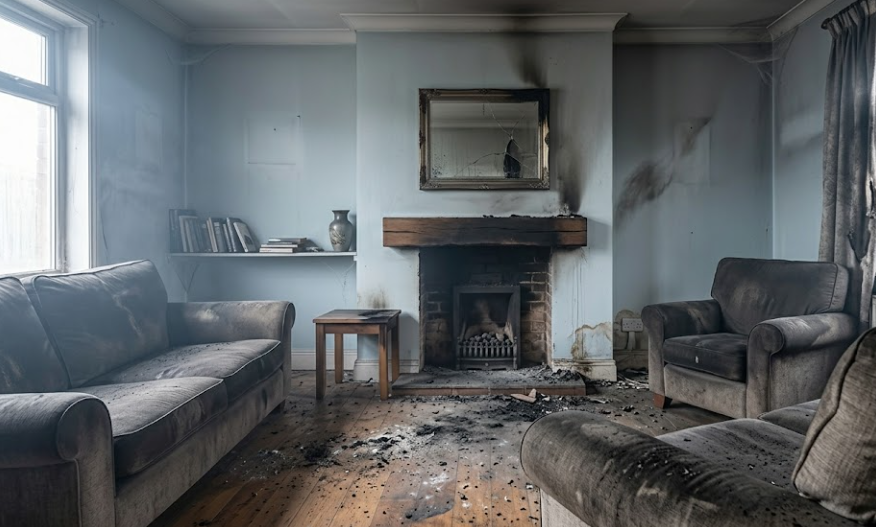
A fire is extinguished in minutes. The smoke it leaves behind takes a great deal longer to deal with. Long after the flames are out and the immediate emergency has passed, smoke damage continues to affect a home in ways that are far more extensive, far more chemically complex, and far more difficult to address than most homeowners expect.
Smoke does not stay where the fire was. It travels through every room a building’s air currents reach, deposits residue on every surface it touches, and embeds odor compounds into porous materials at a molecular level that no amount of surface wiping can fully resolve.
Smoke damage cleaning is a specialized restoration discipline that requires an understanding of smoke chemistry, material science, and the specific cleaning techniques required to fully remove residue and odor rather than simply masking them.
The type of fire, the materials that burned, and how long the smoke residue has been sitting on surfaces all determine the cleaning approach – and getting this wrong, whether through delayed response or inadequate technique, results in damage that persists long after a homeowner believes the cleanup is complete.
This guide covers the science of smoke damage, the different types of smoke residue and how each must be addressed, the room-by-room and material-by-material cleaning process, what professional restoration involves, and the mistakes that homeowners most commonly make when attempting smoke damage cleaning on their own.
Understanding Smoke Damage: Why It Is More Than Soot
Smoke is a complex mixture of fine particulate matter, unburned and partially burned fuel particles, and a wide range of gaseous combustion byproducts including volatile organic compounds, carbon compounds, and in some fires, toxic chemical residues from synthetic materials.
The visible soot deposit that most people associate with fire damage is only one component of the full smoke damage picture – the odor-causing compounds, the acidic residues that corrode metal and discolor surfaces, and the fine particulate that penetrates deep into porous materials are all part of what smoke damage cleaning must address.
Why Smoke Travels Far Beyond the Fire’s Origin
Heat from a fire creates strong convective air currents that carry smoke throughout a structure rapidly, well beyond the room where the fire originated. Smoke moves through HVAC ductwork, travels through wall cavities and ceiling plenum spaces, and infiltrates closets, cabinets, and drawers that were never directly exposed to flame.
A fire that was contained to a single room can produce smoke damage requiring cleaning throughout an entire home, because the smoke itself does not respect the boundaries that contained the fire.
The Three Types of Smoke Residue
Effective smoke damage cleaning requires identifying which type of smoke residue is present, because each type responds to different cleaning agents and techniques. Using the wrong approach on the wrong residue type can smear, set, or spread the contamination rather than removing it.
Dry Smoke Residue
Dry smoke residue results from fast-burning, high-temperature fires involving materials such as paper, wood, and natural fibers. It produces a fine, dry, powdery residue that is relatively easy to remove with dry cleaning methods – chemical sponges and HEPA vacuuming – because the particles have not bonded into surfaces with an oily or sticky binder.
Dry smoke residue is the most straightforward type to clean, though its powdery nature means it transfers easily and can spread to unaffected areas if not handled carefully during the cleaning process.
Wet Smoke Residue
Wet smoke residue results from slow-burning, low-temperature, smoldering fires – often involving synthetic materials like plastics, rubber, and foam padding in furniture. This residue is sticky, smeary, and difficult to remove because the combustion byproducts include partially melted and oily components that bond strongly to surfaces.
Wet smoke produces a stronger and more persistent odor than dry smoke, and it requires the use of solvent-based or specialized cleaning agents rather than dry methods – attempting to dry-clean wet smoke residue typically smears it across the surface rather than lifting it away.
Protein Residue
Protein residue results from fires involving food, particularly kitchen fires where meat, fats, or other organic food materials have burned. This residue is often nearly invisible – it may leave little to no visible discoloration on surfaces – but it produces an extremely strong and unpleasant odor and creates a sticky, varnish-like film.
Protein residue is one of the most commonly underestimated forms of smoke damage because homeowners often assume that a kitchen fire with minimal visible soot has not caused significant smoke damage cleaning needs, when in fact the protein film has likely coated cabinetry, surfaces, and walls throughout the kitchen and adjacent rooms.
Smoke Damage Cleaning by Material Type
Different building materials and contents respond to smoke contamination in different ways and require different cleaning techniques to fully restore them.
Walls and Ceilings
Painted walls and ceilings affected by smoke residue require a careful cleaning sequence: dry cleaning first using a chemical sponge to remove loose surface soot without smearing it into the paint, followed by wet cleaning with an appropriate degreasing solution for any remaining residue, and finally – in cases of significant smoke penetration – sealing with a stain-blocking primer before repainting.
Skipping the sealing step on heavily smoke-damaged walls is one of the most common smoke damage cleaning mistakes, because smoke odor compounds embedded in the wall surface and substrate will continue to off-gas through new paint if they are not sealed first.
Ceilings and Acoustic Materials
Ceiling surfaces accumulate smoke residue more heavily than walls because warm, smoke-laden air rises and concentrates at the ceiling level. Textured or acoustic ceiling finishes are particularly difficult to clean because their irregular surface traps soot particles in ways that flat surfaces do not. In many cases, heavily smoke-damaged textured ceilings are more cost-effectively replaced than cleaned, particularly if the texture material is older and likely to require asbestos testing before any disturbance.
Carpet and Upholstery
Smoke particles settle deeply into carpet fibers and upholstery fabric, and odor compounds bond to these materials at a level that surface vacuuming cannot address. Professional smoke damage cleaning for carpet and upholstery involves HEPA vacuuming to remove loose particulate, followed by hot water extraction cleaning with specialized smoke-residue cleaning solutions, and in many cases, additional odor treatment using ozone or hydroxyl radical generators to neutralize odor compounds that surface cleaning alone cannot remove.
Carpet padding beneath affected carpet, which is highly porous and absorbs smoke odor readily, frequently requires replacement even when the carpet itself can be cleaned and retained.
Hard Flooring
Tile, hardwood, and laminate flooring affected by smoke residue are generally cleaned using appropriate degreasing solutions matched to the flooring material – alkaline cleaners for sealed hardwood and tile, and gentler solutions for unsealed or specially finished surfaces. Grout lines in tile flooring trap smoke residue in their porous surface and frequently require more aggressive scrubbing or grout sealing after cleaning to fully address the contamination.
HVAC Systems
The HVAC system is one of the most critical and most frequently overlooked components of comprehensive smoke damage cleaning. If the system was running during the fire or smoke event, smoke particles have been distributed throughout the ductwork and have deposited in the blower assembly, the evaporator coil, the air filter, and the supply and return ductwork serving every room.
An HVAC system that continues to operate without professional cleaning will continue to circulate smoke odor and particulate throughout the home indefinitely, undermining cleaning efforts performed everywhere else in the structure. Professional duct cleaning using high-powered vacuum equipment and rotary brush systems, combined with replacement of all filters and cleaning of the air handler components, is essential after any significant smoke event.
Personal Belongings and Contents
Clothing, linens, and washable fabric items affected by smoke can often be successfully cleaned through specialized laundering processes – professional restoration laundry services use detergents and additives specifically formulated to break down smoke residue and neutralize odor compounds, often more effectively than consumer laundry products.
Non-washable items including furniture, electronics, and decorative objects require the specific cleaning approaches appropriate to their material – ultrasonic cleaning for hard surfaces and electronics, specialized upholstery cleaning for fabric furniture, and in some cases, professional pack-out to a restoration facility where contents can be cleaned and treated under controlled conditions.
Odor Elimination: The Step Most DIY Cleaning Misses
The most consistent shortfall in homeowner-attempted smoke damage cleaning is the failure to address odor at a molecular level. Surface cleaning removes visible residue but does not neutralize the volatile organic compounds embedded within porous materials that continue to off-gas smoke odor long after surfaces appear clean. Professional odor elimination uses one or more of the following technologies:
- Ozone treatment: high concentrations of ozone gas chemically oxidize odor-causing VOCs into odorless compounds, penetrating into the same porous materials that absorbed the smoke odor. Requires full evacuation of the space during treatment and proper ventilation afterward.
- Hydroxyl radical generation: a slower-acting but occupant-safe alternative to ozone that breaks down odor compounds through a similar oxidation process without requiring evacuation
- Thermal fogging: a specialized deodorizing solution is vaporized into a fine fog with particle sizes comparable to smoke particles, allowing it to penetrate the same materials and surfaces that smoke contaminated
- Sealing primers: for surfaces with persistent odor that cannot be fully eliminated through cleaning, a specialized sealing primer creates a vapor barrier that prevents residual odor compounds from migrating through new paint or finishes
Common Mistakes in DIY Smoke Damage Cleaning
Attempting smoke damage cleaning without professional knowledge and equipment frequently produces disappointing or counterproductive results. These are the most common mistakes:
- Using water-based cleaners on wet smoke residue without first testing – water can react with certain wet smoke residue compounds and set the stain permanently rather than removing it
- Rubbing or scrubbing dry smoke residue, which smears the fine powdery particles into the surface rather than lifting them away
- Using a household vacuum without HEPA filtration, which exhausts fine smoke particles and odor compounds back into the air rather than capturing them
- Relying on air fresheners and odor-masking products, which do nothing to address the underlying odor-causing compounds and often create an unpleasant combination smell
- Painting over smoke-stained surfaces without proper cleaning and sealing first, which allows the stain and odor to bleed through the new paint within weeks
- Running the HVAC system during cleanup, which redistributes smoke particles throughout the home and undoes cleaning progress in other rooms
- Failing to address contents and personal belongings, focusing cleaning efforts only on the structure while smoke-contaminated furniture, clothing, and decor continue to off-gas odor throughout the home
When to Call a Professional for Smoke Damage Cleaning
Minor smoke exposure – a small kitchen incident that was quickly contained, or light smoke odor from a brief and limited event – may be manageable with careful homeowner cleaning using appropriate techniques and products.
However, professional smoke damage cleaning is strongly recommended, and in many cases necessary, for any fire event that involved a structural fire, affected multiple rooms, involved synthetic materials that produce wet smoke or toxic residue, or has left a persistent odor that homeowner cleaning attempts have not resolved.
Professional restoration companies bring industrial-grade equipment, specialized cleaning agents matched to specific residue types, and the technical knowledge to assess which materials can be cleaned versus which must be replaced – decisions that have significant cost implications and that benefit from professional judgment. Most homeowner’s insurance policies cover professional smoke damage cleaning as part of a covered fire damage claim, making professional restoration both more effective and often more cost-efficient than extended DIY effort that ultimately requires professional intervention anyway.
Complete Smoke Damage Cleaning Protects Your Health and Your Home
Smoke damage cleaning is not a single task but a comprehensive process that must address every surface, every material type, and every air pathway that smoke has contacted – structural surfaces, contents, HVAC systems, and the molecular-level odor compounds embedded in porous materials throughout the home.
Incomplete smoke damage cleaning leaves behind health hazards, persistent odor, and progressive material degradation that will continue to affect the home long after the visible signs of the fire have been addressed.
Arizona’s Premier Restoration Specialists at PuroClean bring the equipment, expertise, and systematic approach needed to fully restore a smoke-damaged home – addressing every surface, every system, and every odor source completely. Leaders in recovery. Calm in the Chaos.
Smoke Damage in Your Home? Call PuroClean for Complete, Professional Cleaning
PuroClean’s certified smoke damage restoration specialists respond 24/7 throughout the Phoenix metro area, bringing the equipment and expertise to fully clean structures, contents, and HVAC systems and eliminate odor at its source. Arizona’s Premier Restoration Specialists. Leaders in recovery. Calm in the Chaos.
Call PuroClean now at (480) 767-5588 for smoke damage cleaning anywhere in Arizona. Fast response. Proven results. Complete peace of mind.
Do not settle for a home that still smells like smoke. PuroClean gets it completely clean.