


Asbestos Cleanup During Fire or Water Restoration Guide
When fire or water damage strikes an older home or commercial building, the restoration process involves more than drying walls and cleaning soot. In properties built before 1980, and in many built through the early 1990s, the physical disturbance of building materials during restoration can expose a hidden hazard that changes everything about how the project must be managed: asbestos.
Asbestos-containing materials were used extensively in residential and commercial construction for decades, and they remain in place in millions of properties across Arizona today. When those materials are disturbed by fire damage, water intrusion, or the demolition work that follows both, asbestos fibers become airborne – creating a serious and legally regulated health hazard that must be handled through a process entirely separate from standard restoration.
Understanding asbestos cleanup during fire or water restoration is not optional knowledge for property owners in older buildings. It is essential. Failing to identify asbestos before restoration work begins, or proceeding with demolition and material removal without proper abatement protocols, exposes occupants, workers, and neighboring properties to carcinogenic fiber release – and exposes the property owner to significant legal and financial liability. This guide explains where asbestos hides in older buildings, how fire and water damage disturb it, what the legal requirements are, and how professional abatement is integrated into the restoration process.
What Is Asbestos and Why Was It Used in Construction?
Asbestos is a naturally occurring silicate mineral that was prized in the construction industry for its extraordinary fire resistance, tensile strength, thermal insulation properties, and low cost. From the early 1900s through the late 1970s, it was incorporated into dozens of building materials used in residential and commercial construction across the United States. The EPA and the Consumer Product Safety Commission began restricting its use in the 1970s and 1980s as the scientific evidence connecting asbestos fiber inhalation to mesothelioma, lung cancer, and asbestosis became irrefutable.
Asbestos is not hazardous when it is intact and undisturbed. The danger arises when asbestos-containing materials are cut, broken, abraded, demolished, or otherwise disturbed in ways that release microscopic fibers into the air. Inhaled asbestos fibers lodge in lung tissue and cannot be expelled by the body’s natural clearance mechanisms. The resulting diseases – particularly mesothelioma, a form of cancer with a notoriously poor prognosis – can take 20 to 50 years to develop after exposure, which allowed the problem to persist for decades before its full magnitude was understood.
Where Asbestos Hides in Arizona Homes and Commercial Buildings
Arizona’s construction boom decades mirror the national timeline for asbestos use. Homes and commercial buildings constructed before 1980 are at highest risk for asbestos-containing materials, but properties built through the late 1980s and in some cases the early 1990s may also contain asbestos in specific product categories. The following are the most common locations where asbestos is found during restoration work:
Popcorn Ceilings and Textured Ceiling Finishes
Spray-applied textured ceilings – commonly called popcorn ceilings – were widely produced with asbestos content through the late 1970s. This is one of the most common asbestos-containing materials encountered during fire and water restoration in older Arizona homes because ceiling materials are among the first to be disturbed by both fire damage and water intrusion. A fire that chars ceiling surfaces or a water leak that causes ceiling collapse can release asbestos from textured ceiling material that was otherwise completely stable and harmless. Before any ceiling work is performed in a pre-1980 home, textured ceiling material must be tested.
Floor Tiles and Adhesive
Nine-inch and twelve-inch vinyl floor tiles manufactured before 1980, along with the black tar adhesive used to install them, frequently contain asbestos. These tiles are extremely common in Arizona homes and commercial buildings from the 1950s through the 1970s. Water damage that requires floor removal – from flooding, slab leaks, or appliance failures – creates an immediate asbestos exposure risk if the vinyl tile beneath the carpet or newer flooring is asbestos-containing. The adhesive is often even more highly asbestos-concentrated than the tile itself.
Pipe Insulation and HVAC Duct Wrap
Hot water pipes, steam pipes, and HVAC ductwork in older buildings were frequently wrapped with asbestos-containing insulation materials that are visually distinctive – white or gray corrugated or smooth wrapping on pipes and duct connections. Fire damage in a utility room, basement, or mechanical space that contacts this pipe insulation creates immediate fiber release. Water damage that saturates pipe insulation can also cause it to deteriorate and release fibers as it dries.
Drywall Joint Compound and Plaster
Joint compound (also called drywall mud) used to tape and finish drywall seams was produced with asbestos through the early 1980s. Plaster wall and ceiling finishes in older buildings – particularly pre-1960 construction – may also contain asbestos. Fire restoration that requires drywall removal and water restoration that saturates and collapses drywall both create the risk of asbestos fiber release from joint compound and plaster materials that look completely unremarkable during visual inspection.
Roofing Materials
Asbestos-cement roofing shingles and corrugated roofing panels, felt underlayment, and roof patching compounds were used extensively in older residential and commercial construction. Fire damage to a roof that includes asbestos-cement roofing materials creates fiber release during the fire itself and during the subsequent demolition and debris removal. Restoration contractors who remove fire-damaged roofing without asbestos testing are creating a serious and uncontrolled exposure event.
Insulation Board and Ceiling Tiles
Acoustic ceiling tiles, insulation board used as fire blocking, and sheet insulation products were frequently manufactured with asbestos content through the 1970s. In commercial buildings particularly, drop ceiling systems with asbestos-containing tiles are a common finding during restoration work. Fire damage that chars or collapses ceiling tiles and water damage that saturates and warps them both create conditions for fiber release during disturbance.
Vermiculite Insulation
Vermiculite attic insulation – sold under the brand name Zonolite among others – was produced from a specific ore deposit that was naturally contaminated with tremolite asbestos. Millions of homes received vermiculite insulation during the 1950s through the 1980s. Fire damage that reaches the attic or water damage that saturates attic insulation may disturb vermiculite, and any disturbance of this material must be treated as a potential asbestos event until testing confirms otherwise.
How Fire and Water Damage Disturb Asbestos-Containing Materials
Both fire damage and water damage create conditions that disturb asbestos-containing materials that were previously stable and contained.
Fire Damage and Asbestos
Fire consumes, chars, and structurally compromises building materials. Asbestos-containing materials that were previously bound in place – ceiling texture, floor tile adhesive, pipe insulation, roofing shingles – are disrupted by the physical destruction of fire and by the water from firefighting and suppression system activation. The debris removal phase of fire restoration is a particularly high-risk moment for asbestos disturbance: debris that appears to be simply burned construction material may contain asbestos that was not identified before removal began. In heavily fire-damaged areas where multiple material types are mixed in debris piles, the exposure risk is compounded by the difficulty of identifying individual material types visually.
Water Damage and Asbestos
Water damage creates a different but equally significant asbestos disturbance pathway. Saturated drywall that is removed during restoration may contain asbestos in its joint compound. Wet flooring that is pulled up may expose asbestos-containing vinyl tile and adhesive below. Wet pipe insulation that is removed for structural drying may be asbestos-containing. The material removal phase of water damage restoration – which is often conducted with urgency to prevent mold growth – is a high-risk moment for inadvertent asbestos disturbance if testing has not been performed in advance.
Legal Requirements for Asbestos Cleanup During Fire or Water Restoration in Arizona
The legal framework governing asbestos cleanup during fire or water restoration in Arizona is established by overlapping federal and state requirements that apply to property owners, contractors, and restoration companies.
EPA National Emission Standards for Hazardous Air Pollutants (NESHAP)
The EPA’s NESHAP regulations require that owners and operators of renovation and demolition projects involving regulated asbestos-containing material (RACM) notify the appropriate state or local air pollution control agency before work begins. In Arizona, the Maricopa County Air Quality Department has jurisdiction over NESHAP compliance in the Phoenix metro area. NESHAP regulations apply to all renovation and demolition activities that disturb more than a threshold quantity of asbestos-containing material, and they establish specific wet methods, waste disposal, and notification requirements.
OSHA Asbestos Standards
OSHA’s asbestos construction standard (29 CFR 1926.1101) establishes exposure limits, required protective equipment, air monitoring requirements, and work practice requirements for workers who may contact asbestos-containing materials. Restoration companies that permit their workers to disturb asbestos-containing materials without complying with OSHA‘s asbestos standard are violating federal law and creating significant liability for worker exposure claims.
Arizona Department of Environmental Quality Requirements
ADEQ regulates asbestos abatement in Arizona and requires that asbestos abatement contractors be licensed, that abatement projects be conducted following specific removal and disposal protocols, and that asbestos waste be transported and disposed of at licensed asbestos waste disposal facilities. Asbestos-containing waste material cannot be disposed of in standard construction and demolition debris streams.
Property Owner Liability
Arizona property owners who fail to test for asbestos before restoration work begins, who hire unlicensed contractors who disturb asbestos without proper protocols, or who allow asbestos-containing waste to be disposed of improperly face significant legal and financial exposure. Asbestos cleanup during fire or water restoration that is handled improperly creates liability for worker exposure claims, neighboring property contamination claims, regulatory fines, and in some cases criminal charges. The cost of proper asbestos testing and abatement is a fraction of the liability exposure created by failing to address it.
The Integrated Asbestos Abatement and Restoration Process
Professional handling of asbestos cleanup during fire or water restoration requires a specific sequence of steps that integrates asbestos abatement with the broader restoration process without creating delays that allow secondary damage to worsen.
Step 1: Pre-Restoration Asbestos Survey
Before any restoration work begins in a building of unknown asbestos status, a licensed asbestos inspector conducts a comprehensive survey of all materials that may be disturbed during the restoration project. This survey includes visual identification of suspect materials and collection of bulk samples for laboratory analysis by an accredited laboratory. The survey report identifies all confirmed and assumed asbestos-containing materials in the project area and establishes the abatement scope that must be completed before restoration work can proceed.
In emergency situations – such as active flooding where structural drying must begin immediately to prevent mold growth – restoration companies may proceed with drying equipment placement and non-destructive stabilization work while the asbestos survey is being completed, provided that no material disturbance occurs. The urgency of water damage does not eliminate the requirement to test before disturbing materials.
Step 2: Asbestos Abatement Before Material Removal
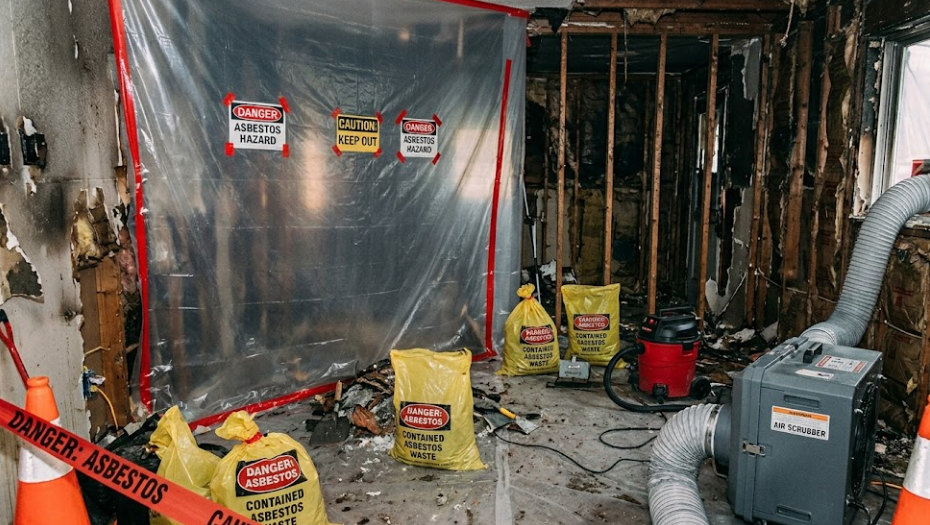
All confirmed asbestos-containing materials in the project area are removed by licensed asbestos abatement contractors following ADEQ and NESHAP protocols. Abatement work is conducted under containment conditions with negative air pressure and HEPA filtration to prevent fiber migration to adjacent areas. Workers wear appropriate respiratory protection and protective clothing. Asbestos-containing waste is wetted, double-bagged in labeled asbestos waste bags, and transported to a licensed asbestos waste disposal facility.
Step 3: Post-Abatement Air Clearance Testing
Following completion of asbestos abatement, a licensed asbestos inspector conducts air clearance testing using phase contrast microscopy (PCM) or transmission electron microscopy (TEM) to confirm that airborne fiber levels in the abated area are below the clearance threshold. Written clearance documentation is provided before the containment is removed and before restoration work can begin in the abated area.
Step 4: Restoration Work in Cleared Areas
Once asbestos abatement is complete and clearance testing confirms acceptable air quality, fire or water restoration work proceeds in the abated areas. The restoration team can now perform demolition, drywall removal, floor material removal, and structural drying without the asbestos exposure risk that would have existed if these steps had been conducted before abatement. Coordination between the abatement contractor and the restoration company is essential for managing the project timeline efficiently and minimizing the total duration of the restoration.
What Homeowners Should Do When Asbestos Is Suspected
If you own or manage a property built before 1985 and fire or water damage requires restoration work, take these steps before any demolition or material removal begins:
- Do not allow any contractor – restoration, plumbing, roofing, or otherwise – to begin cutting, demolishing, or removing building materials until asbestos testing has been completed in the affected areas
- Contact a licensed asbestos inspector to conduct a pre-restoration survey and collect samples for laboratory analysis – do not rely on visual identification, as asbestos cannot be reliably identified without testing
- Notify your homeowner’s or commercial property insurance carrier that asbestos has been identified or is suspected – most policies include asbestos abatement coverage as part of a covered restoration claim, but this coverage must be specifically invoked
- Engage a restoration company that has established working relationships with licensed asbestos abatement contractors and experience managing integrated asbestos abatement and restoration projects
- Do not disturb suspected asbestos-containing materials yourself – do not sand, drill, scrape, or remove textured ceilings, old floor tiles, pipe insulation, or deteriorated ceiling tiles without professional assessment
- Keep the affected area ventilated and limit access until the asbestos status of all materials has been confirmed through laboratory testing
Choosing a Restoration Company Equipped for Asbestos Situations
Not every restoration company is prepared to manage projects that involve confirmed or suspected asbestos-containing materials. When selecting a restoration partner for a property that may have asbestos, look for:
- Demonstrated experience managing restoration projects in pre-1980 construction where asbestos abatement integration was required
- Established relationships with licensed Arizona asbestos abatement contractors who can be mobilized quickly to prevent project delays
- Knowledge of the applicable regulatory framework – ADEQ, NESHAP, and OSHA asbestos standards – and the ability to coordinate project sequencing to maintain compliance throughout
- Insurance documentation capability that properly identifies asbestos abatement costs separately from restoration costs for the purposes of the insurance claim
- A project management approach that coordinates abatement and restoration as a single integrated project rather than treating them as entirely separate and sequential efforts
Asbestos Awareness Is Part of Responsible Restoration
In Arizona’s older housing and commercial building stock, asbestos cleanup during fire or water restoration is not a rare edge case – it is a regular occurrence that requires proactive identification and professional management. Property owners who approach restoration of older buildings without considering the asbestos question are not just taking a personal health risk.
They are creating legal and financial exposure, potentially contaminating neighboring properties, and exposing workers to a carcinogenic hazard that will not produce health consequences for decades – long after any sense of connection to the original restoration decision has faded.
The right approach is straightforward: test before you disturb, abate before you demolish, and engage a restoration team that understands how to integrate these requirements into a project plan that protects health, maintains compliance, and recovers your property efficiently. Arizona’s Premier Restoration Specialists understand that a truly professional restoration means protecting people as well as property – and that means never cutting corners on asbestos.
Older Property With Fire or Water Damage? Call PuroClean First
PuroClean’s restoration specialists work with licensed asbestos abatement partners to manage integrated restoration projects in pre-1980 Arizona properties safely, legally, and efficiently.
We coordinate every phase from asbestos survey through clearance testing and final reconstruction – so you never have to manage multiple contractors or navigate the regulatory requirements alone. Arizona’s Premier Restoration Specialists. Leaders in recovery. Calm in the Chaos.
Call PuroClean now at (480) 767-5588. Available 24/7. Fast response. Proven results.
When the stakes are highest, you need a team that knows exactly what they are doing. That is PuroClean.