


Attic Water Damage From Roof Leak: Arizona Guide
Of all the places water damage can develop in an Arizona home, the attic is the one most likely to go undetected the longest and cause the most structural harm before anyone realizes there is a problem.
Unlike a burst pipe in the kitchen or a flooded bathroom that announces itself immediately through visible water on a floor, attic water damage from a roof leak develops silently above the ceiling – saturating insulation, rotting framing, feeding mold colonies, and weakening the structural capacity of the roof deck for weeks or months before a ceiling stain, a musty smell, or a sagging drywall panel finally signals that something is seriously wrong.
Arizona homeowners face a particularly elevated risk of attic water damage from roof leaks because of the combination of flat and low-slope roofing systems common in this region’s architecture, the intensity of monsoon season rainfall that accumulates on those flat surfaces faster than drainage can remove it, the extreme thermal cycling that accelerates the deterioration of roofing materials, and the haboob conditions that deposit fine particulate matter in every roof drain and scupper in the Valley.
Understanding attic water damage from roof leaks – how it begins, how it spreads, how to recognize it before it becomes catastrophic, and what professional restoration involves – is essential knowledge for every Arizona homeowner.
How Arizona’s Climate and Architecture Drive Attic Water Damage Risk
Flat and Low-Slope Roofing Systems
More than half of homes built in the Phoenix metro area feature flat or low-slope roofing systems – the signature of southwestern contemporary and ranch-style architecture that defines the Valley’s residential landscape. These roofing systems offer aesthetic appeal and practical advantages for the desert environment, but they carry a water management challenge that pitched roofs do not: water does not naturally shed from a flat surface. It accumulates.
When roof drains, scuppers, and overflow outlets are clear and functioning, flat roofs drain adequately. When they are partially or fully blocked – with debris from haboobs, with algae growth in the moisture that collects around drains, with bird nesting material, or with the accumulated fine particulate that settles during Arizona’s dry season – water ponds on the roof surface and exploits every imperfection in the membrane.
A flat roof that has ponding water above it is not a question of if it will leak – it is a question of where and when. The hydraulic pressure of standing water forces water through membrane seams that were performing adequately under dry conditions, through flashing connections that are slightly loose, and through the base of HVAC curbs and roof penetrations where sealant has begun to break down. Every drop of water that finds its way through the roof membrane ends up in the attic below.
Monsoon Rainfall Intensity
Arizona’s monsoon storms do not deliver rain the way a cloudy Pacific Northwest day does. They deliver one to three inches of precipitation in 30 to 60 minutes as intense downbursts that challenge every drainage system on every roof in their path simultaneously.
A flat roof with drains that are 80 percent clear under normal conditions may be functionally impassable during a monsoon event when rainfall arrives faster than even fully clear drains can remove it. The resulting temporary ponding during high-intensity rainfall creates conditions for water to find and exploit any vulnerability in the roofing system that a slow rain would never reveal.
Extreme Thermal Cycling
Arizona’s temperature extremes – from overnight winter lows approaching freezing to summer highs exceeding 115 degrees Fahrenheit on the roof surface itself – subject roofing materials to thermal expansion and contraction cycles of extraordinary range.
Roofing membrane seams, flashing connections, and sealant joints that expand and contract repeatedly through this temperature range eventually fatigue and fail. This failure process is gradual, invisible from inside the home, and often produces leaks that are intermittent at first – only appearing when rainfall exceeds a certain intensity or when wind-driven rain strikes from a specific direction.
Intermittent attic water damage from roof leaks is particularly insidious because the absence of visible leakage in dry periods creates the impression that the problem has resolved when in fact the leak source remains and will perform again in the next storm.
Haboob Debris Accumulation
Arizona’s massive dust storms deposit fine particulate matter across every horizontal surface they contact – and roof drain openings are among the most vulnerable collection points. Roof drains that are partially silted with haboob deposits drain slowly, creating ponding conditions during subsequent rain events. Over multiple haboob seasons, the cumulative debris loading in roof drains can create near-complete blockage that only becomes apparent when a monsoon event turns a flat roof into a shallow pond.
How Attic Water Damage From Roof Leaks Develops and Spreads
Understanding the physical pathway of water from a roof leak to the visible interior damage helps homeowners recognize how much damage can accumulate before it becomes visible and why attic inspections matter even when no interior signs are present.
The Insulation Absorption Phase
Water that enters the attic through a roof leak first contacts the insulation layer. In Arizona attics, the dominant insulation type is blown-in fiberglass or blown-in cellulose, both of which are highly absorbent when wet.
A relatively small volume of water can saturate a large area of blown-in insulation because the insulation distributes the absorbed water laterally as well as downward. A roof leak that introduces a gallon of water into the attic during each rain event may create a wet insulation zone four to six feet in diameter that is completely invisible from below and that shows no ceiling staining until the insulation is thoroughly saturated and water begins to penetrate the ceiling drywall.
Wet blown-in insulation has two serious consequences beyond the immediate moisture damage. First, it loses essentially all of its thermal insulating value when saturated – compressed, wet insulation provides very little resistance to the conduction of Arizona’s extreme outdoor heat into the conditioned living space below, increasing cooling costs significantly.
Second, wet cellulose insulation in particular provides an excellent growth medium for mold, and mold colonies established in attic insulation can spread spores into the living space below through the ceiling drywall assembly and through HVAC systems that draw air from or pass through the attic space.
Roof Deck Saturation and Rot
Beneath the roofing membrane and above the attic insulation sits the roof deck – typically plywood or oriented strand board (OSB) sheathing that provides the structural substrate for the roofing system.
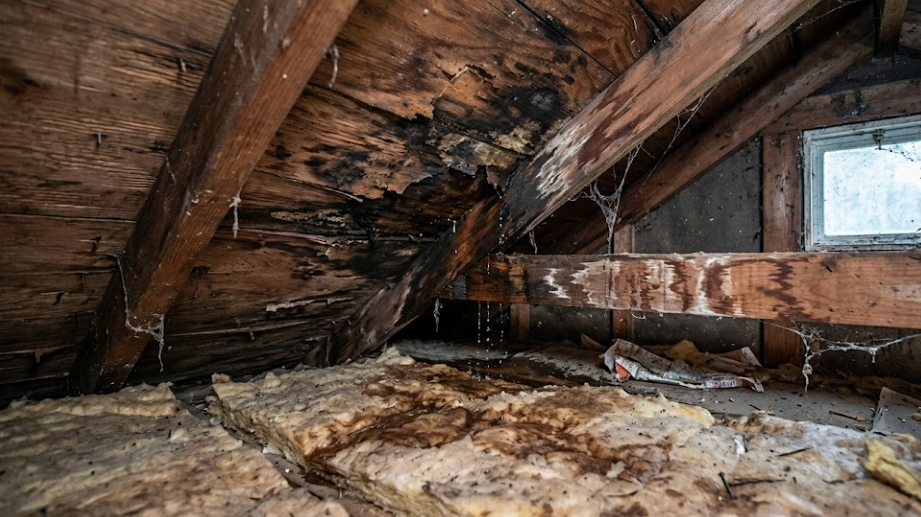
Roof deck wood that is repeatedly wetted and dried by attic water damage from roof leaks develops several progressive failure modes: delamination of the plywood veneers or the OSB mat structure, loss of fastener grip strength as the wood around nails and screws deteriorates, dimensional instability that causes the deck to warp and buckle, and ultimately rot that compromises the structural capacity of the deck to support the weight of the roofing system above it.
A roof deck that has been saturated by repeated attic water damage may appear structurally intact from below while having lost significant load-bearing capacity in the upper plies of the plywood nearest the leak. Walking on such a roof during an inspection or HVAC service creates a concentrated load on structurally compromised material and presents a fall-through risk.
Professional assessment with moisture meters that read through roofing materials is the only reliable way to evaluate the structural condition of a potentially wet roof deck.
Rafter and Framing Damage
Water that saturates the roof deck and penetrates to the rafters and structural framing below creates the same progressive failure modes as any structural wood exposed to chronic moisture: surface mold growth, loss of structural section, and eventually dry rot – a condition where wood-destroying fungi have colonized the structural fibers to the point where the wood no longer carries loads effectively.
Rafter ends, ridge board connections, and hip and valley framing intersections are particularly vulnerable because these are the areas where multiple pieces of framing meet, creating complex moisture-trapping geometries that dry slowly even in favorable conditions.
Ceiling Drywall Saturation
Water that passes through saturated insulation eventually reaches the top face of the ceiling drywall below. Ceiling drywall that becomes wet loses its structural integrity rapidly – the paper facing that gives the drywall panel its tensile strength softens and fails when saturated, and the gypsum core crumbles and loses rigidity.
A ceiling that has sustained significant attic water damage from a roof leak may appear intact – with just a water stain visible – while the gypsum panel has lost most of its structural capacity and is at risk of sudden collapse if disturbed or subjected to additional water loading.
Mold Growth and Air Quality Impact
The attic environment – warm, poorly ventilated, and rich in organic materials including wood framing and cellulose insulation – is one of the most favorable mold growth environments in a residential structure when moisture is introduced.
Mold can establish visible colonies in attic insulation and on roof framing within 24 to 48 hours of water intrusion, and in Arizona’s warm attics, this timeline may be even shorter during summer months when attic temperatures can exceed 150 degrees Fahrenheit. Attic mold affects not just the attic itself but the air quality of the entire home below, because stack effect air movement carries mold spores from the attic downward through ceiling penetrations, recessed light fixtures, and HVAC systems into the conditioned living space.
Warning Signs of Attic Water Damage From Roof Leaks
Because attic water damage from roof leaks develops out of sight, homeowners must rely on indirect indicators to detect it before it becomes severe. These warning signs warrant immediate professional investigation:
- Water stains on ceilings – brown or yellowish discoloration on ceiling surfaces, particularly after a rain event, is the most common visible indicator of attic water intrusion that has penetrated through the insulation to the ceiling drywall
- Sagging or soft ceiling areas – ceiling drywall that has lost structural integrity from saturation may sag visibly or feel soft and spongy when pressed
- Musty or moldy odors in rooms below the attic – a persistent earthy smell that intensifies after rain or during periods of higher humidity often indicates mold growth in the attic above
- Unexplained increases in cooling costs – wet insulation loses its thermal value and allows significantly more heat transfer from the hot Arizona attic into the conditioned space below
- Visible dripping from recessed light fixtures or HVAC ceiling registers during or after rain – indicates that water has penetrated through the full depth of the insulation and is now finding exit points through ceiling penetrations
- Granule loss in gutters following storms – while not directly indicating an attic leak, significant granule loss from asphalt shingles or deteriorating tile materials indicates roofing system deterioration that increases leak risk
- Any area of the roof that shows visible settling, soft spots when walked on, or sagging between rafters – visible indicators of roof deck compromise from moisture damage
Annual Attic Inspection: The Most Underutilized Protective Tool
The single most effective way to detect attic water damage from roof leaks before it becomes structural is an annual attic inspection immediately after the first significant rain event of monsoon season.
Most Arizona homeowners never enter their attic – and certainly not after rain – which means that years of progressive water damage can develop undetected. An annual post-rain inspection takes 20 to 30 minutes and provides evidence of whether the roof held up to the season’s first major storm.
During an attic inspection, look for visible water staining on the underside of the roof deck, wet or darkened insulation in any area, any visible mold growth on framing or insulation, dripping from roof penetrations or HVAC equipment, and daylight visible through the roof assembly from any location. If any of these conditions are present, stop the inspection and contact a professional for assessment – do not attempt to walk on or apply weight to roof deck areas that appear wet or structurally compromised.
The Professional Attic Water Damage Restoration Process
Comprehensive Assessment With Moisture Mapping
Professional restoration begins with a complete moisture assessment of the attic using calibrated moisture meters and thermal imaging cameras. This assessment measures moisture content in the roof deck, the framing, and any areas where water has penetrated below the insulation layer.
The moisture map establishes the true extent of the wet zone, which is consistently larger than the visibly stained or obviously wet area. In attics with blown-in insulation, moisture can migrate laterally through the insulation layer for several feet beyond the visible wet spot, and this hidden moisture must be identified and addressed as part of the restoration scope.
Insulation Removal
Attic insulation that has been saturated with water from a roof leak almost always requires removal and replacement rather than drying in place. Blown-in insulation that has been wet cannot be effectively dried without removal because the insulation mass traps moisture against the roof deck and framing below, preventing the airflow needed for structural drying.
Wet insulation also serves as a continuing mold growth medium regardless of how well the structural materials below it are dried. Complete removal of wet insulation exposes the roof deck and framing for assessment, cleaning, and drying.
Mold Remediation of Structural Materials
Once the insulation is removed, roof deck and framing materials are inspected for mold growth. Mold on wood structural materials is treated with EPA-registered antimicrobial solutions and HEPA-vacuumed. In cases where mold growth has been present for an extended period and has penetrated into the wood fibers, affected sections of roof deck and framing may need to be removed and replaced.
Post-remediation air quality testing confirms that airborne spore levels in the attic have returned to acceptable levels before new insulation is installed.
Structural Drying of Roof Deck and Framing
After insulation removal and mold treatment, commercial drying equipment – air movers positioned to direct airflow across the roof deck surface and commercial dehumidifiers – dries the structural wood to its target moisture content level.
In Arizona’s low ambient humidity, structural drying is typically faster than in more humid climates, but the drying process must be verified with daily moisture meter readings rather than assumed to be complete based on elapsed time alone. Structural materials that are reinstalled or covered with new insulation before reaching dry standard will continue to harbor moisture that supports ongoing biological activity.
Ceiling Assessment and Repair
Ceiling drywall that has been stained, softened, or structurally compromised by attic water damage is removed and replaced. The extent of ceiling replacement is determined by the moisture mapping assessment – areas that show elevated moisture content even without visible surface damage may require drywall removal to allow complete drying of the ceiling assembly. New drywall is installed, finished, and painted after the attic drying is verified as complete.
Roof Repair Coordination
Attic water damage restoration must be coordinated with roofing repairs that address the leak source. The preferred sequence is to have a licensed roofing contractor identify and repair the leak source before restoration drying begins – restoring a wet attic while the roof continues to leak simply adds new water to the drying project.
However, in cases where structural drying is urgently needed to prevent progressive mold growth, temporary weatherproofing of the leak area may be installed while permanent roofing repairs are arranged. All roofing repairs should be pressure-tested or inspected during the next rain event to confirm that the leak source has been completely resolved.
New Insulation Installation
After complete structural drying is verified and mold remediation is documented, new insulation is installed to restore the attic’s thermal performance. In Arizona, the Department of Energy recommends R-38 to R-60 insulation for attics depending on location within the state. The insulation replacement is an opportunity to upgrade to current energy code standards, which may be required by the building permit process depending on the extent of the restoration work.
Preventing Attic Water Damage in Arizona: The Pre-Season Checklist
Proactive maintenance reduces attic water damage risk dramatically. Complete this checklist before each monsoon season begins:
- Have a licensed roofing contractor inspect the roof membrane, all flashing connections, parapet seams, and roof penetrations and repair any identified vulnerabilities before the first monsoon rain
- Clear all roof drains, scuppers, and overflow drains of debris – including the fine particulate deposited by haboobs – and verify that they drain freely by running water from a hose at each drain location
- Inspect and reseal all HVAC curb flashings, skylights, and roof penetration boots with appropriate roofing sealant
- Clear gutters and downspouts on any pitched roof sections and verify that downspout extensions direct water away from the foundation
- Conduct a post-rain attic inspection after the first significant storm of the season to confirm that no water intrusion has occurred
- Ensure that attic ventilation – ridge vents, gable vents, and soffit vents – is clear and functioning to prevent moisture buildup from condensation and to limit the temperature differential that drives condensation on cold surfaces
Attic Water Damage and Insurance Coverage in Arizona
Most standard homeowner’s insurance policies cover sudden and accidental roof leak damage – including the resulting attic water damage, ceiling damage, and mold that develops as a direct result of a covered roof event. However, several coverage limitations are important to understand before a claim arises.
Gradual damage exclusions are the most common coverage challenge in roof leak claims. If an insurance adjuster determines that a roof leak has been active for an extended period – evidenced by widespread staining, advanced mold growth, or significant wood deterioration – the carrier may argue that the damage resulted from a gradual deterioration process rather than a sudden and accidental event.
Annual roof inspections, maintenance records, and prompt reporting of any discovered leak are the best protection against gradual damage exclusion arguments, because they document that the homeowner was actively maintaining the roof and did not allow a known condition to persist without action.
Flood damage from external rising water – monsoon runoff that enters the attic through gable vents rather than through a roof failure – is typically excluded from standard homeowner’s policies and requires separate flood insurance coverage. This distinction matters in Arizona communities where monsoon flooding affects properties that have not experienced a direct roof failure.
Protecting Your Home From the Top Down Requires Vigilance and Speed
Attic water damage from roof leaks is among the most preventable and most costly categories of residential water damage in Arizona. The combination of flat roofs, intense monsoon rainfall, and thermal cycling that characterizes this region creates consistent vulnerability in the roofing systems of hundreds of thousands of Valley homes.
The homeowners who avoid the worst outcomes are those who inspect their roofs and attics proactively, who address minor vulnerabilities before they become active leaks, and who call a certified restoration professional immediately upon discovering any evidence of attic water intrusion.
Arizona’s Premier Restoration Specialists at PuroClean respond to attic water damage events throughout the Phoenix metro area and West Valley communities with the moisture mapping, insulation removal, mold remediation, structural drying, and reconstruction expertise that complete attic restoration requires. Leaders in recovery. Calm in the Chaos. When the damage is above the ceiling, you need a team that knows exactly what is happening up there – and exactly how to fix it.
Attic Water Damage or Roof Leak? Call PuroClean for Complete Restoration Today
PuroClean’s IICRC-certified specialists respond 24/7 to attic water damage events throughout the Phoenix metro area and West Valley communities. From professional moisture mapping and insulation removal to mold remediation, structural drying, and ceiling reconstruction, PuroClean delivers complete, verified restoration that protects your home from the top down. Arizona’s Premier Restoration Specialists. Leaders in recovery. Calm in the Chaos.
Call PuroClean now at (480) 767-5588. Fast response. Proven results. Complete peace of mind.
Do not let what is happening above your ceiling become a crisis below it. Call PuroClean today.