


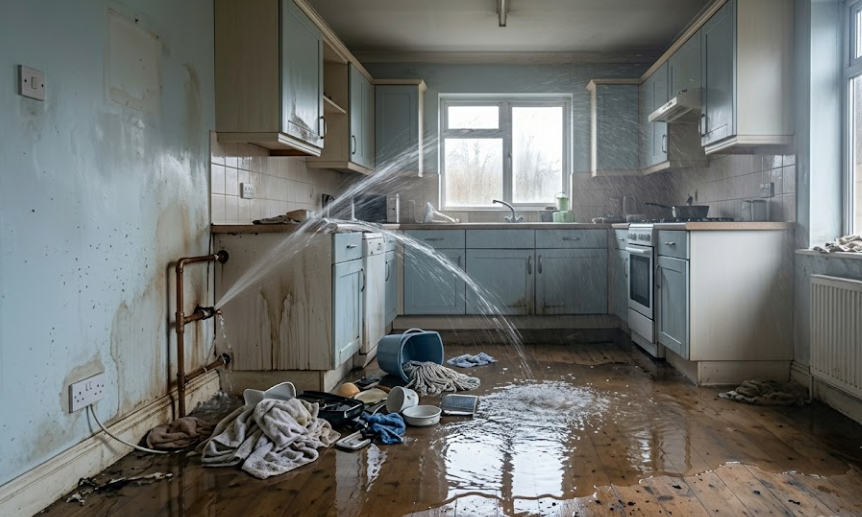
A burst pipe ranks among the most sudden and disorienting emergencies a homeowner can face. One moment everything is normal, and the next, water is pouring into a room at a rate that can release hundreds of gallons before anyone manages to find and close a shutoff valve.
In Arizona, burst pipes carry their own set of regional quirks – rare but severe winter freeze events, relentless hard water corrosion, and extreme thermal cycling that stresses plumbing materials in ways that homeowners in milder climates never have to think about. Knowing exactly what to do in the first minutes and hours after a burst pipe is discovered can be the difference between a contained, manageable cleanup and a multi-room renovation project.
This guide walks through everything Arizona homeowners need to know about burst pipe cleanup: why pipes burst here in the first place, the exact steps to take the moment you discover one, how professional water extraction and drying works, what determines whether your flooring and walls can be saved, and how to navigate the insurance claim that follows. Whether you are dealing with an active burst pipe right now or want to be prepared before the next freeze warning or hard water failure, this guide has you covered.
Why Pipes Burst in Arizona Homes
Arizona’s plumbing failure profile looks different from the Midwest or Northeast, where freeze damage is the dominant cause. Here, several distinct mechanisms combine to put Arizona pipes at meaningful risk.
Rare but Severe Freeze Events
Arizona’s occasional overnight freezes catch homes off guard precisely because they are infrequent. Homes built for desert heat often have minimal pipe insulation in exterior walls, garages, and attic spaces – areas that would be heavily insulated in a colder climate but were never expected to need it here. When a rare hard freeze does arrive, water trapped in these poorly insulated pipe runs expands as it freezes and can split copper or PVC pipe at a weak point. The break itself often is not discovered until the ice thaws and water begins flowing – sometimes hours or a full day after the freeze event has passed.
Hard Water Corrosion
Arizona’s water supply carries significant mineral content, and the calcium and magnesium deposits that build up inside copper pipes over years create localized pitting corrosion. This corrosion weakens the pipe wall at specific points rather than uniformly, and a pipe that has been in service for 20 to 30 years can fail suddenly at one of these pitted weak points – even with no temperature change or unusual pressure event involved. Hard water-driven pipe failure is one of the most common causes of burst pipe cleanup events in Arizona homes built in the 1980s through 2000s.
Extreme Thermal Cycling
The dramatic daily temperature swings common across Arizona, combined with the intense heat that slab-embedded and exterior-wall pipes experience during summer months, cause repeated expansion and contraction in copper plumbing. Over years, this cycling fatigues pipe material at joints and bends, eventually producing a crack or split. Unlike freeze bursts, thermal cycling failures can occur at any time of year and are not tied to a specific weather event, which makes them harder to anticipate.
Water Pressure Issues
Municipal water pressure that runs consistently high, or pressure spikes from water hammer when valves close suddenly, place ongoing stress on pipes and fittings. A pressure-reducing valve that is missing, undersized, or has failed can allow pressure levels well above what residential plumbing is designed to handle indefinitely, accelerating wear at every joint and connection in the system.
The First 30 Minutes: What to Do When You Discover a Burst Pipe
The actions you take in the first half hour after discovering a burst pipe have an outsized impact on the total scope of damage. Move through these steps in order.
- Shut off the water immediately. Locate your home’s main water shutoff valve – typically near the street-side water meter or where the main line enters the house – and close it fully. If you know specifically which fixture or branch line has failed and there is a dedicated shutoff for that line, closing it may stop the flow faster than finding the main valve.
- Turn off electricity in affected areas. If water has reached or is near electrical outlets, panels, or any plugged-in appliances, shut off the relevant circuit breakers before doing anything else in that area. Do not step into standing water if there is any chance it is in contact with live electrical components.
- Document the scene before you touch anything. Take photos and video of the active flooding, the water level, and the visible damage from multiple angles. This documentation is the foundation of your insurance claim and is far more valuable when captured before any cleanup begins.
- Move furniture and valuables out of the water’s path. Anything portable – electronics, rugs, furniture, boxes – should be relocated to a dry area immediately to prevent additional losses.
- Remove as much standing water as you safely can. Towels, a wet vacuum, or a mop can reduce the volume of water sitting on hard flooring while you wait for professional help. Do not use a standard household vacuum, which is not designed for water and can be damaged or create a shock hazard.
- Call a professional water damage restoration company. Burst pipe cleanup in Arizona requires industrial extraction and drying equipment that most homeowners do not have access to – and the clock on mold growth starts the moment the water hits your floors and walls.
- Contact your homeowner’s insurance carrier. Report the loss the same day. Burst pipes are typically a covered sudden and accidental event under standard policies, and prompt reporting protects your claim.
How Far Burst Pipe Water Actually Travels
One of the most consistent surprises for homeowners during burst pipe cleanup is discovering just how far the water has spread beyond the visibly wet area. Water from a burst pipe does not stay contained to the room where it was discovered.
It follows gravity downward through floor assemblies, wicks horizontally through drywall and baseboards into adjacent rooms, and travels along the inside of wall cavities to locations well beyond where the pipe actually failed. A burst pipe in an upstairs bathroom wall can produce ceiling damage in a downstairs living room, water intrusion in a hallway closet on the same floor, and saturated insulation in a wall that shares no visible connection to the original leak.
This is why professional moisture mapping – using thermal imaging cameras and calibrated moisture meters – is such a critical part of burst pipe cleanup. Without it, a cleanup crew working only from what they can see will dry the obviously wet area and leave moisture trapped in wall cavities and subfloor assemblies that continues to support mold growth for weeks after the visible damage appears resolved.
The Professional Burst Pipe Cleanup Process
Water Extraction
Industrial wet vacuums and truck-mounted or portable extraction units remove standing water far faster and more completely than any consumer equipment. On hard flooring, extraction can remove the bulk of standing water within the first hour of arrival. Where water has soaked into carpet and padding, weighted extraction tools draw water out of the fibers and from the padding layer beneath, which holds significantly more water than the visible carpet surface suggests.
Moisture Mapping
Before drying equipment is placed, a thorough moisture assessment using thermal imaging and moisture meters identifies every affected area – including the hidden wall cavity and subfloor moisture described above. This mapping establishes the full scope of the burst pipe cleanup project and creates a baseline for tracking drying progress over the following days.
Structural Drying
Commercial air movers and dehumidifiers are positioned in a calculated configuration based on the moisture map, not simply placed wherever there is visible water. In Arizona’s low ambient humidity, structural drying for a burst pipe event typically takes three to five days, with daily moisture meter readings tracking progress in every affected material until all readings reach the appropriate dry standard. Stopping the drying process early because surfaces look or feel dry is one of the most common causes of mold callbacks weeks after a burst pipe cleanup appears finished.
Material Assessment: What Gets Dried vs Removed
Not every wet material is a candidate for drying in place. The restoration team evaluates each affected material based on how long it was wet, what it is made of, and the water’s contamination level. Drywall saturated for more than 24 to 48 hours typically cannot be effectively dried and is removed.
Wet insulation is always removed and replaced – it loses its insulating value once wet and cannot be reliably dried. Hardwood flooring may be a drying candidate if response was fast and the water was clean, while carpet padding beneath a significant flood is rarely worth attempting to save.
Mold Prevention and Reconstruction
All exposed structural materials receive an EPA-registered antimicrobial treatment to prevent mold colonization during and after the drying process. Once drying is verified complete, reconstruction replaces removed drywall and insulation, restores or replaces flooring, and repaints affected surfaces to bring the space back to its pre-loss condition.
Insurance Coverage for Burst Pipe Cleanup in Arizona
Burst pipe damage is one of the more straightforward water damage claims under a standard Arizona homeowner’s policy, because a pipe bursting is generally treated as a sudden and accidental event – the type of loss these policies are built to cover. Coverage typically extends to the water damage itself, including structural repairs, flooring, and damaged personal property, though the cost of repairing or replacing the failed pipe section itself may or may not be covered depending on your specific policy language.
The main place burst pipe claims run into trouble is when the carrier suspects the failure was the result of long-term neglect rather than a sudden event – for example, a slow weep at a corroded fitting that was visible for months before the pipe fully gave way. Prompt reporting, thorough photo documentation, and a professional restoration company’s moisture mapping records all help establish that the damage resulted from a sudden failure and was addressed responsibly and quickly.
Preventing Burst Pipes Before They Happen
- Insulate exposed pipes in garages, exterior walls, and attics, especially if your home was built without cold-weather plumbing considerations
- During any forecasted hard freeze, let faucets drip slightly overnight and open cabinet doors under sinks on exterior walls to allow warm air circulation around the pipes
- Have a plumber inspect older copper plumbing every five to seven years for signs of pitting corrosion, particularly in homes over 20 years old
- Install a pressure-reducing valve if your home does not already have one, and have your water pressure tested to confirm it falls within a safe residential range
- Know the location of your main water shutoff valve before you ever need it, and make sure every adult in the household knows how to operate it
- Consider a whole-home water leak detection system with automatic shutoff capability, which can stop a burst pipe event within seconds of detection rather than however long it takes a person to notice and respond
Speed Determines the Outcome of Burst Pipe Cleanup
Burst pipe cleanup in Arizona is a race against the clock from the moment the pipe fails. The faster the water is stopped, the faster professional extraction and drying begins, and the faster moisture is mapped and addressed throughout the full extent of its spread, the more of your home’s structure and flooring can be saved – and the lower your total restoration cost will be. Every hour of delay narrows what can be dried in place and widens what must be removed and rebuilt.
Arizona’s Premier Restoration Specialists at PuroClean respond to burst pipe emergencies throughout the Phoenix metro area and West Valley communities around the clock, bringing the extraction equipment, moisture mapping technology, and drying expertise that a fast, complete recovery requires. Leaders in recovery. Calm in the Chaos.
Burst Pipe Right Now? Call PuroClean for Immediate Emergency Response
PuroClean’s IICRC-certified technicians respond 24/7 to burst pipe emergencies throughout the Phoenix metro area and West Valley communities, with the extraction, moisture mapping, and drying equipment needed to save what can be saved and restore the rest quickly and completely. Arizona’s Premier Restoration Specialists. Leaders in recovery. Calm in the Chaos.
Call PuroClean now at (480) 767-5588 for burst pip cleanup in Arizona. Fast response. Proven results. Complete peace of mind.
Every minute counts after a burst pipe. Call PuroClean now and let us take it from here.