


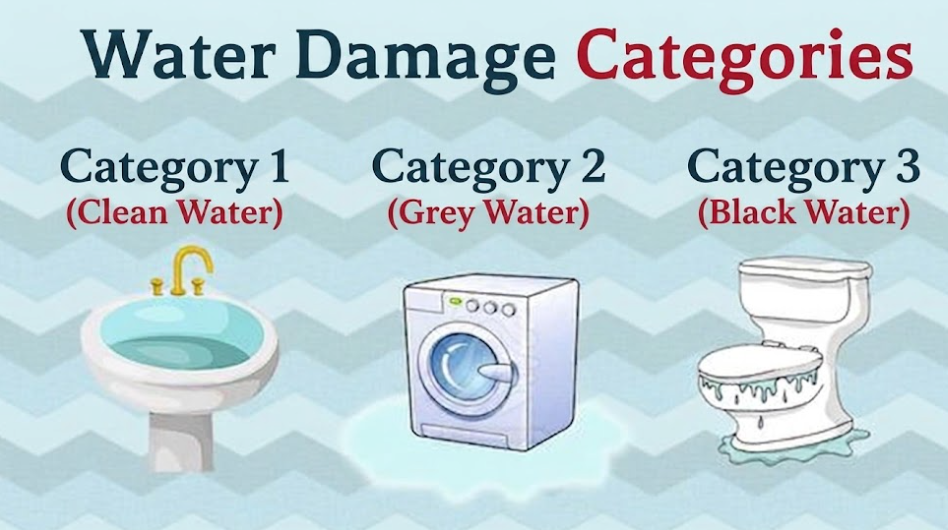
When a water damage event occurs, not all water is treated the same way. The approach a professional restoration company takes to drying your home, protecting your family’s health, and determining which materials can be saved versus which must be removed is determined in large part by a classification system that most homeowners have never heard of – but that has a direct and significant impact on the cost, scope, and health implications of the restoration.
The water damage category system – Categories 1, 2, and 3 – is established by the Institute of Inspection Cleaning and Restoration Certification (IICRC) in the S500 Standard for Professional Water Damage Restoration. It classifies water damage by the level of contamination in the water source, which determines the health risk, the appropriate personal protective equipment, the cleaning and disinfection requirements, the salvageability of affected materials, and the insurance documentation approach. Understanding this system gives homeowners the knowledge to ask the right questions, evaluate the scope of their restoration project correctly, and make informed decisions about their home’s recovery.
This guide explains each category in plain language, describes where each type is commonly found in Arizona homes and commercial properties, explains how water degrades from a lower to higher category over time, and outlines what professional restoration looks like for each classification.
The Foundation: Why Water Contamination Categories Matter
The IICRC’s category system exists because water from different sources carries dramatically different levels of biological, chemical, and physical contamination. Treating Category 3 sewage water the same way a restoration company would treat Category 1 clean water from a supply line failure would expose occupants and workers to serious health risks and would fail to meet the decontamination standards required to make the property safe for reoccupancy.
Beyond health implications, the category classification affects which building materials can be dried and retained versus which must be removed and replaced. A hardwood floor that has been wetted by Category 1 supply line water may be a restoration candidate with proper drying. The same hardwood floor wetted by Category 3 sewage backup is almost always a replacement item, regardless of its structural condition, because the biological contamination in the wood cannot be sufficiently decontaminated in place. The category classification is not a technicality – it is a framework that drives every major decision in the restoration process.
Category 1 Water Damage: Clean Water
What It Is
Category 1 water is water that originates from a sanitary source and poses no substantial risk from dermal, ingestion, or inhalation exposure at the time of contact. This is the cleanest classification and represents the best-case scenario in a water damage event.
Common Sources of Category 1 Water Damage in Arizona
- Broken or burst water supply lines – the most common clean water source in residential restoration
- Failed or leaking supply connections to dishwashers, washing machines, and refrigerator ice makers
- Overflowing sinks, bathtubs, or showers with clean supply water when the drain has not backed up
- Toilet tank overflows where the tank water does not contain contaminants
- Rainwater infiltration through roof damage, window failures, or storm intrusion
- HVAC condensate overflow from blocked drain lines
- Slab leaks from supply line failures beneath the foundation
Health and Safety Profile
Category 1 water poses minimal health risk at the time of the event. Workers can address Category 1 restoration without the full personal protective equipment required for higher categories, though standard precautions remain appropriate. Occupants can typically remain in unaffected portions of the property during restoration.
Restoration Approach for Category 1
Category 1 restoration focuses on water extraction, structural drying, and monitoring – without the antimicrobial treatment and material replacement requirements that higher categories trigger. Porous materials such as drywall, insulation, hardwood flooring, and carpet can be candidates for drying in place when they are Category 1 water-affected and drying is initiated promptly. The critical window for Category 1 restoration is 24 to 48 hours – after that point, microbial growth in wet porous materials begins to develop, and the water damage classification may degrade from Category 1 to Category 2.
A key principle of Category 1 restoration is speed. The cleaner the water and the faster the professional response, the greater the opportunity to dry materials in place rather than remove and replace them – which significantly limits both the restoration cost and the disruption to the home.
Important Caveat: Category 1 Water Degrades Over Time
Water that begins as Category 1 does not remain Category 1 indefinitely. As clean water contacts building materials, it picks up bacteria, mold spores, chemical contaminants, and biological matter from those surfaces. The IICRC S500 standard acknowledges that Category 1 water can degrade to Category 2 within 24 to 48 hours and potentially to Category 3 over a longer period, particularly in Arizona’s warm structures. This time-based degradation is one of the primary reasons that immediate professional response to any water damage event is so important, regardless of how clean the original water source was.
Category 2 Water Damage: Gray Water
What It Is
Category 2 water – commonly referred to as gray water – contains significant contamination and has the potential to cause discomfort or sickness if humans are exposed through contact, ingestion, or inhalation. It does not contain the high levels of pathogenic biological agents found in Category 3 water, but it carries chemical and biological contamination that requires a higher level of protective response and more stringent restoration protocols than Category 1.
Common Sources of Category 2 Water Damage in Arizona
- Discharge from washing machines containing laundry chemicals, fabric softeners, and detergents
- Dishwasher discharge water containing food residue and biological material
- Toilet overflow where the water contains urine but not solid waste
- Aquarium water that has been standing and contains biological growth
- Hydrostatic seepage through foundation walls contaminated by soil contact
- Sump pump failures where the water has contacted soil and groundwater
- Stormwater that has contacted soil surfaces before entering the structure through window wells or foundation penetrations
Health and Safety Profile
Category 2 water can cause illness through skin contact with broken skin surfaces, through mucous membrane contact, and through ingestion. Workers addressing Category 2 restoration should wear waterproof gloves, eye protection, and appropriate respiratory protection. Occupants should avoid contact with Category 2 water and the materials it has saturated.
Restoration Approach for Category 2
Category 2 restoration requires antimicrobial treatment of all affected non-porous surfaces in addition to water extraction and structural drying. The decision about which porous materials can be dried and retained versus which must be removed is more conservative than for Category 1. Heavily saturated porous materials such as carpet padding, insulation, and drywall that has been saturated beyond the face layer are generally removed rather than dried in place, because the difficulty of achieving adequate disinfection of highly saturated porous materials at Category 2 contamination levels makes in-place treatment insufficiently reliable.
Hardwood flooring and cabinetry subjected to Category 2 water for a limited time may still be candidates for restoration if drying is initiated promptly, but the decision must account for the contamination level and the degree of saturation. A restoration professional performs this assessment based on the specific conditions rather than applying a blanket rule.
Category 3 Water Damage: Black Water
What It Is
Category 3 water – called black water – is grossly contaminated and contains pathogenic agents that present significant health risks from any form of exposure. Category 3 events are the most serious water damage classification and require the most stringent protective measures, the most comprehensive decontamination protocols, and the most conservative material replacement decisions. Sewage is the primary source, but Category 3 encompasses several additional sources that many homeowners do not immediately recognize as serious health risks.
Common Sources of Category 3 Water Damage in Arizona
- Sewage backup from main drain line blockages, municipal sewer surges, or septic system failures – the most common and most recognizable Category 3 source
- Rising floodwater from monsoon flooding, wash overflows, or street flooding that has contacted soil, vegetation, and the exterior environment
- Water from rivers, streams, or irrigation canals that enters the structure
- Wind-driven rain that has contacted contaminated exterior surfaces before entering the building
- Category 1 or 2 water that has been standing for an extended period and has degraded through microbial activity to Category 3 contamination levels
Health and Safety Profile
Category 3 water contains pathogenic bacteria, viruses, parasites, and toxic chemicals that can cause serious illness through skin contact, ingestion, and inhalation of aerosolized droplets. Common pathogens include E. coli, salmonella, hepatitis A virus, norovirus, and Cryptosporidium. Workers addressing Category 3 restoration must wear full personal protective equipment including N95 or higher respiratory protection, waterproof coveralls, face shields, and double-layer nitrile gloves. Occupants must vacate the affected areas and should not return until all contaminated materials have been removed, surfaces have been professionally decontaminated, and post-remediation testing has confirmed safe conditions.
Restoration Approach for Category 3
Category 3 restoration is the most extensive and most expensive classification because all porous materials that have been contacted by Category 3 water must be removed and replaced – regardless of their structural condition, their apparent cleanliness after drying, or their replacement cost. Carpet, carpet padding, drywall, insulation, hardwood flooring, laminate, and any other porous material that Category 3 water has reached is treated as a disposal item. Non-porous materials including concrete, ceramic tile, metal, and glass can be cleaned and disinfected in place, but they require multiple rounds of antimicrobial treatment with hospital-grade EPA-registered disinfectants.
The rationale for the blanket removal standard is scientific: pathogenic organisms in Category 3 water penetrate into porous materials beyond the depth that surface disinfection can reliably reach. A floor that looks clean after a surface wipe-down may harbor viable pathogens in the substrate layer. The only way to reliably eliminate Category 3 contamination from porous materials is to remove them entirely.
Containment and HEPA Air Filtration for Category 3
Category 3 restoration requires containment barriers and negative air pressure with HEPA filtration before any material removal begins. This prevents contaminated dust, particles, and aerosols generated during demolition from spreading to unaffected areas. HEPA air scrubbers run continuously throughout the Category 3 restoration process. This adds time and cost but is non-negotiable for protecting the health of occupants in portions of the building that remain accessible.
How Water Degrades From Category 1 to Category 3
One of the most practically important concepts in the category system is the principle of category degradation over time. Water does not maintain its original category once it enters a building and contacts materials. The degradation process is driven by temperature, time, and the organic content of the materials the water contacts.
- Category 1 water sitting in a warm, organic-rich environment for 24 to 48 hours begins to support microbial growth that moves its contamination level toward Category 2
- Category 1 or 2 water standing for 72 hours or more in warm conditions – characteristic of Arizona’s climate year-round – may have degraded to Category 3 contamination levels through unchecked microbial proliferation
- Water that begins as Category 1 but travels through areas with biological contamination – drain lines, sewage-adjacent spaces, soil – picks up contamination from those pathways and may enter the building at a higher category than its original source
- Stormwater that begins as Category 1 rainwater but contacts soil, plant material, and exterior surfaces before entering the structure typically enters the building as Category 2 or Category 3
This degradation dynamic explains why restoration professionals do not simply ask where the water came from but also how long it has been present and what it has contacted. A water damage event described as a clean supply line break may actually present as Category 2 or Category 3 if the break occurred days before discovery. Category assessment is always based on the current condition of the water and affected materials, not the original source.
Category Determination in Professional Practice
Professional restoration technicians do not assign water damage categories based solely on the homeowner’s description of the source. Category determination involves direct assessment of the water and affected materials at the time of the professional assessment, including visual observation, odor assessment, and in some cases laboratory testing. In Arizona, where warm temperatures accelerate microbial growth, restoration professionals apply conservative category assessments when there is uncertainty about the time elapsed since the event or the water’s pathway into the structure. The cost of treating an event as a higher category than strictly required is modest compared to the health and liability risks of under-classifying it.
Insurance Implications of Water Damage Categories
The water damage category has direct implications for insurance coverage and claim scope:
- Category 1 events involving sudden and accidental supply line failures are typically the most straightforward covered losses under standard homeowner’s policies – clean source, clear cause, and relatively contained scope
- Category 2 events may be covered, but coverage for specific gray water sources should be confirmed with the carrier – some policies have exclusions for certain sources
- Category 3 sewage backup events require a specific sewage backup endorsement – standard homeowner’s policies do not automatically cover sewage backup, and Arizona homeowners should verify their coverage before a loss occurs
- Category 3 monsoon flooding from external rising water is a flood event requiring separate flood insurance through the National Flood Insurance Program or a private carrier
- Category degradation situations – where Category 1 water was not discovered promptly and has degraded – may face coverage disputes if the insurer argues delayed discovery or inadequate maintenance contributed to the expanded scope
The Right Response for Each Category
Each water damage category requires a calibrated professional response. Arizona’s Premier Restoration Specialists at PuroClean apply IICRC S500 standards to every water damage assessment, ensuring that the restoration protocol precisely matches the contamination category of each event – protecting health, optimizing material salvage decisions, and documenting the project in the format that insurance carriers require.
- Category 1: rapid extraction and drying, moisture mapping, material salvage maximized, daily drying logs, complete insurance documentation
- Category 2: extraction and drying with antimicrobial treatment of non-porous surfaces, conservative porous material assessment, appropriate PPE, thorough insurance documentation
- Category 3: full PPE and containment, removal of all affected porous materials, multi-round disinfection, HEPA air filtration throughout, post-remediation testing, complete insurance documentation
Category Knowledge Protects Your Home and Your Family
The IICRC water damage category system exists because water from different sources carries fundamentally different risks – and those risks demand fundamentally different responses. Understanding Categories 1, 2, and 3 gives you the framework to ask the right questions when a water event occurs, to understand why your restoration professional is recommending specific materials for removal versus drying, and to verify that the response being applied to your home matches the actual contamination level of the event.
In Arizona’s warm climate, where category degradation happens faster than in cooler environments, the most important action a homeowner can take after any water event – regardless of how clean the source appears – is to call a certified restoration professional immediately. Every hour of delay narrows the window for material salvage and increases the probability of category degradation that expands both the health risk and the restoration cost. Leaders in recovery. Calm in the Chaos.
Water Damage in Your Home? Call PuroClean for Expert Category Assessment and Restoration
PuroClean’s IICRC-certified water damage restoration specialists respond 24/7 throughout the Phoenix metro area and West Valley communities. We assess every event to the correct IICRC category, apply the appropriate restoration protocol, and document the project completely for your insurance claim. Arizona’s Premier Restoration Specialists. Leaders in recovery. Calm in the Chaos.
Call PuroClean now at (480) 767-5588. Fast response. Proven results. Complete peace of mind.
The category determines the protocol. PuroClean gets it right from the first assessment.