


A wildfire that passes through or near a residential area leaves behind a landscape of ash, debris, and destruction that is immediately visible and universally understood as a crisis. What is far less visible – and far more dangerous than most survivors realize – is the chemical complexity of what that ash and debris actually contains, and what it will do to every person who breathes it, touches it, or tracks it through a home without proper protection and professional remediation.
Cleanup after wildfire is not a matter of hosing down the driveway and sweeping up ash. It is a serious, multi-phase remediation project that addresses one of the most chemically toxic residential environments that exists in the aftermath of any natural disaster. Wildfire ash and smoke residue contain heavy metals, volatile organic compounds, carcinogens, and toxic combustion byproducts from burned vegetation, structures, vehicles, propane tanks, pesticide stores, and decades of accumulated chemical materials that were stored in the path of the fire.
Getting cleanup after wildfire wrong – through delay, through inadequate technique, or through well-intentioned but unprotected DIY effort – has real and lasting health consequences for survivors and their families.
This guide explains what wildfire ash and smoke residue actually contain, why cleanup must begin promptly, what the professional remediation process involves, and what actions survivors should take and avoid in the days immediately following a wildfire event.
What Wildfire Ash and Smoke Residue Actually Contain
Wildfires are not simply large versions of a campfire. They burn at extreme temperatures, consume enormous volumes of diverse materials simultaneously, and produce a complex mixture of combustion products that bears little chemical resemblance to the ash from burning natural wood.
Heavy Metals
Wildfire ash consistently contains elevated concentrations of heavy metals including arsenic, lead, cadmium, chromium, and mercury – metals that were present in burned structures, vehicles, electronic equipment, paint, treated lumber, and commercial products in the fire’s path. Research published following the 2018 Camp Fire in California found that ash samples from destroyed homes contained lead concentrations exceeding EPA hazardous waste thresholds. These metals do not break down or dissipate – they remain in the ash and soil where they settle until physically removed or chemically stabilized.
Volatile Organic Compounds
Wildfire combustion of synthetic materials – plastics, foam insulation, adhesives, paints, coatings, and petroleum-based products – produces hundreds of volatile organic compounds (VOCs) including benzene, formaldehyde, acrolein, and polycyclic aromatic hydrocarbons (PAHs). These compounds are present in both the airborne smoke that infiltrates homes and in the ash deposits that settle on every surface the fire’s plume reached. Many of these compounds are classified as known or probable human carcinogens by the International Agency for Research on Cancer.
Fine Particulate Matter
Wildfire smoke contains enormous concentrations of fine particulate matter (PM2.5 and PM10) – particles small enough to penetrate deep into lung tissue and, in the case of PM2.5, small enough to pass through lung membranes into the bloodstream. PM2.5 particles are roughly 30 times smaller than the diameter of a human hair and are not filtered by the nose and upper respiratory tract the way larger particles are. These particles carry adsorbed toxic compounds into the lung where they cause both acute inflammation and chronic injury with repeated exposure.
Ash-Bonded Pesticides and Herbicides
Wildfire ash from rural and suburban interface areas contains residue from agricultural pesticides, residential herbicides, lawn chemicals, and pest control products that were stored or applied in the burned area. Studies following California and Colorado wildfires found that ash from fire-affected properties contained a wide range of pesticide compounds that persist in the ash matrix and can be transferred to skin, food surfaces, and indoor air through ash disturbance.
Combustion Gases
Beyond particulate matter and ash deposits, wildfire combustion produces toxic gases including carbon monoxide, hydrogen cyanide (from burning synthetic materials), hydrogen chloride, nitrogen oxides, and sulfur dioxide. While the acute concentrations of these gases are highest during active burning, they can persist in enclosed spaces – attics, crawl spaces, basements, and poorly ventilated rooms – that accumulated smoke during the fire event.
Why Cleanup After Wildfire Cannot Wait
The Rain Mobilization Problem
Ash and smoke residue that has settled on properties surrounding a wildfire is stable as long as it remains dry and undisturbed. The first rain after a wildfire transforms stable ash into a mobilized toxic slurry that flows across soil surfaces, concentrates in drainage channels, and infiltrates into the ground, potentially contaminating groundwater and soil at depth. Cleanup after wildfire that occurs before the first post-fire rain event is dramatically simpler and more effective than cleanup attempted after ash has been mobilized and distributed by rain. In Arizona, where monsoon season may follow wildfire season in close succession, this window can be short.
Wind Resuspension and Inhalation Risk
Dry ash on surfaces is continuously resuspended by wind, foot traffic, and vehicle movement, creating ongoing inhalation exposure for everyone in the area. Every time someone walks through an ash-covered yard, enters an ash-contaminated home, or drives a vehicle through ash-covered streets, particles become airborne and can be inhaled for hours afterward as they slowly resettle. The longer cleanup after wildfire is delayed, the more resuspension events occur and the more cumulative inhalation exposure accumulates.
Smoke Penetration of Building Materials
Wildfire smoke that infiltrated a home during the fire event deposited chemical compounds in porous building materials – drywall, insulation, carpet, upholstery, and wood – throughout the interior. These deposited compounds do not remain inert. They continue to off-gas VOCs back into the interior air space at elevated concentrations for weeks or months after the fire has passed, particularly as temperatures rise. In Arizona, where interior temperatures without air conditioning can reach extreme levels in summer, this off-gassing accelerates significantly. Cleanup after wildfire must address this interior chemical contamination as aggressively as the exterior ash.
The HVAC Distribution Problem
If the home’s HVAC system was running during the wildfire smoke event, smoke particles have been distributed throughout the ductwork and have deposited in the air handler, the evaporator coil, and the supply and return ducts. Running the HVAC system after a wildfire event without first cleaning it simply recirculates smoke particles and chemical compounds continuously throughout the home, re-contaminating cleaned surfaces and maintaining elevated interior VOC concentrations.
Secondary Health Effects Over Time
The health research on wildfire smoke and ash exposure is unambiguous: prolonged or repeated exposure produces dose-dependent health effects that accumulate over time. Respiratory inflammation, impaired lung function, cardiovascular effects from PM2.5 in the bloodstream, and potential carcinogenic effects from benzene and PAH exposure are all documented consequences of ongoing wildfire-related exposure. The populations most at risk – children, elderly individuals, pregnant women, and people with pre-existing respiratory or cardiovascular conditions – are at risk from lower concentrations and shorter durations of exposure than healthy adults. Cleanup after wildfire is not optional for these populations.
Who Needs Professional Cleanup After Wildfire
Not every property affected by a wildfire is affected equally, and the level of professional intervention needed depends on how close the property was to active burning, how long it was exposed to heavy smoke, and whether structural fire damage occurred alongside smoke damage.
- Properties with direct structural fire damage require the full scope of fire damage restoration including debris removal, structural assessment, mold remediation from firefighting water, and reconstruction – the most extensive intervention category
- Properties that escaped structural fire damage but were within heavy smoke plumes or received significant ash deposition from nearby burning require professional exterior ash cleanup, HVAC decontamination, interior smoke cleaning, and air quality verification
- Properties at the periphery of a wildfire event that received light ash deposition and moderate smoke exposure may be manageable with enhanced protective DIY cleaning, though air quality testing before reoccupancy is strongly recommended
- Properties downwind of a wildfire – even many miles away – that showed visible smoke infiltration or ash deposition should have indoor air quality testing performed before the space is fully reoccupied, particularly if vulnerable individuals are among the occupants
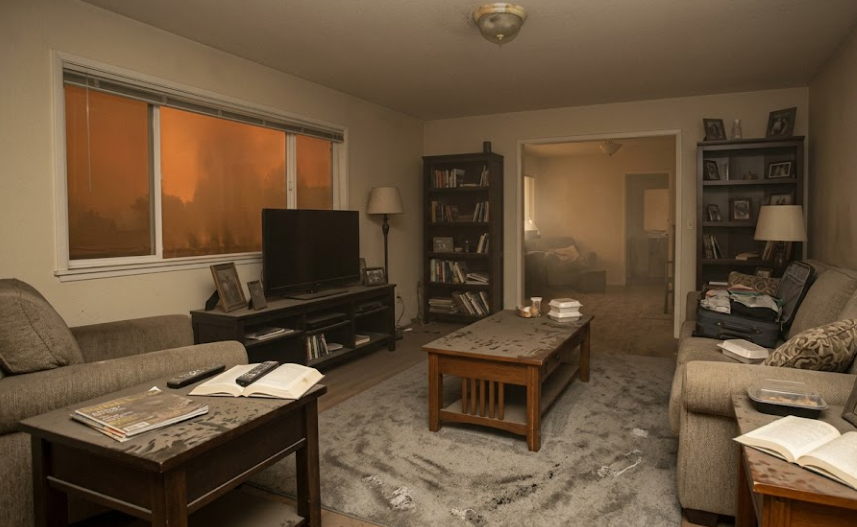
The Professional Wildfire Cleanup Process
Air Quality Assessment
Professional cleanup after wildfire begins with an indoor air quality assessment to establish the chemical and particulate concentrations present in the home. This assessment measures VOC levels, PM2.5 concentrations, and in some cases specific compounds of concern such as benzene. The results determine the remediation scope and establish a baseline against which post-cleanup air quality can be compared to verify that the cleaning has been effective.
HVAC System Decontamination
The HVAC system is addressed early in the cleanup sequence to prevent it from redistributing contamination during the cleaning process. All filters are replaced with MERV-13 or higher rated replacements. The blower assembly, evaporator coil, and air handler cabinet are cleaned. Supply and return ductwork is professionally cleaned using contact vacuum methods, and the system is verified clean before being returned to operation.
Exterior Ash Removal
Exterior ash removal requires wet methods to prevent resuspension during the cleanup process. Workers wear N95 respirators and appropriate protective clothing. Ash is wetted, carefully consolidated, and disposed of through appropriate channels. In California and some other states, wildfire ash is classified as hazardous waste requiring special disposal; Arizona homeowners should contact the Maricopa County Environmental Services Department for current disposal guidance for their specific situation.
Interior Surface Cleaning
Interior cleaning addresses every surface the smoke has contacted: walls, ceilings, floors, cabinetry, appliances, and personal belongings. Dry chemical sponges remove loose soot particles from painted surfaces without smearing. Wet cleaning with appropriate cleaning agents removes embedded residue. Surfaces with significant smoke penetration receive a stain-blocking sealing primer before repainting to prevent VOC off-gassing and odor bleed-through that would otherwise recur through new paint.
Soft Content Cleaning
Upholstered furniture, mattresses, draperies, clothing, and other soft contents that absorbed smoke compounds require professional cleaning with specialized agents. Items with significant ash deposition or smoke contamination may be pack-out candidates – transported to a professional cleaning facility where they receive ozone treatment and appropriate cleaning in a controlled environment before being returned to the restored home.
Odor Elimination
Smoke odor from wildfire is particularly persistent because of the chemical complexity of the compounds involved and the depth to which they penetrate porous building materials. Professional odor elimination using ozone treatment, hydroxyl radical generation, and thermal fogging with specialized deodorizing agents is required after surface cleaning is complete. These treatments neutralize odor compounds at the molecular level rather than masking them.
Post-Cleanup Air Quality Verification
Following completion of all cleaning, HVAC decontamination, and odor elimination work, post-cleanup air quality testing verifies that VOC and particulate concentrations have returned to acceptable levels. This verification testing provides the documentation needed to confirm that the home is safe for reoccupancy – particularly important when vulnerable family members will be returning.
What Survivors Should and Should Not Do
What to Do
- Check with local authorities and air quality agencies for current air quality index readings before entering a wildfire-affected area
- Wear an N95 respirator whenever entering a property with visible ash or known smoke infiltration – cloth masks, dust masks, and surgical masks do not provide adequate protection against wildfire smoke particles
- Wet ash before disturbing it to minimize resuspension
- Remove shoes before entering the home to prevent tracking ash and contaminants through interior spaces
- Wash hands and exposed skin thoroughly after any contact with ash or smoke-contaminated surfaces
- Document all visible ash deposition, smoke damage, and property conditions with photographs for insurance purposes before any cleanup begins
- Contact your homeowner’s insurance carrier to report the loss and inquire about smoke and ash damage coverage before beginning cleanup
What Not to Do
- Do not use leaf blowers or dry sweeping to remove ash – these methods dramatically increase resuspension and inhalation exposure
- Do not run the HVAC system until it has been professionally cleaned – this recirculates contamination
- Do not allow children to play in ash-contaminated outdoor areas or touch ash-covered surfaces
- Do not grow or consume vegetables from garden beds that received ash deposition without soil testing first
- Do not assume that an ash-covered home is safe because it does not smell strongly of smoke – the most dangerous chemical compounds may have no detectable odor at health-affecting concentrations
Insurance Coverage for Cleanup After Wildfire
Wildfire is a named peril under most standard homeowner’s insurance policies, and cleanup after wildfire – including smoke damage remediation and ash removal – is typically covered as part of a wildfire damage claim. Coverage extends to professional cleaning, HVAC decontamination, contents cleaning, and temporary housing while cleanup is underway.
The claim process for wildfire-affected properties in Arizona can be complex when multiple properties in a community are affected simultaneously, as the insurer’s resources are spread across many claims.
Document all damage and all cleanup costs meticulously. Work with a restoration company that provides detailed scope-of-work documentation in the format your insurance carrier requires. If the initial settlement offer does not fully cover the professional cleanup costs your property requires, you have the right to request a re-inspection or engage a public adjuster.
Cleanup After Wildfire Is a Health Imperative, Not Just a Property Task
Cleanup after wildfire is one of the most health-critical restoration tasks that property owners face. The chemical complexity of wildfire ash and smoke residue, the persistent off-gassing that continues for weeks after the fire has passed, and the cumulative health effects of ongoing exposure make professional remediation not merely advisable but essential for any property with significant wildfire smoke or ash contamination.
Delay makes the problem worse, resuspension events increase cumulative exposure, and incomplete cleanup leaves hazardous materials in place under a veneer of apparent cleanliness
Arizona’s Premier Restoration Specialists at PuroClean respond to wildfire smoke and ash cleanup situations throughout the Phoenix metro area and surrounding Arizona communities with the expertise, equipment, and systematic approach that complete, verified remediation requires. Leaders in recovery. Calm in the Chaos.
Wildfire Smoke or Ash on Your Property in Arizona? Call PuroClean for Professional Cleanup on (480) 767-5588.
PuroClean’s certified restoration specialists respond 24/7 with air quality assessment, HVAC decontamination, interior smoke cleaning, exterior ash removal, and post-cleanup verification. We do not consider the job done until air quality testing confirms your home is safe to reoccupy. Arizona’s Premier Restoration Specialists. Leaders in recovery. Calm in the Chaos.
Call PuroClean now at (480) 767-5588. Fast response. Proven results. Complete peace of mind.
Do not return to a wildfire-affected home without professional cleanup first. Call PuroClean today.
SEO META DATA
Meta Title (60 chars max): Cleanup After Wildfire: Why It’s Crucial and Can’t Wait
Meta Description (155 chars max): Cleanup after wildfire is a health emergency, not just a property task. Learn what ash contains, why delay makes it worse, and what professional remediation involves.