


Hardwood floors are one of the most valued features in any home. They add warmth, character, and lasting value to a property – and they represent a significant investment that homeowners want to protect. When water damage strikes, one of the first and most urgent questions is almost always: can the hardwood floors be saved? The answer is more nuanced than a simple yes or no, and it depends on several factors that a qualified water damage restoration professional is best positioned to evaluate.
Hardwood floor water damage restoration is a specialized field within the broader water damage restoration industry. It requires an understanding of wood species behavior, moisture equilibrium, drying science, and flooring construction that goes well beyond general water extraction and drying. Acting quickly, correctly, and with the right professional support dramatically increases the probability that water-damaged hardwood floors can be restored rather than replaced – a distinction that can represent tens of thousands of dollars in a high-quality hardwood installation.
This guide covers what happens to hardwood floors when they are exposed to water, what determines whether restoration is possible, what the professional restoration process involves, what homeowners can do in the critical first hours, and how to evaluate restoration versus replacement decisions accurately.
What Water Does to Hardwood Floors
Wood is a hygroscopic material, meaning it naturally absorbs and releases moisture from the surrounding environment to reach equilibrium with ambient humidity levels. This property makes wood a beautiful and durable flooring material in stable conditions – and a challenging one when exposed to water intrusion events.
Cupping
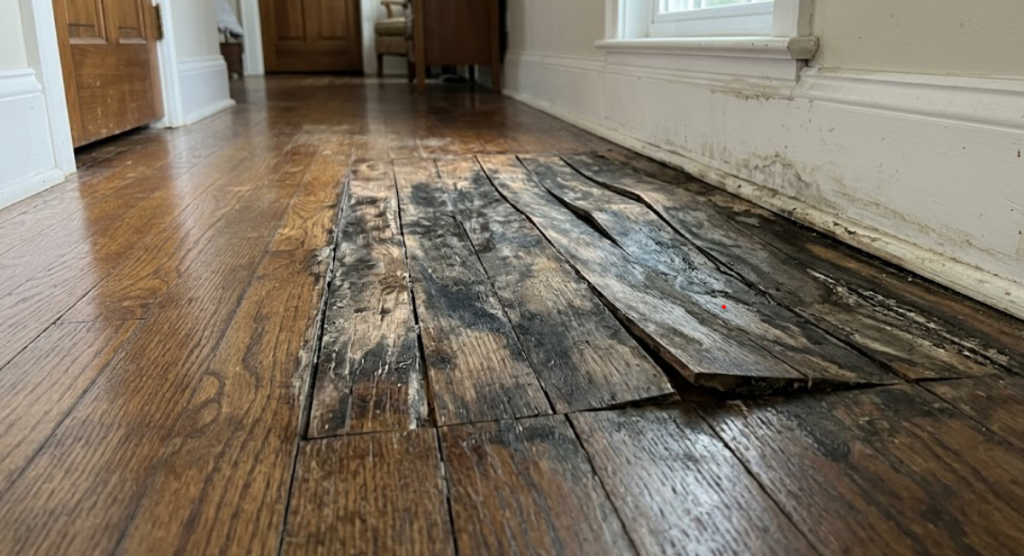
Cupping is the most common form of water damage in solid hardwood flooring and is characterized by the edges of individual boards curling upward while the center of the board remains relatively flat, creating a concave appearance across the surface of the floor. Cupping occurs when the bottom face of the flooring boards absorbs more moisture than the top face – which happens when water infiltrates from below through the subfloor assembly, from a slab, or from flooding. The differential moisture content between the top and bottom of the board causes the wood to expand unevenly, forcing the edges upward.
Cupping that is identified and professionally dried quickly – ideally within 24 to 48 hours of the water event – has a high probability of reversing as the floor returns to its equilibrium moisture content. Cupping that has been present for an extended period or that results from severe moisture exposure may result in permanent deformation that cannot be corrected through drying alone.
Crowning
Crowning is the opposite of cupping: the center of the board rises above the edges, creating a convex appearance. Crowning typically occurs when the top face of the floor absorbs moisture more rapidly than the bottom face – for example, from surface flooding or a leak that saturates the top of the floor while the subfloor remains relatively dry. Crowning can also develop as a secondary response when cupped floors are sanded before they are fully dry, removing wood from the high edges and leaving the center elevated when drying is eventually complete. Premature sanding of cupped hardwood floors is one of the most damaging mistakes in hardwood floor water damage restoration.
Buckling
Buckling is the most severe form of hardwood floor water damage, occurring when boards absorb enough moisture to expand beyond the space available in the floor installation and physically lift away from the subfloor. Buckling is typically a sign of significant and prolonged water exposure and is most commonly seen in flood situations, chronic subfloor moisture conditions, or severe plumbing failures that have gone undetected for an extended period. Buckled boards have usually been under severe stress and may have sustained structural damage that makes restoration of individual boards difficult or impossible.
Mold Growth
Any hardwood floor that has been wet for more than 24 to 48 hours is at risk for mold growth. Mold develops on the underside of flooring boards, within the tongue-and-groove connections between boards, and on the subfloor surface beneath the flooring. Mold growth on the underside of flooring is not visible from above and is often detected only through professional moisture assessment or during flooring removal. Mold in a hardwood floor system requires specific antimicrobial treatment as part of the restoration process and, in advanced cases, replacement of the affected boards.
Staining and Finish Damage
Water exposure causes staining in hardwood floors through two mechanisms: mineral deposits left behind as water evaporates from the surface, and tannin reactions in certain wood species – particularly oak – that cause dark gray or black discoloration when the wood contacts water. Surface finish damage including clouding, peeling, and delamination of the protective coating also occurs with water exposure. These surface-level effects can often be addressed through sanding and refinishing as a final step in hardwood floor water damage restoration, but only after the floor has been completely dried and any structural deformation has been corrected.
What Determines Whether Hardwood Floors Can Be Restored
Several key factors determine whether hardwood floor water damage restoration is achievable or whether replacement is the more appropriate and cost-effective course:
Time Since Water Exposure
Time is the single most critical variable in hardwood floor restoration. Floors that are identified as wet and professionally dried within the first 24 to 48 hours of a water event have a substantially higher restoration rate than floors that have been wet for longer periods. At 48 to 72 hours, mold risk increases significantly and the degree of wood deformation intensifies. After 72 hours or more, floors may have sustained permanent structural changes that make restoration difficult. Immediate professional response is the single most important action a homeowner can take to maximize the restoration probability of water-damaged hardwood floors.
Severity and Source of the Water
The source and contamination level of the water matters significantly for hardwood floor water damage restoration. Clean water from a supply line or rain event presents the most favorable restoration conditions. Gray water from appliances or drains introduces chemical and biological contamination that complicates the restoration protocol. Black water from sewage backup or significant flooding typically requires replacement of all flooring materials that have been contacted, regardless of their structural condition, because the health risks of contaminated porous materials cannot be adequately mitigated through cleaning alone.
Wood Species and Construction
Different wood species respond differently to water exposure. Denser hardwood species such as hickory, hard maple, and Brazilian cherry tend to be less absorbent and more structurally stable during water events. More porous species such as white oak and ash absorb moisture more rapidly but can also release it more readily during controlled drying. Engineered hardwood flooring – which consists of a hardwood veneer over a plywood core – responds differently than solid hardwood and has specific drying protocols and limitations. Laminate flooring that resembles hardwood is not a candidate for hardwood floor water damage restoration at all – the composite core material swells permanently when wet and must be replaced.
Installation Method
How the hardwood floor is installed affects both the way water infiltrates and the drying options available. Glued-down installations over concrete slabs – common in Arizona’s slab-on-grade construction – trap moisture between the flooring and the slab and prevent drying from below, making restoration more challenging and often requiring the installation of drying equipment beneath the floor through targeted drilling or controlled demolition. Nail-down installations over a plywood subfloor allow for more drying flexibility because moisture can be addressed from both above and below. Floating installations may allow for complete floor removal and drying of the subfloor with reinstallation, depending on the condition of the flooring after removal.
Degree of Deformation
The degree of cupping, crowning, or buckling present when the restoration process begins is a direct indicator of restoration difficulty. Mild to moderate cupping that has developed recently has good restoration potential. Severe cupping that has been present long enough for the wood to take a permanent set – meaning the fibers have permanently realigned in the deformed position – may not fully recover through drying alone and may require sanding after complete drying to achieve an acceptable surface. Buckling, as noted above, represents the most severe form of hardwood floor water damage and may indicate that some or all of the affected boards require replacement.
The Professional Hardwood Floor Water Damage Restoration Process
Moisture Mapping and Assessment
Professional hardwood floor water damage restoration begins with a thorough moisture assessment of both the flooring and the subfloor system below it. Moisture meters calibrated specifically for wood measure the moisture content of the flooring boards in multiple locations across the affected area. Thermal imaging cameras identify moisture variation patterns that indicate where water has traveled beneath the floor surface. This assessment establishes the baseline moisture content, confirms the extent of the wet area, and guides the drying plan.
Water Extraction
Surface water is extracted using commercial-grade extraction equipment. In hardwood floor situations, specialized weighted extraction wands or extraction mats are used to draw moisture from within the wood fibers – a level of extraction that is not achievable with standard wet vacuums or mops. Thorough extraction before the drying phase is placed reduces the total drying time and the degree of deformation that the wood must undergo before returning to equilibrium.
Controlled Structural Drying
The most critical and technically demanding phase of hardwood floor water damage restoration is controlled structural drying. Because wood must return to its equilibrium moisture content gradually to avoid creating new deformation as it dries, the drying environment must be carefully controlled. Professional drying uses commercial air movers positioned to maximize airflow across the floor surface, combined with commercial dehumidifiers sized to remove the volume of moisture being evaporated from the affected area.
For glued-down floors over concrete slabs, drying mats or specialized drying systems are often placed directly over the floor surface to direct heat and airflow into the wood from above while drawing moisture upward. In some cases, small holes are drilled through the subfloor from below – accessible in homes with crawl spaces – to allow drying airflow to reach the underside of the flooring. Drying hardwood floors too quickly is as damaging as not drying them at all, as rapid moisture loss causes cracking and splitting. Professional technicians monitor moisture levels daily and adjust drying conditions to achieve a controlled, even drying rate.
Daily Monitoring and Drying Verification
Throughout the drying process, technicians take daily moisture meter readings at multiple locations across the affected floor and document the progression of moisture content toward the target dry standard for the specific wood species and local equilibrium conditions. In Arizona’s climate, the ambient equilibrium moisture content for hardwood flooring is approximately 6 to 8 percent. Drying is considered complete when moisture readings have stabilized at or below the target level across all monitored locations.
Post-Drying Assessment and Restoration Decision
After the floor has been completely dried and moisture readings have stabilized, a final assessment determines the residual deformation in the flooring and establishes the appropriate restoration path. Floors that have returned to an acceptable flatness level may require only surface refinishing. Floors with residual cupping or crowning may require sanding to achieve an acceptable surface profile, followed by refinishing. Individual boards that have sustained permanent structural damage or that show evidence of mold that could not be adequately treated may be replaced on a selective basis while the surrounding installation is retained.
Sanding and Refinishing
Sanding following hardwood floor water damage restoration removes the surface layer of deformed, stained, and finish-damaged wood to expose the undamaged wood beneath. This is performed only after the floor has been verified as completely dry – premature sanding of a floor that retains elevated moisture content will result in crowning when the floor finishes drying. After sanding, the floor is finished with the appropriate stain and topcoat to match the original appearance. A properly executed sanding and refinishing following complete restoration drying can produce results that are effectively indistinguishable from the original pre-damage floor in most cases.
What Homeowners Can Do in the First Hours
Before a professional restoration team arrives, homeowners can take several steps that meaningfully impact the restoration outcome for water-damaged hardwood floors:
- Stop the water source immediately – turn off the water supply to the failing fixture or the home’s main water supply to prevent additional water from entering the affected area
- Remove surface water using clean towels or a wet vacuum if available – do not use a standard household vacuum, which is not designed for water extraction and can be damaged or create electrical hazards
- Move furniture off the wet floor area immediately – furniture legs that remain in contact with wet hardwood floors cause concentrated staining and localized excessive moisture loading that worsens the deformation in those areas
- Place aluminum foil or plastic wrap under furniture legs if the furniture cannot be fully removed – this prevents direct wood-to-wood contact and reduces localized staining
- Do not place newspapers on the floor – newsprint dyes transfer onto wet hardwood and create additional staining that complicates subsequent refinishing
- Do not use household fans to try to speed up drying – uncontrolled high-velocity airflow across a wet hardwood surface without professional dehumidification dries the surface unevenly and worsens cupping and cracking
- Do not turn up the heat to accelerate drying – elevated temperatures without controlled humidity management cause rapid and uneven drying that permanently damages wood fibers
- Call a certified water damage restoration professional immediately – response time is the most important factor in the restoration outcome for water-damaged hardwood floors
Restoration vs. Replacement: Making the Right Decision
Hardwood floor water damage restoration is typically more cost-effective than replacement when the floor is a candidate for restoration – but not every floor is a candidate. The restoration vs. replacement decision should be made by a qualified restoration professional after a complete moisture assessment and evaluation of the degree of structural deformation, the contamination category of the water source, the wood species and construction type, and the time elapsed since the water event.
Factors that generally support restoration: clean water source, response within 24 to 48 hours, solid hardwood construction, mild to moderate cupping without permanent set, no evidence of mold, and flooring that was in good condition prior to the event.
Factors that generally support replacement: black water or sewage contamination, response delayed more than 72 hours, severe buckling or permanent structural deformation, advanced mold growth, engineered or laminate flooring construction, and flooring that was already at the end of its useful life prior to the event.
A professional restoration company that evaluates your situation honestly and recommends replacement when replacement is warranted is providing you with far more value than one that attempts restoration on floors that cannot be successfully restored. Get a full assessment before committing to either path.
Professional Response Gives Hardwood Floors the Best Chance
Hardwood floor water damage restoration is one of the most technically demanding and time-sensitive applications in the water damage restoration field. The difference between a floor that is successfully restored to its original beauty and one that must be fully replaced often comes down to hours – specifically, whether professional drying equipment was placed on the floor within the critical 24 to 48 hour window after the water event.
If your hardwood floors have been affected by water damage, do not wait to see how they respond on their own. Every hour of delay narrows the restoration window and increases the probability that permanent damage will occur. Contact a certified water damage restoration professional immediately for a professional assessment and the best possible chance of restoring the floors you have invested in.
Water-Damaged Hardwood Floors? Call PuroClean Before You Lose Them
PuroClean’s IICRC-certified water damage restoration specialists have the advanced moisture assessment equipment, specialized hardwood drying systems, and technical expertise to give your water-damaged hardwood floors the best possible chance of full restoration. We respond 24 hours a day, 7 days a week throughout the Phoenix metro area and West Valley communities.
Call PuroClean restoration specialists now at (480) 767-5588. Fast response. Proven results. Complete peace of mind.
Do not let water damage end the life of your hardwood floors. Call PuroClean now and give them every chance to be saved.