


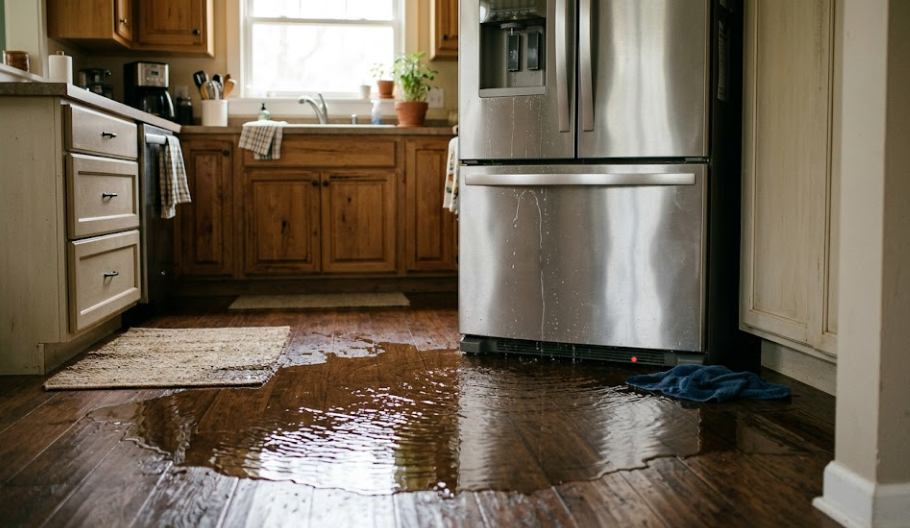
Of all the appliances in a modern home, the refrigerator is the one that rarely gets a second thought. It hums quietly in the corner of the kitchen, keeps the food cold, and for millions of households, dispenses filtered water and ice through a built-in line connection that most homeowners never inspect. That unexamined connection – the refrigerator water line – is one of the most common sources of slow and catastrophic water damage in American homes. It is ordinary, invisible, and persistently underestimated.
A refrigerator ice maker and water line leak can range from a drip so slow it evaporates before anyone notices to a sudden hose failure that floods an entire kitchen floor in minutes. Both ends of that spectrum cause serious damage – the slow leak silently saturating the subfloor, cabinetry, and wall cavity over months, and the fast failure creating immediate and extensive water intrusion that spreads to adjacent rooms. In either case, the result is a water damage restoration event that involves far more than mopping up the visible water.
This guide covers why refrigerator water line leaks happen, how the damage spreads through kitchen and adjacent areas, what the warning signs are, how to respond correctly in the first hours, and what professional restoration of refrigerator ice maker and water line leak damage involves.
How Refrigerator Water Lines Work and Why They Fail
Understanding the water line system that serves an ice maker and water dispenser helps explain why leaks occur and why they are so difficult to detect in their early stages.
The Water Line Connection
Most refrigerators with ice makers and water dispensers connect to the home’s water supply through a small-diameter flexible supply line – typically a quarter-inch line in either braided stainless steel, reinforced plastic, or – in older installations – unsheathed plastic tubing. This line runs from a saddle valve or dedicated shutoff valve on the nearest cold water supply pipe to the inlet valve at the back of the refrigerator. It is almost always routed behind the refrigerator, against the wall, and underneath the appliance – areas that receive essentially no inspection or maintenance between the day of installation and the day something goes wrong.
Saddle Valve Failures
Saddle valves are the small self-tapping connectors that pierce an existing water supply pipe to create a tap point for the refrigerator line. They are convenient to install and ubiquitous in older refrigerator installations, but they are inherently unreliable. The rubber gasket that seals the piercing point degrades with age, the valve mechanism corrodes, and the connection can work loose over time. A saddle valve that has been in service for more than seven to ten years in Arizona’s hard water environment is a significant failure risk. Saddle valve failures are a leading cause of refrigerator ice maker and water line leak events.
Plastic Supply Tubing Brittleness
Older refrigerator installations frequently used unsheathed plastic supply tubing – the kind that looks like a clear or white quarter-inch tube coiled against the wall. This plastic becomes brittle over time, particularly in Arizona’s extreme temperature environment where kitchen walls can reach elevated temperatures during summer months. Brittle plastic tubing cracks under the normal stress of moving the refrigerator for cleaning, or simply fails spontaneously at a fitting or along the tube body. When it fails, it can discharge water at full supply pressure – typically 40 to 60 psi – until someone shuts off the supply valve.
Inlet Valve Failures
The refrigerator’s internal inlet valve – a solenoid valve that opens to allow water into the ice maker fill cycle and closes when the cycle is complete – can fail in either direction. A valve that fails in the open position allows water to flow continuously into the ice maker, overfilling it and causing water to overflow and drip beneath the refrigerator. A valve that develops a slow internal leak allows a steady small-volume drip that runs beneath the appliance and into the subfloor without any external sign until damage has been occurring for weeks or months.
Ice Maker and Dispenser Component Failures
Beyond the supply line and inlet valve, the ice maker mechanism itself contains water supply tubes, a fill cup, a mold assembly, and in refrigerators with door water dispensers, a supply line that runs up through the door hinge area. Each of these components can develop cracks, connection failures, or freeze-thaw damage in Arizona’s cycling temperature environment. Ice maker overflows, where the fill cycle introduces more water than the mold can retain, send water running beneath the unit and down into the floor structure.
Connection Stress From Refrigerator Movement
Every time a refrigerator is moved for cleaning behind it or rolled out for service, the flexible supply line and its connections are subjected to bending and tension stress. Connections that are slightly loose, fittings with degraded thread sealant, and supply lines that are too short for the appliance’s movement range can all fail during or after a move. A refrigerator ice maker and water line leak that begins immediately after the appliance was serviced or moved is almost always the result of a fitting that was disturbed but not visually checked after the move.
The Damage Pattern of a Refrigerator Ice Maker and Water Line Leak
The physical damage caused by a refrigerator water line leak follows a predictable pattern determined by the volume and duration of the leak, the construction of the kitchen floor, and the layout of adjacent spaces.
The Hidden Slow Leak
The most damaging scenario is the slow leak that goes undetected for weeks or months. A pinhole in a plastic supply tube, a weeping saddle valve, or a slightly dripping inlet valve may discharge as little as a few ounces of water per day – too little to be noticed on the floor surface, particularly beneath an appliance. This water follows the path of least resistance: through the flooring seams at the base of the refrigerator, beneath the kickplate, and down through gaps in the subfloor assembly.
Day after day, this small volume of water saturates the subfloor and the framing below, creating the warm, moist, dark environment in which mold thrives. By the time the homeowner notices discoloration, soft spots in the floor, or a musty smell, the subfloor damage and mold growth may extend well beyond the footprint of the refrigerator itself.
Damage to Cabinetry and Adjacent Walls
Water that migrates from beneath the refrigerator reaches the base of adjacent kitchen cabinetry. Particleboard and MDF cabinet bases – the most common materials in production cabinetry – swell, delaminate, and crumble when repeatedly wet. The toekick and base panels at the bottom of kitchen cabinets are among the first components to show visible damage from a refrigerator water line leak, but by the time swelling is visible externally, the cabinet interior and the wall behind the cabinetry have often been wet for a significant period.
Flooring Damage
Kitchen flooring is directly in the path of water from a refrigerator ice maker and water line leak. Tile flooring may appear unaffected at the surface while the grout and adhesive beneath are thoroughly saturated. Hardwood and laminate flooring cupping, buckling, and staining are common findings when the refrigerator is moved during an investigation. Vinyl flooring that appears watertight at the surface can trap water beneath it while the subfloor assembly below becomes progressively more saturated.
Multi-Floor Damage in Two-Story Homes
In two-story homes where the kitchen is on the upper floor – common in Arizona townhomes and some larger single-family layouts – a refrigerator water line leak can cause damage to the ceiling and living areas on the floor below. Water that penetrates the subfloor migrates through the floor assembly and appears as staining, bubbling paint, or active dripping on the ceiling of the room beneath. This multi-floor damage pattern significantly increases the total scope of the restoration project.
Adjacent Room Intrusion
Significant volume refrigerator line failures – a burst plastic tube or a failed saddle valve that discharges at full supply pressure – can send water across the kitchen floor and into adjacent dining rooms, living areas, hallways, and laundry rooms before the homeowner can respond. Water travels quickly across hard flooring and seeps beneath baseboards into adjacent spaces. The longer the time between failure and discovery, the farther the water has traveled and the larger the area that requires professional drying.
Warning Signs of a Refrigerator Ice Maker and Water Line Leak
Identifying a refrigerator water line leak early is the single most effective way to limit the scope and cost of the resulting water damage. Watch for these indicators:
- Visible water pooling on the kitchen floor around or beneath the refrigerator, particularly after the ice maker has cycled
- Water staining, discoloration, or warping of flooring material at the base of the refrigerator or beneath adjacent cabinetry
- Soft, spongy, or springy feel to the flooring when walking near the refrigerator – a sign that subfloor saturation has compromised the structural integrity of the floor assembly
- Mold or mildew odor in the kitchen, particularly when the area beneath or behind the refrigerator is disturbed
- Visible mold growth at the base of kitchen cabinetry adjacent to the refrigerator, typically showing first as dark discoloration along the toekick
- Unexplained increase in monthly water utility bills that cannot be attributed to other usage changes
- Ice maker that produces less ice than usual or stops producing ice – a sign that the inlet valve may be partially blocked with scale or beginning to fail
- Ice cubes that are smaller than normal or that have an unusual appearance – indicators of inlet valve supply restriction that often precedes failure
- Water staining on the ceiling of the room below the kitchen in multi-story homes
Immediate Steps When a Refrigerator Water Line Leak Is Discovered
- Shut off the water supply to the refrigerator immediately. Locate the shutoff valve on the supply line behind the refrigerator or beneath the sink near the saddle valve connection, and close it fully. If the valve cannot be located or will not close, shut off the home’s main water supply.
- Unplug the refrigerator from its electrical outlet. Water and electricity are a dangerous combination, and a refrigerator that has been standing in water or whose base has been wet may present an electrical hazard.
- Move the refrigerator away from the wall to expose the full extent of the water behind and beneath it. Document everything you find with photographs before any cleanup begins.
- Document all visible damage thoroughly with photographs and video – the water staining, any visible mold, the condition of flooring and cabinetry – before touching anything. This documentation is essential for your homeowner’s insurance claim.
- Remove standing water from the floor surface using towels or a wet vacuum if available. Do not use a standard household vacuum.
- Contact your homeowner’s insurance carrier to report the loss. Refrigerator water line failures are typically covered under the water damage provisions of standard homeowner’s policies as sudden and accidental events.
- Contact a professional water damage restoration company for a professional assessment. Even if the visible damage appears minor, the hidden moisture in the subfloor and wall assemblies requires professional moisture mapping to determine the true scope of damage.
Professional Restoration After a Refrigerator Ice Maker and Water Line Leak
Moisture Mapping and Full Scope Assessment
Professional restoration begins with a comprehensive moisture assessment of all areas potentially affected by the refrigerator ice maker and water line leak. Using thermal imaging cameras and calibrated moisture meters, the restoration team maps moisture in the subfloor assembly beneath the refrigerator footprint and surrounding area, the wall cavities behind and adjacent to the refrigerator, the base cabinets on either side, and in multi-story homes, the ceiling assembly of the room below. This assessment establishes the true scope of the damage – which is consistently larger than the visible surface suggests – and guides the drying plan.
Water Extraction
Surface water is removed using commercial wet vacuums and extraction equipment. In kitchen environments where water has penetrated beneath vinyl or tile flooring, specialized extraction mats and injection drying systems may be used to draw moisture from beneath the floor surface without requiring immediate flooring removal. The goal of the extraction phase is to remove as much water as possible before the drying phase begins, reducing total drying time and limiting further damage to materials.
Flooring and Cabinet Assessment and Removal
The restoration team evaluates affected flooring and cabinetry to determine what can be dried in place versus what must be removed. Saturated particleboard and MDF cabinetry bases almost never survive a significant leak and must be removed. Tile and vinyl flooring may need to be removed to allow drying of the subfloor beneath. Hardwood flooring is assessed for cupping severity and moisture content to determine restoration versus replacement. All materials removed are documented for insurance purposes.
Structural Drying
Commercial air movers and dehumidifiers are deployed in a calculated configuration that addresses the subfloor, the wall cavities, and any adjacent spaces affected by moisture migration. Drying in a kitchen environment typically takes three to five days with daily moisture meter readings documenting progress in the subfloor, the wall base, and any affected cabinet interiors. Drying is not considered complete until all materials have reached their dry standard moisture content levels.
Mold Assessment and Remediation
In refrigerator water line leak situations where the damage has been progressing for more than 24 to 48 hours before discovery – which is common given the hidden nature of these leaks – mold is often already present in the subfloor assembly and at the base of the wall framing. Any visible mold or elevated spore levels detected during the assessment triggers an IICRC S520 mold remediation protocol before reconstruction proceeds. Skipping mold assessment in a slow-leak refrigerator situation is one of the most common and costly mistakes in kitchen water damage restoration, and one that reliably produces mold callbacks weeks or months after the restoration appears complete.
Reconstruction
Following complete drying verification and mold remediation sign-off, reconstruction restores the kitchen to its pre-loss condition. This typically includes replacement of damaged subfloor sections, new flooring installation, replacement of water-damaged cabinetry bases, repainting of affected wall areas, and reinstallation of the refrigerator with a new supply line and properly configured shutoff valve. A full-service restoration company manages the complete reconstruction scope under a single contract, eliminating the coordination burden of managing separate flooring, cabinetry, and general contractors.
Replacing the Refrigerator Water Line After a Leak
A refrigerator ice maker and water line leak that has caused damage is a clear signal that the supply line infrastructure needs to be fully replaced and upgraded, not simply repaired at the failure point. When the refrigerator is reinstalled after restoration, take these steps:
- Replace the supply line with a braided stainless steel line rated for at least 500 PSI burst pressure – these lines are significantly more durable than plastic tubing and have a far better long-term failure record
- Replace the saddle valve with a dedicated quarter-turn ball valve connected to the supply line with proper compression fittings – saddle valves should not be reinstalled once a leak has occurred
- Ensure the supply line has adequate slack for the refrigerator to be moved without tensioning the connections – typically 6 to 8 inches of extra length coiled behind the appliance
- Install the supply line with the connections visible and accessible so they can be inspected annually without moving the refrigerator
- Consider installing a water leak detector behind the refrigerator that sends a smartphone alert when moisture is detected at floor level – a $20 to $50 sensor can provide early warning that prevents the next slow leak from becoming a subfloor replacement project
Insurance Coverage for Refrigerator Water Line Damage
Standard homeowner’s insurance policies in Arizona typically cover refrigerator ice maker and water line leak damage under the sudden and accidental water damage provisions of the policy. A supply line that bursts or a saddle valve that fails suddenly and unexpectedly is a covered event. The resulting damage to flooring, cabinetry, subfloor, and adjacent rooms falls within the property damage coverage.
The one scenario that is commonly excluded is damage from a slow leak that was known or should have been known to the homeowner and was not addressed. If an insurance adjuster determines that visible signs of a leak were present for an extended period and the homeowner did not take action, the carrier may argue that the damage resulted from neglect rather than a sudden event. This is why documenting the discovery date and acting immediately when a leak is identified – rather than waiting to see if it resolves itself – is important for preserving your insurance coverage.
The Refrigerator Water Line Deserves Your Attention
The refrigerator ice maker and water line leak is a deceptively ordinary source of some of the most costly and preventable water damage in Arizona homes. The combination of aging plastic supply tubing, unreliable saddle valves, hidden installation locations, and slow leak patterns that evade early detection creates conditions where thousands of dollars of subfloor and cabinetry damage can develop from a connection that cost less than twenty dollars to install. Replacing aging supply lines, upgrading saddle valves, and installing a water sensor behind the refrigerator are straightforward and inexpensive preventive steps that return enormous value compared to the cost of a full kitchen water damage restoration.
When a refrigerator water line leak is discovered, act immediately. Document, shut off the supply, and call a certified restoration professional the same day. Arizona’s Premier Restoration Specialists know that calm, fast, and thorough response in the first hours after discovery is what separates a manageable kitchen restoration from a protracted mold and subfloor reconstruction project. Leaders in recovery. Calm in the Chaos.
Refrigerator Water Line Leak? Call PuroClean Before the Damage Spreads
PuroClean’s IICRC-certified water damage restoration specialists respond 24/7 to refrigerator and appliance water damage events throughout the Phoenix metro area and West Valley communities. From professional moisture mapping and subfloor drying to mold remediation and complete kitchen reconstruction, we deliver the fast, thorough restoration your home deserves. Arizona’s Premier Restoration Specialists. Leaders in recovery. Calm in the Chaos.
Call PuroClean now at (480) 767-5588. Fast response. Proven results. Complete peace of mind.
Do not let a small line become a big loss. One call to PuroClean starts your recovery today.