


Slab Leak Detection and Water Damage in Arizona Guide
Beneath the concrete foundations of hundreds of thousands of Arizona homes, a network of copper, galvanized steel, and PEX plumbing lines carries fresh water in and wastewater out. When one of those lines develops a leak inside the slab – a situation known as a slab leak – the consequences unfold slowly and silently, often for weeks or months before the homeowner has any idea something is wrong.
By the time a slab leak announces itself through visible damage, the water has typically been infiltrating the structure for long enough to cause serious damage to flooring, wall bases, insulation, and in some cases the slab itself.
Slab leak detection and water damage in Arizona is a particularly pressing concern because Arizona’s specific soil conditions, hard water chemistry, and thermal cycling environment accelerate the corrosion and failure of underground plumbing in ways that are not as prevalent in other parts of the country.
Arizona homeowners who understand why slab leaks happen here, how to recognize the early warning signs, what professional detection involves, and how water damage from slab leaks is properly restored are far better positioned to protect one of the most significant investments of their lives.
Why Arizona Homes Are at Elevated Slab Leak Risk
Expansive Soils and Ground Movement
Arizona’s desert soils contain significant expansive clay content in many areas, particularly across the Phoenix metro area. Expansive soils shrink during dry periods and swell when saturated – sometimes dramatically. This shrink-swell cycle exerts constant physical stress on underground plumbing lines that pass through or beneath the slab. Over years and decades, the repeated movement causes stress fractures at fittings and joints, abrasion damage to pipes that contact rough aggregate, and displacement of pipe sections that were installed in straight runs. Slab leak detection and water damage in Arizona is more common than in regions with stable sandy or rocky soils precisely because of this ground movement dynamic.
Caliche Layers
Caliche – a hard calcium carbonate deposit that forms naturally in Arizona soils – creates rigid subsurface barriers that interfere with uniform drainage and soil movement beneath slabs. When caliche layers exist beneath a home’s foundation, water from slab leaks can pond against the caliche rather than dispersing into the surrounding soil, directing the water upward into the slab and the structure above. Caliche also abrades pipes during ground movement, accelerating wear on the pipe exterior.
Hard Water Corrosion
Arizona’s water supply carries some of the highest mineral content in the United States. The calcium and magnesium bicarbonates that make Arizona water hard deposit mineral scale on the interior of copper pipes, gradually narrowing the flow channel and creating localized areas of turbulence.
This turbulence causes pitting corrosion – pinhole formation – on the interior pipe wall. Hard water pitting corrosion of copper supply lines is one of the most common causes of slab leaks in Arizona homes, particularly in properties that are 15 to 30 years old where the initial copper pipe installations have had time to develop significant internal corrosion.
Thermal Expansion and Contraction
Arizona’s extreme temperature swings – from overnight winter lows near freezing to summer highs exceeding 115 degrees Fahrenheit – cause copper plumbing to expand and contract repeatedly throughout the year. This thermal cycling is most pronounced in the supply lines embedded in the slab, which are in direct contact with the concrete that absorbs and radiates heat.
Over time, the repeated expansion and contraction fatigues pipe material at bends and joints, creating small cracks that eventually become active leaks. Slab leak detection and water damage in Arizona homes is therefore more common in properties with significant sun exposure on the slab and in communities built in the Valley’s hotter western and southern corridors.
Original Pipe Material and Age
The type of pipe material used in original construction and its age are significant factors in slab leak risk. Copper pipe installed in the 1970s through 1990s in Arizona homes is now at or approaching the end of its useful service life given the accelerated corrosion environment described above. Galvanized steel pipe, which was used in some pre-1970 construction, has an even shorter service life in Arizona’s hard water environment. Homes with original copper or galvanized steel plumbing are the highest-risk category for slab leaks, while homes re-piped with PEX – which is not susceptible to the same corrosion mechanisms – have significantly reduced slab leak risk.
Warning Signs of a Slab Leak in an Arizona Home
Slab leaks are difficult to detect in their early stages precisely because the leaking water is contained within or beneath the slab rather than flowing visibly into the living space. These warning signs indicate that a slab leak may be present:
- The sound of running water inside the walls or beneath the floor when no fixtures are in use – one of the earliest and most reliable indicators of an active slab leak
- An unexplained increase in the water meter reading or water utility bill – a leak of even one-quarter gallon per minute adds up to more than 10,000 gallons per month
- Warm or hot spots on the floor surface, particularly on tile or concrete flooring – a sign that a hot water supply line is leaking beneath the slab
- Damp or wet flooring on the surface of carpet, hardwood, tile, or laminate without any obvious water source above
- Cracking or heaving of flooring materials including tile cracking along grout lines, hardwood cupping or buckling, or laminate lifting
- Mold or mildew growth at baseboard level or beneath flooring materials without a history of surface water intrusion
- Cracks in interior walls at or near floor level, particularly on exterior walls, which can indicate slab movement associated with soil saturation from a leak
- A water meter that continues to move when all fixtures are closed – confirmed by the meter test described below
The water meter test: shut off all water-using fixtures and appliances in the home. Note the meter reading. Wait 30 to 60 minutes without using any water. Check the meter again. If the meter has moved, water is leaving the system somewhere – either through a slab leak, a running toilet, or another leak somewhere in the plumbing system.
Professional Slab Leak Detection Methods
Confirming the presence and location of a slab leak requires professional detection equipment. Slab leak detection and water damage in Arizona assessment begins with diagnostic methods that locate the leak precisely before any concrete cutting or repair work begins, minimizing the disruption to the home and the cost of repair.
Electronic Leak Detection
Electronic leak detection equipment uses highly sensitive microphones and amplifiers to detect the sound of water escaping from a pressurized pipe beneath the slab. The technician methodically surveys the slab surface with the detection equipment, identifying the area of highest acoustic signal that corresponds to the leak location. Electronic detection is effective for pressurized supply lines and can pinpoint leak locations to within a few inches, allowing targeted concrete cutting rather than exploratory excavation.
Pressure Testing
Pressure testing isolates individual plumbing circuits by closing isolation valves and pressurizing each circuit separately. A circuit that loses pressure confirms a leak in that branch, and the process of elimination narrows the leak location to a specific line before acoustic detection is used to pinpoint the exact location. Pressure testing is particularly useful in homes with complex plumbing layouts where multiple branch lines run beneath the slab.
Thermal Imaging
Infrared thermal imaging cameras detect temperature differences at the slab surface that indicate water migration from a leak beneath. Hot water supply line leaks produce warm areas that are clearly visible as thermal anomalies on an infrared camera image. Cold water line leaks may be detectable through evaporative cooling patterns or through the contrast between the cooler water temperature and the warm slab temperature in Arizona’s climate. Thermal imaging is often used as a first-pass survey to identify the general area of a leak before electronic detection pinpoints the exact location.
Tracer Gas Detection
For leaks that are difficult to locate through acoustic or thermal methods – particularly small leaks in quiet pipe sections or leaks in drain lines that are not under pressure – tracer gas detection introduces a non-toxic gas mixture (typically hydrogen and nitrogen) into the pipe system through a pressurized connection. The gas migrates through the leak point and rises through the slab and soil to the surface, where a sensitive detector identifies the exact exit location. Tracer gas detection is particularly effective for drain line slab leaks that acoustic methods cannot reliably locate.
Water Damage From Slab Leaks: What Happens Inside Your Home
The water damage created by a slab leak follows a consistent pattern that is governed by the volume of the leak, its duration, and the construction of the floor assembly above the slab.
Flooring Saturation and Damage
Water migrating upward from a slab leak first saturates the flooring material directly above the leak. Tile grout becomes saturated and begins to fail. Hardwood floors absorb moisture from below and develop cupping – the edges of individual boards rise higher than the center, creating a concave appearance across the floor surface. Laminate flooring swells and delaminates from its locking joints. Carpet becomes wet and its padding – a particularly effective mold growth medium – becomes saturated. In all cases, flooring damage from a slab leak that has been active for an extended period often requires complete replacement of the affected floor covering.
Subfloor and Slab Interface Damage
Slab leaks create a persistent moisture environment at the concrete surface that promotes the deterioration of any adhesive or material layer between the slab and the finished flooring. Tile adhesive mortar becomes saturated and loses its bond strength. Hardwood flooring adhesive used in glued-down installations softens and releases. Vapor barriers degrade. Over time, a slab leak can create enough moisture at the concrete surface to cause efflorescence – the white mineral deposits that appear on concrete surfaces as dissolved minerals are carried upward by water and deposited as it evaporates.
Wall Base and Framing Damage
Water that migrates upward through the slab and across the floor surface reaches the base of interior and exterior walls. Wood base plates – the horizontal framing members that sit on the slab at the bottom of wall assemblies – absorb moisture and develop mold growth. Drywall wicking water from the saturated base plate shows moisture damage at floor level that progressively rises up the wall as moisture content increases. In severe or prolonged slab leak situations, base plate rot and mold growth in the lower wall cavity are common findings that require structural repair in addition to drying.
Mold Growth
The sustained, low-level moisture environment created by a slab leak provides ideal conditions for mold growth in all of the porous materials it contacts. Carpet padding, wood subfloor materials, base plates, lower drywall, and insulation at the base of walls are all common mold growth sites following extended slab leak events. Because slab leaks are often discovered late – after weeks or months of active leaking – mold remediation is a standard component of slab leak water damage restoration rather than a preventable secondary event.
Professional Slab Leak Water Damage Restoration Process
Moisture Mapping of the Full Affected Area
Professional restoration following slab leak detection and water damage in Arizona begins with comprehensive moisture mapping of all affected areas. Thermal imaging cameras and calibrated moisture meters identify the full extent of moisture migration – which is consistently larger than the visibly wet area on the floor surface. Water from a slab leak migrates laterally beneath flooring materials and vertically up wall assemblies, creating affected zones that may extend several feet beyond the leak location and well above floor level in wall cavities. Complete moisture mapping is essential for defining the true restoration scope and for preventing the common and costly mistake of drying only the visible wet area while leaving hidden moisture to fuel ongoing mold growth.
Flooring Removal and Subfloor Assessment
Affected flooring materials are removed to expose the slab surface and assess the degree of saturation, efflorescence, and adhesive failure. In hardwood floor situations, the restoration professional evaluates whether individual boards are candidates for drying and restoration or whether the degree of cupping and saturation requires replacement. Tile, laminate, and carpet in the affected zone almost always require removal and replacement after a slab leak event.
Structural Drying of the Slab and Building Assembly
Drying a slab that has been a moisture source requires a specific approach. Commercial air movers positioned at floor level create high-velocity airflow across the slab surface, drawing moisture upward and out of the concrete. Commercial dehumidifiers remove the evaporated moisture from the air. The drying process for a concrete slab is slower than for wood materials because of concrete’s density and lower moisture diffusion rate. Daily moisture readings document progress, and drying is not considered complete until the slab surface moisture content has reached the appropriate dry standard for the flooring material that will be installed.
Wall Cavity Drying and Mold Remediation
Lower wall cavities affected by wicking moisture from the slab leak are addressed through drywall removal at the base of affected walls to expose the framing and insulation below. Wet insulation is removed and replaced. Base plates and lower framing are assessed for mold growth and structural integrity. If mold is present – which is common in slab leak events that were not discovered quickly – IICRC S520-standard mold remediation protocols are followed, including containment, HEPA vacuuming, antimicrobial treatment, and post-remediation air clearance testing before reconstruction begins.
Slab Repair Coordination
Slab leak repair is performed by a licensed plumber, not by the restoration company, but the two scopes must be coordinated carefully to avoid disrupting restoration work that has already been completed. The preferred sequence is to complete the detection and locate the leak precisely, allow the plumber to perform the repair through targeted concrete cutting or pipe rerouting, and then begin restoration drying after the repair has been confirmed leak-free through pressure testing.
Preventing Slab Leaks in Arizona Homes
While no prevention measure eliminates slab leak risk entirely in Arizona’s challenging plumbing environment, these steps meaningfully reduce the probability and catch developing leaks early:
- Install a whole-home water softener to reduce the mineral content of water contacting copper pipes – the single most effective preventive measure for Arizona homeowners with hard water supplies
- Have a plumber conduct a plumbing pressure test and visual inspection of accessible plumbing every 5 to 7 years in homes with original copper plumbing that is 20 or more years old
- Install a whole-home water monitoring system with automatic shutoff capability that detects abnormal flow patterns and closes the main water valve before a slab leak can cause significant damage
- Monitor your water meter and water bill regularly – a sudden unexplained increase is often the first detectable sign of a developing slab leak
- Consider re-piping with PEX plumbing if your home has original copper plumbing that is approaching 30 years of age – PEX is not susceptible to the corrosion mechanisms that cause copper slab leaks and eliminates this risk category entirely
Fast Detection and Professional Restoration Are the Keys to Slab Leak Recovery
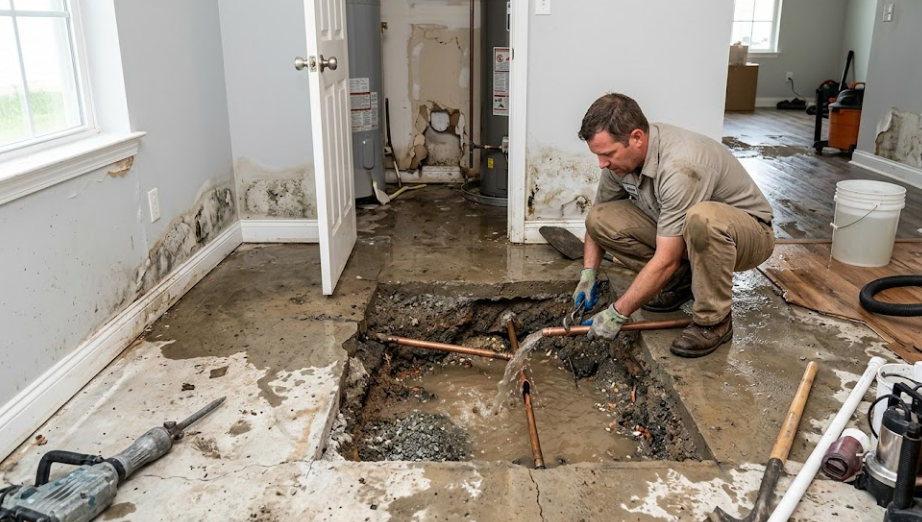
Slab leak detection and water damage in Arizona is a homeowner concern that demands both awareness and preparation. Arizona’s unique combination of expansive soils, hard water chemistry, and thermal extremes creates a slab leak environment that is more demanding than most parts of the country, and the consequences of a late-discovered leak can be severe. The homeowners who fare best are those who know the warning signs, act immediately on any indication of a possible slab leak, engage professional detection services to confirm and locate the leak before any concrete is cut, and call a certified water damage restoration company to assess and address the full scope of moisture damage before mold becomes an additional and costly problem.
Arizona’s Premier Restoration Specialists understand the specific challenges of slab leak water damage in this climate and this soil environment. When a slab leak is discovered, every hour of delay allows additional moisture to migrate deeper into the building assembly. The fastest path to a fully restored, dry, and mold-free home starts with one call.
Slab Leak Water Damage in Your Arizona Home? Call PuroClean Immediately
PuroClean’s certified water damage restoration specialists are available 24 hours a day, 7 days a week to assess and restore homes affected by slab leaks throughout the Phoenix metro area and West Valley communities. From professional moisture mapping and structural drying to mold remediation, PuroClean delivers complete, verified restoration. Arizona’s Premier Restoration Specialists. Leaders in recovery. Calm in the Chaos.
Call PuroClean now at (480) 767-5588. Fast response. Proven results. Complete peace of mind.
Do not let a slab leak become a structural crisis. PuroClean stops the damage and restores your home – completely.