


Tear Gas Cleanup in Scottsdale, Arizona
When law enforcement deploys tear gas or other chemical agents inside a home, apartment, vehicle, or commercial space as part of a tactical response, the immediate public safety goal is achieved – but the property left behind is a different matter entirely. Tear gas residue is not simply an unpleasant smell that fades on its own. It is a potent chemical contaminant that coats every surface it contacts, penetrates deeply into porous materials, and can cause serious health effects – including respiratory distress, skin and eye irritation, and in high concentrations or confined spaces, more severe effects – for days or weeks after deployment if the space is not properly decontaminated.
Tear gas cleanup in Scottsdale, AZ is a specialized decontamination service that addresses the chemical contamination left behind after law enforcement use of chemical agents. Law enforcement agencies are not responsible for decontaminating properties after deploying these agents, and the standard instructions to “air it out and wipe it down” that officers sometimes provide are wholly inadequate for the true scope of decontamination required. Property owners who attempt to reoccupy a tear-gas-contaminated space without professional decontamination are exposing themselves, their families, and their tenants to ongoing chemical exposure that can cause real harm.
What Tear Gas Actually Is and Why It Is So Difficult to Remove
The Chemistry of Tear Gas and Chemical Agents
The term tear gas encompasses several different chemical compounds that law enforcement may deploy depending on the tactical situation. The most common agents deployed in residential and commercial settings include CS gas (2-chlorobenzalmalononitrile), CN gas (chloroacetophenone), OC (oleoresin capsicum, or pepper spray in aerosol form), and combinations of these compounds. CS gas is by far the most commonly deployed agent in tactical law enforcement situations and is the primary chemical most Scottsdale property owners will encounter after a law enforcement response at their property.
CS gas works by binding to pain receptors in the eyes, nose, mouth, and respiratory tract, causing intense tearing, burning, and temporary incapacitation. The compound itself is a white crystalline solid that is typically deployed as a fine powder or dissolved in a solvent carrier and then aerosolized or released as a pyrotechnic grenade. When deployed, the particles and aerosol spread throughout the space and deposit on every surface they contact.
Why Residue Persists Long After Deployment
Tear gas residue is oily, sticky, and chemically reactive in ways that make it uniquely difficult to remove. The particles deposit on hard surfaces, soft furnishings, carpeting, walls, and HVAC systems and adhere strongly to these surfaces. On porous materials – carpet, upholstery, drywall, insulation, and clothing – the particles penetrate into the material where they cannot be reached by surface cleaning. Even surfaces that have been wiped down may retain sufficient residue to cause symptoms in sensitive individuals, particularly children, elderly persons, and people with respiratory conditions.
A phenomenon called off-gassing occurs when tear gas residue on surfaces releases chemical compounds back into the air as vapor, particularly when temperatures increase or when humidity changes. This off-gassing can continue for days or weeks after the initial deployment, meaning that a space that appears clean may continue to expose occupants to irritating chemical concentrations whenever they are inside it.
The HVAC Distribution Problem
When tear gas is deployed inside a structure with a running HVAC system, or when the deployment occurs near air intake areas, the chemical agents are drawn into the return air stream and distributed throughout the entire ductwork system. A tear gas deployment in a single room can contaminate the entire HVAC system and through it, every room in the structure. This distribution means that tear gas cleanup in Scottsdale must address the full HVAC system – including the air handler, filters, and all supply and return ductwork – not just the room or rooms where the deployment visibly occurred.
Health Effects of Exposure to Tear Gas Residue
Understanding the health effects of tear gas residue exposure helps property owners understand why rapid, professional decontamination is not optional.
Immediate Exposure Effects
Immediate effects of tear gas exposure include intense tearing and eye pain, burning of the nose, mouth, and throat, coughing, choking, and shortness of breath, skin burning and rash, and nausea. These effects are intentionally severe enough to be incapacitating in the moment of deployment. When people re-enter an inadequately cleaned space hours or days later and experience the same symptoms at lower intensity, they may not immediately connect their symptoms to the tear gas residue.
Prolonged Low-Level Exposure Effects
Prolonged exposure to low concentrations of tear gas residue – the kind that occurs when people live or work in an inadequately decontaminated space – can cause persistent respiratory irritation, chronic cough and bronchitis, skin sensitization and recurring contact dermatitis, eye irritation and increased susceptibility to eye infections, and in some documented cases, long-term respiratory sensitization. Children, the elderly, and individuals with asthma or other respiratory conditions are at elevated risk from low-level prolonged exposure to tear gas residue and should not reoccupy a space where professional decontamination has not been completed.
Specific Vulnerabilities
The health literature on tear gas acknowledges that certain populations face heightened risk from CS and CN exposure. Pregnant women are advised to avoid any CS exposure due to evidence of fetal developmental effects at high concentrations. Individuals with reactive airways disease, asthma, or COPD may experience acute exacerbation from residue exposure. Infants and young children are more vulnerable than adults because of their smaller body mass and proportionally greater respiratory exposure relative to body weight.
Who Is Responsible for Tear Gas Cleanup in Scottsdale
This is one of the most consequential questions for property owners following a law enforcement tear gas deployment, and the answer is one that many property owners find deeply frustrating: in virtually all cases, the property owner bears the cost and responsibility for decontamination, not the law enforcement agency that deployed the agents.
Law enforcement agencies in Scottsdale and throughout Arizona operate under legal authority to use chemical agents as part of lawful tactical operations, and this authority does not create an obligation to pay for or perform cleanup afterward. Courts have consistently upheld this position. Property owners who wish to pursue reimbursement from the deploying agency typically face a difficult civil legal process with no guaranteed outcome.
The practical implication is that as soon as law enforcement releases the scene, the property owner should initiate contact with their insurance carrier and a professional decontamination company rather than waiting for any agency to accept responsibility for the cleanup costs.
Insurance Coverage for Tear Gas Cleanup in Scottsdale
Homeowner’s and commercial property insurance policies may cover tear gas decontamination costs depending on the specific policy language and the circumstances of the deployment. Coverage is most likely available when the tear gas deployment occurred as a result of a criminal incident on or near the property – a home invasion response, a barricade situation, or a law enforcement operation targeting criminal activity at the location. Some policies have specific provisions for government action exclusions that may limit coverage in some circumstances, making it essential to review your specific policy language with your carrier rather than assuming coverage is or is not available.
Report the incident to your insurance carrier on the same day the scene is released. Provide documentation of the incident from law enforcement if available, and engage a professional decontamination company that can document the scope of chemical contamination and the decontamination work performed in the format your carrier requires.
The Professional Tear Gas Decontamination Process in Scottsdale
Initial Assessment and Air Quality Testing
Professional tear gas cleanup in Scottsdale begins with an assessment of the extent of chemical contamination throughout the property. This includes air quality testing for chemical agent concentration in each room and in the HVAC system, visual assessment of all surfaces for visible residue deposition, and identification of all porous materials that have absorbed chemical compounds during and after the deployment. The assessment establishes which areas require decontamination and guides the prioritization and sequencing of the cleanup process.
HVAC System Isolation and Duct Cleaning
The HVAC system is addressed early in the decontamination process to prevent it from circulating contaminated air during cleanup work. All filters are removed and disposed of. The air handler, blower assembly, and evaporator coil are cleaned. Supply and return ductwork throughout the property is cleaned using professional duct cleaning equipment, and in cases of significant contamination, an encapsulant coating may be applied to duct interior surfaces to seal any residual chemical compounds. The system is not returned to operation until air quality testing confirms that it is free of chemical contamination at hazardous levels.
Protective Equipment and Ventilation Control
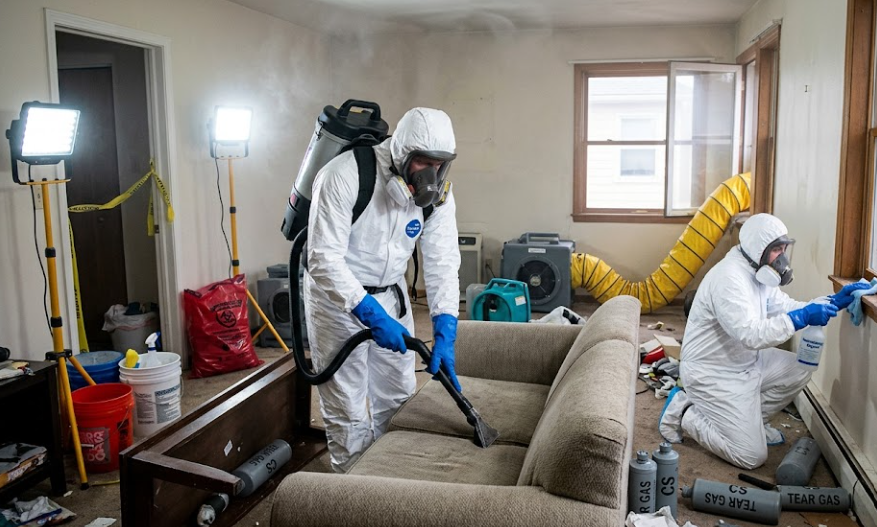
Technicians performing tear gas cleanup wear appropriate chemical protective equipment – not the standard nitrile gloves and Tyvek coveralls used for biological hazards, but chemical-resistant gloves and suits appropriate for organic solvent and chemical irritant exposure. Ventilation is managed carefully during decontamination to direct chemical vapors out of the structure rather than through the occupied portions of the building.
Surface Decontamination
All hard surfaces throughout the contaminated area are cleaned using chemical cleaning agents formulated to break down and remove CS and CN compounds. This is not a general degreaser or household cleaner – tear gas residue requires specific chemical cleaning agents designed to react with and neutralize the active compounds. Multiple cleaning cycles are performed, with surfaces rinsed and dried between cycles. Special attention is paid to areas of concentrated deposition: areas near the deployment point, surface transitions, and any areas where residue may have pooled.
Soft Surface and Content Treatment
Upholstered furniture, draperies, mattresses, and other soft contents that have absorbed tear gas compounds may be cleanable through ozone treatment and professional cleaning, or may require replacement if the level of chemical absorption is beyond practical remediation. Carpeting and carpet padding typically require replacement in heavily contaminated areas because the depth of chemical penetration in carpet fibers and padding material exceeds what surface extraction can address. Clothing and linens require professional laundering with chemical-neutralizing agents.
Structural Material Assessment
Drywall, insulation, and other structural materials in rooms with significant deployment may have absorbed chemical compounds through their porous surfaces. In most cases, structural materials can be adequately decontaminated through surface cleaning and air treatment without removal, but in situations involving prolonged or high-concentration deployment, affected drywall and insulation may need to be removed to eliminate chemical reservoirs that would continue to off-gas after surface cleaning.
Post-Decontamination Air Quality Verification
Following completion of all decontamination work, air quality testing is performed throughout the property to confirm that chemical agent concentrations have been reduced to levels below health-based guidelines. Written post-decontamination documentation is provided to the property owner confirming the scope of work performed, the air quality results achieved, and the materials removed or treated. This documentation supports the insurance claim and protects the property owner against future liability if any health complaints arise after reoccupancy.
Immediate Steps When Law Enforcement Releases a Tear Gas Scene
- Do not reoccupy the property or allow any non-essential persons to enter until professional decontamination is complete. The health effects of residue exposure are real and ongoing.
- Ventilate the property by opening windows and exterior doors if weather permits, but do not run the HVAC system – this will only distribute contamination further through the ductwork.
- Contact a professional decontamination company as soon as the scene is released. The longer tear gas residue remains on surfaces and in materials, the deeper it penetrates and the more difficult removal becomes.
- Contact your insurance carrier on the same day to report the incident and initiate a coverage inquiry. Provide documentation of the law enforcement response if available.
- Do not attempt to clean any surfaces yourself, and do not allow others to enter and attempt cleanup – even with protective gear purchased from a hardware store. Consumer-grade protective equipment is not rated for chemical agent exposure at the concentrations involved in a tear gas deployment.
- Document the visible extent of chemical residue deposition with photographs before any professional team arrives, for insurance claim purposes.
Take Tear Gas Contamination Seriously – Reoccupation Without Decontamination Is Not Safe
Tear gas cleanup in Scottsdale is a service that property owners hope never to need, and one that is less understood than fire or water damage restoration precisely because it occurs less frequently. But the chemical contamination left behind by a law enforcement tear gas deployment is a genuine and persistent health hazard that does not resolve on its own and cannot be adequately addressed with standard cleaning products and methods. The only safe path to reoccupancy is professional decontamination with post-decontamination air quality verification
Arizona’s Premier Restoration Specialists at PuroClean have the training, equipment, and experience to address tear gas contamination completely – protecting the health of future occupants, documenting the work for insurance purposes, and returning properties to safe, habitable condition as quickly as possible. Leaders in recovery. Calm in the Chaos.
Tear Gas Deployed at Your Scottsdale Property? Call PuroClean for Professional Decontamination
PuroClean’s certified decontamination specialists serve Scottsdale and the Phoenix metro area 24 hours a day, 7 days a week. We assess chemical contamination, clean all surfaces and HVAC systems, treat soft contents, and verify safe air quality before any reoccupancy is approved. Arizona’s Premier Restoration Specialists. Leaders in recovery. Calm in the Chaos.
Call PuroClean now at (480) 767-5588. Fast response. Proven results. Complete peace of mind.
Do not return to a tear-gassed property without professional decontamination first. Call PuroClean today.