


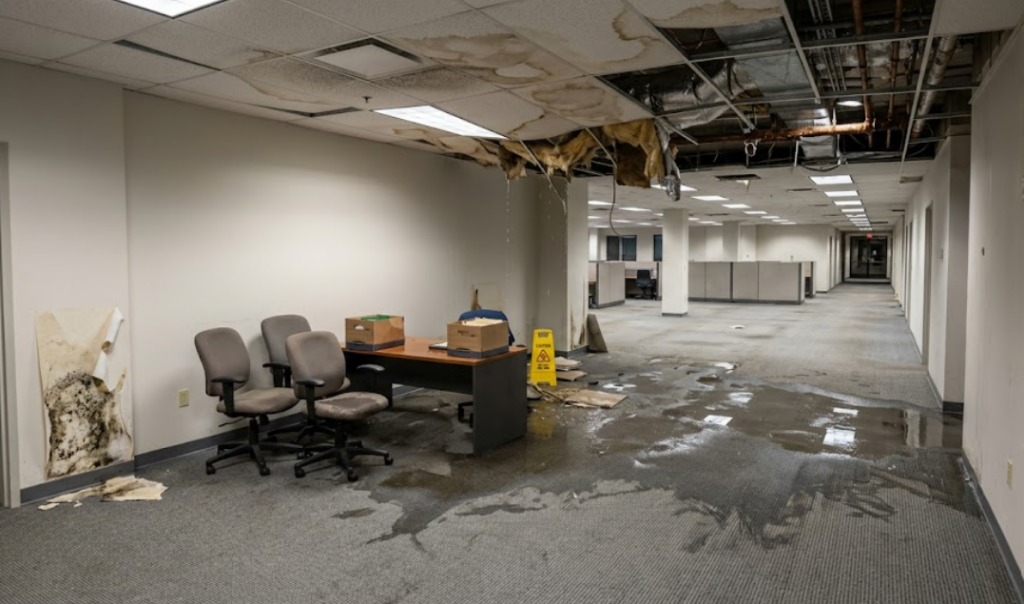
Water Damage Guide for Commercial Property Managers
Water damage is one of the most disruptive, expensive, and operationally complex emergencies a commercial property can face. For a commercial property manager, a single significant water event can simultaneously trigger tenant complaints, lease disputes, business interruption claims, insurance negotiations, contractor coordination, and regulatory compliance obligations – all at once, often in the middle of the night or over a holiday weekend. Without a clear plan and a reliable team of professionals to call on, the chaos that follows a water event can be as damaging to your management reputation as it is to the building itself.
This water damage guide for commercial property managers is designed to serve as a practical operational reference – not a theoretical overview. It covers the most common sources of commercial water damage, the regulatory and liability obligations that property managers must understand, the immediate response protocol that limits damage and protects all parties, the professional restoration process specific to commercial properties, insurance considerations unique to commercial policies, and the preventive maintenance practices that reduce the frequency and severity of water events across your portfolio.
Whether you manage a single office building, a multi-tenant retail center, an industrial complex, or a mixed-use development, the principles in this guide apply directly to your responsibilities and your risk exposure.
The Scope of Commercial Water Damage Risk
Water damage in commercial properties occurs at a rate and scale that consistently surprises property owners who are more familiar with residential water events. Commercial buildings are larger, have more complex mechanical systems, serve more occupants, and carry far higher financial stakes per incident than residential properties. According to the Insurance Information Institute, water damage is one of the top causes of commercial property insurance claims by both frequency and total cost.
A commercial property manager who has not experienced a significant water event should not interpret that as evidence that the risk is low. It is evidence that the event has not occurred yet. Every commercial building – regardless of age, quality of construction, or location – carries ongoing water damage risk from multiple sources simultaneously.
Common Sources of Water Damage in Commercial Properties
Understanding where commercial water damage originates is the first step in building an effective prevention and response plan.
Plumbing System Failures
Plumbing failures are the most frequent source of water damage in commercial buildings. Commercial plumbing systems service far more fixtures, carry far greater daily flow volumes, and operate under higher pressure than residential systems. Pipe failures, fixture leaks, drain blockages, and water heater failures can each release thousands of gallons of water into a building in a relatively short period. Multi-story buildings face the additional challenge that a plumbing failure on an upper floor can damage every floor below it before it is discovered – a scenario that multiplies both the physical damage and the number of tenants affected.
HVAC and Cooling System Leaks
Commercial HVAC systems – including roof-mounted package units, split systems, chilled water systems, and cooling towers – generate significant volumes of condensate that must be properly drained. Condensate drain blockages, pan overflows, and failed drain line connections are consistent sources of ceiling and wall water damage in commercial buildings. Chilled water systems carry the additional risk of pipe sweating and condensation when insulation deteriorates, and cooling tower systems present overflow and drift risks when flow controls fail.
Roof Failures and Storm-Driven Intrusion
Commercial roofing systems – primarily low-slope membrane roofing – are vulnerable to seam separation, ponding water, drain blockage, and wind uplift damage. In Arizona, monsoon season brings intense short-duration rainfall that regularly overwhelms commercial roof drainage systems, particularly when drains and scuppers are not maintained. A single significant roof failure during a monsoon storm can affect thousands of square feet of interior space and multiple tenant suites simultaneously.
Fire Suppression System Activations and Leaks
Commercial buildings are required by code to have fire suppression systems, and those systems represent a significant water damage risk when they malfunction, are accidentally activated, or develop leaks at aging pipe joints. A single activated sprinkler head releases between 10 and 26 gallons of water per minute. An accidental activation in a tenant space that goes undetected for even 15 to 20 minutes can cause catastrophic water damage to the affected suite and the spaces below it.
Tenant-Caused Water Events
In multi-tenant buildings, a significant proportion of water damage events originate within individual tenant spaces from tenant-owned or tenant-operated equipment and activities. Overflowed sinks and toilets, failed under-sink plumbing connections, improperly installed water lines to refrigerators and coffee machines, aquariums, and commercial kitchen equipment are all common sources. This category of water damage creates specific liability questions about responsibility and insurance coverage that property managers must be prepared to address.
Elevator Pit and Below-Grade Flooding
Commercial buildings with below-grade parking structures, storage areas, or mechanical rooms face the risk of groundwater infiltration and stormwater flooding that residential properties rarely encounter at the same scale. Elevator pits are a particularly common collection point for water infiltration in below-grade areas, and a flooded elevator pit creates both operational disruption and potential equipment damage that can take days or weeks to remediate.
Window and Curtain Wall Failures
Large commercial buildings with curtain wall glass systems, storefront glazing, or aging window assemblies face water infiltration risk at every joint, seal, and connection point in those systems. Sealant deterioration is accelerated by Arizona‘s extreme thermal cycling, and failed window seals during monsoon season can allow wind-driven rain to penetrate into occupied tenant spaces in quantities that cause immediate damage to finishes, equipment, and contents.
Legal and Liability Obligations for Commercial Property Managers
This water damage guide for commercial property managers must address the legal and liability framework within which property managers operate, because a water damage event is not just a physical problem – it is a legal and financial one.
Lease Obligations and Landlord Duties
Commercial leases typically establish responsibilities for building systems maintenance and repairs between landlord and tenant. Most commercial leases assign the landlord responsibility for maintaining the building structure, roof, common areas, and primary mechanical systems, while tenants are responsible for their leased premises and tenant-installed improvements. When a water damage event occurs, the lease terms determine who bears responsibility for the damage to the space itself and who is responsible for tenant personal property and business interruption losses.
Property managers must be intimately familiar with the maintenance and repair clauses in every lease in their portfolio. When a water event occurs, the initial response should be focused on stopping the damage and protecting the building and tenants – but the lease review should follow immediately so that liability and cost allocation questions can be addressed promptly and correctly.
Duty to Mitigate
Under both common law and most commercial lease agreements, the landlord has an obligation to take reasonable steps to mitigate damage once a water event is discovered. Failure to respond promptly, failure to engage qualified restoration professionals, or allowing preventable secondary damage such as mold growth to develop because of delayed response can expose the property owner and manager to liability for damages beyond those caused by the water event itself.
In practical terms, this means that the duty to mitigate obligates commercial property managers to have an emergency response plan ready to execute at any hour, to have qualified contractors and restoration companies on call, and to document all response actions thoroughly so that the timeline of events can be reconstructed if needed.
Mold Liability and Indoor Air Quality
Commercial property managers carry significant liability exposure when water damage leads to mold growth in tenant-occupied spaces. OSHA and EPA guidelines establish that landlords have a duty to maintain habitable and safe commercial premises. Mold growth resulting from unaddressed water damage is a direct violation of this duty and can support tenant claims for lease termination, rent abatement, and damages for health effects suffered by employees who occupied the affected space.
The key to limiting mold liability is speed. Mold begins to grow within 24 to 48 hours of a water intrusion event. A property manager who can document that professional drying was initiated within that window – and that all affected materials were fully dried within the IICRC S500 standard timeframe – is in a far stronger legal position than one who delayed response or relied on inadequate drying methods that left hidden moisture in the building assembly.
Documentation and Record-Keeping Requirements
In any water damage event that involves a commercial property, thorough documentation is not optional – it is a legal and financial necessity. Property managers should document the following in every water event, regardless of apparent scale:
- Date and time the water event was discovered and by whom
- Date and time the property manager or management team was notified
- Photographs and video of all affected areas taken before any materials are moved or removed
- Written log of all response actions taken and the time each was initiated
- Names and contact information of all contractors and vendors engaged
- Copies of all work orders, service agreements, and invoices
- Moisture meter readings and drying logs from the restoration contractor
- Written notifications sent to affected tenants and the dates they were sent
- Communications with the property’s insurance carrier
This documentation record protects the property owner and manager in the event of a tenant dispute, an insurance coverage disagreement, or litigation arising from the water event.
The Commercial Water Damage Response Protocol
A clear, pre-established response protocol is the single most valuable tool a commercial property manager can have when a water event occurs. The following protocol is drawn from industry best practices and forms the operational core of this water damage guide for commercial property managers
Phase 1: Immediate Response (First 2 Hours)
The first priority in any water event is life safety. Ensure that all occupants are safely clear of any area where electrical hazards, structural risks, or significant flooding are present. Contact emergency services if any occupants are at risk.
- Identify and stop the water source: Locate and shut off the supply to the failing system – the main water shutoff, the sprinkler system control valve, the HVAC condensate supply, or the relevant isolation valve. If the source cannot be identified, shut off the building’s main water supply.
- Notify the property owner and on-call staff: Follow your escalation protocol and ensure that all relevant parties are informed within the first hour of discovery.
- Document before touching anything: Photograph and video all affected areas, water levels, and visible damage before beginning any cleanup or material removal.
- Notify affected tenants: Contact tenants in affected suites immediately to inform them of the situation, what steps are being taken, and any access restrictions to their space. Written notification should follow verbal contact.
- Contact your commercial water damage restoration company: Engage a professional restoration company with commercial experience immediately. Do not wait to assess the full scope before calling – a good restoration company will assess scope as part of their initial response.
- Notify your insurance carrier: Report the loss to your commercial property insurer as soon as the immediate life-safety and property-safety issues are addressed. Most commercial policies have prompt-reporting requirements that must be met to preserve coverage.
Phase 2: Professional Assessment and Containment (Hours 2-24)
Once a professional restoration team is on site, the property manager’s role shifts to facilitating access, providing building system information, and coordinating communication between the restoration team, tenants, and the insurance adjuster.
The restoration team’s first actions in a commercial property are to conduct a moisture mapping assessment using thermal imaging cameras and moisture meters to identify the full extent of water intrusion. In a commercial property, this assessment is particularly important because water can travel significant distances through ceiling plenum spaces, underfloor systems, and mechanical chases before becoming visible. The assessment results establish the scope of work and the drying plan.
Containment is established in any areas where mold risk is elevated due to prolonged moisture exposure or where demolition of building materials is required. Commercial containment uses polyethylene barriers and negative air pressure units with HEPA filtration to prevent cross-contamination of unaffected tenant spaces – a critical requirement in multi-tenant buildings where a single air handling zone may serve both affected and unaffected suites.
Phase 3: Water Extraction and Structural Drying (Days 1-5)
Commercial water extraction uses truck-mounted or large portable extraction units significantly more powerful than any residential equipment. In large commercial spaces with hard flooring, extraction can remove the bulk of standing water within hours. In spaces with carpet, commercial extraction equipment with weighted extraction wands pulls water from deep within the carpet and pad layers that consumer equipment cannot reach.
Structural drying in commercial properties uses large numbers of commercial air movers and refrigerant or desiccant dehumidifiers deployed according to a calculated drying plan. Desiccant dehumidification is particularly effective in large commercial spaces and in situations where low ambient humidity is needed to dry materials such as hardwood flooring or specialty building products. Daily moisture readings document drying progress and guide equipment adjustments until all materials reach their dry standard moisture levels.
Phase 4: Mold Prevention, Antimicrobial Treatment, and Reconstruction
Following complete drying verification, all exposed structural surfaces receive EPA-registered antimicrobial treatment to prevent mold growth. If mold has already established itself in areas where the water event went undetected for more than 48 hours, a formal mold remediation protocol is initiated before reconstruction begins.
Reconstruction in a commercial property – replacing drywall, ceiling tiles, flooring, and finishes – must account for both the building’s standard specifications and the tenant’s lease improvements. The property manager must coordinate between the restoration contractor, the tenant’s own contractors if applicable, and any building code compliance requirements that apply to the reconstruction work. Selecting a restoration company that provides both mitigation and reconstruction services under a single point of contact simplifies this coordination significantly and typically reduces the total project timeline. This is a key operational recommendation in any water damage guide for commercial property managers
Insurance Considerations Specific to Commercial Properties
Commercial Property Policy Structure
Commercial property insurance policies differ significantly from homeowner’s policies in both their structure and their exclusions. Commercial policies typically cover the building structure and permanently installed equipment under the building coverage section, and tenant improvements and betterments are often covered separately or under the tenant’s own policy. Business personal property, tenant inventory, and business interruption losses are separate coverage categories that may or may not be included in the property manager’s policy versus the tenant’s policy.
Property managers should review their commercial property policy annually with a qualified commercial insurance broker to ensure that all building systems, recent improvements, and known risk exposures are adequately covered. Water damage exclusions in commercial policies – particularly for gradual leaks, maintenance failures, and flood events – are common and must be understood before a loss occurs.
Tenant Insurance and Coordination of Coverage
Most commercial leases require tenants to maintain their own commercial general liability and property insurance and to name the landlord as an additional insured. When a water damage event affects a tenant’s property, the property manager should immediately request a certificate of insurance from the affected tenant and determine whether the damage to tenant property and the tenant’s business interruption losses will be pursued through the tenant’s policy, the landlord’s policy, or both.
Early coordination between the property manager’s insurer and the tenant’s insurer prevents disputes about coverage responsibility and allows both parties to pursue their respective claims simultaneously rather than sequentially.
Business Interruption and Loss of Rent Coverage
If a water damage event renders tenant spaces temporarily unusable, the property owner may face loss of rent during the restoration period. Commercial property policies with loss of rents or business income coverage can protect against this exposure, subject to policy terms and waiting periods. Property managers should document all tenant displacement, all rent abatements offered or required, and the full timeline of the restoration project to support a business interruption claim.
Preventive Maintenance That Reduces Commercial Water Damage Risk
Prevention is always more cost-effective than restoration. The following preventive maintenance practices are the most impactful for reducing commercial water damage frequency and severity across a property portfolio.
Annual Plumbing and Roof Inspections
- Schedule a comprehensive plumbing inspection by a licensed commercial plumber at least annually, covering all supply lines, drain lines, water heaters, pressure regulators, and isolation valves
- Inspect roof drains, scuppers, overflow drains, and membrane seams before the monsoon season each year and immediately after any storm event that causes visible ponding
- Verify that all roof penetrations – HVAC curbs, conduit entries, plumbing vents – are properly sealed and that flashing is intact
HVAC and Fire Suppression System Maintenance
- Flush and test condensate drain lines on all HVAC equipment at least twice per year – before cooling season and at mid-season
- Inspect all condensate drain pans for cracks, corrosion, and biological growth that could cause blockage
- Schedule annual fire suppression system inspections per NFPA 25 standards, including full functional testing of drain lines, alarm systems, and control valves
- Install water detection sensors at known high-risk locations: below HVAC units, in mechanical rooms, in elevator pits, and at building entry points vulnerable to stormwater
Tenant Communication and Education
- Provide all tenants with written water emergency procedures including the building water shutoff location, who to call at any hour, and what to do if they discover water in their suite
- Conduct an annual building orientation for new tenants that covers emergency procedures and the reporting protocol for water events
- Include a water damage reporting obligation in lease language that requires tenants to report any observed water intrusion, plumbing issues, or roof leaks immediately upon discovery
Building System Monitoring Technology
Smart building water monitoring systems – including IoT-connected water flow sensors, leak detection mats, and automatic water shutoff valves – can detect and respond to water events faster than any human monitoring system, particularly during off-hours when buildings are unoccupied. Investing in water monitoring technology for high-value commercial properties delivers a measurable reduction in water damage claims frequency and severity. Several major commercial property insurers offer premium discounts for buildings that install and maintain certified water monitoring systems.
Selecting the Right Commercial Water Damage Restoration Partner
One of the most important decisions a commercial property manager makes before a water event occurs is selecting a qualified commercial restoration company and establishing a working relationship with them before an emergency arises. A restoration company that already knows your building’s layout, your tenant roster, and your management preferences will respond more effectively and with less disruption than one that is encountering the property for the first time during a crisis.
When evaluating commercial restoration companies, look for the following qualifications and capabilities:
- IICRC certification in water damage restoration (WRT) and applied structural drying (ASD) for field technicians
- Commercial-scale extraction and drying equipment – truck-mounted extraction, large desiccant dehumidifiers, and adequate numbers of commercial air movers to handle the square footage of your largest building
- 24-hour emergency response capability with a guaranteed response time commitment – not just an answering service
- Experience with commercial multi-tenant environments and the tenant communication, coordination, and documentation requirements specific to those settings
- Full-service capability covering both mitigation and reconstruction, which simplifies project management and reduces the number of contractors the property manager must coordinate
- Insurance carrier relationships and experience with commercial claims documentation that meets the documentation standards required by major commercial property insurers
Be Ready Before the Water Damage Happens
Water damage in commercial properties is not a matter of if – it is a matter of when. The property managers who protect their assets most effectively, preserve the best relationships with their tenants, and limit their liability exposure most successfully are those who have prepared before the event occurs. This water damage guide for commercial property managers provides the framework for that preparation: understanding your risk sources, knowing your legal obligations, building a response protocol, selecting qualified restoration partners, and maintaining the building systems that reduce the frequency and severity of water events.
Execute on this framework before the next storm season, before the next plumbing failure, and before the next HVAC condensate overflow. The cost of preparation is a fraction of the cost of an unprepared response.
Partner With PuroClean Before Your Next Water Event – Not After
PuroClean provides commercial property managers across the Phoenix metro area with the emergency response, professional restoration, and insurance documentation support they need to protect their assets and their tenants. Our IICRC-certified commercial restoration teams respond 24 hours a day, 7 days a week with the equipment and expertise to address water events of any scale – from a single suite overflow to a full building flooding emergency.
Call PuroClean restoration specialists now at (480) 767-5588. Fast response. Proven results. Complete peace of mind.
Establish your commercial water damage response partnership with PuroClean today – before the next event makes it urgent.