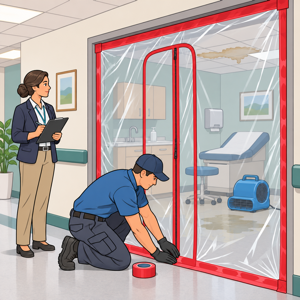
Quick answer: Healthcare water-damage containment separates the restoration zone from patients, staff, visitors, supplies, and unaffected departments. A containment plan may include controlled access, physical barriers, HEPA-filtered air control, pressure monitoring, protected traffic and debris routes, surface protection, equipment staging, cleaning procedures, and daily inspection. The exact controls must be selected by the facility’s authorized infection-prevention, engineering, safety, and clinical leaders based on the incident.
Containment is not the same as hanging plastic around a wet room. It is a coordinated system for managing water, dust, debris, air movement, workers, equipment, waste, and communication while healthcare operations continue nearby.
Why Is Containment Different in a Healthcare Facility?
Hospitals, outpatient centers, clinics, laboratories, rehabilitation facilities, and other healthcare properties serve occupants with very different levels of vulnerability. A restoration project near an administrative office is not automatically managed the same way as work beside an operating room, sterile-processing area, oncology department, neonatal unit, pharmacy, or protective-environment room.
The facility must consider patient population, location, water source, size of the affected area, HVAC connections, procedure types, construction activities, and the condition of utilities. The CDC recommends involving infection-control personnel in construction and repair planning and developing site-specific controls that limit unnecessary exposure to infectious agents.[1]
Who Approves the Containment Plan?
Facility leadership determines the required controls. Depending on the organization and project, the team may include:
The restoration contractor can propose methods and install approved controls, but it does not replace the facility’s infection-control risk assessment or clinical authority.
Start With a Risk Assessment, Not a Standard Barrier
Before work begins, define the source, affected area, planned tasks, adjacent spaces, and occupants. The CDC’s healthcare recovery guidance recommends both a general construction infection-control risk assessment and a water-management construction risk assessment before extensive restoration begins.[2]
Questions the Team Should Answer
Core Elements of Healthcare Restoration Containment
1. Controlled Boundaries
The boundary identifies where restoration controls begin and which people may enter. Depending on the work, barriers may range from a closed and posted room to rigid, sealed containment with controlled entry. Open seams, unsecured plastic, unsealed ceiling interfaces, and gaps around pipes or doors can defeat the plan.
Barriers must not obstruct fire protection, required exits, accessibility, medical-gas controls, utility panels, emergency equipment, or staff access without facility approval and alternate provisions.
2. Airflow and Pressure Control
HEPA-filtered air machines may be used to filter air and establish directional airflow. Negative pressure can help keep work-zone air from moving into adjacent spaces when that approach is appropriate. Pressure goals, exhaust location, monitoring method, alarm response, and HVAC coordination should be specified by the facility plan.
More negative pressure is not automatically better. Excessive pressure can affect doors, building systems, adjacent rooms, and clinical pressure relationships. Do not exhaust contaminated air near building intakes, occupied areas, public walkways, or other sensitive locations.
3. HVAC Isolation and Coordination
Facility engineering should determine whether supply, return, exhaust, and transfer pathways serving the work zone need to remain operating, be isolated, or be modified. Ceiling plenums, shared returns, open chases, and wall penetrations can allow dust and moisture to move beyond the visible room.
Do not cover a diffuser, shut a damper, or alter a pressure relationship without authorization. Specialized patient-care rooms may have critical ventilation requirements that the restoration team must not disrupt.
4. Controlled Entry and Exit
Define worker check-in, protective equipment, hand hygiene, tool movement, decontamination, and exit cleaning. Sticky mats alone do not replace cleaning. Workers should not move from a dirty work zone into a clean patient area wearing contaminated footwear or protective clothing.
5. Dedicated Equipment and Debris Routes
Choose a route that minimizes contact with patients, visitors, clean supplies, food service, sterile processing, and normal staff traffic. The facility may require a service elevator, covered carts, scheduled movement, escort, or terminal cleaning after transport.
Bag or wrap removed materials inside the containment when appropriate so they are not carried openly through occupied corridors. Follow facility, waste, and hazardous-material requirements.
6. Surface and Equipment Protection
Protect floors, walls, doors, casework, elevators, nurse-call stations, and other surfaces from water, wheels, hoses, cords, and debris. Equipment staging should preserve egress and allow environmental services to clean the surrounding area.
7. Daily Inspection and Documentation
Containment should be checked at the start of work, during active operations, after changes, and before the area is left unattended. Document barrier condition, pressure readings when required, equipment status, access, cleaning, and corrective actions.
How Should the Facility Be Divided Into Zones?
A zone plan makes responsibilities and restrictions visible:
Names and requirements can vary by facility. The important point is to define the boundary, permitted activities, responsible authority, and entry conditions for every zone.
Containment for Different Water Sources
Potable-Water Supply Leak
A recent potable-water leak may allow a less complex response when it is discovered quickly and has not contacted contamination. Still evaluate hidden migration, wet porous materials, electrical hazards, and sensitive adjacent spaces.
Sewage or Drain Backup
Restrict access and treat the area as contaminated. Avoid uncontrolled fans. The plan may require enhanced personal protection, removal of affected porous materials, cleaning and disinfection, controlled waste movement, and environmental consultation.
Roof or Storm Water
Water may carry soil, roofing debris, microbial contamination, and chemicals from exterior surfaces. It can enter insulation, ceiling systems, and wall assemblies before becoming visible. Determine the travel path and evaluate the water based on actual exposure rather than appearance.
Fire-Sprinkler Discharge
Sprinkler water may contain corrosion products and stagnant water, and it can combine with smoke, soot, burned materials, or firefighting water. Coordinate water extraction with fire investigation, life-safety-system restoration, and smoke-damage assessment.
Containment During Drying
Drying equipment creates airflow, heat, noise, cords, hoses, and additional electrical load. Coordinate placement and operation with facilities engineering, infection prevention, clinical leadership, and safety.
A drying enclosure should not trap moisture or cause air to move into adjacent spaces. Track humidity, temperature, and material readings inside the zone. If materials remain wet despite drying, reassess access, equipment, material condition, and hidden moisture rather than simply extending the same setup.
For the complete response sequence, see our hospital water-damage response guide.
Containment During Mold Remediation
Visible mold or long-term wet materials may require different controls from a new water loss. The work plan should address source correction, removal methods, pressure, HEPA filtration, waste, cleaning, and verification. If the HVAC system is contaminated or connected to the affected area, facility engineering and infection prevention should determine the response.
The CDC states that mold remediation requires physical removal rather than merely applying disinfectant to mold-contaminated surfaces.[2] See our guide to mold remediation in healthcare facilities.
Common Containment Mistakes
When Can Containment Be Removed?
Define removal criteria before work begins. Depending on the project, the facility may require confirmation that:
Removing barriers is not the same as authorizing patient care. The facility may still need final cleaning, system testing, room setup, regulatory inspection, or clinical readiness review.
Healthcare Water-Damage Containment in Delaware County
PuroClean of Springfield provides healthcare facility restoration in Delaware County. We coordinate containment, extraction, moisture mapping, drying, material removal, HEPA-filtered cleaning, mold remediation, documentation, and phased recovery with the facility’s authorized team.
We serve healthcare properties in Springfield, Media, Swarthmore, Wallingford, Upper Darby, Drexel Hill, Broomall, Havertown, Ridley Park, Morton, Folsom, Prospect Park, and surrounding communities.
Frequently Asked Questions
Does every healthcare water loss require negative pressure?
No. Controls depend on the source, work activity, location, patients, HVAC, and facility assessment. Negative pressure may be appropriate for some projects but is not a universal requirement for every leak.
Can ordinary plastic sheeting provide containment?
Plastic may be part of a barrier system, but effective containment also addresses seams, penetrations, entry, airflow, pressure, cleaning, fire safety, access, and monitoring. The facility should approve the complete plan.
Who monitors containment?
Responsibilities should be assigned in the work plan. Restoration staff may inspect and document barriers and equipment; facility infection-prevention, facilities, safety, or environmental personnel may also inspect according to policy.
Can patients remain next to a drying area?
That is a facility decision based on the patient population, source, controls, shared systems, noise, heat, access, and clinical requirements. Some incidents allow phased operation; others require relocation.
Does containment eliminate the need for cleaning?
No. Containment limits migration. It does not remove water, contamination, dust, or mold. Cleaning, drying, material removal, and verification are separate parts of restoration.
Plan a Controlled Healthcare Restoration
If a Delaware County healthcare property has water damage, call PuroClean of Springfield at (610) 541-8606. We will coordinate entry, assessment, containment, equipment, documentation, and restoration sequencing with the authorized facility team.