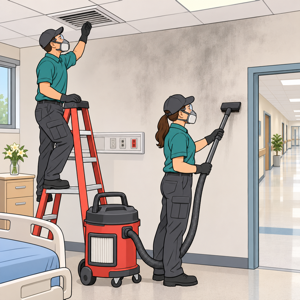
Quick answer: After a fire in a healthcare facility, follow fire-department and facility emergency procedures, protect patients and staff, preserve the scene until it is released, and evaluate smoke, soot, sprinkler water, firefighting water, utilities, HVAC, medical equipment, supplies, and adjacent departments before cleanup begins. Restoration should be coordinated through the facility’s incident command, infection prevention, engineering, safety, clinical leadership, environmental services, risk management, and authorized restoration team.
Flames may affect one room while smoke and water affect several floors. Soot can move through doors, corridors, ceiling spaces, elevators, and air-handling systems. Water used for suppression can saturate walls, ceilings, flooring, insulation, casework, and electrical spaces. A fast response matters, but safety, investigation, and healthcare controls come first.
What Should Happen Immediately After a Healthcare Facility Fire?
CMS emergency-preparedness guidance uses an all-hazards framework and identifies planning, policies and procedures, communication, and training and testing as core elements for participating healthcare providers.[1] Fire recovery should operate within that established structure.
Why Is Healthcare Fire Restoration More Complex?
Healthcare facilities combine vulnerable occupants, continuous operations, regulated spaces, specialized equipment, medications, sterile supplies, laboratories, medical gases, ventilation requirements, and strict access controls. A cleanup method suitable for a general office may not be appropriate beside a treatment room or sterile storage.
The facility must determine which departments can remain open, where patients can be moved, how essential services continue, and what controls are required to prevent restoration dust or residue from entering unaffected areas.
Wait for Fire-Department and Investigation Release
Fire officials, law enforcement, insurers, engineers, or other investigators may need to inspect the scene. Restoration work in the origin area should not begin until authorized. Emergency actions necessary to prevent additional damage should be documented and coordinated so evidence is not unintentionally destroyed.
Record the date, time, authorizing person, area released, restrictions, and photographs before moving items. Maintain chain-of-custody procedures for equipment, components, or materials retained for investigation.
Assess More Than the Burned Room
Smoke and Soot Migration
Smoke can move through open doors, corridors, ceiling plenums, elevator shafts, utility penetrations, and HVAC pathways. Pressure differences may move residue into adjoining rooms. Inspect above ceilings, around return grilles, inside cabinets, on horizontal surfaces, and in spaces that were not visibly smoky during the incident.
Water Damage
Sprinklers, fire hoses, and damaged plumbing can create a major water loss. Water may carry soot, ash, corrosion, debris, and contaminants from burned materials. Evaluate it according to the source and contact, not simply its appearance.
Extract standing water after the area is released and safe. Map wet walls, ceilings, floors, insulation, casework, and levels below. For water-response details, see our hospital water-damage response guide.
Structural and Utility Damage
Qualified professionals should evaluate structural components, electrical distribution, emergency power, medical gases, domestic water, sewage, HVAC, elevators, fire alarms, sprinklers, communications, and building controls before affected systems return to service.
Pennsylvania healthcare-facility building-safety oversight includes structural design and fireproofing, electrical, plumbing, HVAC, fire alarm, sprinkler, and smoke-detection considerations.[2]
Establish Fire-Restoration Containment
Containment separates demolition, soot removal, cleaning, drying, odor work, and reconstruction from occupied healthcare areas. The facility’s infection-prevention and facilities teams should approve the controls.
A plan may include:
Do not exhaust restoration air near outdoor-air intakes or occupied areas. Do not block exits, fire doors, sprinklers, emergency equipment, or accessible routes. Review our guide to healthcare restoration containment.
How Are Smoke and Soot Cleaned?
Smoke residue varies with the burned material, heat, oxygen, suppression, and surface. Dry soot, oily residue, protein-related residue, plastics, and synthetic materials can behave differently. Incorrect cleaning may smear, set, or further damage a surface.
Professional Cleaning Sequence
Do not allow untrained staff to wipe soot from walls, ceilings, equipment, or textiles. Household cleaners can react with residues, damage finishes, or spread contamination.
Can Healthcare Building Materials Be Restored?
The decision depends on heat, soot, water, contamination, corrosion, odor, material porosity, structural condition, cleanability, and clinical use.
Materials Often Evaluated for Cleaning
Materials Often Removed or Referred
How Are Medical Equipment and Supplies Evaluated?
Smoke, heat, soot, water, humidity, corrosion, and cleaning agents can affect electrical safety, calibration, sterility, filters, seals, optics, sensors, and internal components.
Restoration personnel can document exposure and surrounding property conditions but do not certify medical devices, medications, biological products, sterile supplies, or clinical records for reuse.
What About HVAC and Smoke Odor?
Facility engineering and qualified mechanical professionals should evaluate air handlers, filters, ductwork, insulation, controls, intakes, returns, and exhaust systems. Do not operate a contaminated system merely to clear odor.
Odor treatment begins with removing burned materials and cleaning smoke residue. Fragrance or deodorizer alone does not remove soot. Specialized odor-control methods may be used only after the source is addressed and with facility approval regarding occupants, equipment, ventilation, and materials.
Document the Fire and Restoration Claim
Maintain one coordinated record that may include:
When Can a Healthcare Department Reopen After a Fire?
Restoration completion is only one part of reoccupancy. The facility and responsible authorities may need to verify:
CDC guidance for extensive healthcare-facility recovery emphasizes multidisciplinary evaluation of utilities, equipment, supplies, records, structural materials, and fire safety before reopening.[3]
Healthcare Fire and Smoke Restoration in Delaware County
PuroClean of Springfield provides healthcare facility fire and smoke damage restoration in Delaware County. We coordinate emergency stabilization, water extraction, smoke and soot cleaning, odor-source removal, containment, contents documentation, moisture monitoring, and phased recovery with the facility’s authorized team.
We serve hospitals, outpatient centers, physician practices, dental facilities, laboratories, rehabilitation centers, urgent care centers, and other healthcare properties in Springfield, Media, Swarthmore, Wallingford, Upper Darby, Drexel Hill, Broomall, Havertown, Ridley Park, Morton, Folsom, Prospect Park, and nearby communities.
Frequently Asked Questions
Can part of a healthcare facility remain open after a fire?
Possibly. Facility leadership must consider smoke and water migration, shared HVAC and utilities, fire protection, access, patient risk, and whether restoration work can be safely isolated.
Can staff clean soot from equipment?
Do not clean or energize exposed medical or electrical equipment without authorization. Biomedical engineering, manufacturers, or qualified vendors should determine evaluation and cleaning requirements.
Does smoke odor mean soot is still present?
Odor can indicate remaining source material or residue, but odor alone does not define the complete scope. Inspection, surface testing, cleaning evaluation, and HVAC assessment may be needed.
How long does healthcare fire restoration take?
The timeline depends on investigation release, structural and system damage, smoke and water spread, equipment decisions, cleaning, inspections, reconstruction, and clinical readiness. The scope must be assessed before a reliable schedule is developed.
Will insurance pay for the restoration?
Coverage depends on the policy, cause, limits, deductibles, endorsements, and documented loss. Notify the facility’s insurer, broker, risk pool, or third-party administrator promptly. PuroClean can provide authorized project documentation but does not determine coverage.
Request Healthcare Fire and Smoke Restoration
If a Springfield or Delaware County healthcare property has fire, smoke, soot, sprinkler, or firefighting-water damage, call PuroClean of Springfield at (610) 541-8606. Provide the affected department, fire-department status, known hazards, patient-care impact, and authorized facility contact.