


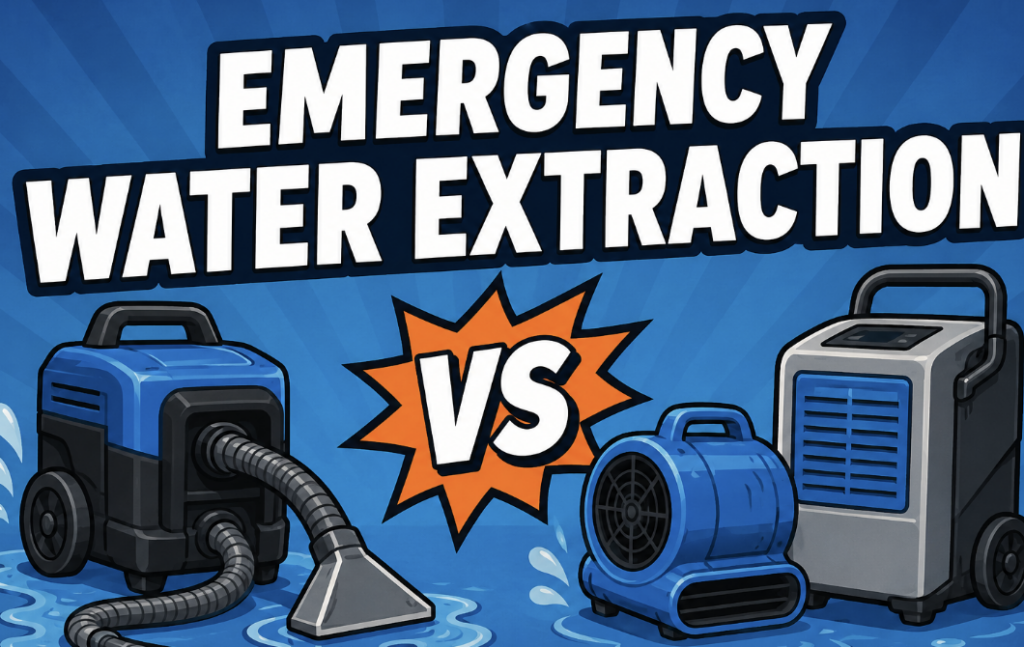
Water Extraction vs. Water Mitigation: What’s the Difference?
Water extraction removes standing or pooled water from a property, while water mitigation is the broader process of limiting additional damage after a water loss. In a Palmdale home, extraction may be one of the first mitigation steps after a burst pipe, appliance failure, bathroom overflow, water heater leak, or flooded room.
The terms are often used interchangeably, but they do not describe exactly the same thing. Water extraction focuses on physically removing liquid water. Water mitigation can include extraction, moisture detection, moving or protecting contents, removing damaged materials, dehumidification, structural drying, cleaning, and other measures intended to prevent the loss from becoming more extensive.
Water Extraction vs. Water Mitigation: Quick Comparison
The simplest distinction is that water extraction is a specific task, while water mitigation is a broader damage-control process.
| Water Extraction | Water Mitigation |
|---|---|
| Removes liquid and standing water | Limits additional damage from the entire water loss |
| Often performed early in the response | Begins as soon as the property is made safe and may continue through drying |
| Uses pumps, extractors, and related water-removal equipment | May include extraction, moisture detection, demolition, drying, cleaning, and content protection |
| Targets visible and accessible liquid water | Addresses both visible damage and moisture that has entered building materials |
| Usually followed by additional drying | May continue until the property is stabilized and further damage is controlled |
For example, if a washing machine supply line fails and floods a laundry room, extracting the standing water is water extraction. Checking adjoining rooms, removing saturated materials when necessary, setting drying equipment, controlling humidity, and monitoring moisture are all part of the broader mitigation process.
What Is Water Extraction?
Water extraction is the physical removal of excess liquid water from a home or business after a water-loss event.
Depending on the amount and location of the water, extraction may involve:
- Portable water extractors
- Truck-mounted extraction equipment
- Submersible pumps
- Wet extraction tools
- Carpet extraction tools
- Specialized equipment for difficult-to-access areas
The immediate objective is to remove as much liquid water as practical before it continues soaking into flooring, drywall, cabinets, subflooring, and other materials.
When standing water is actively affecting a property, see our emergency water extraction in Palmdale service.
What Is Water Mitigation?
Water mitigation is the process of reducing or preventing additional property damage after water enters a building.
It can begin before all standing water has been removed and may continue through the drying phase. The exact scope depends on the water source, affected materials, contamination conditions, and how far moisture has traveled.
Water mitigation may include:
- Stopping or controlling the water source
- Identifying safety hazards
- Water extraction
- Moisture detection
- Moving or protecting contents
- Removing unsalvageable materials
- Creating access to hidden wet areas
- Air movement
- Dehumidification
- Structural drying
- Cleaning affected surfaces
- Monitoring moisture conditions
The purpose of mitigation is not necessarily to complete every repair. It is to stabilize the loss and limit the amount of additional damage that occurs after the original event.
Which Comes First: Water Extraction or Water Mitigation?
Water mitigation is the broader process, so technically mitigation begins as soon as steps are taken to stop additional damage. Water extraction is often one of the earliest major actions within that process when standing water is present.
A typical sequence may look like this:
- Control or stop the water source.
- Address electrical, contamination, or other safety concerns.
- Inspect the affected area and determine how far water traveled.
- Remove standing water.
- Evaluate wet building materials.
- Remove materials that cannot be restored when necessary.
- Begin controlled structural drying.
- Monitor moisture levels until drying goals are reached.
The exact order can vary because water losses are not identical. A small appliance leak may require a different approach than a burst pipe affecting several rooms or contaminated water from a sewage backup.
What Does Water Extraction Remove?
Extraction is primarily intended to remove liquid water that can be physically recovered from the property.
This may include water located:
- Across hard-surface flooring
- Inside carpet and carpet padding
- In flooded rooms
- Inside basements or lower areas
- Under accessible flooring systems
- Around cabinets and appliances
- Within other materials that can be directly extracted
Extraction can dramatically reduce the amount of water in a structure, but it does not necessarily remove moisture already absorbed into wood, drywall, subflooring, insulation, or other porous materials.
This distinction is important because a room can have no visible standing water and still require additional drying.
What Does Water Mitigation Include?
A professional mitigation plan is based on the conditions of the individual water loss. The goal is to limit continued damage while preserving materials that can reasonably be restored.
Moisture Inspection
The visible wet area may not show the complete moisture footprint. Flooring, walls, cabinets, ceilings, and adjoining rooms may be evaluated to determine where water migrated.
Water Extraction
Standing and recoverable liquid water is removed to reduce continued absorption into building materials.
Material Evaluation
Wet materials are evaluated to determine whether they may be dried in place or whether saturation, contamination, deterioration, or other conditions make removal appropriate.
Controlled Demolition When Necessary
Selective removal of drywall, insulation, flooring, baseboards, cabinet components, or other damaged materials can sometimes be necessary to remove unsalvageable materials or provide access to concealed moisture.
Structural Drying
Air movement and dehumidification are used to remove moisture retained in materials and the indoor environment.
Moisture Monitoring
Drying conditions can be monitored over time to determine whether materials are responding as expected and whether equipment or access needs to be adjusted.
PuroClean of West Antelope Valley also provides water extraction and dehumidification in Palmdale for additional information about these related stages of water-loss recovery.
Water Mitigation vs. Water Damage Restoration
Water mitigation and water damage restoration also describe different parts of the recovery process.
Mitigation focuses on limiting additional damage. Restoration focuses more broadly on returning the property toward its pre-loss condition after the immediate damage has been stabilized.
For example, mitigation may include extracting water, removing wet insulation, setting air movers, and drying framing. Later restoration may include installing new drywall, replacing flooring, painting, repairing cabinets, and completing other reconstruction work.
Some restoration companies handle both phases, while other projects involve separate mitigation, reconstruction, plumbing, or specialty contractors.
This distinction is useful for homeowners because an emergency water-loss project may involve several scopes of work rather than a single step called “water cleanup.”
Where Does Structural Drying Fit?
Structural drying is generally part of the mitigation process and usually follows or overlaps with water extraction.
After liquid water has been removed, moisture may remain inside:
- Drywall
- Wood framing
- Subflooring
- Hardwood flooring
- Cabinets and vanities
- Insulation
- Wall cavities
- Ceiling assemblies
Drying these materials may involve air movement, dehumidification, access to concealed areas, and repeated moisture measurements.
For a detailed explanation of this stage, see our structural drying in Palmdale guide.
When Is Emergency Water Extraction Needed?
Emergency extraction becomes particularly important when there is enough liquid water to continue spreading or saturating building materials.
Situations may include:
- Burst or failed plumbing lines
- Water heater tank failures
- Washing machine supply-line failures
- Dishwasher leaks
- Bathroom overflows
- Flooded rooms
- Ceiling leaks releasing water into living spaces
- Multiple-room water losses
The larger the water loss and the more porous materials involved, the more important it becomes to remove liquid water promptly and determine where hidden moisture has traveled.
If you are dealing with standing water now, see our Palmdale emergency water extraction service.
Why Hidden Moisture Matters After Water Extraction
Removing standing water does not necessarily mean the property is dry. Moisture can remain inside porous materials and concealed assemblies after the visible water is gone.
Common areas where hidden moisture may remain include:
- Beneath carpet and carpet padding
- Under hardwood, laminate, and vinyl flooring
- Inside subflooring
- Behind drywall
- Inside wall cavities
- Under kitchen cabinets
- Behind bathroom vanities
- Beneath appliances
- Inside ceiling assemblies
- Within insulation
This is why water mitigation usually continues after extraction. Moisture detection and drying help determine whether affected materials are actually returning to appropriate moisture levels.
If hidden moisture remains after the visible water has been removed, our structural drying in Palmdale service explains how deeper moisture is addressed.
How Long Do Water Extraction and Mitigation Take?
The time required depends on the amount of water, how far it spread, which materials were affected, whether contaminated water is involved, and how deeply moisture penetrated the structure.
Water extraction itself may be completed relatively quickly in some losses, while the broader mitigation and drying process can take several days or longer.
Factors that influence the timeline include:
- Size of the affected area
- Depth and volume of standing water
- Type of flooring and building materials
- Whether walls or ceilings are affected
- Indoor temperature and humidity
- Whether concealed cavities are wet
- How quickly the water source is controlled
- Whether damaged materials require removal
The appropriate endpoint should be based on actual moisture conditions rather than a fixed number of hours or days.
What Do Water Extraction and Mitigation Cost?
The cost of water extraction and mitigation varies depending on the amount of water, project size, source of the loss, materials affected, labor required, and whether structural drying or selective demolition is needed.
For broader national pricing context, Damage Restoration Hero provides a comparison of damage restoration costs across U.S. markets.[2] These figures are general benchmarks and should not be treated as an estimate for a specific Palmdale property.
Extraction and mitigation may also be only part of the total loss. Plumbing repair, appliance replacement, reconstruction, flooring replacement, or other repairs may involve separate costs.
Does Insurance Cover Water Mitigation?
Homeowners insurance may cover mitigation after certain sudden and accidental water losses, but coverage depends on the policy, cause of the damage, exclusions, maintenance history, and specific circumstances.
A sudden burst pipe or appliance supply-line failure may be treated differently from a long-term leak, groundwater intrusion, or flooding from outside the property.
Useful documentation may include:
- Photos and video of standing water
- Photos of damaged flooring, walls, cabinets, and ceilings
- The approximate time the loss was discovered
- Information about the source of the water
- Plumber or appliance repair documentation
- Extraction records
- Moisture readings
- Drying documentation
- Photos of removed materials
Homeowners should contact their insurance carrier or adjuster to determine how their specific policy applies.
Water Extraction and Mitigation in Palmdale
If a burst pipe, appliance failure, overflow, water heater leak, or other sudden water loss has created standing water in your Palmdale property, extraction is often one of the first steps in limiting further damage.
PuroClean of West Antelope Valley provides emergency water extraction and water damage mitigation in Palmdale for both localized and larger residential water losses.
Once standing water is removed, the next step is determining whether moisture remains inside flooring, walls, cabinets, framing, insulation, or other building materials.
For active standing-water losses, see our emergency water extraction in Palmdale service. For moisture that remains inside the structure afterward, see our structural drying in Palmdale service.
Water Extraction vs. Water Mitigation FAQs
Are water extraction and water mitigation the same thing?
No. Water extraction is the physical removal of liquid water. Water mitigation is the broader process of limiting additional damage and may include extraction, moisture detection, material removal, drying, cleaning, and monitoring.
Does extraction happen before structural drying?
Usually, yes. When standing water is present, removing as much liquid water as practical generally comes before deeper structural drying. Some mitigation and drying activities may overlap depending on the loss.
Is mitigation finished when the standing water is gone?
No. Building materials may remain wet after visible water is removed. Mitigation can continue through moisture detection, dehumidification, structural drying, and evaluation of affected materials.
Can I perform water mitigation myself?
Small clean-water spills limited to nonporous surfaces may sometimes be manageable without professional help. Larger losses, saturated porous materials, hidden moisture, contaminated water, or water near electrical systems may require professional evaluation and equipment.
What equipment is used for water extraction and mitigation?
Depending on the loss, professionals may use pumps, portable or truck-mounted extractors, air movers, dehumidifiers, moisture meters, thermal imaging equipment, and specialty drying tools.
Does homeowners insurance pay for water mitigation?
It may, depending on the cause of the loss and the terms of the policy. Sudden and accidental water damage may be treated differently from long-term leakage, maintenance problems, or external flooding.
Who should I call after sudden water damage?
A water damage restoration company can help with extraction, moisture detection, mitigation, and drying. A plumber, appliance technician, roofer, or other trade professional may also be needed to repair the source of the water.
References
- U.S. Environmental Protection Agency. A Brief Guide to Mold, Moisture and Your Home. Guidance on moisture control and prompt drying after water damage.
- Damage Restoration Hero. Restoration Costs by U.S. Market. General water, fire, and mold restoration pricing benchmarks by market.