


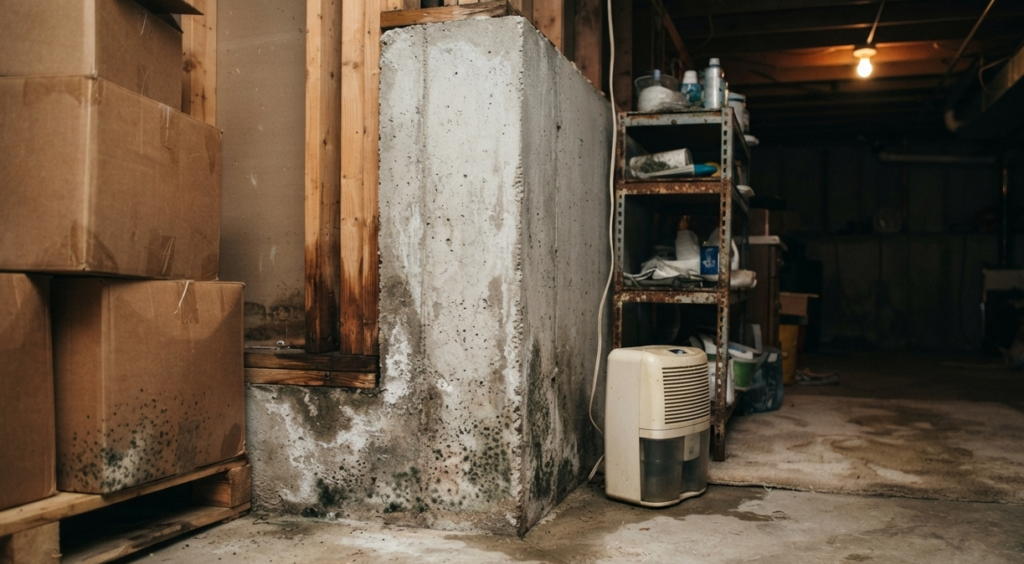
The arrival of late June brings long, sun-drenched days and beautiful outdoor weather to Berks County. However, it also brings a less welcome seasonal visitor: soaring regional humidity. As the outdoor air grows increasingly thick and sticky, many homeowners notice a familiar, unwelcome transformation happening right beneath their feet. You open the basement door, and you are immediately hit with a heavy, damp, and unmistakably musty odor.
That classic “musty basement smell” isn’t just a minor seasonal annoyance that you can ignore until autumn. It is an active warning sign. That odor is the primary indicator that your below-grade environment has crossed the threshold into the ideal breeding zone for fungal colonies.
Understanding the unique relationship between early summer weather, building physics, and fungal biology is your best defense. If you want to protect your property, safeguard your indoor air quality, and prevent mold growth in basement spaces this season, here is exactly what is happening behind your drywall—and the concrete steps you need to take to stop it.
The Science Behind the Summer Must: Why June is Peak Mold Season
To solve the mystery of the musty June basement, you have to look at how warm air interacts with a subterranean environment. Basements are surrounded by earth, which maintains a relatively cool, constant temperature of around $55^\circ\text{F}$ to $60^\circ\text{F}$ ($12^\circ\text{C}$ to $15^\circ\text{C}$) just a few feet below the surface.
When hot, moisture-laden June air makes its way into your home—whether through open windows, structural gaps, or your HVAC system—it eventually settles into the lowest point of the house. As that warm, humid air comes into contact with the cool concrete walls and floor of your basement, its temperature drops rapidly. Because cool air cannot hold as much moisture as warm air, the relative humidity in the basement spikes. If the surface temperature is cold enough, the moisture reaches its “dew point,” resulting in tiny droplets of condensation forming on your walls, pipes, and floor joists.
Mold spores exist naturally everywhere in the outdoor and indoor air, completely invisible to the naked eye. They are entirely harmless until they find three specific ingredients to kickstart a colony:
- Oxygen (abundant in any home)
- An organic food source (drywall paper, wooden studs, cardboard boxes, carpets, or dust)
- Moisture (relative humidity consistently above 60%)
When summer humidity pushes your basement’s relative humidity into the 70% or 80% range, stagnant mold spores find the final missing piece of the puzzle. Within just 24 to 48 hours of continuous moisture exposure, these spores germinate, take root in your structural materials, and begin emitting microbial volatile organic compounds (mVOCs). It is these airborne gasses that create that signature, earthy, musty smell.
4 Practical Steps to Lower Humidity and Prevent Mold Growth
Leaving your basement to fend for itself during a humid Pennsylvania summer is a recipe for an expensive structural cleanup down the road. Take a proactive approach this weekend by implementing these four environmental controls to keep your lower levels dry, fresh, and completely inhospitable to mold.
1. Deploy and Maintain a Heavy-Duty Dehumidifier
During the peak of summer, standard residential air conditioning units rarely remove enough moisture from subterranean spaces on their own. A dedicated basement dehumidifier is your single most powerful weapon against fungal growth.
- The Target: Set your dehumidifier to maintain a relative humidity level between 30% and 50%. Never let it rise above 50% if you want to actively prevent mold growth in basement environments.
- The Maintenance: A dehumidifier can only do its job if it runs continuously. If your unit relies on a manual collection bucket, it will likely fill up and automatically shut off within a few hours, leaving your basement unprotected while you are at work or asleep. If possible, hook up a direct hose expansion to route the condensate water straight into your sump pit or a floor drain. Additionally, clean the unit’s air filter every two weeks; a dusty filter restricts airflow, forcing the compressor to work harder, freeze up, or burn out prematurely.
2. Keep Basement Windows Firmly Shut
It is a common instinct for homeowners to open up basement windows on a warm summer day, thinking that a fresh breeze will air out the musty space. In reality, doing this achieves the exact opposite result.
- The Consequence: Opening windows during a humid June day allows a continuous stream of moisture-heavy air to rush inside, where it will instantly hit the cool basement surfaces and condense into liquid water. You are essentially feeding the mold precisely what it needs to thrive.
- The Rule: Keep your basement windows sealed tight throughout the high-humidity summer months. Rely entirely on mechanical dehumidification and air circulation to manage the indoor climate.
3. Optimize Subterranean Air Circulation
Stagnant air creates microclimates. Even if you have a dehumidifier running in the center of the basement, the air trapped in far corners, cluttered storage areas, or dark closets can remain highly humid and localized enough to foster mold growth.
- The Fix: Strategically position a few oscillating floor fans or air circulators to keep air moving constantly throughout the entire footprint of your lower level. Moving air speeds up evaporation, preventing stagnant condensation from settling on vulnerable building materials. Furthermore, pull storage bins and furniture a few inches away from exterior concrete walls to allow proper airflow behind them.
4. Ditch the Cardboard Storage Boxes
Mold requires an organic food source to grow, and cellulose-based products are its absolute favorite meal.
- The Risk: Standard brown corrugated cardboard boxes act like massive sponges in a high-humidity environment, absorbing airborne moisture until they become damp and soft. Once damp, a cardboard box stored on a concrete floor becomes an ideal incubator for mold, risking total destruction of the family photos, holiday decorations, or clothes stored inside.
- The Swap: Go through your basement storage and replace traditional cardboard boxes with heavy-duty, airtight plastic tote bins with secure lids. Not only do these bins keep moisture out, but they also cannot serve as a food source for fungal spores if an unexpected water event occurs.
Recognizing When to Call the Professionals
Sometimes, despite your best efforts with fans and retail dehumidifiers, the musty smell persists, or you actually begin to spot the physical signs of an infestation: dark spotting on drywall, a powdery white substance (efflorescence) on concrete walls, or visible fuzzy patches under your stairs.
If mold has already established a foothold across a surface area larger than 10 square feet, attempting to scrub it away with household bleach or generic sprays can actually worsen the situation. Aggressive scrubbing without containment releases millions of invisible spores into the air, allowing them to hitch a ride on your HVAC system and spread throughout the upper levels of your home.
When a musty odor indicates a larger, hidden problem, it is time to bring in professional assistance. As the Paramedics of Property Damage®, PuroClean of Reading specializes in precise biohazard remediation and comprehensive mold mitigation services.
Our local, highly trained professionals use specialized moisture meters and thermal imaging cameras to track down the exact source of hidden moisture behind your walls. We establish negative air pressure containment zones to completely isolate the affected area, ensuring surrounding rooms remain safe. Using HEPA filtration air scrubbers, antimicrobial sanitizing agents, and precise structural drying techniques, we eliminate the mold at its source, remove the airborne spores, and completely eradicate that stubborn musty smell.
Protect Your Home’s Foundation This Summer
Your basement shouldn’t be a source of stress or an indoor air hazard. By understanding how the changing June climate impacts your property and taking immediate control of your indoor humidity levels, you can maintain a clean, dry, and healthy space all year long.
Take a look at your basement environment today. Clean out those dehumidifiers, swap out those cardboard boxes, and check the corners for any early warning signs. If you discover a problem that feels beyond your control, remember that you don’t have to tackle it alone—PuroClean is always standing by to help restore your home to a safe, healthy state.