Serving Greenfield and the greater Indianapolis area
If you have noticed a musty smell in your bathroom, discoloration around the tub, or unexplained allergy symptoms at home, you may be facing more than a simple cleaning problem. Black mold in a bathroom can spread behind tile, under flooring, and inside wall cavities long before it becomes visible. This guide explains the warning signs, the science behind them, and what Greenfield and Indianapolis homeowners should do next.

Key Takeaways for Homeowners
- Black mold thrives in bathrooms because of consistently high humidity, warm temperatures, and limited airflow.
- Visible spotting is often just the surface of a much larger colony growing inside walls or subfloor.
- Health symptoms such as coughing, headaches, and skin irritation can signal mold exposure, including exposure to mycotoxins produced by certain mold species.
- Indianapolis area humidity, older housing stock, and seasonal temperature swings all increase bathroom mold risk.
- Professional remediation, not bleach and a sponge, is required once mold covers more than a small, contained area.
- PuroClean Disaster Restoration follows IICRC S500 and S520 standards for safe, documented mold remediation.
- If you recognize any of the signs below, call PuroClean Disaster Restoration at (317) 467-4436 for an inspection.
Understanding the Problem: What “Professional Mold Remediation” Actually Means
Before reviewing the warning signs, it helps to understand the standard that separates DIY cleanup from professional restoration. The Institute of Inspection, Cleaning and Restoration Certification (IICRC) publishes two documents that govern this industry: the S500 Standard for Professional Water Damage Restoration and the S520 Standard for Professional Mold Remediation. These standards define how technicians should assess moisture, contain a work area, remove contaminated materials, and verify that a space is safe again. When you hire a company that follows S500 and S520 protocols, you are hiring a process built on measurable science, not guesswork.
The 8 Warning Signs of Black Mold in Your Bathroom
1. A Persistent Musty or Earthy Odor
Mold produces microbial volatile organic compounds (mVOCs) as it grows, which create the distinct musty smell many homeowners describe. If this odor lingers even after cleaning, it usually means the colony is growing somewhere you cannot see, such as behind a vanity or inside a wall cavity.
2. Discoloration Around Grout, Caulk, or Baseboards
Black, green, or dark brown spotting along grout lines or baseboards is often the first visible sign. This staining indicates that spores have colonized a surface with enough consistent moisture to sustain growth.
3. Peeling or Bubbling Paint and Wallpaper
When moisture becomes trapped behind a painted or wallpapered surface, it weakens the adhesive bond. Bubbling or peeling near a bathroom wall is frequently a sign of hidden water intrusion and, by extension, a favorable environment for mold.
4. Warped or Soft Flooring Near the Tub or Toilet
Subfloor damage near plumbing fixtures is a strong indicator of long term moisture accumulation. Restoration professionals use infrared moisture detection and moisture mapping tools to locate saturation inside flooring and subfloor materials that is invisible to the naked eye.
5. Condensation That Never Fully Dries
If your bathroom mirror, window, or tile stays damp for hours after a shower, the room’s relative humidity and psychrometrics (the science of air and moisture behavior) are working against you. Chronic condensation is one of the clearest predictors of future mold colonization.
6. Unexplained Allergy or Respiratory Symptoms
Sneezing, coughing, sinus congestion, or headaches that improve when you leave the house can point to poor indoor air quality (IAQ) caused by airborne spores. Some mold species also produce mycotoxins, compounds that have been linked to more serious health complaints with prolonged exposure.
7. Visible Growth Behind or Under Fixtures
Pulling back a bath mat, moving a hamper, or checking under the sink and finding fuzzy or slimy patches is a clear sign that active colonization is underway, often fed by a slow leak.
8. A Recent History of Leaks, Flooding, or High Humidity
Any bathroom that has experienced a supply line leak, an overflow, or consistently high humidity from inadequate ventilation is at elevated risk, even if no visible mold has appeared yet.
Why Greenfield and Indianapolis Bathrooms Are Especially Vulnerable
Central Indiana’s climate plays a direct role in bathroom mold risk. Indianapolis area summers bring high humidity and dew points that push moisture into homes, while winter heating cycles create condensation on cooler bathroom surfaces. Many homes throughout Greenfield and the surrounding Indianapolis neighborhoods were built decades ago with limited or no bathroom exhaust ventilation, a factor that local building codes have since addressed for new construction but that older housing stock still lacks. Homes with basement level or slab on grade bathrooms are also more prone to elevated humidity because of limited airflow and proximity to ground moisture.
What Professional Remediation Looks Like for Mold Inspection and Removal
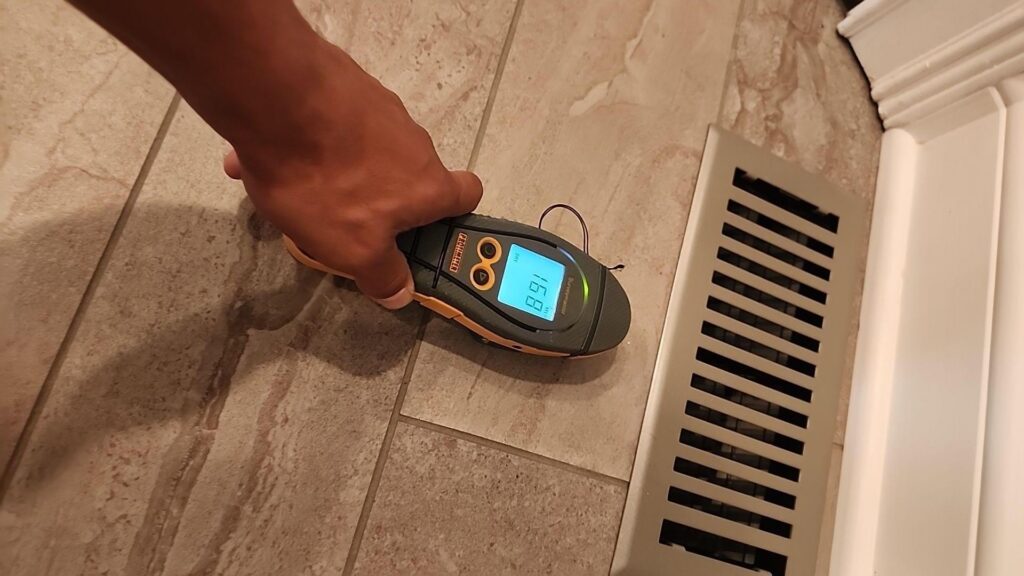
Once mold is confirmed, a qualified restoration team follows a structured process:
- Inspection and moisture mapping to identify the full extent of water intrusion, often using thermal imaging and hygrometers to measure relative humidity in affected materials.
- Containment setup using physical barriers and negative air pressure to prevent spores from spreading to unaffected areas of the home during work.
- Air filtration with HEPA filtration equipment and air scrubbers to capture airborne spores throughout the remediation process.
- Removal of contaminated materials, including drywall, insulation, or flooring that cannot be safely restored.
- Treatment of remaining surfaces with an EPA registered antimicrobial biocide to eliminate residual spores.
- Structural drying using dehumidification equipment until moisture readings return to normal, dry standard levels.
- Post remediation verification to confirm the space meets clearance standards before the area is considered safe again.
Frequently Asked Questions
Does home insurance cover mold caused by high humidity in Greenfield and Indianapolis homes?
Coverage depends on the cause. Most standard homeowners policies cover mold that results from a sudden, accidental event, such as a burst pipe, but they typically exclude mold caused by long term neglect or gradual humidity buildup. A documented inspection from a certified restoration company can help clarify whether your specific situation qualifies for a claim.
Can I remove black mold myself with bleach?
Bleach can address small, surface level mold on non porous materials, but it does not reach spores that have penetrated drywall, wood, or subfloor. For any area larger than roughly ten square feet, the EPA and IICRC recommend professional remediation rather than DIY treatment.
How quickly can mold grow after a leak in an Indianapolis area bathroom?
Under favorable conditions of warmth and moisture, mold spores can begin colonizing surfaces within 24 to 48 hours of water exposure, which is why prompt drying and inspection are critical after any leak.
Is black mold always toxic?
Not every dark colored mold is the toxin producing species commonly referred to as “black mold.” However, any mold growth can affect indoor air quality and should be professionally identified and addressed rather than assumed to be harmless.
What should I do first if I suspect mold in my bathroom?
Avoid disturbing the affected area, since scrubbing or sanding can release additional spores into the air. Increase ventilation if possible, and contact a certified restoration provider for a moisture and air quality assessment.
Take Action Before the Problem Spreads
Black mold rarely stays contained to the spot where you first notice it. The sooner a certified team evaluates your bathroom, the more likely you are to resolve the issue before it spreads into walls, flooring, or your home’s air supply. PuroClean Disaster Restoration serves Greenfield and the greater Indianapolis area with S500 and S520 compliant mold assessment and remediation.
Call PuroClean Disaster Restoration today at (317) 467-4436 for an immediate inspection and get your bathroom back to a safe, healthy condition.