By PuroClean Disaster Restoration, Greenfield, Indiana
Reviewed for technical accuracy by PuroClean Disaster Restoration’s IICRC-certified restoration team.
Flood damage and water damage sound like the same problem, but insurance companies treat them as two different events. That difference can decide who pays for your basement. Restoration professionals work from the IICRC S500 Standard for Professional Water Damage Restoration, which defines water categories, damage classes, and the drying goals behind every job. This guide explains how Indiana policies usually separate flood from water damage, what each one covers, and how long it takes to dry a flooded basement in Greenfield and the surrounding Hancock County neighborhoods.
Water and mold do not wait for a claims adjuster. If your basement has standing water or damp walls right now, a quick call can stop the damage from spreading. PuroClean Disaster Restoration at (317) 467-4436 can tell you what to do in the next hour while you sort out your insurance.
What is the difference between flood damage and water damage?
Flood damage comes from water that enters a home from outside, such as rising groundwater, overland runoff, or overflowing rivers and streams. Water damage usually means sudden, accidental water released inside the home, such as a burst supply line or a failed water heater. Insurers define each term differently, and the cause of the loss decides which policy responds.
In Greenfield, the most common flood mechanism is not a river. It is the spring thaw. As snow melts and rain soaks the ground, the water table rises and presses against basement floors and walls. Engineers call this hydrostatic pressure. Water finds the weakest path, which is often the joint where the floor meets the wall, a hairline crack, or a mortar joint. Gutters and downspouts that dump water near the foundation, and soil that slopes toward the house, add to the load.
Some losses sit in a gray area. A sump pump that fails during a storm, or a sewer line that backs up through a floor drain, may or may not count as “flood” depending on your policy wording. That is why reading the exact language matters more than the label on the event.
Actionable takeaway: Write down where the water came from, because the source of the water usually decides which coverage applies.
What does a standard Indiana homeowners policy cover?
A standard homeowners policy typically covers sudden and accidental water damage from inside the home, such as a burst pipe, a failed supply line, or a leaking water heater. It generally excludes flood, surface water, and groundwater seepage. Sump pump overflow and sewer backup usually require an added endorsement.
Policies also tend to exclude damage that develops slowly over time, such as a long-term leak or repeated seepage that the homeowner could have prevented through maintenance. Wording varies by insurer and by policy, so the details of your declarations page and endorsements matter. The Indiana Department of Insurance publishes consumer guidance on homeowners and flood coverage and accepts consumer questions, and it is a reliable starting point if your claim is denied or unclear.
If your basement took on groundwater during a spring thaw, expect the adjuster to ask where the water entered and for how long. A water backup endorsement, sometimes called sump pump or sewer backup coverage, is the piece many Greenfield homeowners discover they are missing only after a loss.
Actionable takeaway: Pull out your policy today and look for the words “water backup,” “sump pump,” and “flood” so you know where you stand before the next storm.
Does flood insurance cover a flooded basement?
Flood insurance covers a flooded basement only in part. Federal flood policies through the National Flood Insurance Program, and many private flood policies, cover certain basement structural elements and equipment but usually limit what is covered below grade. Finished walls, flooring, and belongings in a basement often receive limited or no coverage.
FEMA flood guidance states that flooding can happen outside mapped high-risk zones, which is why Hancock County homeowners outside a Special Flood Hazard Area still face groundwater and runoff risk. NFIP policies generally carry a waiting period before coverage starts, commonly 30 days, so buying a policy after you see storm clouds is too late. Lenders require flood coverage in mapped high-risk zones, but many homeowners elsewhere can choose to buy it.
Private flood policies differ from NFIP policies in limits, basement treatment, and waiting periods. Ask your agent to explain basement coverage in plain terms, and ask for it in writing.
Actionable takeaway: Ask your agent what your policy pays for below grade, including finished basement materials and stored belongings.
How long does it take to dry a flooded basement?
Most flooded basements need about 3 to 5 days of structural drying after standing water is extracted. Sewage contamination, deep saturation of concrete block or stone, or delays before drying begins can stretch the timeline to a week or more. Drying is complete when materials reach the dry standard set by IICRC S500.
The timeline depends on four things: the water category, the damage class, the materials involved, and how soon drying starts. Technicians use psychrometrics, the science of air temperature, humidity, and moisture content, to control the drying environment. They track humidity in grains per pound with a hygrometer and check material moisture with meters and thermal imaging. The goal is not just dry air. The goal is for wood, drywall, concrete, and framing to return to normal moisture content.
Spring in central Indiana can slow the job. Outdoor air is often damp, so the equipment must work harder to pull moisture out of the structure. Low-grain refrigerant (LGR) dehumidifiers do most of that work, paired with air movers that drive moisture off surfaces.
Actionable takeaway: Ask any contractor how they will prove the basement is dry. The answer should include documented moisture readings, not a guess.
What happens during professional basement flood drying?
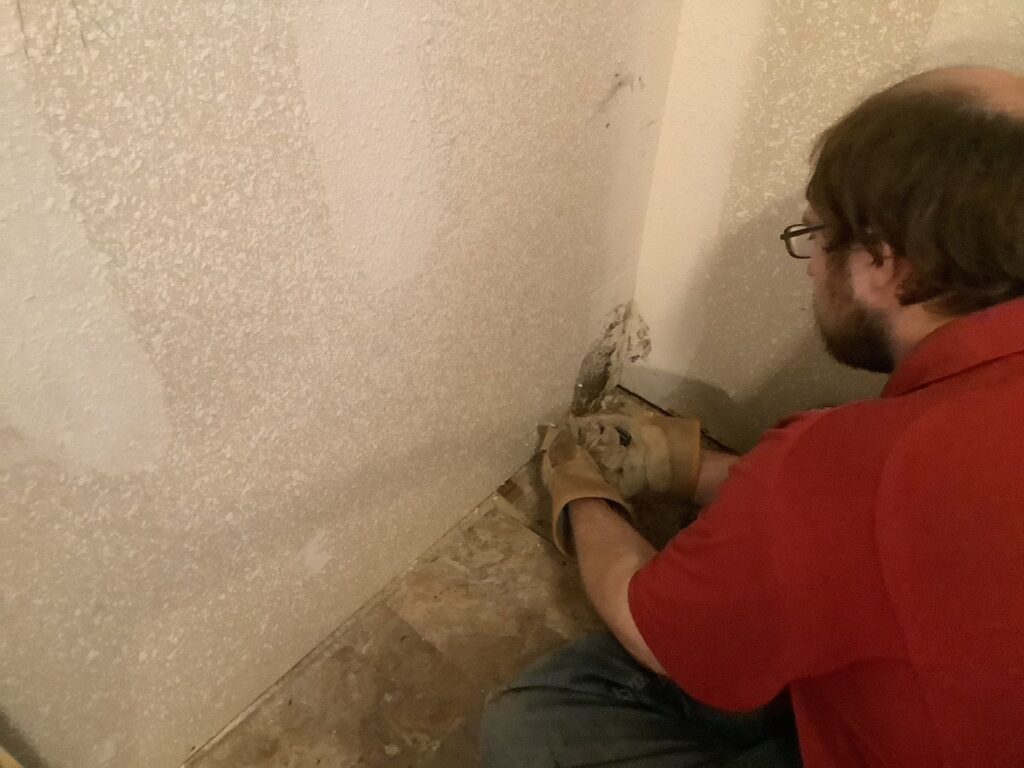
Professional drying follows a set sequence under IICRC S500: stop the source, extract water, map moisture, remove what cannot be saved, dry the structure, and verify dryness with readings. Each step is documented, which also supports the insurance claim. Here is how a typical Greenfield basement job runs.
- Stop the source and make the area safe. Technicians check for electrical hazards, shut off affected circuits when needed, and confirm whether the water is clean, gray, or black.
- Extract standing water. Truck-mounted or portable extraction units remove the bulk of the water. Faster extraction means less water absorbed into framing and block.
- Map the moisture. Technicians use moisture meters and thermal imaging cameras to trace how far water traveled behind walls and under flooring, then record baseline readings.
- Remove unsalvageable materials. Wet carpet, pad, and saturated drywall are cut out. Flooded insulation and any porous material touched by black water are removed.
- Set containment and air control. A containment barrier keeps contaminants from reaching the upstairs living space. Negative air pressure and HEPA air scrubbers filter particles from the work area.
- Apply antimicrobial treatment. An antimicrobial biocide is applied to surfaces to limit bacterial and mold growth, following the contamination category.
- Install drying equipment. LGR dehumidifiers and air movers are placed according to the room’s size and the Class of water damage, then monitored.
- Monitor daily and verify. Technicians return to take readings, adjust equipment, and remove it only once materials reach the dry standard.
Watch for subfloor delamination if the basement has a finished floor system. Plywood and engineered flooring can separate when saturated, and finding it early prevents a second repair.
Actionable takeaway: Keep every moisture log and equipment record. Adjusters often ask for them.
If you see any of these signs, stop and call a professional right away: water coming up through a floor drain, a sewage smell, water touching outlets or the electrical panel, or a musty odor that returns after you have dried the surface. These point to contamination or hidden moisture that household fans and a wet vac cannot fix. Call PuroClean Disaster Restoration at (317) 467-4436 for emergency dispatch to Greenfield and Hancock County.
How does a sewer backup change the timeline?
A sewer or drain backup is Category 3 water, also called black water, and it lengthens every step of cleanup. Porous materials touched by it must be removed, surfaces need cleaning and disinfection, and contamination control adds time. Expect a longer job and a more detailed scope than a clean-water leak.
Sewer system overload during heavy storms can push wastewater back through floor drains and sanitary laterals. IDEM, the Indiana Department of Environmental Management, regulates sewer overflow and sets the framework for how overflow contamination is categorized and addressed. For homeowners, the practical rule is simple: treat any backup as contaminated, keep children and pets away, and avoid cross-contamination by not carrying wet items through clean rooms.
Containment matters more here than speed alone. Technicians isolate the affected area, work under negative air pressure, and clean in a set order to prevent spreading contaminants upstairs.
Actionable takeaway: Do not wade into sewage water without protective gear, and do not run your HVAC system until the area is controlled.
Why do Greenfield basements dry at different speeds?
Greenfield basements dry at different speeds because of how they are built. Poured concrete dries slowly from the inside. Concrete block holds water in its hollow cores. Older fieldstone and mortar basements wick moisture through original mortar joints. Material, age, and the depth of saturation all change the drying plan.
Hancock County subdivisions are full of postwar ranch and split-level homes on poured concrete or block foundations. Block walls can hold moisture in the cores long after the surface looks dry. Older brick homes near the historic downtown often sit on fieldstone or aging block, where seepage through mortar joints is common and moisture can run deeper into the wall.
When water has soaked into dense materials or has been present for several days, technicians may classify the loss as Class 4, a specialty drying situation that needs longer, more controlled drying and sometimes added equipment. Saturated concrete and stone release moisture slowly, so patience and measurement matter more than appearances.
Mold is the other clock. Mold can start on damp materials within 24 to 48 hours, and some molds produce mycotoxins, compounds that can irritate people with sensitivities. Quick extraction and steady drying remove the moisture mold needs.
Actionable takeaway: Fix the exterior causes. Extend downspouts away from the foundation, clear gutters, and check the grading before the next thaw.
How do you document a flood loss for your insurance claim?
Document the loss before cleanup starts and keep records throughout. Take dated photos and video, list damaged items, save receipts, and keep written records of every call with your insurer. Good documentation speeds the claim and shows what the water touched and when.
- Photograph the water line and source. Capture wide shots and close-ups, including the point where water entered if you can find it.
- Record damaged belongings. List item, age, and estimated value, and keep damaged items until the adjuster approves disposal when it is safe.
- Call your insurer promptly. Ask what your policy covers and request the claim number and adjuster contact information.
- Take reasonable steps to prevent more damage. Many policies require this, and emergency mitigation is typically part of a covered loss. Keep receipts.
- Save the restoration records. Moisture logs, equipment placement, and daily readings help show the scope of work.
PuroClean Disaster Restoration works with insurance carriers, offers direct insurance billing support, and keeps documentation ready for adjusters.
Actionable takeaway: Photograph first, then move or remove anything. The original condition is your best evidence.
When can you handle a wet basement yourself?
You can handle a small, clean-water leak that covers a limited area, has been wet for under 24 hours, and has not reached walls or electrical systems. Anything larger, longer, or contaminated needs a professional. Household fans cannot dry wall cavities or block, and hidden moisture invites mold.
A good threshold is simple. If water came from the ground or a sewer, if it has been present more than a day, if it touched drywall or insulation, or if you smell mustiness, bring in IICRC-certified help. What separates PuroClean Disaster Restoration from a generic cleanup service is 24/7 emergency dispatch, IICRC-certified technicians, and direct insurance billing support for Greenfield and Hancock County homes.
Actionable takeaway: When in doubt, get a moisture reading. It is faster and cheaper than guessing.
Frequently Asked Questions
Does homeowners insurance cover a flooded basement in Indiana? Usually not when the water comes from outside, such as groundwater or runoff. Standard policies typically exclude flood. Sudden internal causes like a burst pipe are generally covered. Sump pump overflow and sewer backup usually need an added endorsement. Review your policy or ask your agent for the exact wording.
What is the difference between flood damage and water damage? Flood damage is water that enters from outside, such as rising groundwater or overland runoff. Water damage is typically sudden, accidental water from inside the home, such as a burst pipe or failed appliance. Insurers treat them as separate causes, and each may be covered by a different policy or endorsement.
How long does it take to dry a flooded basement? Most basements need about 3 to 5 days of structural drying after water is extracted. Sewage contamination, saturated block or stone, and delayed response can extend that to a week or longer. Drying is finished when moisture readings meet the dry standard under IICRC S500, not when surfaces feel dry.
How much does flooded basement cleanup cost? Cost depends on the square footage affected, the water category, the damage class, the materials removed, and how long drying takes. Sewage backup and Class 4 saturation cost more than clean-water leaks. A professional assessment with moisture readings gives a defensible estimate, and your insurer may cover part of it.
Can I dry a flooded basement myself? You can handle a small, clean-water spill caught within 24 hours using a wet vac, fans, and a dehumidifier. Contaminated water, ground water, wet drywall, or lingering odor calls for a professional. Hidden moisture in block walls and framing is hard to detect without moisture meters and thermal imaging.
Is a flooded basement a health risk in Greenfield? Yes. Sewage backup can carry bacteria and other contaminants, and damp materials can grow mold within 24 to 48 hours. People with asthma, allergies, or weakened immune systems are more sensitive. Avoid contact with the water, keep children and pets out, and call a professional before disturbing wet materials.
Need Help Now? Call PuroClean Disaster Restoration
If your Greenfield basement is wet, the next 24 hours matter. PuroClean Disaster Restoration serves Greenfield, Indiana and surrounding Indianapolis-metro neighborhoods in Hancock County with IICRC-certified technicians and 24/7 emergency dispatch.
Call (317) 467-4436 to talk with a restoration professional, get guidance on what to do before help arrives, and learn how we can work with your insurance company.
PuroClean Disaster Restoration, 625 S. State St., Greenfield, IN 46140