


Reviewed for technical accuracy by PuroClean Disaster Restoration’s IICRC-certified restoration team.
Water and mold damage get worse by the hour. If water is still in your home, call PuroClean Disaster Restoration at (317) 467-4436 for 24/7 emergency dispatch while you work through this checklist.
What Is Flood Cleanup, and Which Standard Governs It?
Flood cleanup is the process of stopping water entry, removing contaminated water and materials, drying the structure, and sanitizing surfaces. Professionals follow the ANSI/IICRC S500 Standard for Professional Water Damage Restoration. It classifies water by contamination and by how much moisture materials absorb, which determines the safe method for each job.
For homeowners in Greenfield and the surrounding Indianapolis-metro neighborhoods of Hancock County, the S500 framework matters because most local flooding is not a clean burst pipe. It is groundwater, storm runoff, or sewer backup, and each carries different risks. FEMA flood guidance echoes the same priorities: personal safety first, documentation second, then fast removal of water and wet materials.
Takeaway: Treat every flood as contaminated until a trained person says otherwise.
Why Do Greenfield Homes Flood in Spring?
Greenfield homes flood in spring mainly because melting snow and rain raise the underground water table. That water presses against basement floors and walls, a force called hydrostatic pressure, and finds any crack, joint, or floor drain. Storm sewers and sump pumps can then be overwhelmed at the same time.
Housing style changes the pattern. Postwar ranch and split-level homes in Hancock County subdivisions usually sit on poured concrete or block foundations, where seepage tends to show up at the floor-wall joint or through hairline cracks. Older brick homes near the historic downtown often have fieldstone or aging block basements, and the original mortar joints can weep groundwater slowly for days. Gutters that dump water beside the foundation, soil that slopes toward the house, and failed sump pumps add to the load.
Takeaway: Walk your property before the spring thaw and check that downspouts discharge well away from the foundation.
What Should You Do in the First Hour After a Flood?
In the first hour, protect your safety, stop the water source, and document the damage. Do not enter standing water until power is off. Then take photos and video before touching anything. These steps protect your health and your insurance claim at the same time.
- Turn off electricity to the affected area. Shut off the breaker only if you can reach the panel without stepping in water. If the panel is wet, call your utility and an electrician. Water and live circuits can be fatal.
- Shut off gas if you smell it, and leave. Do not use open flames or run gas appliances in a flooded space.
- Stop the source if you can. Close the main water valve for a supply line failure. For groundwater or storm entry, you usually cannot stop it, so focus on keeping people and valuables clear.
- Identify the water category. Clean supply water is Category 1. Water with some contamination is Category 2. Groundwater, river or storm water, and any sewer backup is Category 3, or black water. IDEM guidance on sewer overflows treats sewage-contaminated water as a public health hazard, so assume Category 3 if a floor drain or toilet backed up.
- Photograph and video everything. Capture the waterline, damaged belongings, and the source. Do this before you move or throw away anything.
Takeaway: Document first, then act. Insurers rely on what you can show.
Who Should You Call First After a Flood?
Call your insurance company first to open a claim, then a licensed restoration company. Most policies require prompt notice. Ask what your policy says about water backup and flood coverage, because those are often separate endorsements or separate policies entirely.
- Call your insurer the same day. Give a clear description, ask about coverage for water backup, and ask what documentation they want. Keep a log of every call.
- Call a restoration professional. A certified crew can begin extraction and drying while you wait for an adjuster. Waiting for the adjuster before starting mitigation usually makes the loss larger.
If you see any of these, stop and call a professional now: sewage odor, water that came up through a floor drain or toilet, standing water deeper than a few inches, or a musty smell that returns after you clean. These are signs of Category 3 contamination or hidden moisture, and DIY cleanup can spread the problem. PuroClean Disaster Restoration can be at your Greenfield home any hour at (317) 467-4436.
Takeaway: Open the claim and start mitigation in parallel, not one after the other.
How Do You Remove Floodwater Safely?
Remove floodwater gradually and with protective gear. Wear waterproof boots, gloves, and an N95 or better respirator. Pump out basement water in stages rather than all at once, because emptying too fast can let outside soil pressure damage walls and floors.
- Put on personal protective equipment. Rubber boots, nitrile gloves, eye protection, and a respirator are the minimum for any flood that may be contaminated.
- Pump standing water slowly. FEMA guidance advises removing basement water in stages, about one third at a time, so that pressure outside the walls does not collapse them inward. A submersible pump or a wet vacuum handles shallow water. Professionals use truck-mounted or portable extractors for carpet and deeper loss.
- Move salvageable contents to a dry, clean area. Lift furniture off wet carpet, and set electronics aside for a technician to evaluate. Do not plug in anything that was wet.
Takeaway: Slow pumping and proper gear prevent a second disaster on top of the first.
Which Materials Must Be Removed After a Flood?
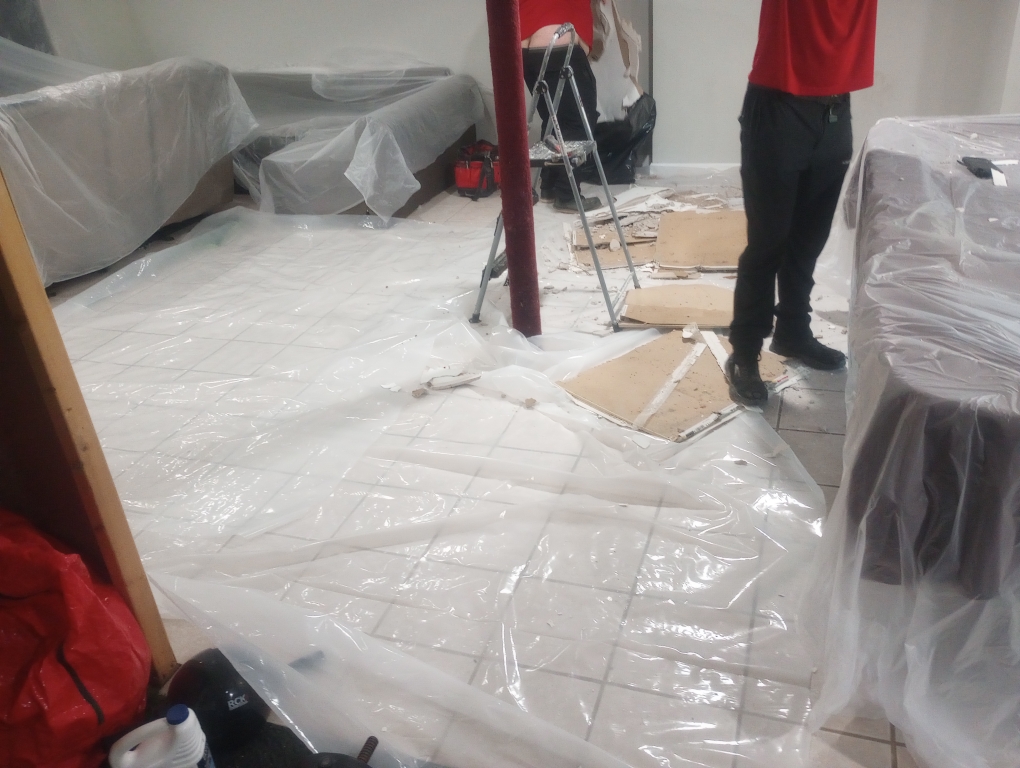
Porous materials touched by contaminated water must be removed, not dried. This includes carpet, carpet pad, insulation, and drywall. Hard, nonporous items can usually be cleaned and disinfected. When water has been in contact for more than a day or two, even structural wood needs a professional evaluation.
- Tear out wet carpet and pad. Cut it into manageable strips and bag it. Carpet and pad that sat in Category 3 water cannot be saved.
- Cut out wet drywall and insulation. Technicians typically make a flood cut at least a foot or two above the visible waterline, then check readings above the cut to confirm the wicking has stopped. Wet insulation holds moisture against framing and must go.
- Check subfloors and baseboards. Prolonged soaking causes subfloor delamination, where layers of plywood or OSB separate and lose strength. Thermal imaging cameras help locate moisture inside walls and under floors without demolishing more than needed.
Takeaway: If a material cannot be cleaned and fully dried within 48 hours, plan to replace it.
How Do Professionals Dry and Sanitize a Flooded Home?
Professionals dry a flooded home by mapping moisture, setting air movers and dehumidifiers, and tracking readings daily until the structure reaches its drying goal. They then apply an antimicrobial biocide to cleaned surfaces. This is structural drying, and it follows psychrometric principles that control humidity and temperature.
A typical sequence works like this. Technicians first perform moisture mapping with a meter and thermal imaging to find every wet area, including the ones you cannot see. They then set low-grain-refrigerant (LGR) dehumidifiers and high-velocity air movers sized to the room. They record hygrometer readings, temperature, and material moisture each day and adjust equipment as the space dries. Severe soaking, such as a basement saturated with groundwater for days, can qualify as Class 4 water damage, which involves deeply held moisture in dense materials like concrete, plaster, or hardwood and calls for specialty drying methods.
- Clean and disinfect every surface that stays. Remove silt and debris first, wash with detergent, then apply an EPA-registered antimicrobial. Use separate tools for clean and contaminated areas to avoid cross-contamination.
- Dry the structure and verify. Run LGR dehumidifiers and air movers until moisture readings match an unaffected reference area. Surfaces that feel dry can still hold moisture inside, which is where hidden mold begins.
Takeaway: Dry means measured dry. Ask any contractor for the readings, not just their word.
How Do You Prevent Mold After a Flood?
Prevent mold by finishing drying within 24 to 48 hours, keeping indoor humidity low, and inspecting for hidden growth. According to EPA mold guidance, controlling moisture is the only reliable way to control mold. Mold growth on wet drywall, wood, and fabric can start in that same short window.
If mold appears, the response changes. Professionals set a containment barrier of poly sheeting, run negative air pressure so spores flow toward filtered exhaust rather than into clean rooms, and use HEPA filtration and air scrubbers to capture airborne particles. Some molds produce mycotoxins, so do not scrub visible growth dry or run a fan across it, which spreads spores through the house. Keep a hygrometer in the basement and aim for steady, moderate humidity.
After repairs, fix the cause. Extend downspouts away from the foundation, regrade soil so it slopes away from the house, seal visible foundation cracks, and test your sump pump before each spring thaw. A battery backup is worth considering for storm-season outages.
Takeaway: Cleanup is only finished when the cause of the flooding has been addressed.
Why Choose a Certified Local Team for Flood Cleanup?
PuroClean Disaster Restoration serves Greenfield and the Hancock County area with 24/7 emergency dispatch, IICRC-certified technicians, and direct insurance billing, so you are not fronting costs while you wait for a claim. Local crews know the area’s basements, from postwar slab-and-block homes to downtown brick with fieldstone foundations.
Frequently Asked Questions About Flood Cleanup in Greenfield
Does homeowners insurance cover flood damage in Indiana? Standard homeowners policies usually exclude flood from rising groundwater or surface water. Sudden pipe bursts and some water backups may be covered, often only with an added endorsement. Flood coverage typically comes from a separate policy such as the National Flood Insurance Program. Read your policy and ask your agent before filing.
How much does flood cleanup cost? Cost depends on water category, square footage affected, materials involved, and drying time. Category 3 loss costs more than clean water because more material must be removed and disinfected. A reputable company provides a written estimate after moisture mapping, and many bill your insurer directly.
How long does flood cleanup and drying take? Water extraction takes hours. Structural drying usually runs three to five days, though dense materials or Class 4 water damage can take longer. Daily moisture readings, not a fixed calendar, determine when drying is complete. Repairs and rebuilding follow after the structure meets its drying goal.
Can I clean up a flooded basement myself? You can handle a small, clean-water spill if you start within hours and dry thoroughly. Call a professional if water is deeper than a few inches, came from a sewer or floor drain, soaked drywall or insulation, or has been present for more than 24 hours. Contaminated water and hidden moisture need trained handling.
Is flood mold dangerous for my family? It can be. Mold exposure may trigger allergy and asthma symptoms, and some people, including children, older adults, and anyone with respiratory conditions, are more sensitive. Visible growth or a persistent musty smell after a Greenfield spring flood should be inspected rather than ignored or covered with paint.
What should I do before spring snowmelt to avoid basement flooding? Clear gutters, extend downspouts several feet from the foundation, check that soil slopes away from the house, and test your sump pump by pouring water into the pit. Seal visible foundation cracks. Older homes with fieldstone or block walls should be checked for seepage at the mortar joints.
Need Help Now? Call PuroClean Disaster Restoration
If your Greenfield home has flooded, you do not have to handle it alone. PuroClean Disaster Restoration is located at 625 S. State St., Greenfield, IN 46140, and serves Greenfield and surrounding Hancock County neighborhoods. Call (317) 467-4436 any time, day or night. Our IICRC-certified technicians are available 24/7 and can bill your insurance company directly.
SEO and Technical Output
SEO Title Tag (under 60 characters): 15 Flood Cleanup Steps for Greenfield, IN Homeowners
Meta Description (under 155 characters): Flooded home in Greenfield? Follow 15 expert flood cleanup steps to stop mold fast. Get 24/7 help from certified pros. Call now.
URL Slug: /flood-cleanup-steps-greenfield-in
FAQPage Schema (JSON-LD):
Internal Link Anchor Text Suggestions:
- water damage restoration in Greenfield
- basement flood cleanup services
- sewage backup cleanup
- mold remediation after flooding
- emergency water extraction