


Key Takeaways for Homeowners
- Spring thaw cycles in Central Indiana create hydrostatic pressure against slab and basement foundations, forcing moisture into hidden cavities.
- Hidden water damage follows IICRC S500 standards for water intrusion and S520 standards for microbial contamination; early detection prevents secondary damage.
- Musty odors, warped hardwood, discolored drywall, efflorescence on masonry, and sudden utility spikes are the five critical warning signs.
- Homes in Greenfield and Indianapolis built on clay-heavy soils or with aging galvanized plumbing face elevated risk during spring precipitation events.
- Professional moisture mapping, thermal imaging, and psychrometric analysis are required to locate non-visible moisture before mold colonization begins.
What Is Hidden Water Damage and Why Does It Worsen in Spring?
Hidden water damage refers to moisture intrusion that occurs within wall cavities, beneath flooring systems, inside crawl spaces, or above ceiling assemblies where it remains undetected by routine visual inspection. Unlike overt flooding, this damage operates silently, degrading structural substrates and creating ideal conditions for mold amplification.
In the Greenfield and Indianapolis corridor, spring introduces a unique convergence of risk factors. Central Indiana sits on expansive clay soils that swell during spring rains and contract during dry periods, creating foundation stress cracks. When snowpack melts and spring storms deliver heavy precipitation, hydrostatic pressure builds against foundation walls and slab perimeters. Water exploits these micro-fractures, entering basements and crawl spaces without visible pooling.
The region’s humid continental climate produces average spring relative humidity levels between 65% and 75%, slowing evaporation and extending the drying time of saturated building materials. Indianapolis also features a significant inventory of mid-century ranch homes and historic Victorian properties in neighborhoods like Irvington and Fountain Square, many of which retain original galvanized steel plumbing that corrodes from the interior, producing pinhole leaks inside walls.
According to IICRC S500, water damage is categorized by contamination level and structural impact. Category 1 water can degrade to Category 2 or 3 within 48 to 72 hours if left untreated, triggering microbial growth and compromising indoor environmental quality.
The 5 Devastating Signs Indianapolis Homeowners Cannot Ignore
Sign 1: Persistent Musty Odors Without a Visible Source
A musty odor indicates active microbial volatile organic compound (MVOC) off-gassing, typically from mold colonization in hidden spaces. When you detect this smell but cannot locate visible mold, the contamination likely exists behind drywall, under carpet pad, or within HVAC ductwork.
In Indianapolis homes with crawl space foundations, common in Greenfield and surrounding Hancock County, ground vapor rises through unsealed crawl spaces and enters the living envelope through floor penetrations. This creates chronic humidity that sustains mold growth even without a liquid water event. MVOCs produced during fungal metabolism include compounds such as geosmin and 1-octen-3-ol, which humans detect at extremely low concentrations.
What to do: Do not mask the odor with air fresheners. Contact a certified restoration professional to perform moisture mapping and air sampling. If mycotoxin-producing species such as Stachybotrys chartarum or Aspergillus are identified, containment with negative air pressure and HEPA filtration is required before remediation begins.
Sign 2: Warping, Cupping, or Buckling of Hardwood Floors
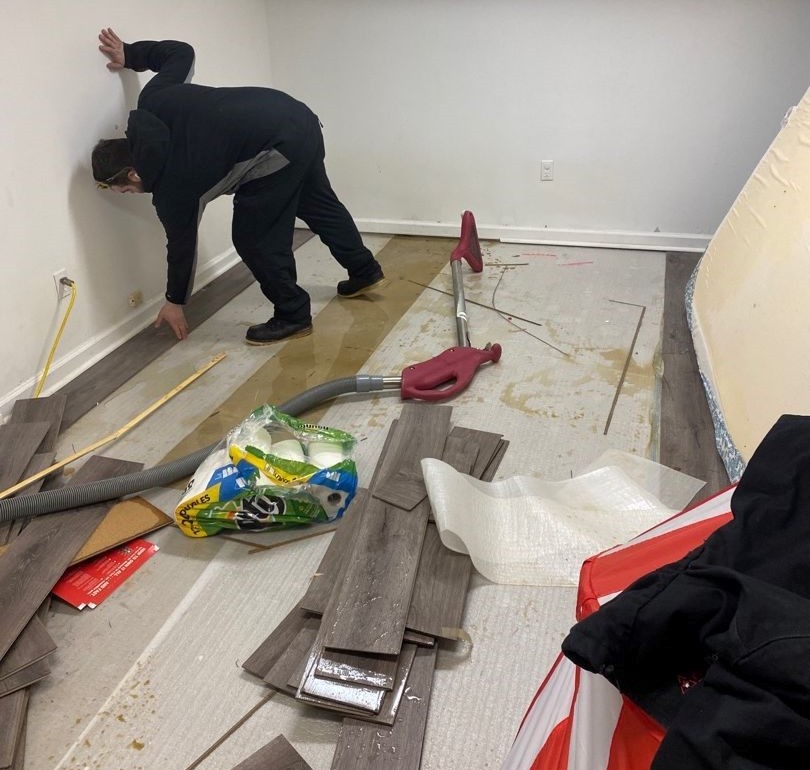
Hardwood flooring is hygroscopic, meaning it absorbs and releases moisture in response to ambient conditions. When hidden moisture accumulates beneath the flooring substrate, the bottom of the boards expands faster than the top, causing cupping (edges raised) or crowning (center raised). Buckling occurs when the boards detach from the subfloor entirely.
Indianapolis neighborhoods like Broad Ripple and Meridian-Kessler feature historic homes with original oak or maple hardwood installed directly over crawl spaces or unconditioned basements. Spring groundwater intrusion through compromised vapor barriers creates the exact conditions that trigger these deformations.
What to do: Surface drying will not resolve subfloor saturation. A professional team must deploy injectidry systems or tenting methods to deliver targeted airflow beneath the flooring. Moisture content readings must return to within 2% of the equilibrium moisture content (EMC) for the species before refinishing.
Sign 3: Discoloration, Staining, or Softening of Drywall and Ceilings
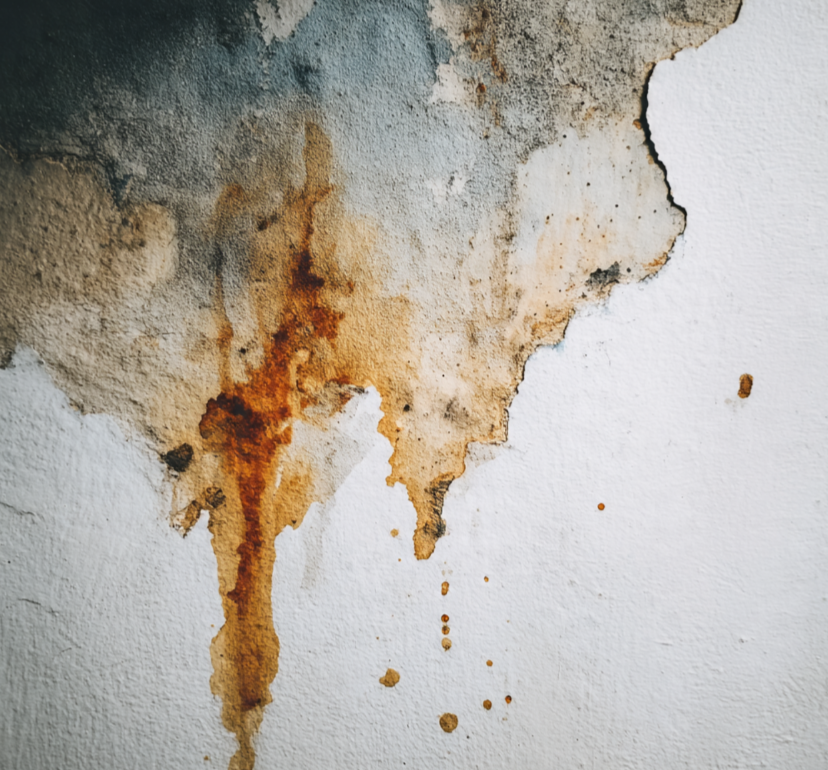
Water staining on drywall appears as yellowish-brown discoloration that expands in irregular patterns. When the gypsum core becomes saturated, the paper facing delaminates and the panel loses structural integrity. Ceiling stains often indicate roof leaks, ice dam infiltration from winter damage, or plumbing failures in second-floor bathrooms.
In Greenfield’s newer construction zones, rapid build schedules sometimes result in improper flashing around windows and doors. Spring wind-driven rain exploits these vulnerabilities, channeling water into wall cavities where it wicks upward through insulation and downward through ceiling assemblies.
What to do: Do not paint over stained drywall. The core may contain elevated moisture content supporting mold growth. Affected panels must be removed, cavity drying must be completed with desiccant dehumidification, and antimicrobial biocide treatment must be applied to framing members before reconstruction.
Sign 4: Efflorescence or Damp Spots on Basement Walls and Floors
Efflorescence is the white, powdery deposit left when water migrates through concrete or masonry, dissolving soluble salts and depositing them on the surface as the water evaporates. Its presence proves that liquid water is actively moving through the foundation matrix.
Indianapolis and Greenfield homes built on the Tipton Till Plain often feature basements with block walls that experience seepage through mortar joints during spring. The clay soils surrounding these foundations retain meltwater, creating sustained hydrostatic pressure. Damp spots that appear after rainfall but dry between events indicate intermittent seepage that will progressively worsen as freeze-thaw cycles degrade the masonry.
What to do: Interior waterproofing alone is insufficient. A restoration professional must identify the source, which may require exterior grading correction, downspout extension, or sump pump installation. Interior mitigation includes cavity drainage systems, vapor barrier installation, and dehumidification to achieve relative humidity below 60%.
Sign 5: Unexplained Increases in Water Bills or Utility Costs
A sudden spike in your municipal water bill without a corresponding change in usage behavior indicates a concealed plumbing leak. A running toilet wastes approximately 200 gallons daily; a pinhole leak in a pressurized supply line hidden inside a wall can waste thousands of gallons monthly while saturating insulation and framing.
Aging infrastructure in Indianapolis neighborhoods like Garfield Park and the Near Eastside includes original copper or galvanized service lines that corrode internally. Spring ground shifting from clay soil expansion can stress these lines, accelerating failure. Additionally, water heaters in utility closets often develop tank fractures or valve leaks that drain into adjacent wall cavities.
What to do: Perform a meter test by shutting off all fixtures and observing the flow indicator. If movement continues, the leak is on the supply side and requires immediate professional location services using acoustic listening devices or thermal imaging. Delay increases both water loss and structural damage exponentially.
Why Spring in Central Indiana Accelerates Hidden Damage
The Indianapolis metropolitan area, including Greenfield, experiences a humid continental climate characterized by sharp seasonal transitions. Spring delivers an average of 4.5 inches of precipitation across April and May, often concentrated in severe thunderstorms with high-intensity rainfall rates. The region’s clay-dominant soils, classified as Crosby-Miami and Tracy associations, exhibit low permeability, causing surface water to pool against foundations rather than percolating downward.
Local building stock compounds this risk. Many Greenfield subdivisions built during the 1990s and 2000s feature slab-on-grade construction with minimal exterior waterproofing. Historic Indianapolis districts rely on balloon framing that allows water to travel vertically inside walls with minimal obstruction. Neither construction type provides natural drainage pathways for trapped moisture.
Indianapolis building codes require sump pumps in new construction below-grade spaces, but older homes often lack this protection. When spring storms coincide with power outages, basement flooding becomes inevitable in these unprotected structures.
Professional Detection: What IICRC-Certified Technicians Do Differently
DIY inspection cannot locate moisture trapped inside structural assemblies. PuroClean Disaster Restoration employs IICRC S500-certified water damage restoration technicians who use advanced detection technology:
- Thermal Imaging Cameras: Infrared cameras detect temperature differentials caused by evaporative cooling at wet surfaces, revealing moisture behind walls without destructive probing.
- Moisture Meters: Pin and pinless meters measure moisture content in wood, drywall, concrete, and other substrates against established dry standards.
- Psychrometric Calculations: Technicians measure temperature, relative humidity, and vapor pressure to calculate dew point and determine optimal drying equipment placement.
- Borescopes: Fiber-optic cameras inserted through small wall penetrations visually inspect cavity conditions without large-scale demolition.
- Air Quality Sampling: Spore trap and air cassette samples identify airborne fungal concentrations and species, guiding containment and remediation protocols.
When hidden water damage is confirmed, the restoration process follows IICRC protocols: emergency response, moisture extraction, controlled demolition of non-salvageable materials, structural drying with air movers and dehumidifiers, antimicrobial application, and full reconstruction.
FAQ: Complex Questions Indianapolis Homeowners Ask
Does home insurance cover mold caused by high humidity in Greenfield or Indianapolis?
Standard HO-3 homeowners policies typically exclude mold damage unless it results from a covered peril, such as a sudden pipe burst or storm damage. Humidity-related mold from poor ventilation or gradual leaks is generally excluded as a maintenance issue. However, if a covered water loss is not properly mitigated and mold develops as secondary damage, some policies extend limited mold coverage, often capped at $10,000. Review your policy’s mold endorsement and document all moisture events promptly.
How long can water damage remain hidden before mold develops?
Under IICRC S520 guidelines, mold can begin colonizing on organic substrates within 24 to 48 hours of moisture introduction. However, visible growth may not appear for weeks or months if the moisture source is intermittent or the colony develops in a dark, stagnant cavity. By the time odors or stains appear, the contamination is often well-established.
Are historic Indianapolis homes more vulnerable to hidden water damage?
Yes. Homes in historic districts like Lockerbie Square and Old Northside often feature original plumbing, uninsulated crawl spaces, and aging roof systems. Balloon framing provides continuous vertical channels for water migration, and lime-based mortars in older masonry are more permeable to moisture than modern Portland cement formulations.
What is the difference between a plumber and a restoration company for hidden leaks?
A plumber repairs the source of the leak. A restoration company addresses the consequential damage: saturated building materials, microbial contamination, and structural drying. Both professionals are often needed. PuroClean coordinates with licensed plumbers to ensure the source is stopped while simultaneously beginning extraction and drying to prevent secondary damage.
Can I use household fans and store-bought dehumidifiers to dry hidden moisture?
No. Consumer-grade equipment lacks the airflow volume (measured in cubic feet per minute) and moisture removal capacity (measured in pints per day) required to dry structural cavities. Professional-grade low-grain refrigerant (LGR) dehumidifiers and axial air movers create the airflow patterns and vapor pressure differentials necessary to force moisture from deep within substrates.
Do Not Wait Until the Damage Surfaces. Call Now.
Hidden water damage does not resolve itself. Every day of delay allows moisture to migrate deeper into structural components and mold to release spores into your indoor air. If you have noticed any of the five warning signs in your Greenfield or Indianapolis home, immediate professional assessment is the only way to prevent catastrophic repair costs and protect your family’s health.
PuroClean Disaster Restoration serves homeowners throughout Greenfield, Indianapolis, and surrounding Marion and Hancock County communities. Our IICRC-certified technicians are available 24/7 for emergency response, moisture detection, and complete restoration.
Call (317) 467-4436 now for immediate assistance. We answer live, dispatch within the hour, and restore your property to pre-loss condition using science-backed protocols and industry-leading equipment.