Reviewed for technical accuracy by PuroClean Disaster Restoration’s IICRC-certified restoration team.
When a sump pump fails during heavy rain, water can rise across a basement floor in minutes. The IICRC S500 Standard for Professional Water Damage Restoration is the industry reference for how that water is categorized, classified, and dried, and it shapes every recommendation here. If the floor drain is also backing up, the problem may be larger than groundwater. This guide covers what to do in your first 24 hours, why Greenfield basements are vulnerable each spring, and when to stop and call a professional before the damage spreads.
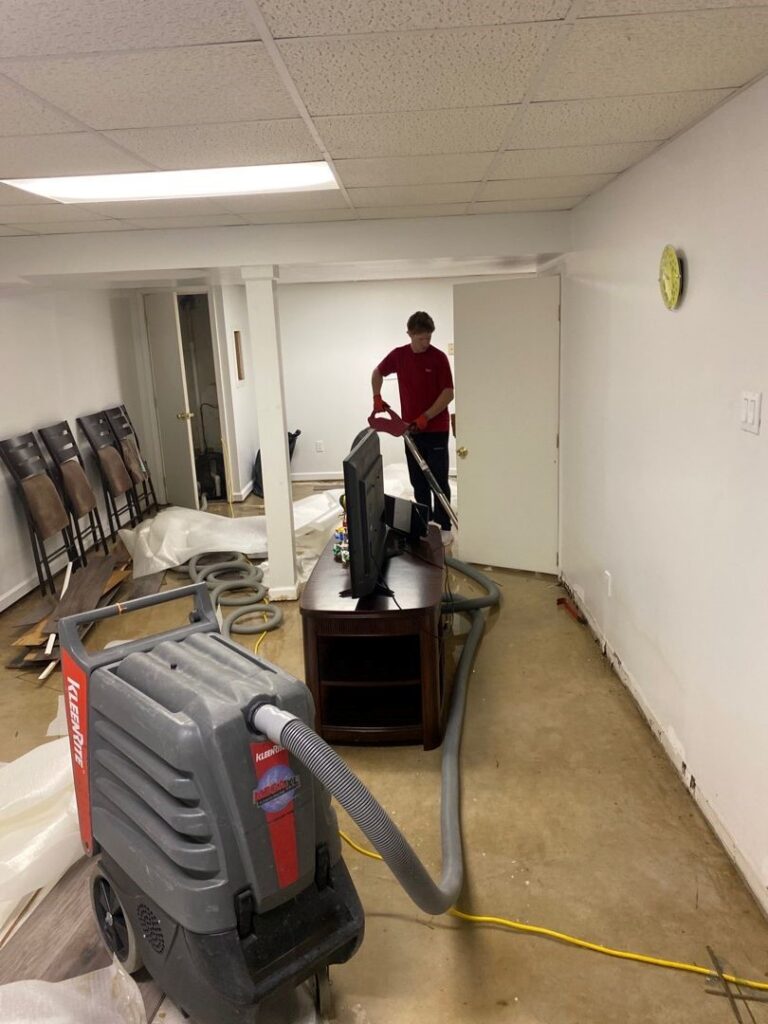
Key Takeaways for Homeowners
- Stay out of a flooded basement until the electricity is shut off by a safe method, because water and live power can be deadly.
- A floor drain backing up can mean sewer overload, and sewage contaminated water is treated as Category 3 (black water).
- Stop using sinks, toilets, showers, and washers while the drain is backing up, so you do not add water to the problem.
- EPA mold guidance says wet materials should be dried within 24 to 48 hours, so the first day sets the outcome.
- Photograph the water line, the pump, and damaged items before you move anything, and keep notes on the timeline.
- Spring snowmelt raises the groundwater table in Greenfield, so a failed pump in March or April is a higher risk than a dry summer failure.
What should you do in the first 24 hours after a sump pump fails and the basement floods?
First make the space safe: cut electrical hazards, stop adding water to the sewer line, and keep people and pets out. Then document the damage, protect belongings, and call a restoration company and your insurer. Professionals should begin extraction and drying within the first day, ideally within hours.
The first 24 hours, step by step
- Hour 0 to 1: Protect yourself from electrical hazards. Do not step into standing water if outlets, cords, or the panel are wet or submerged. If the panel is dry and reachable without wading, switch off the breakers feeding the basement. If you cannot reach it safely, call your electric utility or an electrician.
- Hour 0 to 1: Stop sending water down the drain. Skip showers, flushing, laundry, and the dishwasher. Extra water entering an overloaded sewer line can push more into your floor drain.
- Hour 0 to 2: Treat the water as contaminated. Floodwater from outside and drain backup can carry bacteria and other contaminants. Wear rubber boots, gloves, and an N95 mask, and keep children, pets, and anyone with a health condition upstairs.
- Hour 1 to 3: Identify the failure. If you can do so from dry ground, check whether the pump has power, whether the float switch is stuck, and whether the discharge line outdoors is clogged, frozen, or disconnected. A tripped breaker or power outage is a common cause. Do not reach into a pit with water near power.
- Hour 2 to 6: Document and protect. Take photos and video, note the water line on walls, and record the pump model. Lift furniture and boxes onto blocks, and move valuables upstairs. Do not keep wet porous items you cannot dry.
- Hour 3 to 12: Begin controlled water removal. Clean groundwater can be removed with a pump rated for the job, but sewage contaminated water is a professional task. Do not use a household vacuum on standing water.
- Hour 6 to 24: Call a restoration company and your insurer. Report the loss, ask about drying equipment dispatch, and keep receipts for any emergency purchases.
- Hour 12 to 24: Start drying only when safe. Professional air movers and LGR dehumidifiers should be set up after contaminated materials are removed. Fans alone can spread contaminants through the home.
Actionable takeaway: Put your electrician, insurer, and restoration company numbers in your phone before spring, so you can act in minutes.
Why does a sump pump fail during heavy rain?
Sump pumps usually fail from power loss, a stuck float switch, a clogged intake, a failed check valve, an overloaded or undersized pump, or a blocked discharge line. During long storms or spring snowmelt, a pump can run nonstop and overheat. A pump past its service life may also fail silently until the pit fills. A battery backup or water-powered backup covers power outages, but not a worn-out pump.
Actionable takeaway: Pour a bucket of water into the pit each spring to confirm the float rises and the pump starts and discharges.
Why is my floor drain backing up after heavy rain?
A floor drain backs up when the sewer line or municipal system is overloaded, or when a clog blocks the lateral. Heavy rain can push more water into sewers than they can carry, forcing wastewater back through the lowest opening in your home. That is often the basement floor drain. Because the water may contain sewage, S500 classifies it as Category 3 (black water), and the cleanup scope changes. IDEM guidance on sewer overflows treats raw sewage as a public health concern, so avoid contact.
Actionable takeaway: If a drain gurgles during a storm, stop water use immediately and ask a plumber about a backwater valve.
Why are Greenfield basements vulnerable in spring?
Greenfield’s primary flood mechanism is a rising water table. Each spring, snowmelt and rain soak into the ground, and the groundwater level climbs, pressing water against basement floors and walls. That is hydrostatic pressure, and it finds cracks, cove joints, and utility penetrations. Overflowing gutters and downspouts that drain too close to the foundation, poorly graded soil, and sump pumps overloaded during storms add to the problem.
Housing stock matters. Postwar ranch and split-level homes across Hancock County subdivisions often have poured concrete or block foundations, where water collects at the wall base and wicks into drywall. Older brick homes near the historic downtown may have fieldstone or aging block basements with original mortar joints that allow seepage. When the sewer system is also overloaded, a failed sump pump and a backing up drain can happen at the same time, which is why floods in Greenfield and the surrounding Indianapolis-metro neighborhoods often carry both groundwater and sewage risks.
Actionable takeaway: Extend downspouts several feet from the foundation and check grading before the spring thaw.
What does professional restoration involve after a sump pump flood?
Professional restoration follows the IICRC S500 sequence: assess, categorize, extract, remove, dry, and verify. Technicians first identify the water category and damage class. Floodwater and sewage are treated as Category 3, and a basement with saturated drywall and subfloor is often Class 3, while dense materials such as masonry, plaster, or hardwood can push a loss into Class 4 water damage.

- Safety and containment. Technicians wear PPE and install a containment barrier of poly sheeting to prevent cross-contamination of dry areas.
- Extraction. Truck-mounted or portable extractors remove standing water.
- Removal of porous materials. Carpet, pad, insulation, and low drywall exposed to Category 3 water are typically removed and disposed of. Subfloor delamination, where layers separate, is checked.
- Moisture mapping. Moisture meters and thermal imaging cameras locate hidden water in walls and under floors.
- Structural drying. Air movers and LGR dehumidifiers dry the structure. Technicians monitor psychrometrics, meaning temperature, humidity, and grains per pound, and log hygrometer readings daily.
- Cleaning and air quality. Antimicrobial biocide is applied, and HEPA air scrubbers clean the air. If mold is present, negative air pressure keeps spores contained while work follows IICRC S520. Mold can release mycotoxins, so containment matters.
- Dry verification. Equipment leaves only when readings reach the dry standard.
Unlike a generic cleanup service, PuroClean Disaster Restoration offers 24/7 emergency dispatch, IICRC-certified technicians, and direct insurance billing for Greenfield and Hancock County homeowners.
Actionable takeaway: Ask for a written scope that lists what will be removed and why.
Frequently Asked Questions
Does homeowners insurance cover a sump pump failure in Indiana?
Standard Indiana homeowners policies often exclude water that backs up through drains or a failed sump pump unless you have a water backup endorsement. Coverage varies by policy. Call your insurer promptly, document everything, and contact the Indiana Department of Insurance if you have questions about your rights.
How much does basement flood cleanup cost in Greenfield?
Cost depends on how much water entered, whether it is Category 1, 2, or 3, which materials are affected, and how long drying takes. Sewage contamination increases scope. A professional inspection provides a written estimate, and many insurers work with restoration companies directly.
How long does it take to dry a flooded basement?
Structural drying often takes about three to five days, depending on materials and conditions. Technicians check moisture readings daily and remove equipment once materials reach the dry standard. Category 3 losses add removal and cleaning time, and masonry or plaster can dry more slowly.
Can I clean up a flooded basement myself?
Only if the water is small in volume, clean, and confined to a sealed floor. Call a professional if the drain backed up, carpet or drywall is wet, electrical hazards are present, or water has stood longer than 24 hours. Household fans cannot dry wall cavities or treat contamination.
Is a flooded basement a health risk?
Yes. EPA guidance notes that mold can grow within 24 to 48 hours on damp materials, and floodwater or sewage can carry bacteria. People with asthma, allergies, or weakened immune systems are most at risk. Avoid contact with Category 3 water, and use protective gear if you must enter.
Should I replace my sump pump after it fails?
Often yes, especially if the pump is old, the motor is burned out, or it failed during a storm. A licensed plumber can check the pump size, check valve, discharge line, and backup power. Fixing the cause helps prevent a repeat flood the next time the groundwater table rises.