24/7 Emergency Fire Sprinkler Water Damage Cleanup Houston Services in Houston, TX
A fire sprinkler discharge can release a large amount of water above ceilings, inside walls, and across multiple rooms before the flow is controlled. In Houston homes, apartments, offices, warehouses, restaurants, and other commercial buildings, that water can move quickly through ceiling assemblies, light fixtures, insulation, drywall, flooring, and contents.
PuroClean of Central Southwest Houston provides fire sprinkler water damage cleanup in Houston, including emergency water extraction, moisture mapping, structural drying, cleaning, contents evaluation, and restoration of affected building materials. We address the resulting water damage; a properly licensed fire-sprinkler contractor must inspect and repair the sprinkler system itself.
Do not disable an active fire-protection system or enter water near energized electrical equipment. If a fire or life-safety emergency is still in progress, evacuate and call 911. Once the scene is safe and the responsible authority has approved system control, call (832) 850-5824 for water-damage assistance.
The first priority is life safety. A sprinkler may have activated because of a fire, excessive heat, accidental impact, a damaged fitting, maintenance work, or a frozen component. The correct response depends on why the system discharged and whether the building remains protected.
Avoid improvised cleanup in an unsafe area. Do not use household vacuums on water, puncture a swollen ceiling, operate electrical equipment while standing on wet flooring, or assume that closing a valve has made the building safe.
Water released overhead rarely stays directly beneath one sprinkler head. It can follow framing, pipes, conduit, ceiling-grid channels, and penetrations before becoming visible somewhere else. In a multi-story Houston building, water may pass through the floor assembly and affect rooms below.
| What You Notice | Where Water May Be Hiding | Why It Matters |
|---|---|---|
| Stained or dripping ceiling tile | Ceiling plenum, insulation, metal grid, wiring, and upper drywall surfaces | Wet materials may extend beyond the visible tile |
| Water at a wall base | Wall cavity, insulation, studs, base plates, and adjacent flooring | Water may have traveled inside the wall before emerging |
| Wet carpet in one room | Carpet pad, seams, tack strip, subfloor, and nearby rooms | Surface extraction alone may not address the underlying assembly |
| Dripping from a light fixture | Electrical box, conduit path, and ceiling cavity | Electrical evaluation is required before normal use |
| Water on a lower floor | Floor-ceiling assembly, shafts, stairwells, and vertical penetrations | The full loss may involve more than one level |
| Swollen cabinets or millwork | Toe kicks, wall connections, backing, and concealed cavities | Laminated and engineered materials can retain moisture or delaminate |
Professional moisture measurements help establish the affected boundary. A surface that looks dry may still contain elevated moisture, while discoloration alone does not prove that a material remains wet.
Houston’s warm, humid conditions can make uncontrolled indoor moisture more difficult to manage. After sprinkler water enters porous materials, the goal is to remove standing water, lower excess humidity, expose concealed wet areas when necessary, and monitor the building until appropriate drying goals are reached.
Fast action can help limit:
For broader water emergencies, visit our Houston water damage restoration services.
Sprinkler water spreading through a Houston property?
Call for emergency extraction, moisture mapping, and structural drying.
The required scope depends on the duration of discharge, the number of affected floors, the type and condition of water, building materials, occupancy, and whether fire, smoke, or suppression residue is also present.
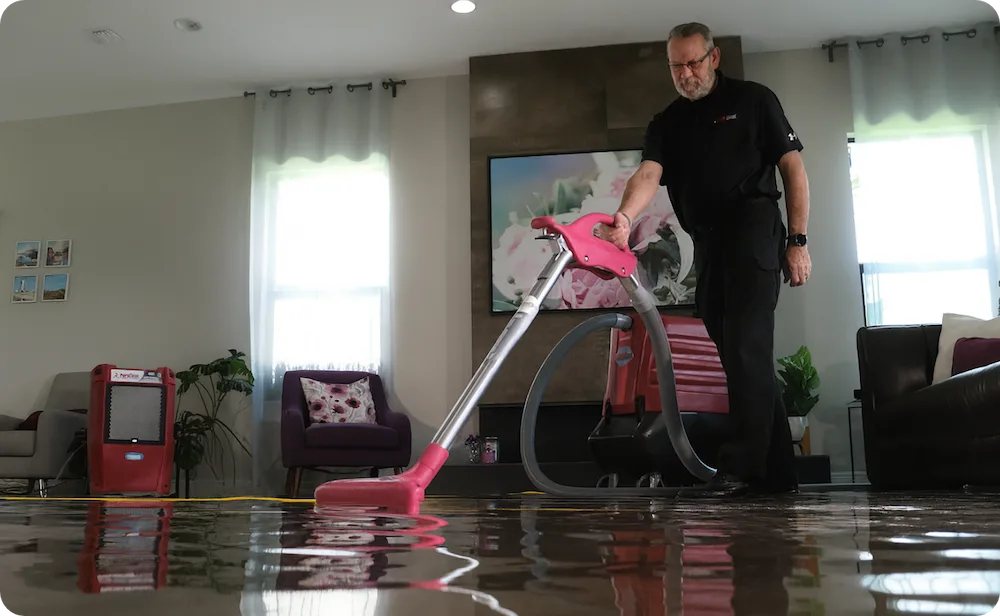
Technicians remove accessible standing water using professional extraction equipment selected for the flooring, room configuration, and amount of water present. Extraction may be required on more than one level and inside adjoining rooms that were not directly below the sprinkler head.
Visual inspection, moisture meters, thermal imaging when appropriate, and material-specific readings help identify where water traveled. The assessment may include ceilings, walls, insulation, flooring systems, cabinets, contents, and concealed cavities.
Some wet materials can be dried in place. Others may need selective removal because they are unstable, contaminated, damaged beyond restoration, or blocking access to concealed moisture. Decisions should be based on actual material conditions rather than automatic removal.
Commercial air movers and dehumidifiers are positioned to support an appropriate drying plan. Equipment placement and operation may change as readings improve. Drying progress is monitored rather than estimated only by elapsed time.
Fire-sprinkler discharge should not automatically be treated as drinking water. The system’s condition, the cause of discharge, visible residue, affected materials, and other site conditions influence cleaning procedures. Technicians evaluate whether surfaces and contents can be cleaned and restored.
Furniture, inventory, documents, electronics, and specialty equipment may require protection, relocation, cleaning, or evaluation by an appropriate specialist. Sensitive commercial equipment should not be energized until its condition has been assessed.
For offices, warehouses, retail spaces, restaurants, multifamily properties, and other facilities, the restoration plan should consider occupant safety, access control, operating schedules, affected departments, and business-continuity priorities. Learn more about our commercial water damage restoration in Houston.
Sprinkler-system repair and water-damage restoration are separate scopes. A licensed fire-sprinkler contractor is responsible for inspecting damaged sprinkler components, completing required repairs, testing the system, and coordinating its return to service. PuroClean addresses water that escaped into the building and the resulting damage to materials and contents.
| Need | Appropriate Provider |
|---|---|
| Stop, repair, inspect, or return the sprinkler system to service | Licensed fire-sprinkler contractor and applicable authority |
| Evaluate wet electrical panels, fixtures, wiring, or equipment | Qualified electrician or equipment specialist |
| Extract water, map moisture, dry the structure, and clean affected materials | Professional water-damage restoration company |
| Repair damaged drywall, ceilings, flooring, framing, or finishes | Qualified reconstruction trades after mitigation |
| Determine insurance coverage and claim payment | Insurance carrier and policy representatives |
Before restoration begins, the team confirms that emergency responders or responsible building personnel have released the affected area for entry. Unresolved fire, electrical, structural, and sprinkler-system hazards must be handled by the appropriate authority or licensed trade.
Technicians document visible conditions and trace the likely movement of water through ceilings, walls, flooring, and lower levels. Moisture readings help define the restoration scope.
Accessible water is extracted from hard surfaces, carpet, and other affected areas. Early extraction reduces the amount of water that must be removed through evaporation and dehumidification.
Salvageable contents may be moved, elevated, covered, or prepared for cleaning. Work zones can be established to separate affected areas and support safe movement through the property.
Unstable ceiling materials, damaged insulation, saturated porous finishes, and materials that cannot be effectively cleaned or dried may require controlled removal. The scope depends on the conditions found.
Air movement and dehumidification equipment are installed according to the building and materials involved. Technicians take follow-up readings and adjust the drying plan as conditions change.
Affected surfaces and salvageable contents are cleaned as appropriate. Once drying goals are reached, required repairs and finish replacement can be coordinated.
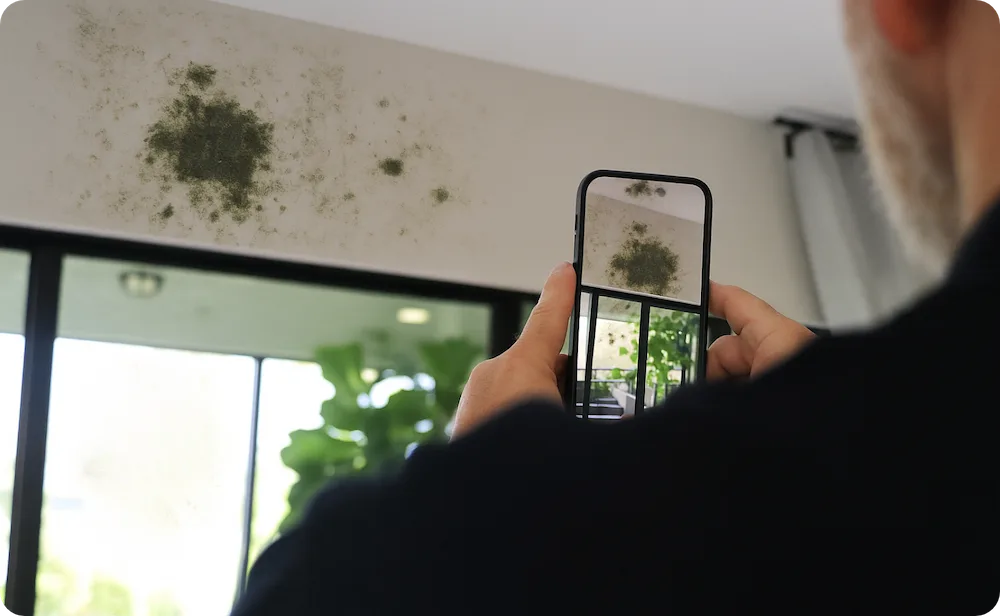
Any uncontrolled moisture can create conditions that support mold growth when susceptible materials remain wet. Drywall paper, ceiling tile, insulation, carpet backing, wood products, and contents can retain moisture even after standing water has been removed.
Mold does not appear on a universal timetable. Temperature, humidity, material type, prior conditions, and the amount of water all matter. Prompt extraction and professional drying are important because concealed areas can remain damp after visible surfaces appear dry. If mold or a persistent musty odor is already present, the property may also require evaluation under our Houston mold removal and remediation services.
Coverage depends on the policy, cause of discharge, maintenance history, exclusions, deductibles, and the damaged property. The restoration company documents conditions and work performed, but the insurance carrier determines coverage.
Useful documentation may include:
Report the loss promptly and ask the carrier what it needs before discarding damaged property. Do not delay reasonable emergency mitigation when doing so would allow the damage to spread.
If fire or an alarm condition is active, evacuate and call 911. After the scene is released, contact a licensed fire-sprinkler contractor for the system and PuroClean of Central Southwest Houston at (832) 850-5824 for resulting water damage.
Do not disable a fire-protection system while a fire may still be present or without authorization from the responsible authority. Building management, emergency responders, or a licensed sprinkler contractor should control the system according to site procedures.
Do not assume it is potable or harmless. Water condition depends on the system, maintenance history, length of stagnation, visible residue, cause of discharge, and contact with building materials. The restoration plan should reflect actual site conditions.
Water can travel along framing, pipes, conduit, ceiling grids, wall cavities, and floor penetrations. Moisture mapping is used to evaluate adjacent rooms and lower levels rather than treating only the visible puddle.
Some materials can be restored, while others lose strength, shape, finish, or cleanliness after saturation. Ceiling tiles that are sagging, damaged, contaminated, or unable to dry effectively may require replacement.
Drying time varies with the amount of water, building materials, humidity, assembly depth, temperature, and how quickly mitigation began. Moisture readings provide better guidance than a fixed number of days.
Typically, the sprinkler contractor repairs and restores the fire-protection system. A water-damage restoration company performs extraction, moisture assessment, structural drying, and cleanup. Confirm each contractor’s scope in writing.
Yes. PuroClean of Central Southwest Houston provides water-damage restoration for commercial properties, subject to site conditions and service availability. Early coordination can help protect occupied areas, contents, inventory, and business operations.
No assumption should be made based on appearance. Wet electrical fixtures, equipment, and wiring should be evaluated by a qualified electrician or equipment specialist before re-energizing.
It may, but coverage depends on the policy and cause of loss. Contact the insurance carrier for a determination and preserve photographs, reports, invoices, and restoration documentation.
A sprinkler discharge can affect more of the building than the area where water is visible. Prompt extraction, moisture mapping, and structural drying help establish the full scope and reduce additional damage.
PuroClean of Central Southwest Houston provides fire sprinkler water damage cleanup for Houston-area homes and businesses. We coordinate the water-damage response while the appropriate licensed professionals address sprinkler, electrical, and specialty-system repairs.
Call (832) 850-5824 to discuss the affected areas, known hazards, and immediate restoration needs.
What Our Customers Say:
Find answers to common questions about our services
PuroClean of Central Southwest Houston offers a full suite of commercial restoration services, including water, fire, mold, biohazard, and storm damage recovery. We also provide emergency board-up, structural drying, and reconstruction services.
Our teams are equipped to manage both local and large-loss commercial projects with consistent quality, safety, and communication.
PuroClean of Central Southwest Houston regularly collaborates with insurance carriers, TPAs, and risk management teams to manage commercial property restoration claims. We provide detailed drying logs, scope documentation, and photo/video reporting for every project in Houston, TX.
Our Certified Priority Response (CPR) Program ensures fast contact, on-site inspection within hours, and rapid reporting, meeting the timelines insurers and clients expect for large-scale commercial losses.
PuroClean of Central Southwest Houston handles nearly every commercial loss scenario, including commercial water damage restoration, fire and smoke damage, mold remediation, sewage cleanup, chemical spills, and biohazard decontamination.
We can also manage full reconstruction when structural repair is needed. Our national network allows us to scale from localized events to large-loss recovery, maintaining consistent quality and communication across every project.
Yes. Our commercial restoration services can be scheduled to accommodate any occupancy or business operation needs. Our top priority is always safety and excellent customer service, so you can count on PuroClean of Central Southwest Houston to work with your business to restore it to pre-loss conditions and help reduce business downtime.
The cost of commercial restoration depends on factors like the extent of damage, size, and complexity of the property, and whether reconstruction or contents cleaning is required. The category of water (clean vs. contaminated) and response time also impact cost.
PuroClean of Central Southwest Houston provides transparent estimates, detailed scopes, and proactive communication if additional work becomes necessary.
Water damage can result from unexpected leaks, flooding from storms, plumbing failures, or appliance malfunctions. Our certified teams focus on rapid water removal, drying, and stabilization to help prevent further damage and mold growth.
 Explore Our Water Damage Mitigation Services
Even after a fire is extinguished, smoke, soot, and odor can continue to affect your home. Fire damage restoration services address visible damage while also helping reduce lingering effects that impact indoor air quality and surfaces.
Explore Our Fire and Smoke Damage Restoration Services
Mold often develops as a result of unresolved moisture or hidden water damage. Professional mold remediation helps identify affected areas, contain growth, and restore healthy indoor conditions.
Explore Our Mold Removal and Remediation Services
Biohazard situations, including crime scene cleanup and virus decontamination, require specialized cleaning and handling to protect health and safety. Biohazard cleanup services address contamination using proper protocols and professional care.
Explore Our Biohazard Cleanup Services
In some cases, property damage requires repairs beyond cleanup and mitigation. Reconstruction services help restore damaged areas of the home after water, fire, or other incidents, supporting a smoother transition from damage to recovery.
Explore Our Reconstruction Services Services
PuroClean provides 24/7 commercial property damage restoration services for businesses and facilities across the United States.
Explore Our Commercial Services
Water damage can result from unexpected leaks, flooding from storms, plumbing failures, or appliance malfunctions. Our certified teams focus on rapid water removal, drying, and stabilization to help prevent further damage and mold growth.
Explore Our Water Damage Mitigation Services

PuroClean of Central Southwest Houston
(832) 856-5900
3635 Willowbend Boulevard, Ste 318, Houston, TX 77054