


Mold problems rarely announce themselves clearly. A faint smell, a small stain, or unexplained discomfort can quietly signal something bigger behind the walls. Many homeowners act quickly, but not always correctly, because the terminology alone creates confusion. Understanding what professionals actually mean when they discuss mold remediation vs removal can make a major difference in how a home recovers from a mold issue and how well it stays protected afterward.
Understanding Mold Problems in Residential Homes
Mold exists naturally in the environment, but it becomes a problem when it starts growing indoors. Once moisture enters a home; through leaks, humidity, or poor ventilation, mold spores can settle and multiply. These colonies don’t always stay visible, which is why surface cleanup often fails to solve the full issue.
Homes experiencing recurring dampness or poor airflow are especially vulnerable. When homeowners misunderstand mold remediation vs removal, they may focus on what they can see rather than what’s spreading quietly beneath surfaces.
What Mold Is and Why It Develops Indoors
Mold is a naturally occurring fungus present in both indoor and outdoor environments. Mold spreads as tiny spores float through the air and attach themselves to surfaces. Growth only begins when these spores encounter moisture from sources like leaks, excess humidity, condensation, or water intrusion. Without damp conditions, mold remains inactive and does not develop.
The U.S. Environmental Protection Agency notes that completely eliminating mold indoors isn’t realistic; instead, preventing growth depends on controlling moisture. Fixing leaks quickly, drying wet materials, and maintaining balanced indoor humidity are essential steps. Mold can grow on many household materials, and visible growth often points to underlying moisture problems that require more than surface cleaning.
Why Mold Issues Are Common in McLean Homes
McLean homes often include basements, crawl spaces, and older construction elements that can trap moisture. Seasonal humidity and heavy rainfall increase the risk further. In these situations, choosing between mold remediation vs removal becomes less about preference and more about how deeply the mold has affected the structure.
What Mold Removal Really Means
Mold removal involves physically getting rid of mold that can be seen on surfaces. This process may include cleaning affected areas, taking out contaminated materials, or using specialized products. While it can improve visible conditions, it only targets surface-level growth and does not go beyond what is immediately noticeable.
While this approach can improve appearance quickly, it doesn’t always consider spores in the air or mold hidden behind walls. This is where homeowners relying solely on surface cleaning may see the problem return.
Situations Where Mold Removal Is Typically Used
Mold removal is usually applied in limited situations, such as small patches caused by a single spill or short-term moisture exposure. In these cases, broader mold treatment options may not be required, as long as the moisture source has been fully resolved and the affected area is isolated.
What Mold Remediation Involves
Mold remediation is a more comprehensive process designed to manage the entire mold problem, not just visible growth. It focuses on identifying affected areas, containing spread, and restoring indoor conditions that discourage future growth.
The difference between mold remediation vs removal lies in scope. Remediation doesn’t promise a mold-free environment, but it aims to return mold levels to what’s considered normal for a healthy home.
Key Elements Included in Mold Remediation
Professional remediation typically includes inspection, containment, air filtration, cleaning, and moisture control. This approach addresses both current growth and the conditions that allowed it to develop. Many mold treatment options used during remediation are selected based on the severity and location of the issue, ensuring the solution fits the home rather than applying a one-size-fits-all method.
Mold Remediation vs Removal: Key Differences Explained
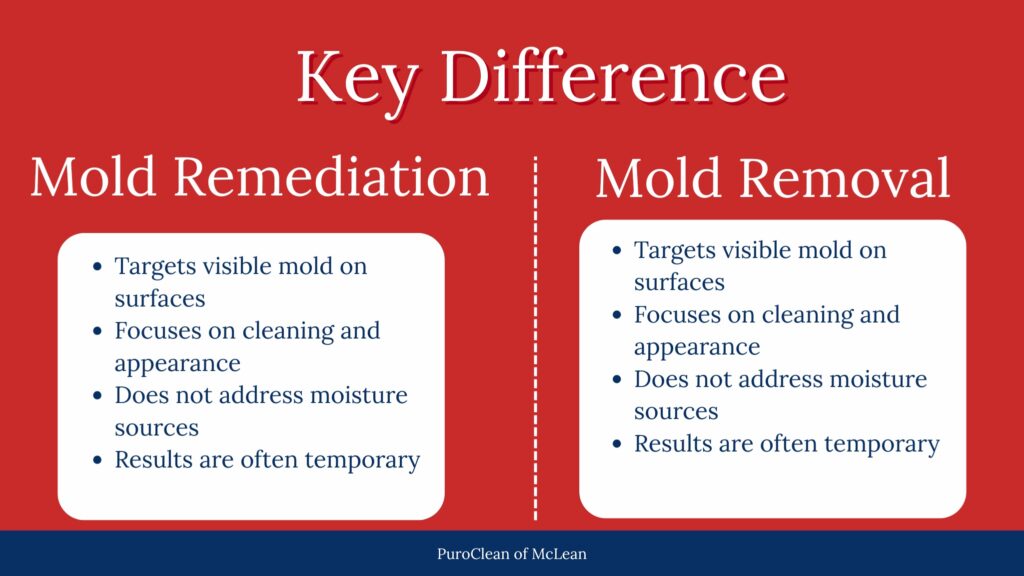
Understanding mold remediation vs removal helps homeowners recognize why some treatments fail while others succeed. Removal focuses on appearance, while remediation addresses the indoor environment as a whole. One reacts to visible growth, while the other works to correct the conditions that allow mold to persist.
Removal may temporarily resolve what can be seen, but remediation considers air quality, building materials, and moisture behavior throughout the home. This distinction becomes especially important when mold has had time to spread beyond a single surface, as unresolved issues can later raise concerns related to property value in McLean homes, a topic we explore further in our blog.
How Professionals Decide Which Approach Is Needed
Professionals evaluate several factors before recommending a solution. These include the size of the affected area, duration of exposure, type of material involved, and whether mold is present in hidden spaces.
In many inspections, the decision between mold remediation vs removal depends on whether mold has penetrated porous materials or compromised indoor air. This assessment ensures the response matches the actual risk rather than assumptions based on visibility alone.
Mold Treatment Options Available for Homeowners
There are various mold treatment options available today, ranging from targeted surface cleaning to full containment systems. Some treatments focus on antimicrobial applications, while others prioritize air filtration or material removal.
The effectiveness of these mold treatment options depends heavily on proper diagnosis. Treatments applied without understanding moisture sources or spread patterns often fail to deliver lasting results.
Which Solution Is Right for McLean Homes?
The CDC explains that mold growth indoors always signals a moisture problem that must be corrected, not just cleaned. Simply removing visible mold doesn’t solve the issue if water intrusion or humidity continues, as mold can regrow on common materials like drywall, wood, and carpet.
Because of this, McLean homes with basements, older construction, or recurring dampness often need solutions that address both the mold and the moisture source. Broader mold treatment options align with CDC guidance by focusing on cleanup and prevention together, helping reduce the chances of mold returning after treatment.
Conclusion
Mold problems are rarely simple, and the language surrounding them often adds confusion. Understanding what separates mold remediation vs removal allows homeowners to respond with clarity instead of urgency alone. Removal focuses on what’s visible, while remediation addresses the broader conditions that allow mold to exist.
For McLean homes, where moisture-related issues are common, recognizing this difference can prevent repeated treatments and ongoing frustration. The right approach starts with understanding the problem fully, not just reacting to what’s seen on the surface.
FAQs
Q1. Is mold removal enough for most homes?
A: Mold removal may be sufficient for very small, isolated issues, but it often doesn’t address hidden growth or airborne spores.
Q2. Can mold come back after treatment?
A: Yes, mold can return if moisture sources aren’t corrected, regardless of the mold treatment options used.
Q3. How do I know which mold treatment options I need?
A: A professional assessment helps determine whether surface cleaning or a more comprehensive solution is appropriate for your home.