 PuroClean of Melbourne
In this article:
Table of Contents
There is a particular kind of dread that settles over a homeowner the moment they peer into an AC vent and see something dark growing along the edges of the grille. Is that dust? Is that dirt? Or is that what they think it is?
Mold Removal in Melbourne, FL
In Melbourne, Florida, the answer is more often than not: yes, that is mold. And if it’s visible at the vent opening, there is almost certainly far more of it deeper inside the ductwork where you cannot see it.

Black mold in AC vents is one of the most serious and most common indoor air quality problems in Brevard County homes. Florida’s combination of heat, humidity, and year-round air conditioning use creates conditions that are nearly ideal for mold growth inside HVAC systems. The problem is that most homeowners don’t catch it early, not because the signs aren’t there, but because they don’t know what to look for.
In this guide, PuroClean of Melbourne walks you through the first five signs that black mold may be growing in your AC vents, why each sign matters, and what you should do the moment you recognize any of them. Catching this problem early is not just a matter of home maintenance, in Florida’s climate, it is a genuine health issue for everyone living under your roof.
First: A Quick Note on “Black Mold” in AC Vents
Before diving into the signs, it’s worth clarifying what people typically mean when they say “black mold” because the term is used loosely and somewhat inaccurately in most conversations.
The phrase “black mold” most often refers to Stachybotrys chartarum, a specific species of mold notorious for producing mycotoxins, toxic compounds that can cause serious health effects with prolonged exposure. However, not all dark-colored mold growing in AC vents is Stachybotrys. Several other mold species, including Cladosporium, Aspergillus, and Penicillium, also commonly appear black, dark green, or dark gray in HVAC systems and are capable of causing significant health problems even without producing the same mycotoxins as Stachybotrys.
Read Also: Mold in Humidifier: How to Remove Mold from Humidifier in 2026
The practical takeaway is this: the color of the mold matters far less than the fact that mold is growing inside your air distribution system. Any active mold growth in AC vents represents a problem that needs professional attention, regardless of species. The five signs below apply to mold in AC vents broadly, not just to Stachybotrys specifically.
Sign #1: A Musty or Earthy Smell That Comes From the Vents When the AC Runs
This is the first sign most Melbourne homeowners notice, and it is also the one most frequently dismissed or misattributed. You turn on the air conditioning, and within a few minutes there is a smell, musty, earthy, stale, vaguely reminiscent of a damp basement or wet cardboard. The smell fades after a while, or you get used to it. Life goes on.
Do not get used to it. That smell is one of the most reliable early indicators of mold growth inside your HVAC system, and it deserves immediate attention.
The odor is produced by microbial volatile organic compounds (MVOCs), chemical byproducts released by mold colonies as they metabolize organic material and reproduce. MVOCs are what give mold its characteristic smell, and they are detectable by the human nose at extremely low concentrations. In many cases, people can smell mold long before any visible growth appears at vent openings.
In a Melbourne home, the mechanism is straightforward: mold growing on the interior surfaces of ducts, on the evaporator coil, or in the air handler cabinet releases MVOCs into the airstream. Every time the AC runs, that airstream, and the odor compounds carried in it, is distributed through every vent in your home. The smell seems to come from everywhere because it literally is coming from everywhere the conditioned air reaches.
What makes this sign particularly important is what it implies about the extent of contamination. By the time an MVOC odor is detectable throughout a home, the mold colony producing it is typically well-established and has been growing for some time. This is not a brand-new problem that appeared overnight. It is a problem that has been developing, often for weeks or months, and the odor is your first real signal that it has reached a meaningful scale.
If you notice a musty smell that appears when the AC turns on and fades or becomes less noticeable when it’s off, schedule a professional HVAC and mold inspection immediately.
Sign #2: Visible Dark Spots, Streaks, or Discoloration Around Vent Openings
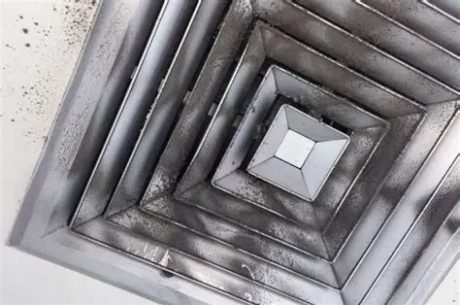
The second sign is the most visually obvious, though it is often misidentified. Homeowners notice dark spots or streaks around their ceiling or wall vent grilles and assume it is dust buildup, particularly the grey-black dusty residue that can accumulate around vents over time. They wipe it down, it comes back, and they wipe it down again.
But there is a critical difference between dust accumulation and mold growth around vent openings, and knowing which you are dealing with changes everything about how you respond.
Dust around vents tends to accumulate in fuzzy, even deposits along the edges of the grille, particularly on the downstream side where air is blowing outward. It wipes off cleanly and does not reappear rapidly after thorough cleaning.
Mold around vents looks different. It tends to appear as dark spots or patches that may have a slightly raised or textured appearance. It often grows in irregular patterns rather than the even coating of settled dust. It may appear greenish, black, or dark gray rather than the lighter gray-brown of dust. Most tellingly, it returns quickly after cleaning, often within days because the cleaning addressed the symptom but not the source. The mold colony deeper in the ductwork continues to send spores outward through the airstream, and those spores settle and colonize the vent surface again almost immediately.
Read Also: The Unlikely Concern With Air Ducts and HVAC Systems
There is also a phenomenon called “ghosting” or “thermal tracking” dark streaking on walls and ceilings around vents caused by fine particulate matter, including mold spores and combustion particles, depositing on surfaces cooled by the air conditioning airstream. Dark streaking radiating outward from a vent opening in a starburst or smear pattern is a strong visual indicator of particulate contamination in the airstream, which can include mold spores.
Any time you see dark discoloration at or around vent openings that returns after cleaning, treat it as potential mold and have it assessed professionally. Remove the vent grille carefully, wearing gloves and an N95 mask, and look at the interior surfaces of the duct collar with a flashlight. Mold growing on the inner duct surface close to the opening is often visible and confirms the diagnosis.
Sign #3: Unexplained Allergy-Like Symptoms That Worsen Indoors
This is the sign that most often sends Melbourne homeowners to their doctor before it sends them to a restoration company and by the time the mold connection is made, the problem has often grown considerably.
The pattern is distinctive: you or members of your household begin experiencing symptoms that look and feel like seasonal allergies sneezing, runny nose, itchy or watery eyes, nasal congestion, postnasal drip, coughing, or throat irritation. But there is something unusual about these symptoms. They are worse when you are at home and improve when you leave go to work, run errands, spend time outdoors. They may be consistently worse in the morning, after sleeping in an air-conditioned bedroom all night. They may be worse in certain rooms that happen to have more or larger vents.
Read Also: Categories of Water Damage Explained
This indoor-outdoor pattern is one of the most telling clues that the source of the irritation is your indoor air and in a home with a central air conditioning system, that means the HVAC system is the prime suspect.
Mold spores are potent allergens. When mold colonizes the ductwork and the AC system distributes spores throughout the home continuously, the occupants are subjected to ongoing, unavoidable inhalation exposure during every hour the system runs. For individuals who are sensitized to mold allergens a condition that can develop over time with repeated exposure the symptoms can be significant even at relatively low spore counts. For children, the elderly, and anyone with asthma or other respiratory conditions, the effects can be severe.
The conditions most commonly reported by people living in homes with mold-contaminated AC systems include persistent nasal congestion that does not respond well to antihistamines, frequent headaches particularly in the morning, chronic low-grade fatigue, eye irritation and redness, worsening asthma or new-onset wheezing, and recurring respiratory infections. None of these symptoms are unique to mold exposure, which is why the indoor-outdoor pattern is the key diagnostic clue.
If members of your household are experiencing allergy-like symptoms that are consistently better when away from home and worse when the AC is running, do not wait for a medical explanation to investigate your HVAC system. The two investigations can and should happen simultaneously.

Sign #4: Standing Water, Moisture, or Rust Near the Air Handler or Drain Pan
This sign is found not at the vents themselves but at the heart of the system, the air handler unit, typically located in a closet, garage, attic, or utility space. It is one of the most reliable predictors of mold contamination in the broader duct system because it indicates that the conditions actively producing mold are present and ongoing right now.
Every central air conditioning system produces condensation as a byproduct of the cooling process. The evaporator coil, the cold component inside the air handler where warm indoor air is cooled, collects moisture from the air as it passes over it. This moisture drips into the condensate drain pan beneath the coil and flows out through the drain line. In Melbourne’s extremely humid climate, this process produces significant amounts of water, particularly during summer months when the AC is running intensively.
When the drain line becomes clogged, one of the most common HVAC maintenance issues in Florida, where algae and biological growth in the warm, moist drain line cause blockages, water backs up in the drain pan and eventually overflows. Standing water in or around the air handler is one of the most direct pathways to mold contamination because it keeps the entire air handler cabinet and surrounding structure wet continuously.
Rust on the drain pan, the air handler cabinet, or nearby metal components is a sign that moisture has been present and persistent, meaning the drainage problem is not new and the mold risk has been elevated for an extended period. Efflorescence, white mineral deposits, on concrete or block walls near the air handler indicates chronic moisture migration from the unit. Water staining on the floor or ceiling below or around the air handler tells the same story.
These moisture indicators at the air handler are critically important because the evaporator coil and drain pan area is ground zero for mold in AC systems. Mold that colonizes the coil surface and drain pan area is in the perfect position to release spores directly into the airstream that flows over the coil and into the distribution ductwork. By the time mold has established itself on the evaporator coil, the entire duct system downstream of it should be considered potentially contaminated.
Inspect your air handler area regularly, at least every few months in Florida. If you find standing water, rust, efflorescence, or visible mold growth in this area, treat it as an emergency and call a professional immediately.
Sign #5: Mold Appearing Repeatedly in Nearby Rooms Despite Regular Cleaning
The fifth sign is one that homeowners often experience for months or even years without connecting it to their AC system: mold keeps appearing in certain rooms, on certain walls, or on certain surfaces, no matter how diligently they clean it. They scrub the bathroom ceiling. The mold comes back within weeks. They clean the bedroom windowsill. More mold. They notice dark spots appearing on the wall near a vent and wipe them away. They return.
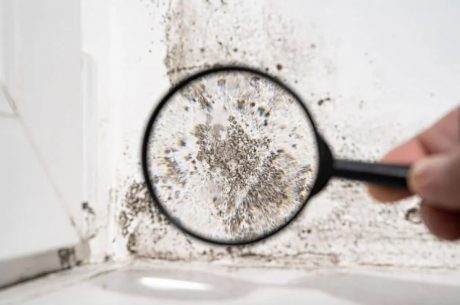
Persistent, recurring mold in living spaces particularly in rooms that are air conditioned is a strong indicator that the mold source is airborne rather than local. When mold spores are continuously introduced into a room through the AC vents, they settle on every available surface: walls, ceilings, windowsills, upholstery, books, and clothing. Even if you kill the surface mold with cleaning agents, new spores arrive with the next cycle of the air conditioning system and begin colonizing again almost immediately.
Read Also: Top 5 Signs You Need Professional Mold Remediation in Melbourne FL
This cycle, clean, return, clean, return is one of the most frustrating and diagnostically important patterns associated with mold in AC systems. It is also one of the clearest signs that surface cleaning alone will never solve the problem. The source is in the air distribution system, and until that source is remediated, the surface mold in your living spaces will keep coming back.
Pay particular attention to rooms that have recently shown new mold growth, especially if those rooms did not previously have mold issues. Mold spreading to new areas of a home often indicates either a new moisture source or a mold source in the HVAC system that is contaminating previously clean spaces.
Why Melbourne Homes Are Especially Vulnerable
All five of these signs are more common in Melbourne and Brevard County than in most other parts of the country, and the reason comes down to climate. Melbourne’s average relative humidity, the intensity and duration of its cooling season, the frequency of heavy rainfall events, and the age of much of the housing stock combine to create conditions where HVAC mold is not an occasional problem it is a persistent, recurring challenge that requires proactive management.
Florida’s AC systems run for 10 to 12 months of the year, meaning the evaporator coil is almost continuously cold and almost continuously producing condensation. Drain lines have less time to dry out between heavy-use periods than they would in a seasonal climate. Ductwork in attic spaces where a significant proportion of Melbourne homes route their duct systems is subjected to extreme heat on the exterior and cold conditioned air on the interior, creating near-constant condensation risk where insulation is imperfect or has degraded.
Older Melbourne homes, many of which were built in the 1970s, 1980s, and 1990s, frequently have original or older HVAC equipment, aging duct insulation, and drainage systems that have never been professionally cleaned. These homes represent the highest-risk category for undetected HVAC mold, and many of their owners are living with contaminated air every day without realizing it.
What to Do If You Recognize Any of These Signs
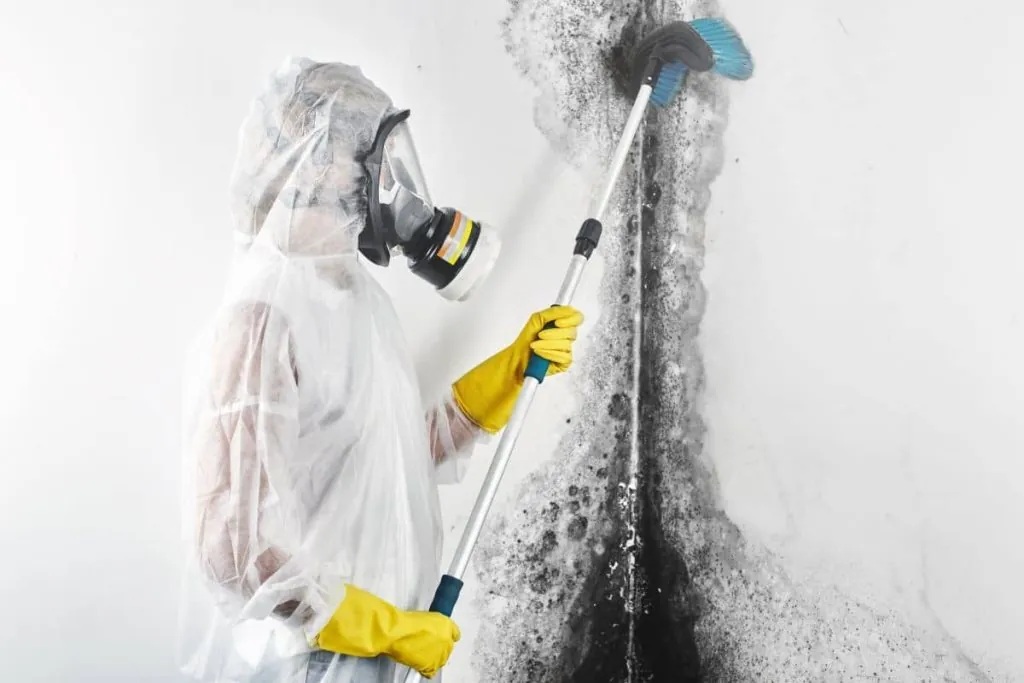
If you have recognized one or more of the five signs described in this article, the next steps are clear. First, do not attempt to clean the ductwork yourself. Consumer duct cleaning approaches, shop vacuums, brushes, spray cleaners applied through vent openings, are not effective at removing mold from duct interiors and can dislodge and spread mold spores more widely throughout the system and the home. Second, turn off the air conditioning system if possible and open windows to ventilate your living spaces with fresh outdoor air while you arrange for a professional assessment. Third, call a certified mold remediation and HVAC cleaning professional who has specific experience with post-mold duct systems, not just a standard HVAC maintenance company.
Read Also: All the Signs of Black Mold in Air Vents and What to Do About It
At PuroClean of Melbourne, our certified technicians perform comprehensive assessments of homes where HVAC mold is suspected, using air quality testing, moisture measurement, and direct inspection of air handler components and duct interiors to determine the full extent of contamination. Our remediation process addresses the mold at its source, the evaporator coil, drain pan, air handler cabinet, and ductwork, rather than simply treating surface symptoms. We verify our work with post-remediation air quality testing to confirm that your home’s air is genuinely clean before we consider the job complete.
We are available 24 hours a day, 7 days a week, and serve all of Melbourne and Brevard County. If you have concerns about mold in your AC system, call us. The inspection is the first step, and knowing what you’re dealing with is always better than not knowing.
Final Thoughts: Your AC System Is Either Your Greatest Ally or Your Greatest Risk
In Melbourne’s climate, your air conditioning system is not optional. It is the foundation of livable indoor conditions for most of the year. But that same system, because of the condensation it produces, the organic material it accumulates, and the air it continuously circulates, is also your home’s single greatest vector for mold exposure if it is not properly maintained.
The five signs described in this article, musty odors from the vents, visible dark growth around vent openings, allergy-like symptoms that improve when you leave home, moisture and rust near the air handler, and persistent recurring mold in living spaces, are your early warning system. They are the signals your home sends before a manageable problem becomes a serious one.
Pay attention to them. Act on them early. And when in doubt, call PuroClean of Melbourne. We know Florida homes, we know Florida mold, and we know how to make your indoor air genuinely safe again.

PuroClean of Melbourne
Mold, Fire & Water Remediation | Available 24/7
📍 739 North Dr, Melbourne, FL 32934
📞 (321) 378-2400
🌐 puroclean.com/melbourne-fl-puroclean-melbourne
✉️ [email protected]
 PuroClean of Melbourne