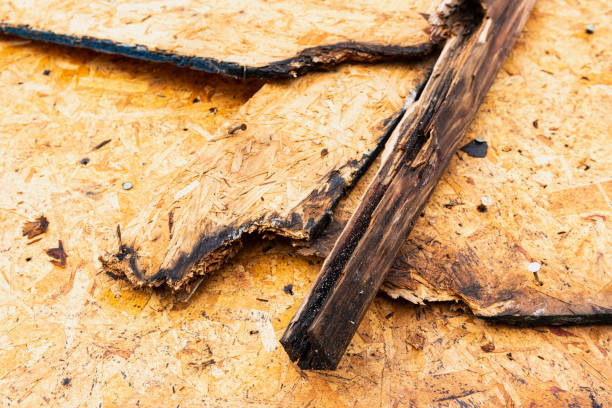
If you’re replacing a subfloor, rebuilding after storm damage, or planning new construction along 30A, plywood vs OSB mold resistance is a genuinely practical question — not just a technical spec sheet debate. Both materials can develop mold under the right conditions, but they don’t behave identically once moisture gets involved, and that difference matters in a climate like ours.
How Plywood and OSB Are Actually Different
Plywood is made from thin wood veneers glued together with the grain running perpendicular in each layer, creating a dense, uniform panel. OSB (oriented strand board) is made from wood strands compressed and bonded with adhesive resins in layered orientations. Both are legitimate structural materials, but their internal structure affects how they interact with water differently.
Absorption Speed: Plywood Wins the First Round
Plywood tends to absorb water more quickly on initial contact than OSB, but it also releases that moisture more completely and more quickly once conditions allow it to dry. OSB behaves differently — it typically absorbs moisture more slowly at first, but once water penetrates the strand structure, it tends to swell more significantly and takes considerably longer to fully dry out. We’ve documented this exact divergence in our guide on the timeline phases of mold growth under hardwood floors, where sustained moisture eventually causes plywood subflooring to delaminate as its glued layers separate, while OSB instead swells, weakens, and crumbles as its strand orientation fails.
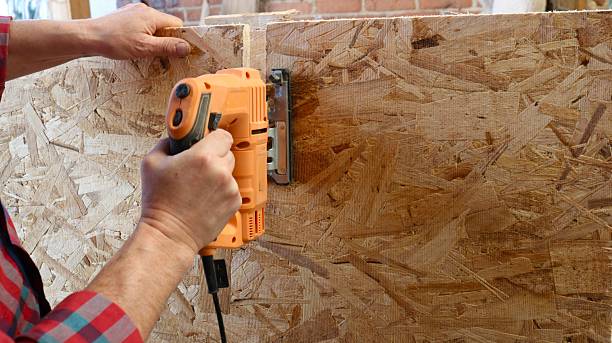
Why That Difference Matters for Plywood vs. OSB Mold Resistance
Slower drying is the real problem here, not slower absorption. Since mold needs sustained moisture to establish itself, a material that takes longer to dry — even if it absorbed water more slowly to begin with — can actually present a higher mold risk over time in humid climates like the Gulf Coast. This is the counterintuitive part of the plywood vs OSB mold resistance question: the material that resists water on contact isn’t necessarily the one that resists mold best in the long run.
Swelling Is a Structural Problem, Not Just a Mold Problem
OSB’s tendency toward what’s often called “edge swell” — visible swelling along panel edges from moisture exposure — signals significant water penetration, and often doesn’t fully reverse even after the material dries (Mold Action Plan). A moisture reading above 20% generally indicates an active moisture problem requiring source correction before any surface treatment, while readings need to drop below 16% before a treated area is considered safely dry. Plywood generally recovers its shape more reliably after drying, assuming the water exposure wasn’t prolonged enough to cause delamination of the veneer layers. PuroClean of Lawrenceville, GA has documented similar patterns in their guide on moisture under floorboards after flooding, noting that both plywood and OSB absorb water through capillary action even after surface water has been removed.
What This Means for Rebuilding in Santa Rosa Beach
Given our year-round humidity and hurricane season exposure, plywood vs OSB mold resistance isn’t a purely academic question for anyone rebuilding a subfloor, roof deck, or wall sheathing here. Plywood’s faster drying cycle can be a genuine advantage in a climate where materials rarely get a fully dry stretch to recover in. That said, cost, application, and local building code requirements often play just as large a role in the choice as moisture behavior alone — this is a conversation worth having with your contractor rather than assuming one material is universally “better.”
Neither Material Is Mold-Proof
It’s worth being direct about this: no wood-based structural panel is inherently mold-resistant without proper moisture management. Both plywood and OSB will support mold growth given sustained moisture and the right temperature range. The plywood vs OSB mold resistance conversation is really about how forgiving each material is when moisture does get in — not whether either one is immune to the problem in the first place.
PuroClean of Santa Rosa Beach: Moisture Assessment Before Rebuilding
Whether your project involves plywood, OSB, or a mix of both, PuroClean of Santa Rosa Beach provides moisture assessments before and after construction work, confirming materials are within safe moisture ranges before they’re closed up behind new flooring or drywall. If you’re already dealing with an active mold problem on plywood subflooring rather than planning new construction, see our companion guide on how to kill mold on plywood subfloors for the remediation side of this conversation. Our technicians serve homeowners and contractors across the 30A corridor and our Dothan, AL service area, following the ANSI/IICRC S520 standard of care for any remediation needed along the way.
Frequently Asked Questions
Is plywood more mold-resistant than OSB? Not definitively — plywood tends to dry faster once wet, which can reduce mold risk over time, but OSB isn’t inherently more prone to mold; it’s more prone to swelling and slower drying, which indirectly raises mold risk.
Does OSB swelling always mean mold is present? No. Swelling indicates moisture exposure and potential structural concern, but mold requires sustained moisture and time to actually develop — a moisture reading is the only way to confirm risk.
Which material should I choose for a subfloor in a humid climate? Both are viable with proper moisture management and ventilation; plywood’s faster drying cycle can be an advantage in consistently humid climates like the Gulf Coast, but local code and cost often factor into the decision too.
Can treated or marine-grade plywood eliminate mold risk entirely? No treatment makes wood immune to mold. Treated and marine-grade plywood can improve moisture resistance, but sustained water exposure can still support mold growth over time.
Get a Moisture Assessment Before You Rebuild
Whatever material you choose, moisture management is what actually determines your mold risk. PuroClean of Santa Rosa Beach provides IICRC-certified moisture assessments and mold remediation for homeowners and contractors across Santa Rosa Beach, the 30A corridor, and Dothan, AL, with 24/7 emergency availability.
Contact PuroClean of Santa Rosa Beach today, or call for 24/7 emergency response.
Available 24/7/365 | Contact Us Online | Google Business Profile | IICRC Certified | Insurance Preferred | Complete Mold Remediation Solutions