


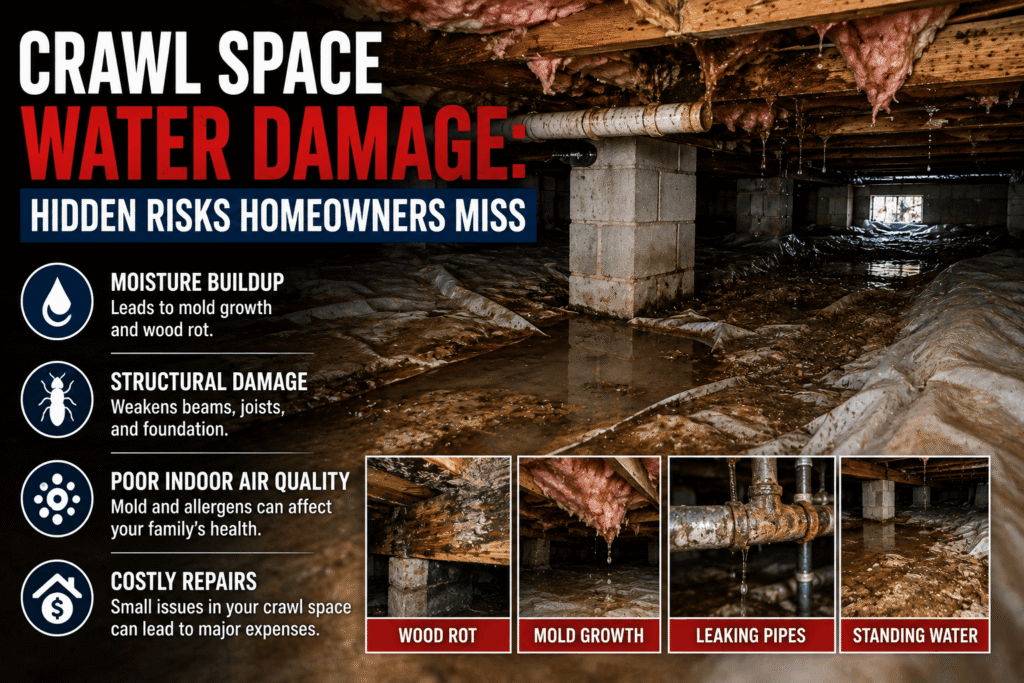
Crawl space water damage frequently goes undetected for weeks or months because it’s out of sight and out of mind, allowing moisture to cause structural wood rot, mold growth, and pest problems long before symptoms show up inside the living space — musty odors, buckling floors, or unexplained humidity upstairs. Because crawl spaces are rarely inspected regularly, catching this early requires knowing what to look for and checking proactively rather than waiting for visible signs.
Why Crawl Space Water Damage Is So Easy to Miss
A crawl space isn’t a room anyone walks through daily — it’s a space most homeowners enter rarely, if ever, after move-in. That makes it fundamentally different from other water damage: a burst pipe under a kitchen sink gets noticed fast because someone’s standing in the kitchen. Water pooling under a crawl space, by contrast, can sit for weeks with the only evidence being a faint musty smell that’s easy to dismiss or a slight increase in humidity that doesn’t register as a red flag on its own.
Not every home in the Southlake area has a crawl space — many newer builds throughout Southlake, Colleyville, and Trophy Club sit on slab foundations, which don’t have this particular risk. But homes with crawl spaces, particularly older properties or those with pier-and-beam construction, carry a distinct set of moisture risks that slab homes don’t, and homeowners who bought into an older or transitional property don’t always realize what they’re now responsible for monitoring.
Warning Signs of Crawl Space Water Damage
- Musty or earthy odor, especially noticeable near floor vents or in rooms directly above the crawl space
- Increased humidity inside the home that doesn’t have an obvious explanation, sometimes showing up as condensation on windows
- Buckling, sagging, or soft spots in flooring directly above the affected area
- Visible mold on floor joists or subflooring, if you do inspect the crawl space directly
- Pest activity increase, since damp crawl spaces attract termites, carpenter ants, and other pests drawn to moist wood
- Higher than expected energy bills, as excess moisture can affect insulation performance and force HVAC systems to work harder
- Standing water or visibly wet soil during a direct inspection, which indicates an active source rather than residual dampness
What Causes Crawl Space Water Damage
- Poor grading around the foundation, allowing rainwater to drain toward the house instead of away from it — a common issue on properties where landscaping has changed over time
- Plumbing leaks running through the crawl space, which can go undetected far longer than a leak in a visible living area
- Inadequate or damaged vapor barriers, allowing ground moisture to migrate upward into the crawl space air
- Foundation cracks or gaps that let groundwater or rainwater intrude, particularly relevant given the clay soil movement common throughout North Texas
- Poor ventilation, trapping humid air in the crawl space with nowhere to escape, which accelerates condensation and mold growth
- Heavy rain events and storm runoff, especially during North Texas’s spring storm season, overwhelming drainage that wasn’t a problem in drier months
What to Do If You Discover Crawl Space Water Damage
- Don’t enter the crawl space yourself if standing water is present, particularly if there’s any chance of electrical wiring being submerged — this is a job for a professional with the right safety equipment.
- Identify the water source if possible, whether it’s a plumbing leak, foundation intrusion, or drainage issue, since ongoing water damage restoration only works if the source is also addressed.
- Get a professional moisture assessment. Because crawl space damage is rarely fully visible even during a direct inspection, moisture meter readings and a trained eye for early-stage wood rot and mold matter more here than almost anywhere else in the home.
- Address ventilation and vapor barrier issues alongside water extraction, not as a separate follow-up project — treating the symptom without fixing the underlying moisture management sets up a repeat problem.
- Have structural wood checked for rot, particularly floor joists and support beams, since prolonged moisture exposure can compromise structural integrity in ways that aren’t obvious from a quick look.
- Monitor for recurring issues after remediation, since crawl spaces that had one moisture problem often have underlying grading or drainage issues that can cause it to happen again if not corrected.
How Severe Is Crawl Space Water Damage? A Reference Guide
| Severity | What You’re Seeing | Response Needed |
| Early / minor | Slight musty smell, no visible standing water, no structural signs | Professional moisture assessment recommended even without obvious damage |
| Moderate | Visible dampness or minor standing water, some condensation on joists | Extraction, dehumidification, vapor barrier inspection |
| Severe | Standing water, visible mold growth, soft or rotting wood | Full extraction, mold remediation, structural wood assessment |
| Long-term neglected | Extensive rot, pest damage, mold spread into living space | Structural repair likely needed alongside remediation |
Why Crawl Space Assessment Requires More Than a Flashlight and a Quick Look
This is the part that catches homeowners off guard: a visual inspection of a crawl space, even a careful one, misses a lot. Wood can appear structurally sound while already holding elevated moisture content that will lead to rot or mold within weeks, and early-stage mold growth on the underside of subflooring isn’t always visible from crawl space floor level depending on lighting and access. Professional assessment typically involves moisture meter readings taken at multiple points — not just where dampness is visibly obvious — because moisture in a crawl space tends to travel along framing members and can be present well beyond the area where a leak or intrusion originated. This mirrors the same moisture-mapping principle used in standard water damage restoration under IICRC S500 guidelines, applied to a space that’s structurally different but follows the same underlying moisture behavior.
DIY Crawl Space Monitoring vs. Professional Assessment
| DIY Monitoring | Professional Assessment | |
| Best for | Periodic visual checks, catching obvious standing water | Any musty odor, humidity increase, or suspected moisture issue |
| Equipment | Flashlight, visual inspection | Moisture meters, targeted readings across multiple points |
| Detects early-stage moisture in wood | No — requires instrument readings | Yes |
| Mold detection | Only if clearly visible | Includes areas with less obvious growth |
| Structural rot assessment | Difficult without training | Standard part of a full assessment |
Why Southlake-Area Homeowners Trust PuroClean of Southlake for Crawl Space Assessments
PuroClean of Southlake, owned by Jiri and Hayley Smetana, provides water damage assessment and remediation throughout Southlake, Colleyville, Grapevine, Keller, and Trophy Club, with technicians trained to IICRC S500 water damage and S520 mold remediation standards. In 2025, the franchise was recognized with PuroClean’s President’s Circle award, given to less than 10% of North American franchises for performance in customer satisfaction and operational excellence.
Because crawl space issues are so easy to overlook until they’ve progressed, the team’s approach relies on moisture meter readings rather than visual inspection alone — identifying elevated moisture and early rot risk before it becomes a structural problem, and coordinating directly with insurance carriers when the damage is significant enough to warrant a claim.
Frequently Asked Questions
How do I know if my crawl space has water damage without going in myself?
A persistent musty odor near floor vents, unexplained indoor humidity, buckling or soft flooring, or an uptick in pest activity are all signs worth investigating even without a direct crawl space inspection. A professional assessment is the most reliable way to confirm what’s happening without needing to enter the space yourself.
Is crawl space water damage covered by homeowners insurance?
Coverage depends on the cause — sudden issues like a burst pipe are typically covered, while damage from long-term poor drainage, ventilation, or maintenance neglect often isn’t. A professional assessment documenting the likely cause can help clarify how a specific situation is likely to be treated by a policy.
How often should I have my crawl space inspected?
An annual check is a reasonable baseline for homes with crawl spaces, with additional inspection after any major storm event or if any warning signs like musty odors or humidity changes appear. Homes with a history of moisture issues may warrant more frequent monitoring.
Can crawl space water damage cause mold to spread into my living space?
Yes — mold spores and musty air from a crawl space can migrate into the home through floor vents, gaps, and general air movement, which is one reason indoor odor or air quality complaints sometimes trace back to a crawl space issue with no other obvious source. Addressing the crawl space directly is usually necessary to resolve the indoor symptom.
What’s the difference between a vapor barrier issue and a plumbing leak in a crawl space?
A vapor barrier issue typically causes gradual, widespread dampness from ground moisture migrating upward, while a plumbing leak usually creates more concentrated wetness near the leak’s location. Both require different fixes, which is why identifying the actual source matters before remediation begins.
How much does crawl space water damage remediation cost?
Cost depends on the extent of moisture, whether mold or structural wood rot is present, and what’s needed to address the underlying source (vapor barrier, drainage correction, or plumbing repair) alongside remediation. A professional on-site assessment is necessary for an accurate estimate, since crawl space conditions vary significantly from home to home.