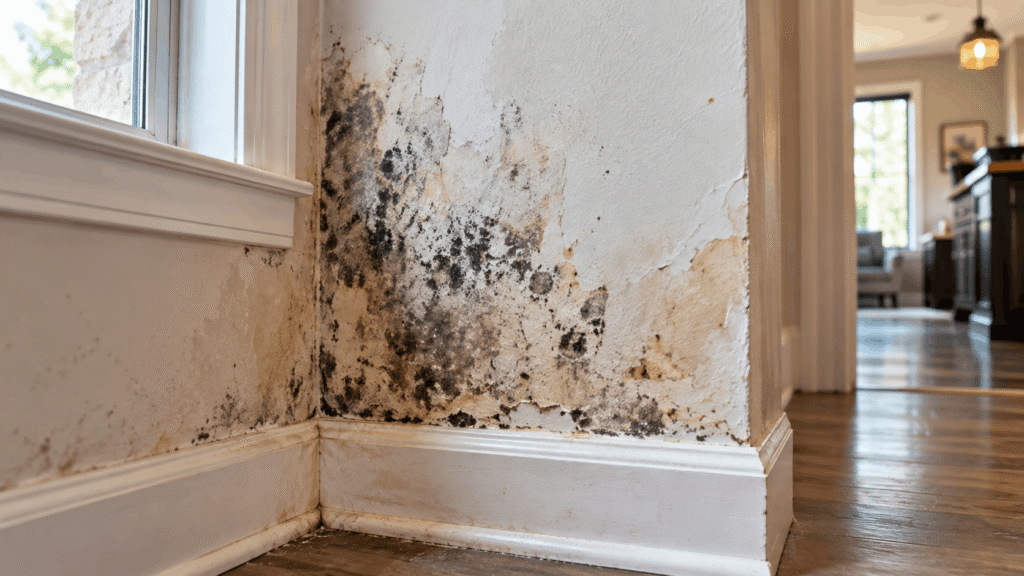
In the right conditions, mold can begin developing within 24 to 48 hours after materials become wet, although the exact timeline varies based on moisture levels, temperature, humidity, the type of material, and the specific mold species.
The important point for homeowners is that you should not wait until you can see mold before addressing a moisture problem. Wet materials can create conditions for mold growth before visible signs appear.
For homeowners in Southlake and surrounding North Texas communities, understanding the relationship between moisture and mold can help you respond faster and reduce the chance of a small water problem becoming a larger restoration issue.
How Long Does It Take for Mold to Grow?
Mold can begin growing within 24 to 48 hours under favorable conditions, although visible mold growth may take longer to become noticeable.
Mold needs several basic conditions to grow:
- Moisture
- A suitable temperature
- Oxygen
- An organic food source
- Sufficient time
Many common household materials provide potential food sources for mold, including drywall, wood, paper, cardboard, insulation, carpeting, and other materials containing organic components.
This means that a small leak can become a mold concern if affected materials remain damp.
The exact timeline cannot be predicted for every property. Some conditions may support faster growth, while others may slow it down.
Why Does Moisture Matter So Much?
Moisture is one of the most important factors homeowners can control.
A home does not need to be flooded for mold to become a concern.
Mold-friendly moisture conditions can develop from:
- Leaking pipes
- Roof leaks
- Appliance leaks
- Air conditioning problems
- Plumbing failures
- Overflowing toilets
- Water heater leaks
- Poor ventilation
- Condensation
- Flooding
- High indoor humidity
Even a relatively small amount of water can create a problem when it becomes trapped inside a wall, ceiling, cabinet, or other enclosed space.
What Happens During the First 24 Hours After Water Damage?
The first day after water intrusion is important because moisture can begin moving into surrounding materials.
For example, if a pipe leaks behind a wall, water may be absorbed by drywall, insulation, flooring, or wood framing.
During the first 24 hours, homeowners should focus on identifying and stopping the water source when it is safe to do so.
Depending on the situation, this may involve:
- Turning off the appropriate water supply
- Addressing the plumbing problem
- Removing standing water
- Moving unaffected belongings away from wet areas
- Increasing appropriate airflow
- Contacting a professional restoration company when necessary
The goal is to prevent moisture from remaining in materials long enough to create additional damage.
What Happens After 24 to 48 Hours?
If materials remain wet, the risk of microbial growth increases.
This does not mean every wet surface will automatically develop visible mold after exactly 48 hours.
The timeline depends on environmental conditions.
However, the longer porous materials remain damp, the more important proper drying becomes.
Materials such as drywall, carpet, wood, and insulation can hold moisture even after the surface appears relatively dry.
That is why simply wiping up visible water may not be enough.
Can Mold Grow Without Visible Water?
Yes.
One of the more difficult mold problems is hidden moisture.
Water can become trapped:
- Behind drywall
- Under flooring
- Inside cabinets
- Above ceilings
- Around plumbing
- Behind appliances
- Inside insulation
- Around windows
- Inside wall cavities
A homeowner may not see standing water but may still have a moisture problem.
Possible warning signs include:
- Musty odors
- Discoloration
- Peeling paint
- Bubbling drywall
- Warped flooring
- Stained ceilings
- Persistent condensation
- Damp areas
- Repeated plumbing leaks
If an area smells musty after a water event, it is worth investigating the source rather than simply masking the odor.
What Materials Are Most Vulnerable to Mold Growth?
Some materials are more likely to retain moisture and support microbial growth than others.
Drywall
Drywall can absorb water relatively quickly. If it remains wet, the material may deteriorate and become more difficult to restore.
Wood
Wood can absorb and retain moisture. Prolonged exposure can contribute to deterioration and create conditions favorable to mold.
Carpet and Padding
Carpet and padding can hold moisture below the surface, making thorough drying important after water damage.
Insulation
Wet insulation can be difficult to dry completely depending on the material and location.
Paper and Cardboard
Paper products can absorb moisture quickly and may become damaged after prolonged exposure.
The appropriate response depends on the material, amount of water, duration of exposure, and contamination level.
Does Warm Weather Make Mold Grow Faster?
Temperature can influence mold growth, but warmth alone does not cause mold.
Moisture remains a critical factor.
Homes in the Southlake and broader North Texas area can experience warm and humid conditions, which can make moisture management particularly important.
However, indoor conditions vary considerably from one property to another.
A cool room with persistent moisture can still experience mold growth.
The better approach is to control moisture rather than focusing only on temperature.
Can High Humidity Cause Mold Growth?
Yes, consistently high indoor humidity can contribute to conditions favorable for mold growth.
Potential sources of excess indoor moisture include:
- Poor bathroom ventilation
- Condensation
- HVAC problems
- Plumbing leaks
- Water intrusion
- Poorly ventilated areas
- Moisture entering from outside
Homeowners should pay attention to areas where condensation repeatedly appears or where the air feels consistently damp.
Controlling humidity can be an important part of preventing future moisture problems.
What Are the Early Signs of Mold?
Mold is not always immediately obvious.
Homeowners may notice:
Musty Odors
A persistent musty smell can indicate a moisture problem, particularly when there is no obvious source.
Discoloration
Mold can appear in different colors and patterns. Color alone, however, is not a reliable way to determine the type or health significance of mold.
Recurring Moisture
If the same wall, ceiling, floor, or cabinet repeatedly becomes damp, the underlying moisture source needs to be addressed.
Peeling or Bubbling Surfaces
Paint, wallpaper, and drywall can change appearance when moisture is present.
Water Stains
A stain on a ceiling or wall may indicate previous or ongoing water intrusion.
These signs do not automatically prove that mold is present. They indicate that the area may need further investigation.
Can Mold Grow After a Small Plumbing Leak?
Yes.
A leak does not need to flood an entire room to create a potential mold problem.
For example, a slow leak beneath a sink could repeatedly wet the cabinet base and surrounding materials.
Similarly, a small leak inside a wall could remain unnoticed while moisture accumulates.
This is why homeowners should address even seemingly minor leaks promptly.
How to Prevent Mold After a Small Plumbing Leak
What Should You Do If Your Home Has Water Damage?
If your property experiences water damage, focus on moisture control as early as safely possible.
1. Stop the Water Source
If the source is a plumbing leak and it is safe to do so, shut off the appropriate water supply.
2. Protect People From Hazards
Avoid areas where water has reached electrical components or where structural damage may exist.
3. Remove Standing Water
The appropriate removal method depends on the amount and type of water involved.
4. Dry Affected Materials
Air movement and dehumidification may help, but hidden moisture may require professional equipment and moisture monitoring.
5. Check for Hidden Moisture
Walls, flooring, cabinets, and other concealed areas may retain water after visible surfaces appear dry.
6. Watch for Mold Warning Signs
Musty odors, discoloration, and recurring dampness should not be ignored.
What Does a Professional Water Damage Inspection Include?
Can You Prevent Mold After Water Damage?
You cannot always guarantee that mold will not develop after water damage, but prompt moisture control can reduce the conditions that support growth.
Homeowners can help by:
- Repairing leaks quickly
- Drying wet materials promptly
- Addressing roof problems
- Maintaining plumbing
- Improving ventilation
- Managing indoor humidity
- Checking areas prone to condensation
- Keeping gutters and drainage systems maintained
- Investigating recurring water stains
Prevention is especially important after repeated leaks.
If the same area continues getting wet, drying the area without correcting the underlying source will not solve the problem.
When Should You Call a Professional?
Professional help may be appropriate when:
- Water damage is extensive
- The water source is contaminated
- Moisture has entered walls or ceilings
- Standing water remains
- The source of moisture is unknown
- A musty odor persists
- Mold is visible over a significant area
- HVAC systems may be affected
- Materials cannot be adequately dried
- The property has experienced repeated water intrusion
Professional restoration technicians can use moisture detection and drying equipment to help identify affected areas and determine what needs to be addressed.
How Does Professional Mold Remediation Work?
Mold remediation is not simply a matter of spraying a chemical on visible growth.
A proper remediation approach focuses on both the mold and the conditions that allowed it to develop.
Depending on the property, the process may include:
- Identifying moisture sources
- Assessing affected areas
- Containing the work area when appropriate
- Removing or cleaning affected materials
- Drying moisture-affected areas
- Cleaning surrounding surfaces
- Addressing the underlying moisture problem
- Monitoring conditions after remediation
The exact process depends on the extent and location of the problem.
Mold Removal vs. Mold Remediation
Does Mold Always Grow Within 48 Hours?
No.
The frequently cited 24-to-48-hour timeframe should not be treated as an exact deadline.
Mold growth depends on multiple factors, including:
- Moisture availability
- Temperature
- Material type
- Humidity
- Air movement
- Existing contamination
- Duration of wet conditions
The important takeaway is that mold can begin growing relatively quickly when conditions are favorable, so homeowners should not intentionally wait to see whether mold appears.
Addressing the moisture problem early is the more important step.
How Long Does Mold Continue Growing?
Mold can continue growing as long as favorable conditions remain available.
If a water leak continues, the affected environment can continue supporting microbial growth.
That means removing visible mold without fixing the moisture source may not solve the underlying problem.
For example, if mold develops around a leaking pipe, cleaning the affected surface without repairing the leak leaves the conditions that contributed to the problem.
Moisture control is therefore a central part of mold prevention and remediation.
Mold and Water Damage in Southlake, TX
Homeowners in Southlake, Grapevine, Keller, Colleyville, Trophy Club, Roanoke, Bedford, and Euless can experience water intrusion from plumbing problems, roof leaks, storms, HVAC issues, and other sources.
North Texas weather can also bring periods of heavy rain and severe storms, making it important to pay attention to roof leaks and other forms of water intrusion.
If you notice a new water stain, musty odor, damp flooring, or recurring moisture, do not assume the problem will disappear on its own.
Finding and correcting the moisture source is usually the most important first step.
Frequently Asked Questions
How long does it take for mold to grow after water damage?
Under favorable conditions, mold can begin growing within approximately 24 to 48 hours, although the exact timeline varies. Moisture, temperature, humidity, material type, and other environmental conditions all influence growth.
Can mold grow overnight?
Mold may begin developing when conditions are favorable, but visible mold is not necessarily going to appear overnight. Because growth can begin quickly, wet materials should be addressed promptly rather than waiting for visible mold.
Does drying a wet area prevent mold?
Prompt and thorough drying can reduce conditions favorable to mold growth, but simply drying the surface may not be enough if moisture remains inside walls, flooring, insulation, or other materials.
Can a small leak cause mold?
Yes. A small plumbing or roof leak can create localized moisture that supports mold growth, particularly when the leak continues or affected materials remain damp.
What should I do if I smell mold but cannot see it?
A persistent musty odor can indicate hidden moisture or microbial growth. Look for signs of water intrusion around walls, ceilings, plumbing, flooring, cabinets, and HVAC areas. If the source cannot be identified, consider having the area professionally assessed.
Final Thoughts
So, how long does it take for mold to grow?
Under favorable conditions, mold can begin growing within 24 to 48 hours, but there is no universal timeline that applies to every property.
The bigger lesson for homeowners is simple: do not wait for visible mold before responding to water damage.
A leaking pipe, wet ceiling, flooded floor, or hidden moisture problem should be addressed as soon as possible. Promptly controlling the moisture source, drying affected materials, and investigating concealed moisture can reduce the conditions that allow mold to develop.
For homeowners in Southlake and nearby communities, early action can make the difference between addressing a localized moisture problem and dealing with a much larger restoration project.
Need Help With Water or Mold Damage in Southlake?
If your home has experienced water damage, persistent moisture, or suspected mold growth, PuroClean of Southlake can help evaluate the situation and determine the appropriate restoration steps.
Call (817) 809-8585 to discuss your property damage and next steps.