


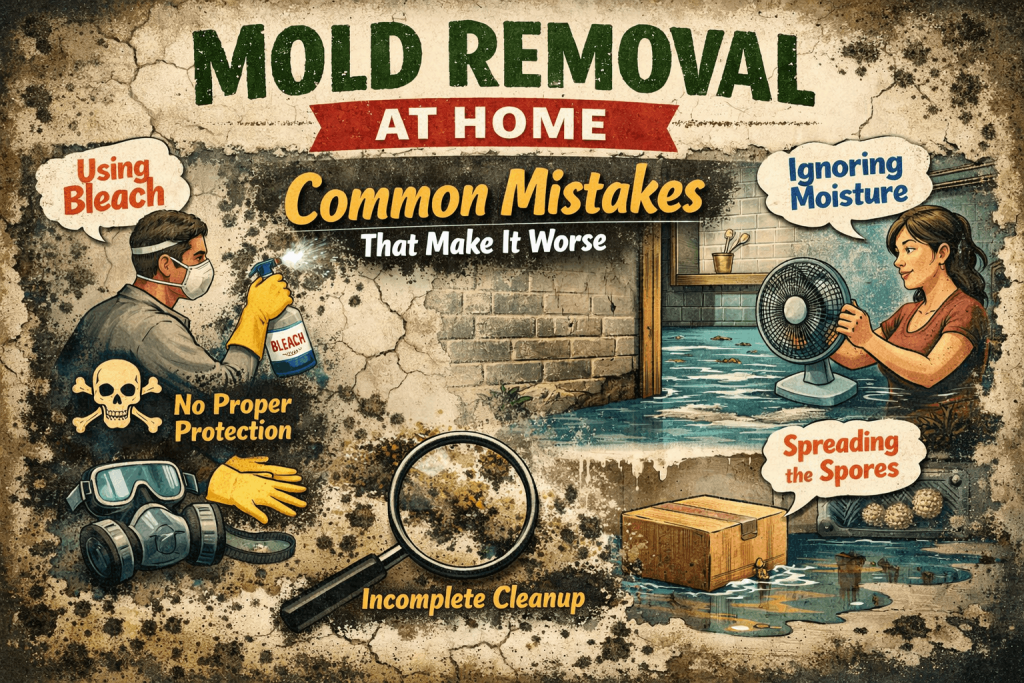
Mold is one of the few problems that gets worse the more casually you treat it.
At first, it looks minor. A few spots on the wall, a faint smell, maybe some discoloration near a bathroom or ceiling. Most homeowners assume it’s a simple cleaning issue.
So they wipe it down, spray something on it, and move on.
That’s exactly where the mistake begins.
If you’re trying to understand how to remove mold at home or how to clean mold safely, you need to stop thinking of mold as dirt. It’s not. It’s a living organism tied directly to moisture.
And if you handle it wrong, you don’t remove it. You spread it.
For homeowners in Southlake, Grapevine, Trophy Club, Roanoke, Colleyville, Bedford, and Euless, mold problems are even more common due to humidity fluctuations and hidden water issues. That makes proper removal even more critical.
Why DIY Mold Removal Often Fail
Here’s the uncomfortable truth.
Most mold problems don’t go away because people don’t actually solve them. They just make them less visible.
Mold exists because of:
- Moisture intrusion
- Poor airflow
- Condensation buildup
- Water damage
If you don’t eliminate the moisture source, mold will return. Every time.
Professionals like PuroClean of Southlake approach mold removal differently. They focus on the cause first, not just the surface.

Mistake #1: Treating Mold Like a Surface Stain
This is the biggest misconception.
You see mold, so you clean mold.
But mold grows roots into porous materials like drywall, wood, and insulation. What you see is only a fraction of the problem.
Cleaning the surface without addressing what’s underneath is like cutting weeds without removing the roots.
The result? It comes back. Usually worse.
Mistake #2: Using Bleach as a “Solution”
Bleach is one of the most misused products in mold removal.
It can remove the stain, but:
- It doesn’t kill mold deep inside materials
- It adds moisture to already damp areas
- It creates temporary results
Over time, mold grows back stronger because the root cause was never addressed.
This mistake is extremely common among homeowners trying to figure out how to remove mold at home without proper knowledge.
Mistake #3: Ignoring Where the Moisture Is Coming From
Mold doesn’t appear randomly.
There is always a source:
- A hidden pipe leak
- Roof damage
- Poor ventilation in bathrooms
- HVAC condensation
If you clean mold but ignore moisture, you’re guaranteeing its return.
This is where most DIY efforts fail. People treat symptoms, not causes
Mistake #4: Not Using Proper Protection
Mold spores are airborne and invisible.
When disturbed, they spread easily and can:
- Trigger allergies
- Cause respiratory issues
- Contaminate other areas
If you’re attempting to clean mold:
- Wear gloves
- Use a proper mask (N95 or higher)
- Protect your eyes
Without protection, you’re exposing yourself and spreading contamination at the same time.
Mistake #5: Scrubbing Aggressively
This sounds productive. It’s not.
Aggressive scrubbing:
- Breaks mold colonies apart
- Releases spores into the air
- Spreads contamination to new areas
Instead of removing mold, you’re redistributing it.
Professional remediation avoids this by using controlled removal techniques and containment systems.
Mistake #6: Skipping Containment
This is a major oversight.
When mold is disturbed without containment:
- Spores travel through air currents
- HVAC systems distribute them
- Other rooms become affected
What started as a localized issue becomes a whole-home problem.
Companies like PuroClean of Southlake use containment barriers and negative air pressure to prevent this spread.
Mistake #7: Not Drying the Area Completely
Moisture is the foundation of mold growth.
Even after cleaning, if moisture remains:
- Mold will return within days
- Hidden areas stay contaminated
Proper drying requires:
- Strong airflow
- Dehumidification
- Time and monitoring
This is essential if you want to understand how to clean mold safely without recurrence.
Mistake #8: Using the Wrong Cleaning Products
Not all cleaners are effective.
Some:
- Only mask odors
- Leave moisture behind
- Fail to kill spores
Using incorrect products creates a false sense of progress.
Professional-grade antimicrobial treatments are designed to eliminate mold, not just hide it.
Mistake #9: Waiting Too Long to Take Action
Time is critical with mold.
Within 24 to 48 hours of moisture exposure, mold can begin to grow.
If you delay:
- The affected area expands
- Removal becomes more complex
- Costs increase significantly
A small issue today becomes a major problem tomorrow.
When You Should Stop DIY and Call Professionals
DIY is limited.
You should call professionals if:
- Mold covers more than a small area
- There’s a strong, persistent odor
- Mold keeps returning after cleaning
- Water damage is involved
At this stage, you’re dealing with contamination, not just cleaning.
Homeowners across Southlake, Grapevine, Trophy Club, Roanoke, Colleyville, Bedford, and Euless often turn to PuroClean of Southlake for professional remediation when DIY efforts fail.
What Professional Mold Remediation Actually Includes
Real mold remediation is a controlled process:
- Moisture detection and source identification
- Containment of affected areas
- Air filtration using HEPA systems
- Safe removal of contaminated materials
- Complete drying and prevention
This is why professional work lasts longer and prevents recurrence.
How to Prevent Mold from Coming Back
Prevention is more important than removal.
Focus on:
- Fixing leaks immediately
- Keeping indoor humidity below 50%
- Improving airflow in bathrooms and kitchens
- Using exhaust fans
- Inspecting high-risk areas regularly
If moisture is controlled, mold has no environment to grow.
Frequently Asked Questions (FAQs)
1. How to remove mold at home safely?
Use protective gear, proper cleaning methods, and ensure the area is completely dry after cleaning.
2. Can mold come back after cleaning?
Yes, if the moisture source is not fixed.
3. Is bleach effective for mold removal?
No, it only removes surface stains and does not eliminate mold roots.
4. How to clean mold safely without spreading it?
Contain the area, avoid aggressive scrubbing, and use proper protective equipment.
5. When should I call a professional?
If mold is widespread, recurring, or linked to water damage.
6. How fast does mold grow?
Mold can begin growing within 24 to 48 hours in moist conditions.
7. Is mold dangerous?
Yes, it can affect air quality and cause health issues.
8. Can mold spread through HVAC systems?
Yes, spores can travel through air circulation systems.
9. What is the main cause of mold?
Moisture from leaks, humidity, or poor ventilation.
10. Can I prevent mold permanently?
Yes, by controlling moisture and maintaining proper ventilation.
Conclusion
Mold removal is not just about cleaning what you see. It’s about understanding what’s causing the problem and eliminating it completely.
Most homeowners make the mistake of treating mold as a surface issue, which leads to recurring problems and higher long-term costs. The right approach focuses on moisture control, proper removal, and prevention.
If you want a lasting solution, you need to go beyond quick fixes and address the root cause.
For homeowners in Southlake and surrounding areas, PuroClean of Southlake provides professional mold remediation that not only removes mold but ensures it doesn’t come back. Don’t let mold spread and create bigger damage. Contact PuroClean of Southlake today for safe, effective mold removal and long-term protection for your home.