


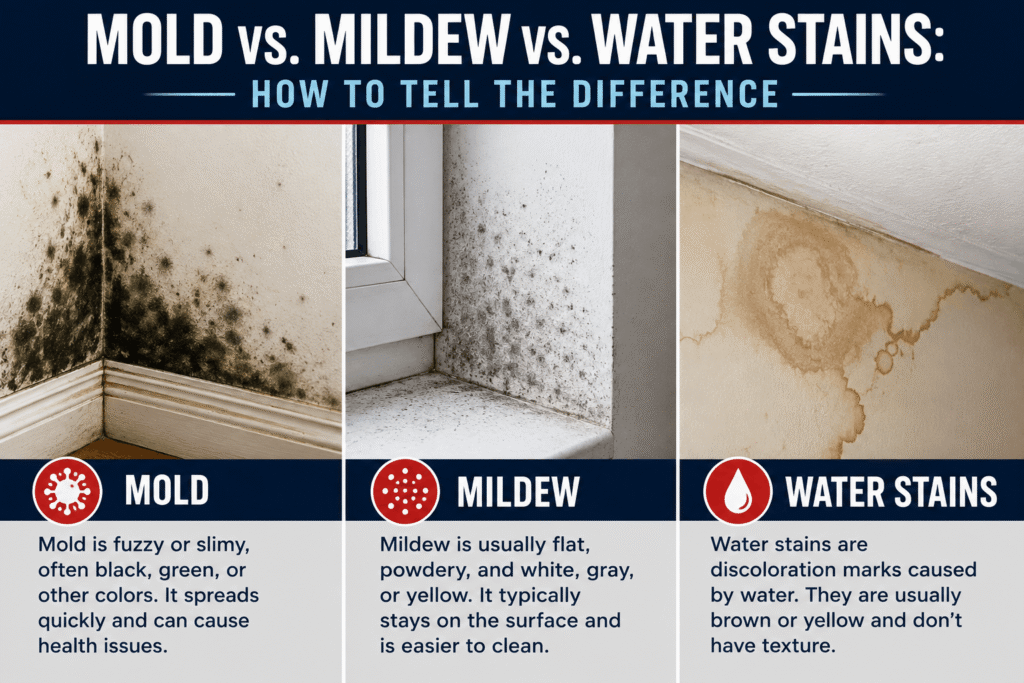
Mold typically appears fuzzy, raised, and ranges from black to green to orange; mildew stays flat, powdery, and is usually white, gray, or light yellow; water stains are flat discolorations — often brown or yellow rings — with no texture at all. Telling them apart matters because each one calls for a different response, and treating a mold problem like a simple stain (or vice versa) is one of the most common mistakes homeowners make.
Why This Distinction Actually Matters
It’s tempting to treat any dark spot on a wall or ceiling the same way — wipe it, paint over it, move on. But these three things behave completely differently, and misidentifying one as another can mean a real mold problem gets covered with paint instead of addressed, or a harmless old water stain gets treated like a health hazard it isn’t.
Mold and mildew are both fungal growth, but they behave differently and pose different levels of concern. A water stain isn’t fungal at all — it’s mineral and organic residue left behind after water evaporates, and while it can indicate a moisture problem, the stain itself isn’t alive or spreading.
Mold: What It Looks and Feels Like
- Texture: Fuzzy, slimy, or raised — mold has visible dimension, unlike a flat stain
- Color: Ranges widely — black, green, blue-green, orange, or occasionally pink or white, depending on species
- Smell: Often accompanied by a musty, earthy odor, especially in enclosed spaces
- Where it shows up: Areas with sustained moisture — behind walls, under flooring, around window frames, in bathrooms, or anywhere a water event went undried
- Growth pattern: Spreads over time if moisture persists, and can appear in patches or spread along a surface following moisture patterns
Mold needs moisture, a food source (drywall paper, wood, dust), and time to establish — typically starting within 24-48 hours of sustained wet conditions on an organic surface, which is why it shows up so reliably after water damage that wasn’t fully dried.
Mildew: What It Looks and Feels Like
- Texture: Flat and powdery, sometimes described as looking like a dusting of flour
- Color: Usually white, gray, or pale yellow, occasionally with a slightly fuzzy edge
- Smell: A milder musty odor than mold, sometimes barely noticeable
- Where it shows up: High-humidity surfaces — shower tile grout, window sills, damp fabric, sometimes on the surface of soil in houseplants
- Growth pattern: Tends to stay on the surface rather than growing into a material, which is part of why it’s generally easier to clean than mold
Mildew is technically a type of fungus too, but it’s more of a surface-level nuisance than a structural concern — the kind of thing a bathroom cleaner and better ventilation usually resolves on its own.
Water Stains: What They Look and Feel Like
- Texture: Completely flat — no raised or fuzzy quality at all
- Color: Typically brown, tan, or yellow, often in a ring pattern showing where water pooled and evaporated
- Smell: Usually odorless, unless mold has developed alongside the original water event
- Where it shows up: Ceilings below roof leaks or upstairs plumbing issues, walls near past water events, around window frames after old leaks
- Growth pattern: Doesn’t spread or change over time on its own — a water stain from three years ago looks the same today unless new water damage occurs
A water stain is essentially a “scar” from a past or ongoing water event. It doesn’t mean there’s an active problem, but it also doesn’t rule one out — that depends on what’s happening behind or beneath the visible surface.
Quick Comparison: Mold vs. Mildew vs. Water Stains
| Mold | Mildew | Water Stain | |
| Texture | Fuzzy, slimy, or raised | Flat, powdery | Flat, no texture |
| Common colors | Black, green, orange, blue-green | White, gray, pale yellow | Brown, tan, yellow |
| Odor | Musty, earthy | Mild or minimal | Usually none |
| Health concern | Can be significant, especially certain species | Generally low | None on its own |
| Spreads over time | Yes, if moisture persists | Slowly, surface-level | No — static once dry |
| Typical location | Behind walls, under flooring, HVAC systems | Bathroom tile, window sills, damp fabric | Ceilings, walls near past leaks |
| DIY-cleanable | Not recommended for anything beyond very small surface spots | Often yes | N/A — surface cleaning won’t remove staining |
How to Tell What You’re Actually Looking At: A Quick Test
- Look at texture first. If it’s raised, fuzzy, or has any dimension, you’re likely looking at mold, not a stain. Flat and dusty leans mildew; flat with no texture at all is likely a stain.
- Check for odor. A musty smell strongly suggests active mold or mildew growth; an odorless mark is more consistent with a dry water stain.
- Consider the surface. Bathroom grout and window sills lean mildew; drywall, wood framing, and areas near past water damage lean mold; ceilings below old roof or plumbing issues often show water staining.
- Think about timeline. If the mark has appeared or changed recently, that points toward active mold growth. If it’s looked the same for months or years, it’s more likely an old water stain.
- When in doubt, don’t touch it and don’t paint over it. Disturbing mold can release spores, and painting over any of these without addressing the underlying moisture just hides the problem rather than solving it.
What a Non-Expert Can’t See: Why Surface Identification Isn’t the Full Picture
This is the detail that trips up even careful homeowners: what’s visible on the surface often isn’t the full extent of the problem. Mold frequently grows inside wall cavities, under flooring, or within HVAC systems without ever showing on a visible surface, which means a home can have a genuine mold issue with no visible spots at all — just a musty smell or unexplained allergy-like symptoms among occupants. Conversely, a small visible mold spot on a bathroom ceiling might be entirely surface-level with no hidden growth behind it.
Professional mold inspection relies on more than a visual check — it typically involves moisture meter readings to identify areas with elevated moisture content (which indicates conditions where mold could be growing even without visible signs) and, in more thorough assessments, air quality or surface sampling to identify mold species and concentration. This follows IICRC S520 standards for mold remediation, which distinguish between surface cleaning appropriate for small mildew-like growth and full remediation protocols required for larger or more established mold colonies.
When to Call a Professional vs. Handle It Yourself
| Situation | DIY Appropriate | Call a Professional |
| Small mildew spot on bathroom tile or window sill | Yes — clean with standard bathroom cleaner and improve ventilation | — |
| Small mold spot (under ~10 sq ft) on a non-porous surface, no musty odor elsewhere | Often manageable, with proper PPE | Consider professional guidance if uncertain |
| Any mold on porous material (drywall, wood, carpet) | — | Yes — porous materials often can’t be fully cleaned and may need removal |
| Mold following a water damage event | — | Yes — likely hidden moisture and possible hidden growth requiring assessment |
| Musty odor with no visible source | — | Yes — professional inspection needed to locate hidden growth |
| Water stain with no odor, unchanged over time | Generally low concern, but confirm the original source was addressed | Consult if unsure whether underlying moisture issue was ever resolved |
Why North Texas Homes Are Especially Prone to This Confusion
Southlake, Colleyville, and Grapevine’s humid summers combined with North Texas’s freeze-thaw winters create ideal conditions for both active mold growth and old water staining to show up in the same home — sometimes in the same room. A ceiling stain from a roof leak fixed years ago can sit next to genuinely active mold growth from a more recent, unrelated HVAC condensation issue, and to an untrained eye, they can look similar enough to misjudge. This is part of why a professional assessment matters more than a quick internet comparison photo when there’s any real uncertainty.
Why Southlake Homeowners Trust PuroClean of Southlake for Mold Identification
PuroClean of Southlake, owned by Jiri and Hayley Smetana, provides mold inspection and remediation services throughout Southlake, Colleyville, Grapevine, Keller, and Trophy Club, with technicians trained to IICRC S520 mold remediation standards. In 2025, the franchise earned PuroClean’s President’s Circle award, recognizing performance among the top 10% of North American franchises for customer satisfaction and operational excellence.
Rather than guessing based on appearance alone, the team uses moisture meters to identify elevated moisture levels that indicate active or likely mold growth, helping homeowners understand not just what they’re looking at, but whether there’s a broader issue behind the wall or under the floor that a visual check alone would miss.
Frequently Asked Questions
Can mold and mildew be told apart just by looking?
Often, yes — mold tends to be raised, fuzzy, or slimy with a wider range of colors, while mildew is flat and powdery, usually white or gray. But surface appearance alone doesn’t reveal whether there’s hidden mold growth elsewhere, so visual identification has real limits.
Is a water stain a sign of mold?
Not necessarily — a water stain is just residue left after water evaporated and doesn’t indicate active fungal growth on its own. However, since mold needs moisture to grow, any water stain is worth checking for signs of mold nearby, especially if the original water source was never professionally addressed.
Can I clean mold myself, or do I need a professional?
Small surface mold on non-porous materials can sometimes be cleaned with appropriate care and protective equipment, but mold on porous materials like drywall, wood, or carpet often can’t be fully removed through surface cleaning and may require professional remediation. Mold following any water damage event should generally be assessed professionally due to the likelihood of hidden growth.
Does mildew turn into mold if left untreated?
Mildew and mold are different types of fungi, so mildew doesn’t technically transform into mold, but the same moist conditions that allow mildew to persist can also support mold growth nearby or on adjacent materials. Addressing the underlying moisture is the real fix in either case.
Why does my house smell musty but I can’t find any visible mold?
A musty odor without visible mold often indicates hidden growth inside wall cavities, under flooring, or within HVAC systems, none of which are visible during a normal walkthrough. This is a common reason to request a professional mold inspection that includes moisture readings rather than a visual check alone.
How can I tell if a ceiling stain is old or from a new leak?
An old, dry stain typically has sharply defined edges and doesn’t change over time, while an active or recent leak often shows a soft, spreading edge or feels slightly damp to the touch. If there’s any uncertainty, checking the area above (attic or upstairs plumbing) for an active source is worth doing before assuming it’s old.