


If your Colleyville home has water damage, the first 24-48 hours determine whether you’re dealing with a straightforward dry-out or a mold remediation project on top of it. PuroClean of Southlake provides 24/7 emergency water damage restoration throughout Colleyville, using IICRC-certified technicians, moisture mapping equipment, and industrial drying systems to stop damage before it spreads into walls, subfloors, and cabinetry.
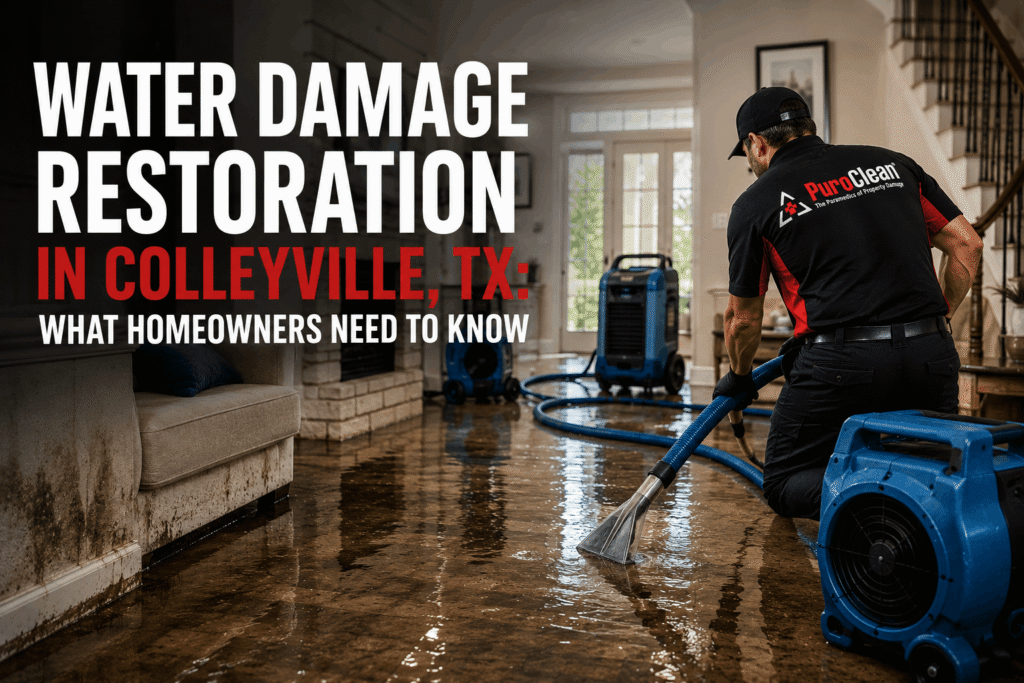
Why Colleyville Homes Are Especially Vulnerable to Water Damage
Colleyville sits on the same expansive clay soil that runs through most of Tarrant County — the kind of soil that swells when wet and shrinks when dry. That movement puts constant, quiet stress on foundations and slab plumbing lines, which is one reason slab leaks show up more often here than homeowners expect, sometimes with no visible water at all until flooring starts buckling or baseboards develop staining.
Colleyville’s housing stock adds a second layer of risk. Many homes in established neighborhoods near Village of Colleyville and around Glade Road were built in the 1980s and 90s, meaning original copper supply lines, aging water heaters, and first-generation PEX installations are now well past the point where failure risk climbs. Newer construction in areas like Cross Timbers isn’t immune either — modern homes have more bathrooms, more appliances with water lines (ice makers, tankless water heaters, washing machines on second floors), and more places for a small leak to do damage before anyone notices.
Add in North Texas’s freeze-thaw winters and its violent spring storm season, and Colleyville homeowners face water damage risk from more directions than most parts of the country: burst pipes in January, hail-driven roof leaks in April, and slow plumbing failures year-round.
What to Do Immediately After Discovering Water Damage
- Stop the source if it’s safe to do so. Shut off the main water valve for plumbing failures, or the water heater’s supply line for tank failures. If water is near electrical outlets or panels, do not enter the area — shut off power at the breaker from a dry location instead.
- Call for professional water extraction within the first few hours. Standing water begins wicking into drywall, baseboards, and subflooring almost immediately, and category 1 (clean) water can degrade toward category 2 within 24-48 hours as it sits.
- Photograph everything before you move anything. Insurance adjusters rely heavily on early documentation — soaked carpet, water lines on walls, damaged furniture — before cleanup begins.
- Remove items that are actively wicking moisture, like rugs or furniture legs sitting in water, but avoid pulling up flooring or cutting drywall yourself. Premature demolition can complicate insurance claims and sometimes removes materials that could have been dried and saved.
- Avoid running fans or a shop-vac as your only response. Surface-level drying gives a false sense of progress while moisture continues sitting inside wall cavities and under flooring.
- Contact your insurance carrier and your restoration company in parallel, not sequentially — most water damage claims move faster when the restoration company is already documenting the loss and communicating with your adjuster from day one.
How Long Does Water Damage Restoration Take in Colleyville?
Most residential water damage restoration projects run 3 to 5 days for drying and extraction, followed by a separate reconstruction phase if drywall, flooring, or cabinetry needs replacement. That timeline shifts based on a few specific factors:
| Factor | Impact on Timeline |
| Water category (clean vs. contaminated) | Category 3 (sewage/flood) water requires more extensive removal of porous materials, adding 1-2 days |
| Square footage affected | A single bathroom may dry in 2-3 days; a whole first floor can take 5-7 |
| Materials involved | Hardwood and engineered flooring often need specialized drying mats; carpet and pad usually dry faster or require replacement |
| How long water sat before treatment | Water present for more than 48 hours significantly raises mold risk and can extend the project |
| Structural drying complexity | Homes with slab leaks may need matting and negative pressure systems that add time versus a simple surface dry |
Reconstruction — replacing drywall, baseboards, flooring, or cabinetry — is typically quoted and scheduled separately once the structure is confirmed dry, since it depends on insurance approval and material availability.
The Professional Water Extraction and Drying Process
A proper water damage restoration job follows a sequence, not a single visit:
Inspection and moisture mapping. Technicians use moisture meters and often thermal imaging cameras to identify not just visible water, but moisture that has migrated into wall cavities, under flooring, and behind baseboards — areas a homeowner would have no way to detect without equipment.
Water extraction. Standing water is removed with truck-mounted or portable extraction equipment, prioritizing speed since every hour of standing water increases the risk of secondary damage.
Structural drying. Industrial air movers and dehumidifiers are placed according to the moisture map, not just wherever there’s visible wetness — this is what separates a proper dry-out from a homeowner running a couple of box fans. Drying is typically monitored daily with moisture readings to confirm materials are returning to normal levels, following IICRC S500 water damage restoration standards.
Antimicrobial treatment. Affected areas are treated to inhibit mold and bacterial growth, particularly important in Texas humidity where drying windows are tighter than in drier climates.
Verification and documentation. Final moisture readings confirm the structure has dried to an acceptable standard, and this documentation — along with the itemized damage assessment — becomes part of what’s submitted to your insurance adjuster.
Why Moisture Readings Matter More Than They Look
Here’s something most homeowners don’t know: drywall, wood framing, and subflooring all have specific moisture content thresholds that indicate “dry” — and those thresholds aren’t the same as “feels dry to the touch.” Wood framing that reads as visually dry can still hold moisture content well above safe levels, and mold only needs about 24-48 hours of sustained moisture to begin colonizing organic building materials. This is why a moisture meter reading, not a visual check, is the actual standard used to close out a drying job under IICRC S500 guidelines — and why a rushed or incomplete drying job is one of the most common reasons homeowners end up dealing with hidden mold weeks later.
DIY Water Cleanup vs. Professional Restoration
| DIY Approach | Professional Restoration | |
| Best for | Very minor spills, small isolated leaks caught immediately | Any standing water, wall/floor saturation, or water sitting more than a few hours |
| Equipment | Fans, wet-vac, dehumidifier from hardware store | Truck-mounted extraction, commercial air movers, moisture meters, thermal imaging |
| Hidden moisture detection | Not possible without specialized equipment | Standard part of the process |
| Mold risk | Higher — moisture often remains in wall cavities/subfloor | Minimized through moisture mapping and monitored drying |
| Insurance documentation | Homeowner-generated, often insufficient for full claim | Professional itemized assessment and adjuster communication |
| Typical outcome | Fine for truly minor incidents; risky for anything larger | Reduces risk of secondary damage and disputed claims |
Why Southlake and Colleyville Homeowners Choose Certified Restoration
PuroClean of Southlake is owned and operated by Jiri and Hayley Smetana, whose focus on water damage restoration grew directly out of the February 2021 Texas winter freeze — an event that caused widespread pipe bursts across North Texas and left many homeowners without a fast, reliable restoration option. That experience shaped water damage into a core focus of the business, alongside fire, mold, and biohazard restoration. In 2025, PuroClean of Southlake earned the President’s Circle award, a distinction given to less than 10% of PuroClean’s North American franchises, based on performance in customer satisfaction and operational excellence.
Every technician sent to a Colleyville property is IICRC certified, trained to the same S500 (water) and S520 (mold) standards referenced above, and EPA Lead-Safe Certified for work in homes built before 1978 — relevant for some of Colleyville’s older housing stock near the city center. The team works directly with major carriers including State Farm, Allstate, USAA, Farmers, and Travelers, providing moisture documentation and itemized assessments adjusters need to process claims without delay.
Frequently Asked Questions
Does homeowners insurance cover water damage restoration in Colleyville?
Most policies cover sudden and accidental water damage, like a burst pipe or water heater failure, but typically exclude damage from gradual leaks or lack of maintenance. Coverage details vary significantly by carrier and policy, so it’s worth confirming specifics with your agent alongside your restoration company’s documentation.
How much does water damage restoration cost in Colleyville, TX?
Cost depends heavily on square footage affected, water category, and whether reconstruction is needed beyond drying — a single-room extraction and dry-out costs far less than a multi-room job involving flooring and drywall replacement. Most restoration companies provide a free on-site assessment before quoting, since remote estimates are unreliable for water damage.
Can I stay in my home during water damage restoration?
In many cases, yes — especially if damage is contained to one area and drying equipment can run in that section while the rest of the home is unaffected. Larger losses involving multiple rooms or air quality concerns from mold may require temporary relocation, which your restoration company can advise on during the initial assessment.
How do I know if water damage has caused mold?
Visible mold growth, a persistent musty odor, or discoloration on walls and ceilings are common signs, but mold can also grow inside wall cavities where it isn’t visible. If water sat for more than 24-48 hours before being addressed, a mold inspection is worth requesting even without visible signs.
What’s the difference between water damage and flood damage for insurance purposes?
Standard homeowners insurance typically covers water damage from internal sources like burst pipes or appliance failures, but excludes flood damage from external sources like rising groundwater or overflowing creeks — flood damage requires separate flood insurance. This distinction matters for Colleyville homeowners near creek-adjacent properties in particular.
How quickly should I call a restoration company after discovering water damage?
As soon as possible — ideally within a few hours, since standing water begins causing secondary damage and mold risk increases significantly after the 24-48 hour mark. Emergency restoration companies operating 24/7 exist specifically for this reason.