


Quick answer: DIY vs professional restoration depends mainly on contamination, affected area, hidden moisture, and personal safety. A small, promptly contained clean-water spill may be manageable, but sewage, floodwater, biohazards, widespread mold, heavy soot, structural damage, and wet electrical systems require restoration pros. When exposure or hidden damage is plausible, stop and get an assessment.
Key takeaways
- DIY is most reasonable for a small, recent clean-water spill on nonporous surfaces.
- Sewage, outdoor floodwater, blood, bodily fluids, and chemical residues are not DIY cleanup jobs.
- A mold area larger than about 10 square feet, recurring growth, or contaminated HVAC equipment warrants professional help.
- Heavy soot, persistent smoke odor, wet electrical components, sagging materials, and hidden moisture are stop-work signs.
- Compare the full cost of tools, protective equipment, disposal, lost time, and possible rework—not labor alone.
DIY or professional restoration: use this quick decision table
The fastest way to decide is to identify the source, affected materials, size, and hazards before cleaning. Do not judge only by what is visible. Water can travel behind baseboards, soot can enter wall cavities, and mold may indicate moisture that has not been corrected.
| Damage situation | DIY may be reasonable when | Hire restoration pros when |
|---|---|---|
| Clean-water leak | The source is stopped, the spill is small and recent, and only washable surfaces are damp. | Water reached drywall, insulation, subflooring, electrical components, multiple rooms, or remained wet overnight. |
| Sewage or outdoor floodwater | Homeowners can avoid the area and document damage from a safe location. | Cleanup, removal, disinfection, drying, and handling contaminated belongings is required. |
| Mold | Growth is limited to a small area on a cleanable surface, the moisture source is fixed, and no vulnerable occupant will be exposed. | The area exceeds about 10 square feet, keeps returning, affects porous materials or HVAC equipment, or followed contaminated water. |
| Smoke and soot | There is a faint odor and a light residue on a few durable, washable objects after a minor, fully extinguished event. | Soot covers walls or ceilings, odor persists, materials are charred, suppression water is present, or the HVAC system operated during the fire. |
| Blood or bodily fluids | The area can be isolated while occupants avoid contact. | Any cleanup, disinfection, porous-material removal, sharp handling, or odor control is needed. |
This table is a screening tool, not a declaration that a building is safe. If there is a fire, electrical, structural, gas, chemical, or medical emergency, leave the area and contact the appropriate emergency service first.
What should you check before attempting any cleanup?
Begin with a two-minute safety check. A small job becomes a professional job as soon as one serious hazard appears. Along the Jersey Shore, storm surge, wind-driven rain, high humidity, and power interruptions can combine several hazards in the same room.
- Identify the source. A supply-line drip is different from a sewer backup or water entering from outdoors. If the source is unknown, treat the water as potentially contaminated.
- Check electricity from a safe location. Do not enter standing water near outlets, appliances, extension cords, a service panel, or submerged equipment. Have electrical hazards addressed by a qualified professional.
- Look above and below. Sagging ceilings, buckled floors, soft drywall, loose plaster, and shifting structural materials are reasons to stay out.
- Consider what is hidden. Wet insulation, wall cavities, cabinetry, crawl spaces, and layered flooring cannot be evaluated reliably by touch alone.
- Protect occupants. Keep children, pets, older adults, and anyone with respiratory or immune-system concerns away from mold, soot, contaminated water, and cleanup dust.
- Document before disturbing materials. Take clear photos and video, note the apparent source and time discovered, and preserve receipts. Contact your insurer promptly if a claim may be involved.
For a broader sequence covering safety, documentation, mitigation, and recovery, use these critical steps after property damage. Avoid demolition until contamination, lead-safe work practices, insurance documentation, and permit needs have been considered.
When can you handle a small clean-water leak yourself?
A limited clean-water spill is the strongest DIY candidate. Think of a recently spilled container or a small supply-line leak that was stopped quickly—not rainwater entering the building, an appliance discharge of uncertain cleanliness, or water that has passed through dirty materials.
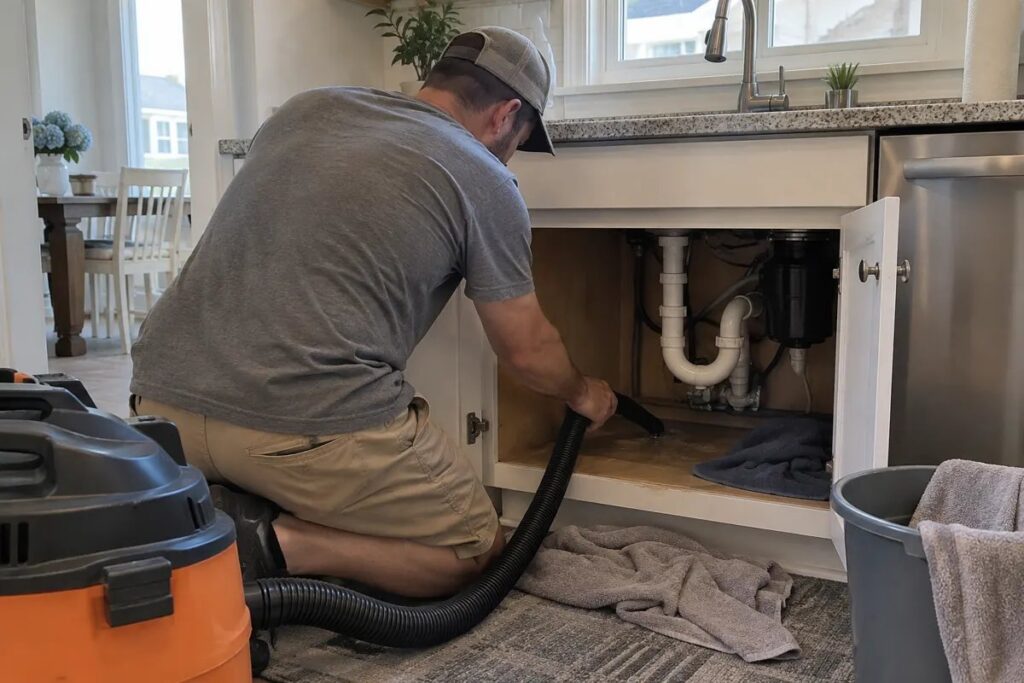
DIY is reasonable when you can safely stop the source, remove the water promptly, wash the affected surface, and dry the area completely. Use towels, a wet-rated vacuum if appropriate, ventilation, and a household dehumidifier without overloading electrical circuits. Move furniture and rugs so moisture is not trapped beneath them.
Check the area over the next several days for swelling, staining, musty odor, peeling finishes, or renewed dampness. A consumer moisture meter can help compare the affected surface with a known-dry area, but a single reading does not prove that a wall or floor assembly is dry.
Call a professional now if you find any of these signs
- Water traveled under cabinets, finished flooring, walls, or built-ins.
- Drywall is soft, insulation is wet, or flooring is lifting or cupping.
- The leak affected more than one room or a floor below.
- The source continued for many hours or the time of loss is unknown.
- Indoor humidity remains high or a musty odor develops.
- You cannot confirm that concealed materials are drying.
Professional drying is not simply placing larger fans in a room. It involves mapping moisture, selecting equipment for the materials and conditions, and checking progress. Our guide to water damage restoration explains that process in more detail.
Why are sewage and storm floodwater not DIY projects?
Sewage backups and water entering from streets, bays, yards, or storm surge can carry microorganisms, chemicals, oils, and debris. The visible water is only part of the problem. Contaminants can remain in carpet padding, drywall, insulation, subfloors, ductwork, and contents after the surface looks dry.
Do not walk through the area to retrieve belongings unless emergency officials say entry is safe and you have appropriate protection. Never run ordinary household fans across a sewage-affected room because airflow can spread contaminated droplets and particles. Do not mix cleaners; combinations such as bleach and ammonia can produce dangerous gases.
Restoration pros determine which materials can be cleaned and which porous materials require controlled removal. They also establish containment, use suitable protective equipment, apply disinfectants as directed, and dry the remaining structure. PuroClean of Toms River provides flood and sewage backup cleanup as part of its residential restoration services.
For businesses, the threshold for professional help is especially low because employee and customer exposure, inventory, food-contact areas, records, and continuity plans may be involved. Commercial owners should isolate the area, stop access, document conditions without exposure, and arrange qualified commercial property damage restoration.
Can you remove a small patch of mold yourself?
The U.S. Environmental Protection Agency’s widely used homeowner guidance uses roughly 10 square feet as a general dividing line for small mold cleanup. That is not an automatic permission to proceed. The water source, material, occupant health, and likelihood of hidden growth matter as much as the visible dimensions.
A small patch on a hard, nonporous surface may be manageable if the moisture source has been corrected and the person cleaning can avoid exposure. Wear gloves, eye protection, and at least an N95 respirator, follow product labels, avoid creating dust, and dry the surface fully. Painting or caulking over active growth does not solve the problem.
Choose professional mold remediation when
- The visible area exceeds about 10 square feet.
- Mold returns after cleaning or a musty odor has no visible source.
- Growth involves drywall, insulation, ceiling tile, carpet padding, or other porous materials.
- The HVAC system or ductwork may be contaminated.
- Mold followed sewage, outdoor flooding, or long-term water intrusion.
- An occupant has significant respiratory sensitivity or a compromised immune system.
Do not open walls merely to “see how far it goes.” Disturbing contaminated material without containment can spread particles into clean rooms. In humid communities such as Toms River, Brick, Bayville, Seaside Heights, and Lavallette, correcting the leak and controlling moisture are essential; surface treatment alone invites recurrence.
Should you clean smoke and soot damage yourself?
A very small, localized cooking incident may leave a light film on a few washable surfaces. After emergency officials have said entry is safe and the source is fully extinguished, you may be able to ventilate naturally and clean a limited number of durable items using the manufacturer’s care instructions.
Widespread soot is different. Depending on what burned, residue can be oily, acidic, irritating, or difficult to remove without driving it deeper into paint, fabric, wood, and masonry. Incorrect wet cleaning can smear soot, while an ordinary vacuum can redistribute fine particles if it is not designed and filtered for the task.
Call restoration pros when soot is visible on walls or ceilings, smoke entered several rooms, the HVAC system was running, plastics or unknown materials burned, or odor persists after basic airing. Charring, damaged wiring, broken windows, roof openings, and water from firefighting also require coordinated repair and drying. For contractor-selection questions specific to this loss type, see this guide to choosing a fire restoration company.
Do not test switches or appliances in the affected area, consume exposed food, or wash smoke-damaged clothing with unaffected laundry. Insurers may want items documented before cleaning or disposal, so photograph room overviews and individual contents first when it is safe.
When do biohazards require trained cleanup professionals?
Blood, bodily fluids, unattended-death conditions, needles, and other potentially infectious materials should not be treated like ordinary household dirt. Cleanup can involve exposure through broken skin, eyes, mouth, or sharp objects. Porous surfaces may also retain contamination and odor below the visible area.
Keep people and pets out, avoid touching or moving objects, and do not use a household vacuum or mop. If sharps are present, never pick them up by hand. Law enforcement, emergency medical personnel, or a property manager may need to release the scene before cleanup begins.
PuroClean of Toms River performs biohazard cleanup, including blood and bodily fluid remediation, and uses EPA-registered disinfectants as appropriate to the job. The local office is IICRC Certified and EPA Lead-Safe Certified, and its public emergency number is available 24/7. Those credentials do not replace asking what scope, documentation, disposal process, and insurance apply to your particular loss.
Chemical spills, suspected drug-lab residue, asbestos-containing material, and other regulated hazards may require specialists beyond a general restoration scope. Do not proceed until the substance and responsible authority are identified.
How do DIY and professional costs and outcomes compare?
DIY usually has the lower initial cash cost when the job requires only basic cleaning supplies and a few hours. Professional work costs more upfront because it may include inspection, containment, extraction, drying equipment, repeated moisture checks, specialized cleaning, controlled demolition, disposal, and documentation. The fair comparison is the complete scope, not a fan-rental price versus a restoration proposal.
| Decision factor | DIY approach | Professional approach |
|---|---|---|
| Upfront spending | Supplies, protective equipment, tool purchase or rental, disposal, and personal time. | Labor, specialized equipment, monitoring, cleaning agents, disposal, and documented scope. |
| Hidden damage | Limited by access and the user’s ability to interpret moisture or contamination. | Can include moisture mapping, thermal imaging as a screening tool, and access planning. |
| Outcome | Suitable for a genuinely small, clean, accessible loss that dries fully. | Better suited to contaminated, concealed, large, technically complex, or time-sensitive losses. |
| Main financial risk | Incomplete drying, spread of contamination, damaged finishes, repeat work, and delayed claims documentation. | Paying for unnecessary scope if estimates are not itemized or providers are not properly checked. |
Rework is a real cost. In a homeowner survey reported by Angi, 25% of respondents hired a professional to fix or finish an attempted DIY project; among that group, 86% spent more than originally planned, with average added fees of $862. Those figures cover home projects broadly rather than restoration alone, but they illustrate why an uncertain hazardous cleanup is a poor place to learn by trial and error.
Before hiring, request a written, itemized scope and verify current insurance and any registration or trade credentials required for the work.
Reconstruction, electrical, plumbing, structural, and other regulated work may require permits or licensed trades. The New Jersey Department of Community Affairs maintains the state’s current construction codes, while the local construction office determines requirements for a particular address and scope. Check before work begins rather than assuming emergency mitigation and permanent reconstruction follow the same rules.
PuroClean of Toms River serves Toms River and surrounding Ocean County communities, including Berkeley Township, Seaside Park, Point Pleasant Beach, Brick, Bay Head, and Allenwood. For a hazardous or uncertain loss, you can contact the restoration team to discuss professional cleanup instead of expanding a DIY project beyond safe limits.
Frequently Asked Questions
Will homeowners insurance cover professional restoration but not DIY cleanup?
Coverage depends on your policy, the cause of loss, and the documentation you provide. Professional reports, moisture readings, photos, and itemized scopes usually make a claim easier to support. DIY cleanup can still be documented, but missing records and incomplete drying can create disputes. Notify your insurer promptly and keep receipts, photos, and contractor notes.
Can I rent professional drying equipment and do the work myself?
Rental equipment can help with a small, clean-water spill, but it does not replace moisture assessment. Without readings, you may stop drying too early or miss water behind walls and under flooring. If the area is large, contaminated, or still damp after a day or two, a professional drying plan is safer.
How quickly should a restoration company be called after water damage?
As soon as possible, especially if the water is contaminated, spreading, or affecting electrical systems. Mold can begin to grow within 24 to 48 hours in damp conditions, and hidden moisture can damage materials even after surfaces look dry.
Should I get multiple estimates during an active property emergency?
In an emergency, stabilization comes first. Stop the source if it is safe to do so, document the damage, and get professional help to prevent further loss. You can compare scopes and pricing once the property is safe and dry, but delaying mitigation to collect bids can increase damage.
What photos should I take before restoration work starts?
Photograph the source, affected rooms, water lines, damaged materials, serial numbers on appliances, and any items you remove. Take wide shots for context and close-ups for detail. Keep a simple list of damaged items, purchase dates if known, and any receipts.
Sources
- Current Construction Codes | New Jersey Department of Community Affairs
- Home Contractors | Ocean County Government
- Is Your DIY Project Actually Costing You More? | Angi
- DIY or Hire a Home Contractor Professional | Nationwide
Reach PuroClean of Toms River Any Time
If you are unsure whether damage is safe to clean yourself, do not guess. Contact PuroClean of Toms River for a professional assessment. The team is available 24/7 for emergency water, fire, mold, sewage, and biohazard restoration across Toms River and the Jersey Shore. Visit the contact page or call (732) 800-1940 for immediate help.
Written by the team at PuroClean of Toms River, an IICRC Certified and EPA Lead-Safe Certified property restoration company at 798 Fischer Blvd., Toms River, NJ, locally owned and operated by Alex Gonzalez.