


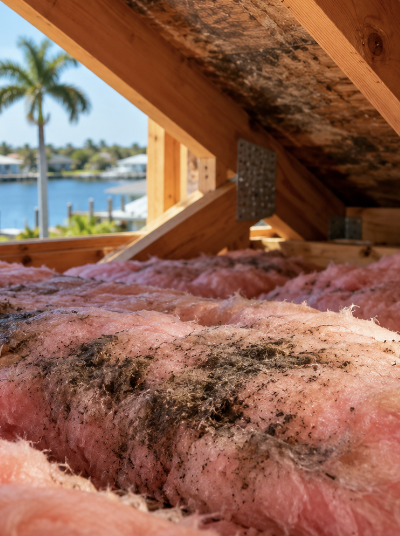
You open your attic access and notice dark spots on the insulation. Maybe the fiberglass batts look dirty, the blown-in insulation has developed unusual discoloration, or there’s a musty smell coming from the attic.
Your first question is probably whether the insulation can be cleaned—or whether all of it needs to be replaced.
Mold in attic insulation often requires removal and replacement when the insulation itself is contaminated, particularly when porous materials have become wet or supported mold growth. However, dark or dirty-looking insulation isn’t automatically moldy, and discovering mold on nearby plywood doesn’t necessarily mean every section of insulation needs replacing.
The appropriate solution depends on the type of insulation, the extent of contamination, whether the material became wet, and whether the underlying moisture problem has been corrected.
For homeowners in Port Charlotte, Florida, moisture may enter an attic through roof leaks following heavy thunderstorms, wind-driven rain during tropical weather, or condensation associated with air-conditioning equipment. Each situation can affect insulation differently.
This guide explains how to recognize suspected mold in attic insulation, when materials may need replacement, what professional remediation involves, and how to prevent the problem from returning.
Safety first: Don’t pull apart suspicious insulation, disturb loose-fill materials, or walk across unfinished attic framing. Attics can contain electrical hazards, extreme heat, and areas where stepping between framing members could cause a serious fall.
Should Moldy Attic Insulation Be Removed and Replaced?
Attic insulation generally should be replaced when mold growth is confirmed within the insulation or when water damage makes the material unsuitable for effective cleaning and reuse. However, replacement isn’t automatically necessary simply because insulation looks dirty or mold has been found on nearby roof decking.
Many insulation products contain interconnected spaces that trap dust, moisture, and other particles. That structure makes them useful for slowing heat transfer, but it can also make thorough cleaning difficult when contamination becomes embedded in the material.
The EPA explains that porous materials affected by mold may need to be discarded because mold can grow into spaces that are difficult or impossible to clean completely.[1]
For example, a small roof leak might wet one section of fiberglass insulation beneath a roof penetration. If that insulation develops mold contamination, removing the affected section may be appropriate without replacing insulation throughout the entire attic.
By contrast, a widespread moisture problem affecting large areas of blown-in insulation may require a more extensive remediation plan.
Quick Decision Guide: Keep or Replace?
| Insulation Condition | Likely Recommendation | Why |
|---|---|---|
| Dry insulation with ordinary dust or discoloration | Evaluate before replacing | Discoloration alone doesn’t establish mold contamination. |
| Mold on nearby plywood but no evidence insulation is affected | Assess insulation separately | Nearby mold doesn’t automatically mean the insulation must be removed. |
| Small section of insulation contaminated by a roof leak | Targeted removal and replacement may be appropriate | Localized contamination may not require whole-attic replacement. |
| Wet, compressed, or deteriorated insulation | Evaluate for replacement | Moisture damage can affect performance and suitability for reuse. |
| Confirmed mold growth within porous insulation | Removal and replacement are commonly appropriate | Embedded contamination may be difficult to clean effectively. |
| Widespread contamination across multiple attic areas | Professional assessment and remediation plan | The extent of affected material must be established. |
Bottom line: Replace insulation because its condition warrants replacement—not simply because someone found black stains elsewhere in the attic.
For help evaluating suspected contamination, learn more about professional attic mold removal in Port Charlotte, FL.
What Does Moldy Attic Insulation Look Like?
Suspected mold in attic insulation may appear as black or gray speckles, irregular discoloration, fuzzy-looking growth, or stained areas associated with moisture.
However, insulation can also become dark from ordinary dust accumulation, air leakage, construction debris, or water staining.
Appearance alone cannot confirm that insulation contains mold. The location, moisture history, material type, and condition of surrounding building components are important parts of the evaluation.
Common Visual Warning Signs
- Black or gray patches: May represent mold-like growth, dust accumulation, or other contamination.
- Greenish discoloration: May indicate suspected fungal growth but isn’t diagnostic by itself.
- White fuzzy-looking areas: Could represent surface growth or another material deposit.
- Wet or compressed insulation: Suggests moisture exposure that deserves investigation.
- Discoloration beneath a roof leak: May indicate water intrusion affecting the insulation.
- Musty odor: May accompany damp materials or microbial growth, but doesn’t prove mold is present.
One useful clue is whether the discoloration follows an obvious moisture pathway.
For example, a dark area directly beneath a leaking roof penetration deserves a different investigation from gray discoloration distributed along gaps where air moves through insulation.
Neither pattern proves mold, but each helps identify what should be evaluated.
For additional examples, see our visual guide to attic mold colors, patterns, and warning signs.
Can Mold Grow on Fiberglass Attic Insulation?
Yes, mold can be associated with fiberglass attic insulation, even though the glass fibers themselves aren’t a typical food source for mold.
Dust, organic debris, paper facings, and other materials within or around insulation may support growth when sufficient moisture is present.
Fiberglass insulation can also trap moisture and become contaminated by nearby mold growth or water-damaged materials.
Why Fiberglass Insulation Sometimes Looks Black
Dark fiberglass insulation isn’t always moldy.
Air moving through insulation can deposit dust and other airborne particles, sometimes creating dark streaks or patches.
This is sometimes described as air filtration staining.
For example, insulation near gaps in a ceiling or around attic penetrations may become visibly darker where air repeatedly moves through the material.
That appearance may resemble mold, but the underlying cause can be different.
When Fiberglass Insulation May Need Replacement
Replacement may be appropriate when fiberglass insulation is:
- Confirmed to contain mold contamination that cannot be effectively removed.
- Wet or damaged after a roof leak or other water intrusion.
- Significantly compressed or deteriorated.
- Contaminated by other materials requiring removal.
- Otherwise unsuitable for continued use following professional evaluation.
Dry, serviceable fiberglass insulation shouldn’t automatically be discarded simply because nearby plywood contains suspected mold.
The objective is to identify the affected materials accurately and avoid both inadequate cleanup and unnecessary replacement.
What Happens When Mold Develops in Blown-In or Cellulose Attic Insulation?
Blown-in insulation presents different challenges because it consists of loose material distributed across the attic floor or within enclosed spaces.
Common loose-fill products include fiberglass and cellulose insulation.
Cellulose insulation is primarily made from processed paper fibers, while loose-fill fiberglass is made from glass fibers. Their material composition and response to moisture differ.
Mold in Cellulose Insulation
Cellulose insulation contains organic material and is typically treated with additives intended to improve fire resistance and discourage certain biological activity.
Those treatments don’t make it immune to problems caused by prolonged water exposure.
When cellulose insulation becomes wet, it may clump, settle, or lose some of its intended performance characteristics.
If mold contamination develops within the material, removal and replacement may be more practical than attempting to clean the loose fibers.
Mold in Blown-In Fiberglass Insulation
Loose-fill fiberglass doesn’t provide the same organic substrate as cellulose, but dust and other contaminants can accumulate within it.
Water intrusion may also affect its condition and performance.
When loose-fill fiberglass is contaminated or significantly water-damaged, professional evaluation can help determine whether targeted removal is appropriate.
Why You Shouldn’t Disturb Loose-Fill Insulation
Loose-fill insulation can release dust and fibers when disturbed.
If the material is contaminated, disturbing it may also release additional particles into the attic air.
Older homes may contain insulation materials that require specialized identification and handling. Vermiculite insulation, for example, can be associated with asbestos contamination, and the EPA advises homeowners not to disturb it.[2]
If you’re unsure what type of loose-fill insulation is present, don’t move or remove it yourself.
Can Spray Foam Attic Insulation Develop Mold?
Spray polyurethane foam insulation behaves differently from fiberglass batts and loose-fill materials.
It is applied as a liquid that expands and adheres to building surfaces. Some Florida homes use spray foam along the underside of roof decking as part of an unvented or conditioned attic design.
Spray foam itself is not generally considered a typical food source for mold, but mold can still develop on dust, debris, or adjacent materials when moisture conditions are favorable.
Can Mold Grow Behind Spray Foam?
Moisture problems can sometimes affect building materials concealed by insulation.
For example, roof leakage may wet wood decking in an assembly where the underside is covered with spray foam.
Because the wood surface may not be visible, determining the extent of moisture damage can require a more specialized evaluation.
However, the presence of spray foam doesn’t automatically mean hidden mold is present.
Should Spray Foam Be Removed if Mold Is Suspected?
Not automatically.
Removal may be necessary in certain situations to access damaged materials, investigate concealed moisture, or complete appropriate remediation.
But spray foam removal can affect the building’s insulation and air-sealing system, so the decision should be based on the actual conditions and a coordinated repair plan.
Have suspected problems evaluated by appropriately qualified professionals familiar with the home’s roof and insulation assembly.
Why Does Attic Insulation Get Moldy in Port Charlotte, Florida?
Port Charlotte’s warm, humid climate creates challenges for residential moisture control, particularly during the summer rainy season and periods of tropical weather.
However, Florida humidity alone doesn’t prove why a particular home’s attic insulation became moldy. The important question is how moisture reached the affected material.
Roof Leaks After Heavy Rain
Wind-driven rain can enter through damaged flashing, compromised roof penetrations, or other defects in a roof system.
Water may then drip onto attic insulation, wetting a localized section or spreading across adjacent materials.
Even when the visible ceiling below appears dry, insulation may have been affected by water intrusion.
Condensation Around Air-Conditioning Equipment
Many Southwest Florida homes rely heavily on air conditioning.
When attic HVAC ducts have damaged insulation, air leakage, or other problems, condensation may develop on sufficiently cold surfaces.
That moisture can affect nearby insulation and building materials.
A licensed HVAC contractor should evaluate suspected equipment or ductwork problems.
Bathroom Exhaust Venting Into the Attic
Bathroom exhaust fans should discharge outdoors.
When humid air is released into an attic, repeated exposure may contribute to condensation and moisture accumulation.
Insulation near the discharge point may be affected, depending on the conditions.
Air Leakage and Insulation Gaps
Air movement through ceiling penetrations, attic access openings, and duct connections can influence moisture conditions.
Depending on the home’s design, these pathways may contribute to condensation or other moisture-related problems.
They can also cause dust accumulation within fiberglass insulation, creating dark staining that resembles mold.
The EPA emphasizes that correcting moisture problems is essential to controlling mold growth.[3]
Dirty Attic Insulation vs. Mold: How Can You Tell the Difference?
One of the most common mistakes homeowners make is assuming that every dark patch in attic insulation represents black mold.
In reality, insulation can become discolored for several reasons.
Dust accumulation, air filtration staining, water damage, and suspected mold growth can produce overlapping visual patterns.
| Appearance or Condition | Possible Explanation | Recommended Next Step |
|---|---|---|
| Dark streaks along insulation near ceiling gaps | Possible dust accumulation from air movement | Evaluate air leakage and material condition. |
| Localized discoloration beneath a roof penetration | Possible water intrusion and associated contamination | Investigate the roof and affected insulation. |
| Wet or compressed fiberglass batts | Possible water damage | Identify the moisture source and evaluate replacement. |
| Clumped or settled cellulose insulation | Possible moisture exposure or other material changes | Determine whether the material remains suitable for use. |
| Visible fuzzy-looking growth on insulation or facing | Possible fungal growth | Avoid disturbance and consider professional evaluation. |
| Musty odor near attic access | Possible damp materials or microbial activity | Investigate moisture conditions and potential contamination. |
These observations are clues, not definitive identification methods.
A qualified professional may consider the insulation type, moisture measurements, surrounding materials, and the history of water intrusion before recommending removal.
Don’t squeeze, shake, or pull apart insulation to determine whether it contains mold.
For additional information about suspected contamination on surrounding roof decking, read our guide to mold on attic plywood and when roof decking needs replacement.
When Should Moldy Attic Insulation Be Removed, Cleaned, or Replaced?
Attic insulation should generally be removed and replaced when mold contamination is embedded in the material, when significant water damage has compromised its condition, or when it cannot be adequately cleaned and restored. However, insulation that remains dry, uncontaminated, and serviceable may not need replacement simply because mold was discovered elsewhere in the attic.
For Port Charlotte homeowners, the distinction can save money while ensuring that contaminated materials are properly addressed.
Consider a roof leak that affects a small section of insulation beneath a plumbing vent. If the surrounding insulation remains dry and uncontaminated, replacing the entire attic’s insulation may be unnecessary.
On the other hand, extensive water intrusion following a tropical storm may affect multiple areas and require a broader remediation plan.
When Insulation May Be Retained
Existing insulation may be suitable to remain in place when:
- It is dry and has not been significantly damaged by water.
- There is no confirmed mold contamination within the material.
- Its condition and insulating performance remain acceptable.
- Any visible discoloration is attributable to ordinary dust or another non-mold condition.
- A qualified professional determines that removal is unnecessary.
For example, dark streaks in fiberglass insulation may result from air filtration staining rather than mold. In that situation, the appropriate response may involve correcting air leakage rather than replacing otherwise serviceable insulation.
When Targeted Removal May Be Appropriate
Localized removal may be appropriate when contamination or water damage is limited to an identifiable section of the attic.
A professional may recommend removing affected insulation, addressing contamination on nearby building materials, correcting the moisture source, and installing replacement insulation after conditions are suitable.
The extent of removal should be based on the actual affected area rather than an arbitrary distance from a visible stain.
When More Extensive Replacement May Be Necessary
More extensive removal may be necessary when contamination is widespread, loose-fill insulation is significantly affected, or prolonged water exposure has compromised large areas.
However, a recommendation to replace all attic insulation should be supported by a clear explanation of why the material cannot be retained.
| Insulation Condition | Possible Action | Important Consideration |
|---|---|---|
| Dry fiberglass with ordinary dust staining | Retain if otherwise serviceable | Investigate air leakage if staining is pronounced. |
| Dry insulation near moldy roof decking | Evaluate separately | Nearby mold does not automatically establish insulation contamination. |
| Localized mold-contaminated fiberglass | Targeted removal and replacement may be appropriate | Determine the actual extent of contamination. |
| Wet or mold-contaminated cellulose | Removal and replacement are commonly appropriate | Porous loose-fill material may be difficult to clean adequately. |
| Extensively water-damaged loose-fill insulation | Evaluate for broader removal | Consider moisture exposure, contamination, and material condition. |
| Suspected moisture behind spray foam | Specialized evaluation | Removal may be needed to investigate concealed damage, but is not automatic. |
The EPA notes that mold can grow into the spaces within porous materials, making complete cleaning difficult or impossible in some circumstances.[1]
How Does Professional Attic Insulation Mold Removal Work?
Professional attic insulation mold remediation typically involves evaluating the affected materials, identifying and correcting moisture sources, establishing appropriate contamination controls, removing insulation that cannot be restored, cleaning surrounding surfaces, and preparing the attic for replacement insulation.
The process varies depending on whether the home contains fiberglass batts, blown-in cellulose, loose-fill fiberglass, or spray foam.
A small, localized roof leak does not necessarily require the same approach as extensive moisture damage following a major storm.
Step 1: Evaluate the Insulation and Moisture Source
Before removing materials, the affected area should be evaluated to determine which insulation is damaged or contaminated.
The evaluation may include examining roof decking, framing, insulation condition, moisture readings, HVAC components, and the history of water intrusion.
If the moisture originated from a roof leak, a qualified roofing contractor may need to complete repairs. If condensation around ductwork contributed to the problem, an HVAC contractor may be needed.
Removing insulation without correcting the moisture source can leave the home vulnerable to the same problem recurring.
Step 2: Establish Appropriate Contamination Controls
Disturbing mold-contaminated insulation can release dust, fibers, and fungal particles.
Depending on the project, professional remediation may involve containment, appropriate respiratory protection, controlled access, and HEPA-filtered equipment.
The purpose is to limit unnecessary disturbance and reduce the spread of contamination during removal.
Step 3: Remove Affected Insulation
Contaminated fiberglass batts may be removed in sections, while loose-fill materials may require specialized collection equipment and handling procedures.
Materials should be handled and disposed of according to the remediation plan and applicable requirements.
Before disturbing older or unidentified insulation, professionals should consider whether additional material identification or testing is necessary. Vermiculite insulation, for example, may contain asbestos and requires special precautions.[2]
Step 4: Address Contamination on Surrounding Materials
Removing insulation may expose previously concealed areas of roof framing, ceiling materials, or other building components.
If mold contamination is present on surrounding surfaces, those materials should be evaluated and appropriately remediated.
For example, contaminated insulation beneath mold-affected roof decking may require a coordinated approach rather than treating each material as an unrelated problem.
Our guide to mold on attic plywood explains when roof decking may be cleaned and when deterioration can make replacement necessary.
Step 5: Verify Moisture Correction and Install Replacement Insulation
Before installing new insulation, the moisture source should be corrected and affected building materials should be appropriately dry.
Replacement insulation should be selected and installed according to the home’s construction, applicable requirements, and the intended thermal and moisture-control design.
Completion may involve visual evaluation, moisture measurements, documentation, and independent verification when appropriate.
For homeowners in Port Charlotte, a coordinated plan helps ensure that new insulation isn’t installed over unresolved moisture damage.
Why Can DIY Attic Insulation Removal Be Dangerous?
Removing attic insulation may look straightforward, especially when fiberglass batts are visible from the attic access.
But working in an unfinished attic introduces hazards that ordinary household cleaning does not.
Those hazards can be particularly significant during Port Charlotte’s hot summer months.
Extreme Attic Heat
Conventional attics can become extremely hot during sunny Florida weather.
Physical work in a confined, poorly accessible space increases the potential for heat stress. Heat exhaustion and heat stroke are serious concerns, particularly during prolonged exertion.[5]
Don’t assume that opening the attic access makes conditions safe for extended work.
Falls Through Unfinished Ceilings
Many attics have exposed framing members with ceiling drywall between them.
Stepping onto unsupported drywall can result in a fall through the ceiling.
Carrying insulation bags or maneuvering collection equipment can make safe movement even more difficult.
Electrical Hazards
Attics may contain wiring, junction boxes, lighting components, and HVAC electrical connections.
Disturbing insulation without understanding the location and condition of electrical components can create additional hazards.
Dust, Fibers, and Potential Mold Exposure
Removing fiberglass or loose-fill insulation can release airborne particles.
If the material is contaminated, removal may also disturb fungal particles.
The CDC notes that exposure to mold may cause symptoms in some people, including respiratory irritation and allergic reactions.[4]
Older or Unidentified Insulation Materials
Not every attic contains modern fiberglass or cellulose insulation.
If the material is unfamiliar, don’t assume it is safe to disturb.
The EPA advises homeowners not to disturb vermiculite attic insulation because some products may contain asbestos.[2]
For mold-contaminated insulation, extensive removal, or uncertain materials, professional evaluation and remediation are generally the safer approach.
How Much Does Moldy Attic Insulation Removal and Replacement Cost in Port Charlotte?
The cost of removing and replacing mold-contaminated attic insulation depends on the insulation type, affected area, attic accessibility, contamination controls, and whether additional remediation or repairs are required.
There isn’t one reliable price for every attic. A small area of contaminated fiberglass insulation may involve a very different scope of work from extensive water-damaged cellulose insulation following a roof leak.
It’s also important to distinguish the cost of mold remediation from the cost of installing new insulation.
For example, a contractor may need to remove contaminated material, clean surrounding surfaces, correct a moisture problem, and then install replacement insulation. Those tasks may involve separate trades and estimates.
Major Cost Factors
| Cost Factor | Why It Affects the Project |
|---|---|
| Square footage affected | More contaminated material generally increases labor, handling, and disposal requirements. |
| Insulation type | Fiberglass batts, loose-fill cellulose, fiberglass, and spray foam may require different removal methods. |
| Depth of insulation | Thicker insulation layers can increase material volume and handling requirements. |
| Attic accessibility | Restricted headroom, difficult entry, and limited safe working areas may increase labor. |
| Containment requirements | More complex contamination may require additional controls and equipment. |
| Nearby mold contamination | Roof decking, framing, or ceiling materials may require separate remediation. |
| Moisture-source repairs | Roofing, HVAC, or other building repairs may be necessary before replacement. |
| Replacement insulation | Material type, required thermal performance, and installation complexity affect cost. |
| Independent assessment or verification | Additional professional services may add to the overall expense. |
What Should an Attic Insulation Mold Estimate Include?
Before approving work, ask for a written explanation of:
- The type and approximate quantity of insulation to be removed.
- Why the affected material requires removal.
- Whether unaffected insulation can remain in place.
- What containment and removal methods are proposed.
- Whether surrounding wood or other materials require remediation.
- Who is responsible for correcting the moisture source.
- Whether new insulation installation is included.
- How the completed work will be evaluated or documented.
Be cautious about estimates that recommend replacing all attic insulation without explaining the extent of contamination or damage.
For a broader discussion of remediation pricing, read our Southwest Florida attic mold removal cost guide.
How Can You Prevent Mold From Returning to Attic Insulation?
Preventing mold in attic insulation starts with keeping unwanted moisture out of the material. New insulation can become damaged again if roof leaks, condensation, or other moisture problems remain unresolved.
For Port Charlotte homeowners, prevention should account for Southwest Florida’s heavy rainfall, tropical weather, humidity, and frequent air-conditioning use.
Address Roof Leaks Promptly
After significant storms, watch for new ceiling stains, visible roof damage, or other indications of water intrusion.
Have suspected roof leaks evaluated and repaired by a qualified roofing contractor.
Even a relatively small leak can repeatedly wet the same section of insulation during the rainy season.
Maintain HVAC Equipment and Ductwork
Have air-conditioning equipment serviced according to the manufacturer’s recommendations.
Address condensate drainage problems, damaged duct insulation, and air leakage that may contribute to condensation.
Make Sure Bathroom Exhaust Fans Discharge Outdoors
Bathroom exhaust ducts should terminate outdoors rather than releasing humid air into the attic.
If the duct routing is incorrect, have an appropriate contractor address the installation.
Correct Air Leakage and Insulation Defects
Gaps around attic access panels, ceiling penetrations, and duct connections can contribute to unwanted air movement.
Appropriate air sealing and insulation improvements may help, but the solution should reflect the home’s construction and moisture-control design.
Adding attic vents isn’t automatically beneficial for every home in a hot, humid climate.
Keep Records of Repairs and Previous Contamination
Save photographs, inspection findings, and repair documentation.
If a previously affected area develops new staining or moisture problems, those records may help identify when conditions changed.
The EPA emphasizes that correcting moisture problems is essential to preventing recurring mold growth.[3]
Frequently Asked Questions About Mold in Attic Insulation
Does moldy attic insulation always need to be replaced?
Not always. However, porous insulation with embedded mold contamination or significant water damage commonly requires removal and replacement because thorough cleaning may not be practical. Dry, uncontaminated insulation may be suitable to remain in place.
Can black fiberglass insulation just be dust?
Yes. Fiberglass insulation can become dark from airborne dust and particles deposited as air moves through the material. Black discoloration alone doesn’t confirm mold contamination.
Can mold grow inside fiberglass insulation?
Mold can be associated with fiberglass insulation when moisture and suitable organic materials, such as dust or paper facings, are present. The glass fibers themselves aren’t a typical food source for mold.
Is mold in blown-in insulation dangerous?
Mold exposure may cause symptoms in some people, particularly those with allergies, asthma, or certain health conditions. Disturbing contaminated loose-fill insulation can release particles, so professional evaluation is advisable when contamination is suspected.[4]
Can you spray mold killer on attic insulation?
Applying a chemical doesn’t necessarily remove contamination embedded in porous insulation or correct the moisture problem. When insulation cannot be adequately cleaned, removal and replacement may be necessary.
Do you need to replace all attic insulation if mold is found?
Not necessarily. The removal area should reflect the actual extent of contamination and damage. A localized problem may allow unaffected insulation to remain, while widespread contamination may require more extensive replacement.
Can wet attic insulation dry out and be reused?
It depends on the insulation type, the source and duration of wetting, the material’s condition, and whether contamination developed. Some materials may be unsuitable for reuse after significant water exposure. Professional evaluation can help determine whether replacement is appropriate.
Does homeowners insurance cover moldy attic insulation?
Coverage depends on the policy, the cause of the damage, applicable exclusions, and any mold-related limits or endorsements. Sudden covered water damage may be treated differently from long-term leaks or maintenance-related problems. Review your policy and consult your insurer for a coverage determination.
Need Moldy Attic Insulation Removed in Port Charlotte? Call PuroClean of Venice.
Finding dark, damp, or suspicious-looking attic insulation can leave you wondering whether the material needs cleaning, partial replacement, or complete removal.
The answer depends on the insulation type, moisture history, extent of contamination, and condition of surrounding building materials.
For Port Charlotte homeowners, moisture problems may follow summer thunderstorms, tropical weather, roof leaks, or condensation around attic HVAC equipment.
You don’t need to pull apart suspicious insulation, climb across unfinished ceiling framing, or work in a dangerously hot attic to begin addressing the problem.
PuroClean of Venice provides mold remediation and restoration services for homeowners in Port Charlotte and surrounding Southwest Florida communities.
If you’ve discovered suspected mold in attic insulation, contact our team to discuss what you’ve found and the appropriate next steps.
Learn more about our professional attic mold removal and cleanup services in Port Charlotte, FL.
References
The following resources provide guidance on mold remediation, moisture control, insulation safety, and heat-related risks.
- U.S. Environmental Protection Agency. Mold Cleanup in Your Home. Guidance on porous materials, cleaning limitations, and professional remediation.
- U.S. Environmental Protection Agency. Protect Your Family from Asbestos-Contaminated Vermiculite Insulation. Guidance on identifying and avoiding disturbance of potentially asbestos-contaminated insulation.
- U.S. Environmental Protection Agency. A Brief Guide to Mold, Moisture and Your Home. Guidance on moisture control and preventing mold recurrence.
- Centers for Disease Control and Prevention. About Mold. Information about mold exposure and potential health effects.
- Centers for Disease Control and Prevention / National Institute for Occupational Safety and Health. Heat Stress. Information about heat-related illness and working in hot environments.