


You pull down the attic ladder, shine a flashlight toward the roof, and notice something unusual. There are dark speckles on the plywood. Maybe a few rafters have white, dusty-looking patches. Or perhaps there’s a greenish-gray discoloration spreading near a roof vent.
Is it mold? An old water stain? Something left behind when the house was built?
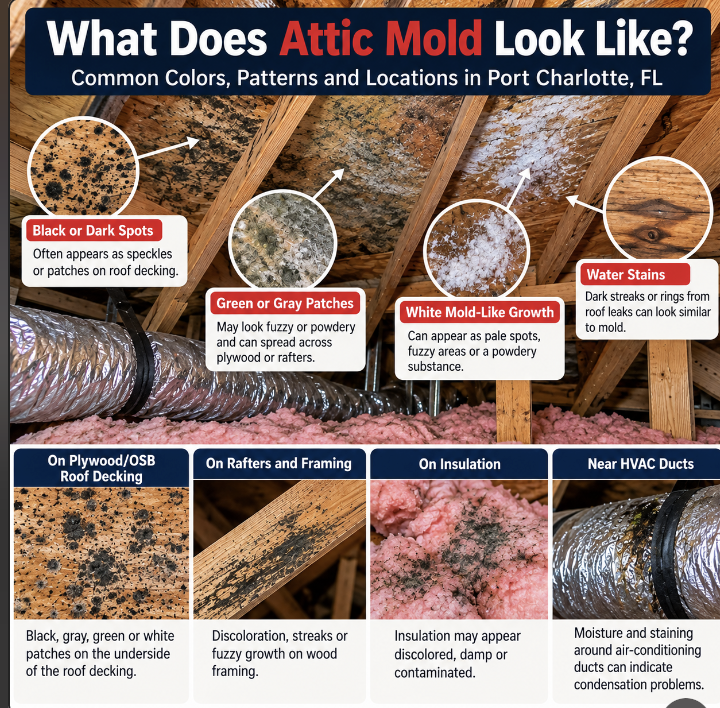
Attic mold commonly appears as irregular spots, speckles, patches, or fuzzy-looking growth on roof decking, rafters, and other materials. It may be black, gray, green, white, or brown. However, color and appearance alone cannot confirm that a stain is mold, identify its species, or establish how hazardous it may be.
For homeowners in Port Charlotte, Florida, this distinction matters. Southwest Florida’s humid weather, frequent summer thunderstorms, and year-round air-conditioning can contribute to several different moisture problems. Some leave stains. Others create conditions where mold can grow.
This guide explains what suspected attic mold looks like, how to recognize common patterns, what can be mistaken for mold, and which warning signs deserve professional attention.
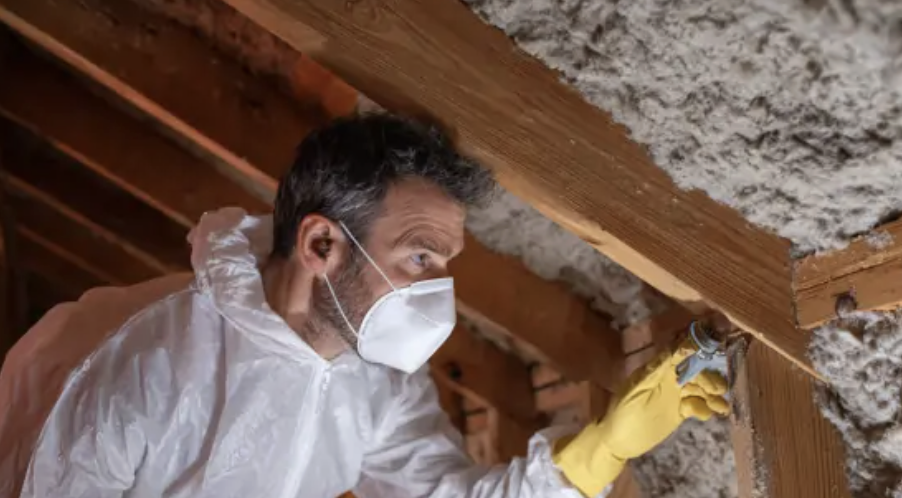
One important safety note: you don’t need to climb across an unfinished attic, touch suspicious growth, or scrape a sample to investigate it. Many useful observations can be made from a safe access point. If the area is difficult to reach, leave the inspection to a qualified professional.
What Does Attic Mold Actually Look Like?
Attic mold often looks like clusters of small spots, irregular blotches, powdery discoloration, or fuzzy growth on wood and other materials. Some patches have clearly defined edges. Others appear as scattered speckles or diffuse staining.
There isn’t one appearance that all attic mold shares.
A homeowner might notice black speckles along the underside of a plywood panel. Another might see white patches on a wooden rafter. Someone else may discover dark discoloration concentrated around a roof penetration where water has entered.
All three situations deserve attention, but none can be conclusively identified from color alone.
When looking at a suspicious area, pay attention to five characteristics:
- Color: Is the material black, white, green, gray, brown, or a combination of colors?
- Pattern: Are the marks scattered like freckles, clustered in patches, or following a visible water path?
- Texture: Does the growth appear fuzzy, powdery, velvety, or simply discolored? Do not touch it to find out.
- Location: Is it near a roof vent, plumbing penetration, HVAC duct, bathroom exhaust, or another potential moisture source?
- Change over time: Is the affected area new, spreading, or unchanged since a previous inspection?
The most useful observation is often the relationship between the suspected growth and nearby moisture conditions.
For example, dark patches immediately below a roof penetration may warrant a leak investigation. Scattered discoloration around cold HVAC equipment may suggest a different moisture mechanism.
Neither pattern confirms mold by itself, but both provide useful information for determining what to inspect next.
Quick Visual Identification Guide
| Appearance | What It Might Be | What to Look for Next |
|---|---|---|
| Small black speckles on plywood | Possible mold growth or other surface discoloration | Check for nearby moisture and whether the pattern has changed. |
| White, fuzzy-looking patches on wood | Possible fungal growth or another surface deposit | Look for moisture sources and avoid disturbing the material. |
| Greenish-gray irregular blotches | Possible mold or staining | Consider the location, material condition, and moisture history. |
| Brown rings or streaks | Possible water staining | Investigate whether a roof leak is active or historical. |
| Dark marks following wood grain | Natural variation, manufacturing marks, staining, or possible fungal discoloration | Compare with adjacent materials and older photographs if available. |
| Soft, sagging, or separating plywood | Possible material deterioration from moisture exposure | Have a qualified roofing or building professional assess the wood. |
Important: This table is a guide to possible explanations, not a visual diagnostic test. The EPA explains that visible mold and moisture problems should be addressed without relying on species identification to determine whether cleanup is needed.[1]
Black, White, Green, and Gray Attic Mold: Does Color Matter?
Color is usually the first thing homeowners notice. It’s also one of the easiest details to misinterpret.
Mold can appear in several colors, and different types may look similar. Lighting, surface materials, age, and moisture conditions can also influence how a patch appears.
You cannot reliably identify a mold species—or determine whether it is dangerous—by its color.
What Does Black Mold Look Like in an Attic?
Black or very dark mold-like growth may appear as scattered speckles, irregular patches, or darker areas across attic plywood and framing.
Some patches look nearly charcoal-colored. Others appear dark green or brown under a flashlight.
Homeowners sometimes assume any black growth must be Stachybotrys chartarum, commonly called toxic black mold. That’s not a reliable conclusion.
Several molds can appear dark, and black staining can also result from causes other than mold.
For a detailed explanation, see our guide to black mold and dark attic stains in Port Charlotte.
What Does White Mold Look Like on Attic Wood?
White mold-like growth may appear as pale spots, dusty-looking patches, or a fuzzy coating on wood surfaces.
However, not every white substance on attic materials is mold.
Dust, construction residue, mineral deposits on certain materials, and other surface conditions can create a similar appearance.
Rather than touching or scraping the material, consider whether the affected area is associated with dampness, staining, or an identifiable moisture source.
What Does Green Mold Look Like in an Attic?
Green or greenish-gray mold-like growth may appear as irregular patches or speckled discoloration.
Depending on the lighting, it may look olive, gray-green, or nearly black.
Green coloring doesn’t identify a particular mold species or establish how serious the contamination is.
The location and moisture conditions remain more useful than the color alone.
What About Gray or Brown Attic Mold?
Gray and brown patches can be especially difficult to interpret because ordinary water stains and natural wood discoloration may have similar colors.
Brown rings, streaks, or marks concentrated below a roof penetration may indicate past or ongoing water intrusion.
But moisture staining and mold growth can also occur together. An old-looking stain doesn’t automatically mean the material is free of contamination.
The CDC explains that mold exposure may cause symptoms in some people, especially those with allergies, asthma, or certain other health conditions. Others may experience no symptoms. Color alone doesn’t predict those effects.[2]
What Does Mold Look Like on Attic Plywood?
The underside of roof decking is one of the first places homeowners look when investigating suspicious attic stains.
In many Port Charlotte homes, this decking consists of plywood or oriented strand board (OSB). Both materials can be affected by moisture, although their appearance and response to water damage may differ.
Suspected mold on roof decking may appear as:
- Small dark dots scattered across the surface.
- Irregular black or gray patches near panel edges.
- Discoloration concentrated around nails or roof penetrations.
- Blotchy areas beneath locations where water may have entered.
- Multiple patches extending across adjacent roof panels.
But the appearance of the plywood doesn’t tell the entire story.
Imagine two homes in Port Charlotte.
In the first, a homeowner notices a dark patch near a plumbing vent after several days of heavy rain. The surrounding wood appears sound, but the stain is new.
In the second, a homeowner discovers similar-looking discoloration during a routine inspection. An older photograph shows that the marks were present years earlier, and there is no obvious evidence of recent water intrusion.
Those observations suggest different inspection priorities. Neither establishes whether mold is present without further evaluation.
Does Black Staining Mean the Roof Decking Needs Replacement?
No. Dark staining alone doesn’t establish that plywood or OSB has lost its structural integrity.
Some structurally sound wood can be cleaned when appropriate. Other materials may require repair or replacement if prolonged moisture exposure has caused deterioration.
Signs that warrant evaluation by a qualified roofing or building professional include visibly sagging decking, separation of plywood layers, significant swelling, or other evidence of material deterioration.
Don’t press on questionable roof decking or attempt to test its strength yourself.
Learn more about attic mold removal and cleanup in Port Charlotte, including when professional remediation may be appropriate.
What Does Mold Look Like on Attic Rafters, Framing, and Insulation?
Not every attic mold problem begins on the broad plywood panels beneath the roof.
Suspected growth may also appear on rafters, trusses, framing connections, or materials surrounding HVAC equipment.
Mold-Like Growth on Rafters and Trusses
On wood framing, suspected mold may appear as scattered dark speckles, uneven patches, or pale surface growth.
Sometimes the discoloration follows a section of framing that has been exposed to repeated moisture. Other times, it appears near a roof intersection or ventilation opening.
Natural wood grain, manufacturing marks, and old staining can complicate visual identification.
What matters is whether the material shows evidence of moisture, changing discoloration, or deterioration.
What Does Moldy Attic Insulation Look Like?
Insulation can be more difficult to evaluate visually than exposed wood.
Fiberglass insulation may appear dusty, stained, compressed, or discolored for reasons unrelated to mold. Water-damaged insulation may also show changes in appearance or performance.
Cellulose and other porous insulation products can be affected by prolonged moisture exposure, but visible appearance alone may not establish the extent of contamination.
Do not pull apart, shake, or disturb suspicious insulation to investigate it. Doing so may release dust and potentially contaminated particles.
If insulation is visibly wet, heavily stained, or associated with suspected mold growth, professional evaluation is advisable.
How Can You Tell Attic Mold From Water Stains or Natural Wood Discoloration?
This is one of the most important distinctions for homeowners because not every dark mark in an attic requires mold remediation.
Roof decking can contain natural color variations, manufacturing marks, old water stains, and other discoloration that may resemble mold.
At the same time, an actual moisture problem can produce both staining and fungal growth.
Use the following comparison to understand what different patterns may suggest.
| Characteristic | Possible Mold Growth | Possible Water Staining | Natural or Other Discoloration |
|---|---|---|---|
| Typical appearance | Speckles, irregular patches, or visible surface growth | Rings, streaks, or blotches associated with water movement | Grain patterns, consistent markings, or isolated color differences |
| Color | Black, white, gray, green, brown, or other colors | Often tan, brown, gray, or dark | Varies with wood and material history |
| Surface texture | May appear fuzzy, powdery, or velvety | May appear flat or simply discolored | Often follows the underlying material |
| Relationship to moisture | Growth requires suitable moisture conditions | May indicate current or historical water exposure | May have no connection to a current moisture problem |
| Change over time | May expand when conditions support growth | May remain after a leak is repaired | May remain stable for years |
| Can appearance confirm the cause? | No | No | No |
Consider a dark patch beneath a roof vent.
If the area developed after a recent thunderstorm, that timeline makes water intrusion worth investigating. If the same patch appears in photographs from several years ago, it may reflect an older condition.
Neither observation proves whether mold is present today.
A qualified evaluation may consider moisture measurements, material condition, building history, and the extent of visible contamination.
The EPA recommends correcting moisture problems and cleaning confirmed mold rather than simply painting over or covering affected surfaces.[1]
For homeowners considering cleanup themselves, our guide to removing attic mold safely explains why heat, falls, electrical hazards, and exposure to disturbed contamination can make DIY attic remediation risky.
Where Does Attic Mold Usually Appear First?
When investigating suspected attic mold, the location of the discoloration can be more informative than its color.
Different moisture problems tend to affect different parts of an attic.
| Location | Possible Moisture Concern | Who May Need to Investigate |
|---|---|---|
| Around plumbing vents and roof penetrations | Compromised flashing or water intrusion | Qualified roofing contractor |
| Near roof intersections or valleys | Water entry during heavy rain | Qualified roofing contractor |
| Near HVAC ducts or equipment | Condensation, damaged insulation, or drainage problems | Licensed HVAC contractor |
| Near bathroom exhaust ducts | Improperly terminated exhaust releasing moisture into the attic | Appropriate ventilation or mechanical contractor |
| Across multiple roof decking panels | Possible broader moisture or ventilation-related conditions | Qualified mold assessor or appropriate building professional |
| Near damaged or wet insulation | Water intrusion or condensation affecting porous materials | Appropriate moisture-source contractor and mold professional |
These are possible explanations, not definitive diagnoses. Moisture can travel along framing, roofing components, or other materials before becoming visible.
For example, a stain several feet from a roof penetration doesn’t necessarily mean water entered directly above that stain.
In Port Charlotte, where heavy summer rainfall and wind-driven storms can expose roof weaknesses, tracing the actual source of moisture is an important part of evaluating suspicious attic growth.
Why Do Port Charlotte Attics Develop Mold?
Port Charlotte sits along Charlotte Harbor in Southwest Florida, where hot summers, high outdoor humidity, frequent thunderstorms, and tropical weather place ongoing demands on residential roofing and moisture-control systems.
Those conditions don’t automatically mean a home will develop attic mold. A properly functioning roof, HVAC system, and building envelope should help keep unwanted moisture from accumulating on attic materials.
The problem begins when water enters the attic or moisture repeatedly collects on surfaces that cannot dry adequately.
For Port Charlotte homeowners, four common situations deserve particular attention.
1. Roof Leaks During Southwest Florida’s Rainy Season
Summer thunderstorms can bring intense rainfall and gusty winds. Tropical storms and hurricanes may place even greater stress on roof coverings, flashing, and penetrations.
A small opening around a plumbing vent, damaged flashing, or another roofing component may allow water to reach the underside of the roof decking.
What it may look like: Dark patches, streaks, or water rings concentrated beneath a roof penetration or along a roof intersection.
What to do: Have a qualified roofing contractor investigate suspected water intrusion. Don’t assume the stain is mold, and don’t begin cleaning before the leak is addressed.
2. Condensation Around Air-Conditioning Ducts
Air conditioning operates for much of the year in Port Charlotte. Some homes have ductwork or HVAC equipment located inside the attic.
When humid attic air contacts a sufficiently cold surface, condensation can develop. Damaged duct insulation, air leakage, or equipment problems may contribute to repeated moisture exposure.
What it may look like: Discoloration near HVAC components, damp insulation beneath ductwork, or staining concentrated around mechanical equipment.
What to do: Have a licensed HVAC contractor evaluate the equipment, insulation, and condensate drainage. Suspected mold on surrounding building materials may require separate professional assessment.
3. Bathroom Exhaust Fans Venting Into the Attic
Bathroom exhaust fans are intended to move humid air out of the home. If the exhaust duct terminates inside the attic, moisture may be released directly into the space.
Repeated exposure can contribute to condensation and moisture-related staining on nearby roof decking or framing.
What it may look like: Localized discoloration near the end of an exhaust duct, sometimes accompanied by damp materials.
What to do: Have an appropriate contractor correct the exhaust routing so it discharges outdoors.
4. Air Leakage and Building-Envelope Problems
Gaps around attic access panels, ceiling penetrations, duct connections, and mechanical openings can allow unwanted air movement.
Depending on the home’s design and operating conditions, humid air may reach cooler surfaces where condensation becomes possible.
What it may look like: Recurring moisture-related discoloration without an obvious roof leak, particularly near insulation gaps, ducts, or ceiling openings.
What to do: Have the moisture pathway evaluated before making ventilation or insulation changes. Adding attic vents isn’t a universal solution for every Southwest Florida home.
The EPA emphasizes that moisture control is central to preventing indoor mold growth. Identifying and correcting the source of moisture is more important than simply changing the appearance of stained materials.[1]
Early Warning Signs of Attic Mold That Homeowners Often Miss
Attic mold doesn’t always announce itself with a large black patch across the roof decking.
Sometimes the first clue is a subtle change that seems unrelated to mold.
For example, you may notice a new ceiling stain after heavy rain, a musty odor near the attic access, or insulation that appears damp beneath an air-conditioning duct.
These observations don’t prove mold is present. They do suggest that moisture conditions deserve attention.
| Early Warning Sign | What It Might Indicate | Recommended Next Step |
|---|---|---|
| New dark speckles on roof decking | Possible surface growth or moisture-related staining | Document the location and investigate moisture conditions. |
| Musty odor near the attic access | Possible damp materials or microbial growth | Arrange an evaluation if the odor persists or accompanies other warning signs. |
| Water marks after a thunderstorm | Possible roof leak | Contact a qualified roofing contractor. |
| Damp insulation near HVAC ducts | Possible condensation or equipment-related moisture | Have an HVAC professional investigate. |
| Discoloration spreading across multiple panels | Possible ongoing moisture exposure or contamination | Consider professional mold assessment. |
| Soft or separating roof decking | Possible material deterioration | Arrange an evaluation by a qualified roofing or building professional. |
| Stains returning after previous cleaning | Possible unresolved moisture source | Investigate why the materials are becoming wet again. |
A Practical Tip: Compare Photographs Over Time
If you have photographs from a previous roof inspection, compare them with what you’re seeing today.
A dark patch that appeared after a recent storm may deserve different attention from a mark that has remained unchanged for several years.
Photographs can help establish a timeline, although they cannot confirm whether mold is present or whether materials are currently wet.
Take pictures only from a safe location. Don’t walk across exposed ceiling joists or enter an attic with suspected structural or electrical hazards.
Is Attic Mold Dangerous to Your Health?
Attic mold can present health concerns, but the level of risk depends on the circumstances.
The CDC explains that exposure to damp and moldy environments may cause symptoms in some people, including nasal congestion, coughing, wheezing, and irritation of the eyes or skin. People with asthma, mold allergies, or weakened immune systems may face additional concerns.[2]
Other people may experience no noticeable symptoms.
The color of mold doesn’t tell you how dangerous it is. Black, white, green, and gray mold-like growth cannot be ranked for health risk based on appearance alone.
Can Mold in the Attic Affect the Rooms Below?
Potentially. Attics and occupied rooms are not always completely separated from one another.
Air can move through openings around attic access panels, ceiling penetrations, ductwork, and other building components.
However, discovering suspected mold in the attic doesn’t automatically establish that the living space is contaminated or that occupants have experienced harmful exposure.
The building’s construction, air pathways, moisture conditions, and extent of contamination all matter.
Why You Shouldn’t Scrape or Disturb Suspected Mold
Scraping, sanding, brushing, or pulling apart contaminated materials can release dust and fungal particles into the air.
Attics also introduce hazards beyond potential mold exposure, including extreme heat, unsafe footing, electrical components, and restricted access.
For Port Charlotte homeowners, these risks can become particularly important during hot summer weather.
If you’re considering cleaning the attic yourself, read our guide to DIY attic mold removal risks and professional cleanup before attempting the work.
If someone in your household is experiencing persistent respiratory symptoms, consult an appropriate healthcare professional rather than trying to diagnose the cause from the appearance of attic stains.
Can You Identify Attic Mold From a Picture?
A photograph can show suspicious discoloration, but it generally cannot confirm that a substance is mold or identify its species.
This is especially important when homeowners compare their attic photographs with images found online.
Two patches that look nearly identical may have different causes. One might represent fungal growth, while another could be an old water stain or natural wood discoloration.
Lighting also changes how materials appear. A dark stain photographed with a flashlight may look different in daylight or under a camera flash.
What Makes an Attic Photograph Useful?
Although a photo isn’t a definitive diagnostic tool, it can help a professional understand what you’re seeing.
If you can safely photograph the area from an established attic access point, try to capture:
- A wider view: Show where the suspicious material is located in relation to the roof, framing, or equipment.
- A closer view: Capture the pattern of discoloration without touching or disturbing it.
- Nearby moisture clues: Include visible water stains, roof penetrations, or damp-looking materials when possible.
- Multiple affected areas: Document whether staining is isolated or appears in several locations.
- The date: Record when you noticed the condition and whether it followed heavy rain or a roof leak.
Don’t climb onto ceiling drywall, move insulation, or approach exposed wiring just to obtain a better photograph.
Do You Need Laboratory Testing to Identify Attic Mold?
Not always.
The EPA explains that when visible mold growth is present, sampling is generally unnecessary to establish that cleanup is needed. Testing may be useful in certain circumstances, particularly when the findings will influence an assessment or remediation plan.[3]
Identifying the exact species is often less important than determining whether contamination is present, how extensive it is, and what moisture problem needs correction.
When the condition is uncertain, an appropriately qualified mold assessor can help determine whether additional investigation is warranted.
When Should You Call a Professional About Suspected Attic Mold?
Not every attic stain requires extensive remediation. But some situations are difficult or unsafe for homeowners to evaluate themselves.
Professional evaluation is particularly advisable when:
- Dark, white, or greenish patches appear to be spreading.
- Suspected mold covers multiple sections of roof decking or framing.
- Insulation is wet, damaged, or visibly contaminated.
- Discoloration appeared after a significant roof leak or storm.
- A musty odor persists without an obvious explanation.
- Roof decking appears soft, sagging, or deteriorated.
- Staining returns after previous cleaning.
- The attic is too hot, difficult to access, or unsafe to inspect.
- You cannot determine whether the material is mold, water staining, or another condition.
Depending on the circumstances, the appropriate first call may be a roofer, HVAC contractor, qualified mold assessor, or remediation company.
For example, an active roof leak needs to be repaired even if mold remediation is also necessary. A remediation contractor cannot prevent future water intrusion simply by cleaning the plywood.
Florida regulates certain mold assessment and remediation activities. The Florida Department of Business and Professional Regulation provides information about applicable licensing requirements and exemptions.[4]
If you’ve found suspicious attic staining in Port Charlotte, PuroClean of Venice can discuss your concerns and help you understand the appropriate next steps.
What Should a Professional Attic Mold Inspection Check?
A useful evaluation should answer more than whether the plywood looks dark.
It should help establish whether suspected contamination is present, what materials are affected, and what moisture conditions may be responsible.
Depending on the situation, a qualified professional may evaluate the following.
| Inspection Priority | Why It Matters |
|---|---|
| Location and extent of suspected growth | Helps determine whether the condition is isolated or more widespread. |
| Roof penetrations and flashing | May reveal possible pathways for rainwater intrusion. |
| Moisture measurements | Can help identify currently damp materials. |
| HVAC equipment and ductwork | May reveal condensation or drainage concerns. |
| Bathroom exhaust routing | Can identify moisture being discharged into the attic. |
| Roof decking and framing condition | Helps distinguish surface discoloration from material deterioration. |
| Insulation condition | May identify wet or contaminated porous materials. |
| Building air pathways | Can help explain moisture movement or potential communication with occupied rooms. |
Not every project requires laboratory sampling. When visible mold is present, the EPA generally recommends addressing the contamination and moisture source rather than relying on routine testing.[3]
If remediation is needed, ask for a clear explanation of the affected materials, recommended work, moisture-source corrections, and how completion will be evaluated.
For more information about professional restoration, visit our Attic Mold Removal and Cleanup Services in Port Charlotte, FL.
Frequently Asked Questions About What Attic Mold Looks Like
What does mold look like on attic plywood?
Suspected mold on attic plywood may appear as black speckles, gray or greenish patches, white surface growth, or irregular discoloration. However, ordinary water stains and natural wood variation can look similar. Appearance alone cannot confirm mold.
What does early attic mold look like?
Early visible growth may appear as small, scattered spots or localized patches. It may also be difficult to distinguish from ordinary staining. The presence of moisture, recent changes, and the location of the marks can provide useful clues.
Is black staining on attic wood always mold?
No. Dark attic staining may result from previous water exposure, natural wood discoloration, construction-related marks, or fungal growth. A qualified evaluation can help distinguish these conditions when the cause is uncertain.
What does white mold look like in an attic?
White mold-like growth may appear as pale spots, fuzzy-looking patches, or powdery discoloration on wood. Dust and other deposits can have a similar appearance, so color and texture alone aren’t sufficient for identification.
Can attic mold look like ordinary dust?
Yes. Some suspected fungal growth may resemble dust or a powdery surface deposit. Because disturbing contaminated materials can release particles, avoid brushing or scraping suspicious areas to test their appearance.
Does attic mold always have a musty smell?
No. Mold may be present without an obvious odor, and a musty smell doesn’t conclusively establish that mold is the cause. Persistent odors accompanied by moisture or visible staining deserve further investigation.
Can a picture tell me whether attic mold is toxic?
No. A photograph cannot reliably identify mold species or establish the health risk associated with a particular area. The CDC explains that mold exposure can affect people differently, and appearance alone doesn’t predict those effects.[2]
Should I remove suspected attic mold myself?
Be cautious. Attics can present extreme heat, fall hazards, electrical risks, and exposure to disturbed contamination. Professional evaluation is advisable when the affected area is extensive, difficult to reach, or associated with moisture damage. The EPA provides guidance on when homeowner cleanup may be appropriate and when professional assistance is recommended.[5]
Found Suspicious Attic Stains in Port Charlotte? Start With a Professional Evaluation.
Black speckles, white patches, greenish discoloration, and dark water stains can all raise questions about the condition of your attic.
But the appearance of the material is only part of the story.
The more useful questions are whether mold is present, whether moisture is still reaching the affected materials, and whether the roof decking, framing, or insulation requires attention.
Those questions are particularly relevant in Port Charlotte, where summer thunderstorms, tropical weather, high humidity, and air-conditioning systems can create different pathways for moisture problems.
You don’t need to scrape suspicious growth, walk across an unfinished attic, or expose yourself to excessive heat to begin addressing the problem.
PuroClean of Venice provides mold remediation and restoration services for Port Charlotte homeowners. If you’ve discovered suspected attic mold, call to discuss what you’ve found and the appropriate next steps.
Learn more about our professional attic mold removal and cleanup services in Port Charlotte.
References
These resources provide additional information about mold identification, moisture control, health considerations, professional cleanup, and Florida mold-related services regulations.
- U.S. Environmental Protection Agency. A Brief Guide to Mold, Moisture and Your Home. Guidance on mold, moisture control, and cleanup.
- Centers for Disease Control and Prevention. About Mold. Information about mold exposure and potential health effects.
- U.S. Environmental Protection Agency. Mold Testing or Sampling. Guidance on when mold testing may be appropriate.
- Florida Department of Business and Professional Regulation. Mold-Related Services. Information about licensing requirements and exemptions.
- U.S. Environmental Protection Agency. Mold Cleanup in Your Home. Guidance on cleanup precautions and professional assistance.