Does Florida homeowners insurance cover roof leak water damage? In many cases, yes—but the answer depends on what caused the roof to leak, what your policy covers, and whether the damage happened suddenly or developed over time.
For homeowners in Port Charlotte and Southwest Florida, this distinction is especially important. Hurricanes, tropical storms, afternoon thunderstorms, wind-driven rain, and aging roofing systems can all result in water entering a home. However, insurance companies do not necessarily treat those situations the same way.
For example, if hurricane-force winds damage your roof and rain enters through the damaged area, your homeowners policy may cover both the roof damage and resulting interior water damage, subject to its terms. But if rain enters through deteriorated flashing or a roof that has been leaking for months, the insurer may determine that some or all of the damage falls under maintenance or wear-and-tear exclusions.
This guide explains how Florida roof leak insurance claims work, what homeowners should document, how hurricane deductibles affect payouts, and what to know about roof repairs and building requirements in Charlotte County.
If water is actively entering your home, prioritize safety and stop additional damage when possible. PuroClean of Venice provides roof leak water damage cleanup in Port Charlotte, including assessment of affected interior materials and appropriate water damage restoration services.
Quick Answer: When Does Florida Homeowners Insurance Cover Roof Leaks?
Florida homeowners insurance may cover roof leak damage when a covered event—such as wind, hail, or another sudden and accidental occurrence—damages the roof and allows water into the home. Coverage for leaks caused by aging, deterioration, faulty maintenance, or repeated seepage may be limited or excluded.
Importantly, coverage for repairing the roof and coverage for repairing water-damaged ceilings, insulation, walls, or flooring may be evaluated separately.
| Roof Leak Situation | Potential Insurance Coverage | Important Consideration |
|---|---|---|
| Wind damages shingles or roofing materials, allowing rain inside. | Often potentially covered. | The policy must cover the wind event, and the damage must satisfy applicable conditions. |
| A hurricane damages the roof and water enters the attic or ceiling. | Often potentially covered. | A separate hurricane deductible may apply. |
| A tree falls onto the roof and rain enters through the opening. | Often potentially covered. | Coverage depends on the cause of the tree fall and policy provisions. |
| An aging roof leaks during ordinary rainfall. | Often limited or excluded. | Wear, deterioration, and maintenance exclusions may apply. |
| Flashing around a vent or chimney has deteriorated over time. | Coverage is uncertain and may be excluded. | The cause of the failure and any resulting damage must be evaluated. |
| Water repeatedly enters through an unrepaired roof leak. | May be excluded or restricted. | Repeated seepage and failure-to-mitigate provisions may matter. |
| Storm surge or rising floodwater enters the house. | Generally excluded from standard homeowners coverage. | Separate flood insurance may provide applicable coverage. |
Bottom line: A roof leaking during a storm does not automatically establish that the storm damaged the roof. The cause of the opening, the path of the water, and the policy language are central to the coverage decision.
In This Guide
- What Roof Leak Damage Does Homeowners Insurance Cover?
- Does Insurance Cover Wind-Driven Rain in Florida?
- Common Roof Leak Insurance Scenarios in Southwest Florida
- Roof Repairs vs. Interior Water Damage: What Is Covered?
- How Florida Hurricane and Roof Deductibles Work
- What to Do Immediately After Discovering a Roof Leak
- How to Document a Roof Leak Insurance Claim
- Florida Insurance Claim Deadlines and Insurer Response Requirements
- Florida Roofing Codes and Charlotte County Permit Requirements
- Does Florida’s 25% Roof Rule Require Full Replacement?
- Replacement Cost, Actual Cash Value, and Ordinance or Law Coverage
- What to Do if Your Roof Leak Claim Is Denied or Underpaid
- Frequently Asked Questions
- Roof Leak Water Damage Help in Port Charlotte
What Roof Leak Damage Does Florida Homeowners Insurance Cover?
Most homeowners policies are designed to protect against specified covered causes of loss, not to pay for every repair a house needs as it ages.
When evaluating a roof leak, insurers generally consider three questions:
- What caused the roof to fail? Was there sudden wind damage, impact damage, deterioration, or another cause?
- How did the water enter? Did rain enter through an opening caused by covered damage, or through an existing defect?
- What property was damaged? Did the loss affect the roofing system, attic insulation, ceiling drywall, flooring, furniture, or other materials?
The answers help determine whether the insurer may cover roof repairs, interior water damage, both, or neither.
Sudden and Accidental Roof Damage
Suppose a severe thunderstorm moves through Port Charlotte and strong winds dislodge roof shingles. Rain enters through the damaged area, saturating attic insulation and staining the bedroom ceiling.
If the policy covers wind damage and its requirements are satisfied, the resulting roof and interior damage may qualify for coverage.
Other potentially covered events may include hail damage, falling objects, or sudden storm-related damage to roofing components.
However, the insurer will still consider exclusions, deductibles, coverage limits, and the condition of the roof before the event.
Gradual Deterioration and Maintenance-Related Leaks
Now consider a different situation: an older roof has deteriorated flashing around a plumbing vent. During several rainstorms, water slowly enters the attic and eventually creates a brown stain on the ceiling.
Even if the homeowner discovers the stain suddenly, the underlying damage may have developed over time.
Many policies exclude damage caused by ordinary wear and tear, deterioration, faulty maintenance, or repeated seepage. The specific wording matters, including whether the policy provides any coverage for resulting interior damage.
A newly discovered leak is not necessarily a newly occurring loss. The age of the stain alone cannot establish the cause or duration of the water intrusion.
Why the Roof’s Age Matters—but Does Not Decide Every Claim
Southwest Florida has many homes with aging asphalt-shingle, tile, and metal roofing systems. The age and condition of a roof can affect underwriting, claim valuation, and the investigation of a reported loss.
However, an older roof is not automatically excluded from coverage simply because of its age.
Florida law also contains specific protections concerning roof age when insurers issue or renew certain homeowners policies. Under Florida Statute 627.7011, an insurer generally cannot refuse to issue or renew a homeowners policy solely because a roof is less than 15 years old. For roofs at least 15 years old, the law provides an inspection process and protections when an authorized inspection shows at least five years of useful life remaining.
Important distinction: Those rules concern issuing and renewing insurance policies. They do not mean that every leak involving an older roof must be covered.
Does Homeowners Insurance Cover Wind-Driven Rain in Florida?
Wind-driven rain may be covered when wind or hail first causes qualifying damage to the building, creating an opening through which rain enters. Many homeowners policies contain specific requirements concerning this type of interior water damage.
This distinction matters in Port Charlotte, where intense thunderstorms can produce heavy rain and strong winds without necessarily causing a hurricane.
Scenario A: Wind Creates an Opening in the Roof
A strong storm damages roofing materials above a bedroom. Rain enters through the newly damaged area and saturates the insulation and drywall.
Because wind caused physical damage that allowed rain to enter, the loss may satisfy the wind-driven-rain requirements in the policy.
The homeowner should document the damaged roofing materials, the interior water path, and the timing of the storm.
Scenario B: Rain Enters Through an Existing Opening
Heavy rain enters around deteriorated flashing that was already allowing water into the attic.
In this case, the insurer may determine that the rain did not enter through an opening created by covered wind damage. Coverage may be denied or limited depending on the policy and circumstances.
That does not mean every disputed leak has the same outcome. Roofing inspections, photographs, weather records, maintenance history, and policy language may all be relevant.
What if the Roof Leaks During a Hurricane but There Is No Visible Roof Damage?
The fact that a leak appeared during a hurricane does not automatically prove that hurricane winds damaged the roof.
Some storm damage is difficult to identify from the ground. Other leaks may involve preexisting vulnerabilities that become apparent during heavy rainfall.
A qualified roofing professional can assess the roofing system and document observed conditions. The insurer then evaluates the claim under the policy.
Do not climb onto a wet or potentially damaged roof to investigate. Roof inspections after severe weather should be performed when conditions are safe.
Common Roof Leak Insurance Scenarios in Port Charlotte and Southwest Florida
Port Charlotte homeowners encounter several roof leak scenarios that can look similar from inside the house but involve very different causes and insurance considerations.
Hurricane Damage to Asphalt-Shingle Roofing
Strong winds can lift, crease, tear, or remove asphalt shingles. Once the roofing system is compromised, rain may reach the roof decking, attic insulation, and ceiling drywall.
For a homeowner in an established Port Charlotte neighborhood, the first visible indication may be a ceiling stain rather than obvious missing shingles.
When a covered hurricane causes the damage, the policy’s hurricane deductible may apply. This deductible is often significantly larger than the deductible for an ordinary household loss.
Cracked or Displaced Tile Roofing
Concrete and clay tile roofs are found throughout Southwest Florida. Tiles may crack, shift, or become displaced because of storm impacts or other causes.
However, cracked tiles do not automatically mean the roof is leaking. The underlayment, flashing, roof penetrations, and other components also affect the roofing system’s ability to resist water intrusion.
An inspection should identify the actual failure rather than assuming that replacing a visibly damaged tile will correct the leak.
Leaks Around Roof Vents, Skylights, and Flashing
Roof penetrations and transitions are common locations for water intrusion.
Possible trouble spots include plumbing vent boots, skylight flashing, roof-to-wall transitions, and areas where different roofing materials meet.
Some failures result from sudden storm damage. Others develop because sealants, flashing, or other components deteriorate over time.
For insurance purposes, identifying the actual cause matters more than the location of the leak.
Roof Leaks During Southwest Florida’s Rainy Season
Southwest Florida’s rainy season can bring frequent thunderstorms and substantial rainfall. A small roof vulnerability may become apparent during repeated heavy rain, even without a named tropical storm.
Homeowners should avoid assuming that every rainy-season leak is hurricane damage or that every leak during a thunderstorm is covered wind damage.
Weather conditions, roof observations, and the policy’s definitions of covered events should be considered together.
Water Damage After a Tree or Branch Strikes the Roof
A falling tree limb can puncture or damage roofing materials, allowing water to enter the attic or living space.
Depending on the cause of the impact and policy terms, the damage may be covered. The claim may also involve emergency protection, debris removal, roofing repairs, and interior water damage restoration.
Stay away from damaged structural areas and any fallen electrical lines. Do not attempt to remove large trees or branches from a damaged roof yourself.
Roof Repairs vs. Interior Water Damage: What Does Insurance Actually Pay For?
One of the most important distinctions in a roof leak claim is the difference between repairing the cause of the leak and restoring the damage caused by the water.
These are related problems, but they do not always have the same coverage outcome.
Repairing the Roof
Roof repairs may include replacing damaged shingles or tiles, repairing flashing, correcting damaged underlayment, or replacing sections of the roofing system.
Whether those repairs are covered depends on the cause of the roof damage, the policy, and the extent of the covered loss.
An insurer may cover storm-damaged roofing components while declining to pay for unrelated deterioration or upgrades.
Restoring Water-Damaged Interior Materials
Once water enters a home, the resulting damage may involve:
- Wet attic insulation.
- Stained or saturated ceiling drywall.
- Moisture inside wall cavities.
- Damaged paint and ceiling finishes.
- Wet carpet, wood flooring, or other floor coverings.
- Water-damaged furniture and personal belongings.
- Moisture affecting electrical fixtures or equipment.
Depending on the policy and cause of loss, necessary interior restoration may be covered even when the insurer evaluates the roof repair separately.
However, homeowners should not assume that interior damage is automatically covered whenever the roof repair itself is excluded. Some policies contain specific exclusions or conditions for rain entering through the building envelope.
Why Emergency Water Mitigation Is a Separate Priority
Consider a Port Charlotte homeowner who discovers water dripping from the living room ceiling after a severe storm.
A roofing contractor may need to identify and repair the exterior source. At the same time, a water damage restoration provider may need to evaluate saturated insulation, ceiling drywall, and concealed moisture.
Waiting until the roofing claim is fully adjusted before addressing active interior water damage can allow additional damage to occur.
The appropriate approach is to coordinate safe, reasonable mitigation with the insurer while documenting conditions and preserving necessary evidence.
Learn more about roof leak water damage restoration in Port Charlotte and the steps involved in evaluating wet ceilings, insulation, and other affected building materials.
How Florida Hurricane Deductibles Affect Roof Leak Insurance Claims
A covered roof leak does not necessarily mean your insurance company will issue a payment. The amount of covered damage must also be considered against the applicable deductible.
This is especially important in Florida, where hurricane deductibles are commonly calculated as a percentage of the insured dwelling limit rather than a flat dollar amount.
What Is a Florida Hurricane Deductible?
A hurricane deductible is the portion of a covered hurricane loss the homeowner is responsible for before the insurer pays covered amounts above that deductible.
Florida homeowners policies may offer hurricane deductible options such as 2%, 5%, or 10% of the dwelling coverage limit, subject to applicable statutory requirements and policy terms.
The percentage generally applies to the insured dwelling limit—not the market value of the home or the amount of the individual roof repair.
Example: A 2% Hurricane Deductible on a Port Charlotte Home
Suppose a homeowner has $400,000 in Coverage A dwelling insurance and a 2% hurricane deductible.
| Item | Illustrative Amount |
|---|---|
| Coverage A dwelling limit | $400,000 |
| Hurricane deductible | 2% |
| Dollar amount of deductible | $8,000 |
| Assumed covered roof and interior damage | $18,000 |
| Illustrative payment after deductible | $10,000 |
In this simplified example, the homeowner is responsible for the $8,000 deductible, and the insurer’s payment would be $10,000.
This example assumes the full $18,000 is covered and does not account for depreciation, other policy limitations, prior hurricane losses during the same calendar year, or other adjustments.
What if the Roof Leak Damage Is Less Than the Hurricane Deductible?
Suppose the same homeowner has $5,000 in covered damage but an $8,000 hurricane deductible.
The insurer may determine that the damage is covered while issuing no payment because the covered amount does not exceed the deductible.
That is different from a claim being denied because the cause of loss is excluded.
Florida’s hurricane deductible rules can also affect multiple covered hurricane losses occurring during the same calendar year. Homeowners should retain records of prior hurricane damage and payments when discussing subsequent losses with their insurer.
Does the Hurricane Deductible Apply to Every Thunderstorm?
No. A hurricane deductible is not automatically triggered by ordinary heavy rain, a severe thunderstorm, or every named tropical system.
Florida law defines the circumstances and time period associated with hurricane coverage and deductibles. A non-hurricane wind or rain loss may be subject to a different deductible under the policy.
For a clear explanation of the rules, see the Florida Department of Financial Services guide to hurricane deductibles.
What About a Separate Roof Deductible?
Some Florida homeowners policies may contain a separate roof deductible. This is not the same as the hurricane deductible.
Under Florida Statute 627.701, separate roof deductibles are subject to specific limits and exceptions. For example, the statute provides exceptions for certain hurricane-related roof losses, tree impacts that puncture the roof deck, and qualifying smaller roof repairs.
Check your policy declarations page and endorsements rather than assuming that the same deductible applies to every type of roof damage.
Practical tip: Before a storm, locate your declarations page and write down the actual dollar amounts of your hurricane, all-other-perils, and any separate roof deductibles. That information can help you make better decisions when a loss occurs.
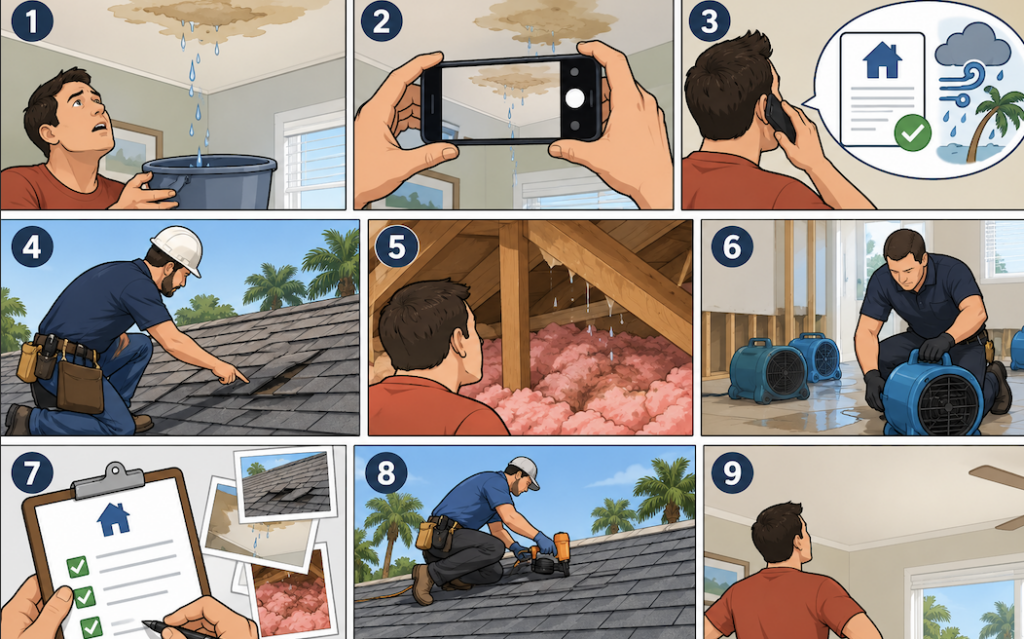
What to Do Immediately After Discovering a Roof Leak in Port Charlotte
If water begins dripping through your ceiling during a storm, your first priority is safety—not determining whether the insurance company will pay.
Follow these steps when conditions allow.
1. Stay Away From Electrical and Structural Hazards
Do not touch wet light fixtures, ceiling fans, outlets, or electrical equipment.
If water is entering an electrical area, disconnect power only if you can do so safely from a dry location. Otherwise, seek qualified assistance.
Keep people away from sagging or bulging ceilings. Saturated drywall and insulation can become heavy, and a compromised ceiling may fail unexpectedly.
2. Do Not Climb Onto the Roof During a Storm
Wet roofing materials, high winds, lightning, and hidden structural damage create serious fall hazards.
Do not attempt to locate the leak by walking across the roof during severe weather. Arrange a professional inspection when conditions are safe.
3. Protect Unaffected Belongings
If the room is safe to enter, move dry furniture, electronics, documents, and other valuables away from the affected area.
Use containers to catch dripping water only where doing so does not expose you to electrical or structural hazards.
4. Photograph the Damage Before Cleanup When Safe
Take photographs and video of visible conditions, including:
- The ceiling or wall where water first appeared.
- Water dripping or collecting inside the room.
- Damaged furniture and belongings.
- Visible roof damage photographed safely from the ground.
- Wet insulation or other materials visible from a safe location.
- The date and time the damage was discovered.
Do not delay urgent mitigation merely to obtain photographs. Safety and preventing additional damage take priority.
5. Arrange Temporary Roof Protection When Appropriate
If the roofing system has been damaged, a qualified roofing contractor may recommend temporary protection to reduce additional water intrusion until permanent repairs can be completed.
Keep receipts and records of temporary protection work. Whether those expenses are reimbursable depends on the policy and circumstances.
6. Address Wet Interior Materials
Once rain enters a home, moisture may spread beyond the visible stain.
Water can soak attic insulation, travel along framing, enter wall cavities, and accumulate beneath flooring.
Professional moisture assessment can help determine whether water extraction, structural drying, material removal, or additional cleaning is needed.
In Southwest Florida’s humid conditions, leaving wet materials untreated can make drying more difficult and increase the potential for additional damage.
7. Notify Your Insurance Company Promptly
Contact your insurer or insurance agent to report the loss and ask about documentation requirements.
Provide accurate information about what you observed. Avoid guessing about the cause of the damage if it has not been established.
For example, saying “I discovered water dripping from the ceiling during heavy rain” accurately describes an observation. Saying “the hurricane destroyed my roof” without evidence may introduce an unsupported conclusion into the claim.
Ask for the claim number, the applicable deductible, and instructions for submitting photographs, estimates, and emergency mitigation invoices.
Important: Florida imposes deadlines for notifying insurers about property claims. Do not wait until the last possible day to report a loss. The deadlines and insurer response requirements are addressed in the next sections of this guide.