



Introduction
Mold can move from a small stain behind a bathroom vanity to a larger repair project faster than many homeowners expect. In Alexandria, older housing, humid summers, basement moisture, and plumbing leaks can create the conditions mold needs to grow.
Insurance coverage is rarely based on the presence of mold alone. The central question is what caused the moisture and whether that cause is covered by the policy. Understanding mold damage insurance coverage before filing a claim can help you avoid missed deadlines, weak documentation, and surprise out-of-pocket costs.
A sudden pipe break may lead to a covered claim, while mold caused by a slow leak or long-term humidity issue may not. The details matter, including the source of water, how quickly you acted, and the wording of your specific policy.
Why The Cause Of Moisture Controls Coverage
Homeowners insurance is designed to cover certain sudden and accidental events, not routine property maintenance. Mold is generally treated as secondary damage. That means the insurer first evaluates the water event that allowed the mold to grow.
For example, a dishwasher supply line that bursts while you are away for the weekend may be a covered water loss. If moisture from that event creates mold inside the kitchen wall, the policy may cover part of the cleanup, subject to its mold limit and deductible.
A slow leak under a sink is different. If the leak dripped for months and mold developed gradually, an insurer may classify the issue as wear, neglect, or repeated seepage. Those causes are commonly excluded, even if the eventual repair bill is substantial.
In Alexandria, claim disputes often arise in finished basements, older bathrooms, and homes with aging plumbing. The visible mold may be recent, but the insurer may look for evidence that the moisture source existed long before the homeowner discovered it.
Situations That May Be Covered
Coverage is more likely when mold follows a covered water event, and the homeowner responds quickly. Policies vary, so these examples are not guarantees of payment.
• A pipe bursts suddenly, and water enters walls, flooring, or cabinets.
• A covered appliance malfunction causes an immediate interior water release.
• Storm damage creates an opening in the roof, allowing rain into the home.
• A fire sprinkler activates unexpectedly and leaves wet building materials.
• Water damage from a covered loss leads to mold before repairs can begin.
The claim is strongest when the mold can be clearly connected to a covered event rather than an existing moisture condition.
Situations Often Excluded From Coverage
Most denials involve gradual moisture, deferred repairs, or water sources excluded by the policy. Read your exclusions and endorsements closely, especially if your home has a basement or older plumbing.
• Mold linked to a long-term roof leak, window leak, or pipe drip.
• Condensation from poor ventilation in bathrooms, attics, or crawl spaces.
• High indoor humidity that was not controlled with ventilation or dehumidification.
• Floodwater entering the property from outside without a separate flood policy.
• Backup from a sewer or drain without water backup coverage.
• Mold found during a renovation with no identifiable covered water event.
These exclusions do not mean you should skip notifying your insurer, but they do mean you should prepare for a careful cause-of-loss review.
How Mold Limits Affect A Settlement
Even if the original water event is covered, mold coverage may have a separate dollar cap. Many homeowners policies limit payment for mold testing, removal, cleanup, and related repairs to a set amount, often lower than the full dwelling coverage limit.
That cap can apply to several costs at once. It may include removing contaminated drywall, cleaning framing, running air scrubbers, testing affected materials, and replacing damaged finishes. A policy with a 10,000-dollar mold limit can be exhausted quickly if contamination extends behind walls or under flooring.
Review the declarations page and endorsements for terms such as “fungi,” “wet rot,” “dry rot,” “microbial matter,” or “mold limitation.” Alexandria homeowners should also check whether the endorsement applies only after a covered loss or whether it provides limited coverage for certain water damage events.
How An Insurer Evaluates A Mold Claim
An adjuster needs a clear timeline that connects the water event, discovery, mitigation, and mold findings. Your actions in the first few days can influence both the inspection and the final payment decision.
• Report the water loss promptly through the insurer’s claims channel.
• Stop the water source if it is safe to do so, such as shutting off a supply valve.
• Photograph standing water, wet materials, damaged contents, and visible mold.
• Keep invoices for emergency plumbing, extraction, drying, and temporary repairs.
• Do not discard damaged materials until the adjuster or mitigation company documents them.
• Ask whether the policy requires insurer approval before major demolition begins.
A well-documented timeline gives the insurer less room to question whether the mold resulted from the reported incident.
What To Document Before Mold Removal Begins
Mold remediation can require opening walls, removing flooring, or discarding porous materials. Once that work starts, the physical evidence of the moisture source may be harder to prove.
• Take wide photos showing the affected room and close photos showing damage details.
• Record the date you first noticed water, odors, staining, or visible growth.
• Save emails, texts, and reports from plumbers, roofers, and restoration companies.
• Request moisture readings and written findings from the mitigation contractor.
• Keep a copy of the remediation estimate with room-by-room scope details.
• Separate emergency mitigation invoices from elective renovation upgrades.
Good records support the covered portion of the loss while preventing upgrade costs from being mixed into the insurance estimate.
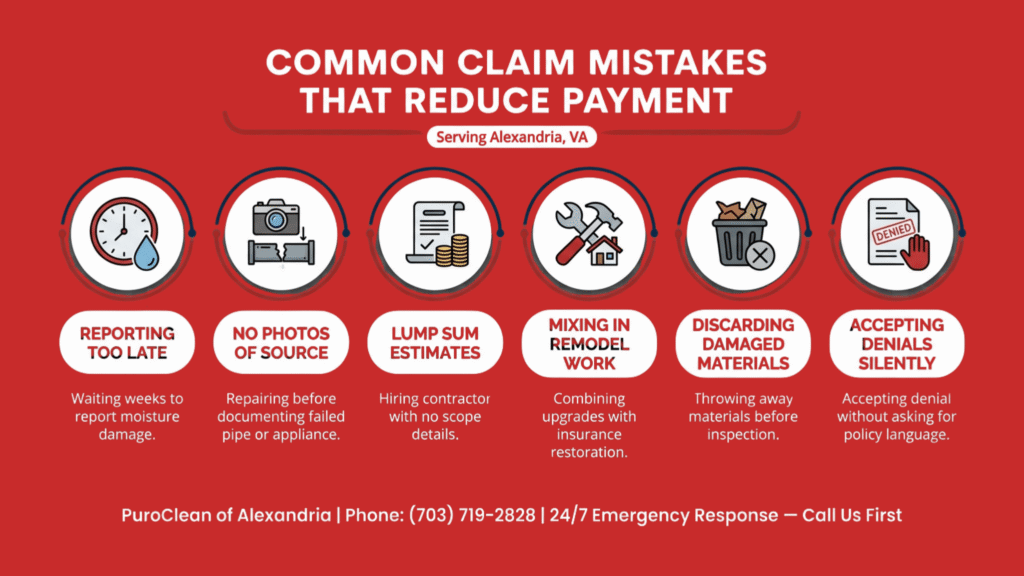
Common Claim Mistakes That Reduce Payment
A mold claim can become more difficult when a homeowner assumes the insurer will infer the cause or pay for every repair automatically. Small decisions early in the process can have costly consequences.
• Waiting weeks to report a water event after discovering moisture damage.
• Repairing the source without photographing the failed pipe, appliance, or roof area.
• Hiring a contractor who provides only a lump sum estimate with no scope details.
• Combining a kitchen or bathroom remodel with insurance-funded restoration work.
• Throwing away damaged materials before they are inspected or documented.
• Accepting a denial without asking for the specific policy language used.
Avoiding these errors keeps the discussion focused on evidence, policy terms, and the actual cause of loss.
Alexandria Homes Have Distinct Moisture Risks
Alexandria’s mix of historic homes, rowhouses, townhomes, and properties with finished lower levels creates several recurring moisture patterns. Older supply lines can fail behind finished walls. Masonry foundations may allow moisture into basements after heavy rain. Closely connected homes can also make it harder to identify whether water came from your unit, a shared wall, or a neighboring property.
Condominium owners need to review both their own HO-6 policy and the condominium association’s master policy. The master policy may cover certain building components, while the unit owner’s policy may cover interior finishes, personal property, loss assessment, and some mold-related expenses. Responsibility can depend on the declaration documents and the exact source of the leak.
For a single-family home, routine inspections of attic ventilation, roof flashing, plumbing connections, gutters, and basement humidity can reduce the chance that a minor moisture issue becomes a larger insurance dispute.
When To Get Independent Help
If the insurer agrees that the water event is covered but questions the extent of mold damage, an independent assessment can clarify the scope. A qualified remediation contractor can identify affected materials, measure moisture, and explain why specific containment or removal work is necessary. Be cautious with broad testing recommendations that do not connect results to a remediation plan. Visible growth and a known moisture source often require removal and drying regardless of an expensive testing package. For a contested claim, ask for written findings that explain the source, affected areas, recommended work, and estimated cost.
If the claim is denied, request the denial in writing and compare it with your policy’s water damage, repeated seepage, mold, and maintenance exclusions. A clear written explanation is more useful than a verbal summary from a claims representative.
Conclusion
Homeowners insurance may pay for mold removal in Alexandria when mold follows a sudden, covered water loss, but gradual leaks, humidity, and excluded water events often fall outside standard protection. The source of moisture, the timing of discovery, and the proof you provide will shape the outcome.
Before starting major work, review your policy’s mold remediation claim limit, document the damage, and ask the insurer what emergency mitigation is authorized. Taking those steps early gives you a clearer path to restoring the property and managing costs.
FAQs
Q: Does homeowners insurance cover mold from a leaking pipe?
A: It may, if the pipe leak was sudden and accidental. Coverage is less likely if the pipe dripped slowly over time or if there were visible warning signs that were not addressed.
Q: Is mold testing covered by homeowners insurance?
A: Mold testing may be covered if it is necessary to evaluate mold caused by a covered water loss and falls within the policy’s mold limit. Insurers may deny testing tied to an excluded condition or routine inspection.
Q: Will homeowners insurance cover mold caused by basement flooding?
A: Standard homeowners insurance usually does not cover floodwater entering from outside the home. A separate flood policy may be needed, while a plumbing backup may require a water backup endorsement.