 PuroClean of Plantation
 Table of Contents
How to Remove Smoke Smell After Fire: To remove smoke smell after fire, you need to ventilate immediately, clean all hard surfaces with TSP or alkaline solutions, treat fabrics and upholstery professionally, clean your HVAC and ductwork, apply natural odor absorbers like activated charcoal, seal walls with odor-blocking primer, and use professional-grade deodorization tools like thermal foggers or hydroxyl generators for stubborn odors. DIY methods work for minor smoke exposure; but fire-related smoke smell almost always requires certified professional intervention to be fully and safely eliminated.
Why Smoke Smell After Fire Is So Hard to Get Rid Of
If you have ever walked into a room days or weeks after a small kitchen fire and still smelled it; you already understand the frustration.
Smoke smell after fire is not like other household odors. You cannot simply open a window and wait it out. You cannot spray an air freshener and call it solved. The smell keeps coming back because the source of it is not in the air; it is in your walls, your furniture, your ductwork, your carpet fibers, and even the paint on your ceiling.
Here is the science behind why this happens.
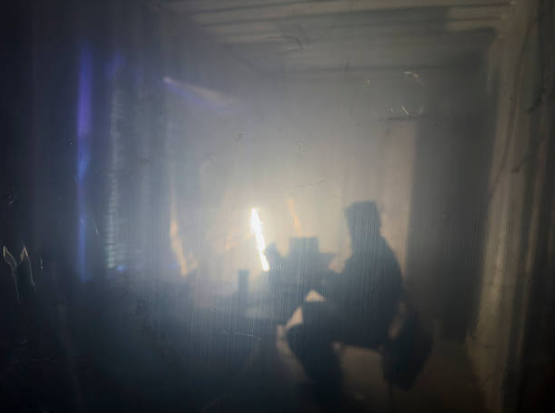
Smoke consists of microscopic particles suspended in gases. These particles; including volatile organic compounds (VOCs), polycyclic aromatic hydrocarbons, and fine matter called PM2.5; are small enough to penetrate into porous materials at a molecular level. When they settle into drywall, carpet, insulation, and fabric, they essentially become part of those materials. Normal cleaning techniques only address the surface layer. The particles underneath continue releasing odorous gases into your indoor air for weeks; sometimes months; after the fire.
Understanding this is the foundation for understanding how to remove smoke smell after fire effectively.
The Hidden Health Danger in That Smoke Odor
This is not just about comfort. It is about safety.
Researchers from the University of Colorado studying the aftermath of the 2022 Marshall Fire confirmed that toxic compounds; including benzene, toluene, and naphthalene; from burned homes entered neighboring surviving homes and caused health symptoms for residents long after the fire was extinguished.
Soot particles that cause smoke smell also contain PM2.5 (fine particulate matter) that can penetrate deep into the lungs when inhaled repeatedly. People with asthma, allergies, or chronic respiratory conditions are especially vulnerable. Children and the elderly face heightened risk.
So when you ask how to remove smoke smell after fire, you are really asking: how do I make my home safe to breathe in again? That reframing matters; because it means this is not a cleaning project. It is a health restoration project.
What You Should Do in the First 24 Hours
Timing is everything when it comes to how to remove smoke smell after fire. The first 24 to 48 hours are the critical window.
Here is what to prioritize before you begin any formal cleaning:
Wait for clearance. Do not re-enter the property until the fire department has officially cleared it as safe. Structural damage, electrical hazards, and air quality issues may still be present.
Open everything. Once cleared, open every window and door. Turn on all exhaust fans; kitchen, bathroom, and whole-house if you have them. Place box fans in windows facing outward to push contaminated air out rather than circulating it around.
Turn off the HVAC. This is a step many homeowners miss. Running your HVAC while smoke residue is present forces those particles throughout every duct in your home; contaminating rooms that had no visible smoke damage. Turn it off and do not run it until the system has been inspected and cleaned.
Protect yourself. Before touching anything, wear an N95 mask or respirator, safety goggles, gloves, and long sleeves. Soot is harmful to the skin and lungs.
Document everything. Take photographs and video of all visible damage before any cleaning begins. This documentation is critical for your insurance claim.
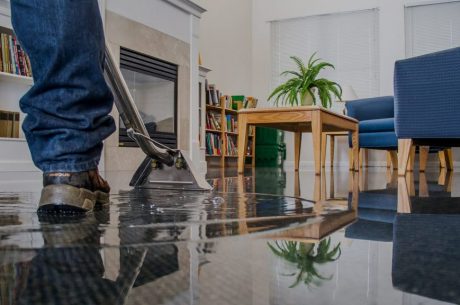
Did you experience flooding alongside the fire from firefighting water? Make sure to also read what to do after flooding in your home as water damage and fire damage often occur together and require coordinated restoration.
9 Expert Steps to Remove Smoke Smell After Fire
These steps are organized from immediate actions to professional interventions. For minor smoke exposure; say a small contained kitchen fire; the first several steps may be sufficient. For fire involving multiple rooms, synthetic materials, or significant flame, you will almost certainly need professional help by step 6.
Step 1: Maximum Ventilation
Before any cleaning, maximize air movement.
Place fans at exterior doorways and windows oriented to push air outward. Create a cross-ventilation path that moves air from clean areas toward areas with heavier smoke contamination. This does not eliminate the odor; but it reduces the concentration of airborne particles and makes the space safer to work in.
Keep ventilation running continuously; day and night if weather permits; for at least 12 to 24 hours before beginning detailed cleaning.
Step 2: Remove All Fabric Items
Fabric is smoke’s favorite hiding place.
Curtains, upholstery, throw pillows, rugs, bedding, clothing; all of these need to be removed from the affected space immediately. Fabric items that remain in a smoke-damaged room will continue to absorb odor and re-release it, undoing any cleaning you do to walls and floors.
Wash machine-washable fabrics in hot water with a cup of distilled white vinegar added to the cycle along with your regular detergent. Do not put items in the dryer until all smoke smell is gone; heat can lock odors permanently into fabric fibers. Air-dry outdoors in sunlight when possible.
Heavily affected items like mattresses, foam cushions, and wall-to-wall carpet may need professional cleaning or full replacement.
Step 3: Clean All Hard Surfaces Thoroughly
Hard surfaces look cleaner than they are after a fire.
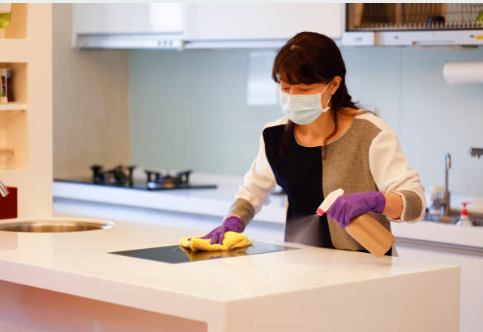
Walls, baseboards, window sills, door frames, countertops, and light switches all carry soot residue; sometimes invisibly. The American Red Cross recommends cleaning all hard surfaces with a solution of warm water, mild soap or trisodium phosphate (TSP); 4 to 6 tablespoons per gallon of warm water; working in small sections from floor to ceiling to prevent streaking.
Use a dry-cleaning sponge (a vulcanized rubber sponge designed for soot removal) first on walls and ceilings before applying any wet solution. Wet the soot before trying to wipe it and you will smear it deeper into the surface. Always rinse with clean water after the cleaning solution and dry completely.
Clean ceilings last to prevent loosened soot from falling onto already-cleaned lower walls.
Step 4: Clean Inside Every Cabinet, Drawer, and Closet
Smoke sneaks into enclosed spaces more effectively than most people expect.
Open every cabinet in the kitchen, every bathroom drawer, every closet door; and inspect the interior surfaces. Wipe down all interior surfaces with your cleaning solution. Remove and wash any items stored inside. Replace shelf liners.
This step is often skipped; and it is often the reason that smoke smell after fire seems to keep returning even after thorough surface cleaning.
Step 5: Treat Carpets and Upholstered Furniture
Carpets and upholstered furniture are among the most stubborn sources of smoke smell after fire because their dense fibers trap particles deep below the surface.
For carpets, sprinkle baking soda liberally over the entire surface and allow it to sit for at least several hours; ideally overnight. Vacuum thoroughly using a HEPA-filter vacuum cleaner that captures fine particles rather than redistributing them into the air.
Steam cleaning provides a deeper level of treatment for carpets and upholstered items that can tolerate moisture. However, for leather, delicate fabrics, or heavily contaminated materials; professional cleaning or replacement is often the most practical path.
PuroClean of Plantation’s carpet and upholstery cleaning service uses professional-grade equipment designed specifically for post-fire restoration scenarios.
Step 6: Address the HVAC System
Every question about how to remove smoke smell after fire must include this step; and most DIY guides give it far less attention than it deserves.
Your HVAC system is essentially a distribution network for smoke particles. During and after the fire, smoke entered the return air vents and was pulled through the entire duct system. Even if you cleaned every surface in your home; if the ducts are not addressed; the system will continue blowing contaminated air into your living spaces every time it runs.
Replace all air filters immediately with high-efficiency MERV 13 or higher rated filters. Have the entire duct system professionally cleaned and inspected before restarting the system. Once new filters are in place, run the system on fan-only mode for 48 hours to cycle out residual particles.
This is a step that genuinely requires professional equipment and expertise. PuroClean of Plantation’s duct cleaning service handles post-fire HVAC contamination as a standard part of comprehensive fire damage restoration.
Step 7: Use Natural Odor Absorbers as Supplements
While professional methods are required for fire-level smoke damage, natural odor absorbers can serve as a helpful supplement during and after the restoration process.
Activated charcoal is particularly effective; place bowls of it around the affected rooms for several days to absorb residual airborne odor compounds. Baking soda serves a similar function; leave open containers in closets, cabinets, and under furniture.
Bowls of undiluted white vinegar placed around rooms can help neutralize odors through a chemical reaction with the acidic smoke residue; though this is best used as a complement to professional treatment, not a replacement for it.
Do not use scented candles, air fresheners, or masking sprays. These cover the odor temporarily but do nothing to eliminate the underlying particles causing it. A few hours later; the smoke smell after fire returns.
Step 8: Seal and Repaint Walls
Paint holds odor.
Even after thorough cleaning, the layers of paint on your walls can retain smoke particles inside them; continuing to off-gas into the room. The correct sequence is: clean the walls, allow them to dry completely, apply a stain-blocking odor-sealing primer (products specifically formulated for smoke odor encapsulation), and then apply two coats of latex paint.
Skipping the primer and going straight to paint results in stains bleeding through the new coat and odors continuing to emanate from the wall surface. This is a mistake that costs homeowners significantly when they later realize the work needs to be redone.
Step 9: Professional Deodorization Technology
For how to remove smoke smell after fire at the level of a structure fire; professional deodorization technology is not optional. It is the step that makes permanent odor elimination possible.
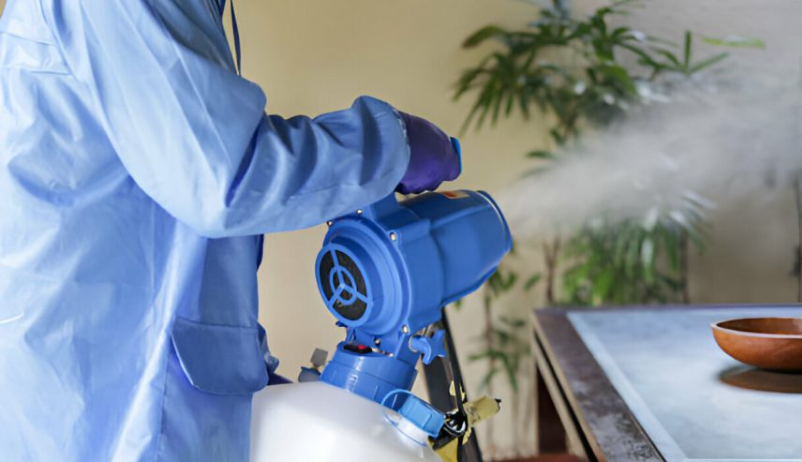
Thermal foggers generate a fine mist of odor-counteracting solution that penetrates the same porous materials that smoke entered. This is one of the most effective methods for treating the odor at its source rather than at the surface.
Hydroxyl generators are safe for occupied spaces and work by producing hydroxyl radicals that break down odor-causing VOCs at a molecular level. They are ideal for ongoing treatment during the restoration process.
Ozone generators produce ozone that chemically destroys odor molecules. These are highly effective but require full evacuation of the space during treatment; as concentrated ozone is harmful to humans, pets, and plants.
The selection of which technology to deploy; or which combination; is a decision that certified restoration professionals make based on the specific materials affected and the severity of the damage. This is precisely the kind of expertise that makes PuroClean of Plantation different from general cleaning services.
The Difference Between Masking Odor and Eliminating It
This distinction matters more than most homeowners realize; and it is where many restoration jobs fall short.
Masking involves applying a fragrance or covering agent that overpowers the smoke smell temporarily. The underlying particles are still present. Once the masking agent fades; in hours or days; the smoke smell returns.
Eliminating the odor means addressing the source compounds directly; through chemical breakdown, physical removal, or encapsulation. True elimination means the particles are no longer present to generate odor. This is what professional smoke damage cleanup services accomplish through the combination of mechanical cleaning, content restoration, HVAC treatment, and deodorization technology.
If you have cleaned your home thoroughly and the smell keeps returning; the source has not been eliminated. It has only been temporarily suppressed.
When DIY Is Not Enough; Signs You Need a Professional
There is no shame in acknowledging that fire-related smoke damage is beyond what household tools and store-bought cleaners can address. Here are the clear signals:
The smoke smell after fire persists beyond 48 to 72 hours despite ventilation and cleaning. The fire involved synthetic materials; carpet, foam, insulation, plastic. Multiple rooms were affected. The HVAC system was running during or after the fire. Anyone in the household has respiratory conditions. You can see visible oily or dark soot deposits on surfaces. The smell is coming back after you clean; which indicates the source is in walls, ducts, or flooring below the surface level.
For homeowners in Plantation and surrounding communities; from Davie and Lauderhill to Dania Beach and Wilton Manors; PuroClean of Plantation is available around the clock to assess and address your situation.
How PuroClean of Plantation Permanently Removes Smoke Smell
PuroClean of Plantation does not just clean your home. It restores it.
The team at 200 Torchwood Ave, Plantation, FL 33324 is available 24/7 at (954) 477-7007 and uses a complete, documented approach to fire and smoke damage restoration that includes assessment, cleaning, odor elimination, air quality testing, content restoration, and reconstruction.
Their CPR (Certified Priority Response) Program ensures that your insurance claim is handled with the same level of care as your home; with pre-approved scopes, clear protocols, and mutual accountability between the restoration team and your insurer. This matters because smoke damage claims are complex; and having a certified partner in your corner speeds up the process and reduces your out-of-pocket exposure.

You can explore water damage restoration FAQs for Plantation, FL as a companion resource; especially relevant if your fire also resulted in water damage from firefighting efforts.
Follow PuroClean of Plantation on Instagram, Facebook, LinkedIn, and X for ongoing restoration tips and local updates.
Helpful Resources for Plantation, FL Homeowners
If you are navigating fire and smoke damage for the first time; these additional resources will help:
Water Damage Restoration Near Me; Plantation, FL Water Damage Restoration Near Me; Plantation, FL (Part 2) Contact PuroClean of Plantation
Conclusion
Figuring out how to remove smoke smell after fire is not about finding the strongest air freshener on the shelf. It is about understanding that smoke is a physical substance; made of particles, chemicals, and compounds that live inside your home’s materials long after the fire is out.
The 9 steps in this guide represent a complete and honest picture of what effective smoke odor removal actually requires. Some of those steps you can start today. Others genuinely require certified professionals with the right equipment and training.
Your home is not a lost cause. Smoke smell after fire; even severe, whole-house contamination; can be fully and permanently eliminated with the right approach. The question is not whether it can be done. The question is whether you want to spend months attempting it yourself; or call (954) 477-7007 today and let PuroClean of Plantation handle it from start to finish.
Your home deserves more than a temporary cover-up. It deserves restoration.

 PuroClean of Plantation