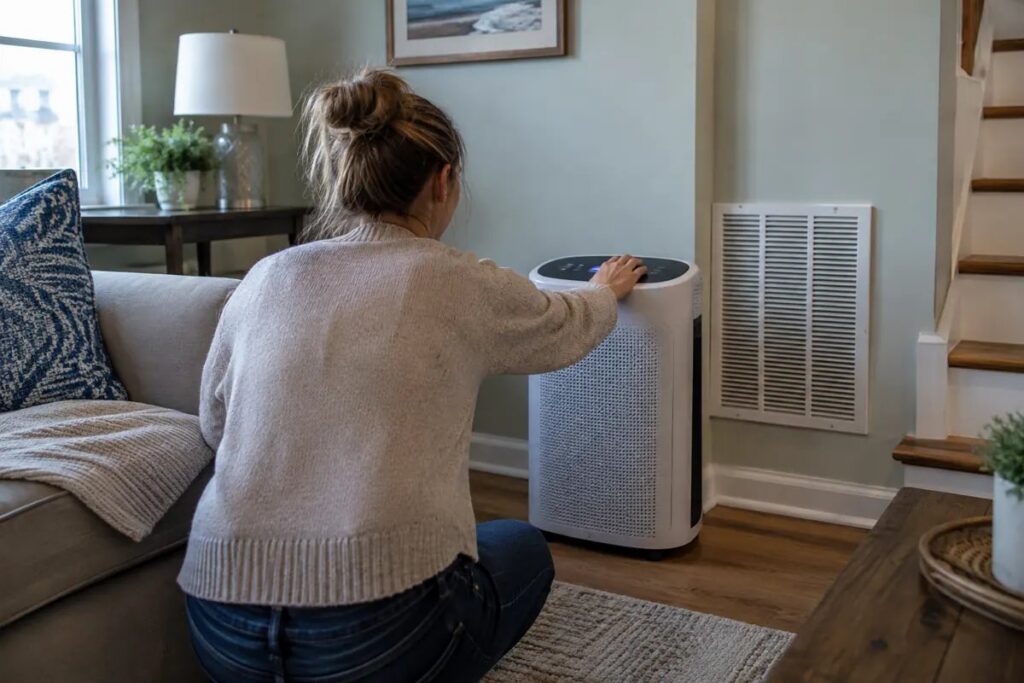
Quick answer: After a smoke or mold event, the best air cleaner is a true HEPA portable unit with a CADR rating matched to your room size, paired with an activated carbon stage for odors; CARB-certified mechanical-filter models that produce little or no ozone are a safer choice, and widespread or hidden contamination usually calls for professional remediation rather than a standalone purifier.
Key takeaways
- A true HEPA filter traps fine smoke particles, but no portable unit removes gases or solves a mold problem at its source.
- Choose a clean air delivery rate (CADR) for smoke that is at least two-thirds of your room’s square footage, per the EPA.
- Avoid ionizing or ozone-generating purifiers for smoke cleanup; the EPA favors mechanical filtration and recommends choosing a CARB-certified portable air cleaner that produces little or no ozone.
- New Jersey’s appliance efficiency law (effective January 2023) sets minimum CADR and ozone limits for air purifiers sold in the state.
- If soot has settled into HVAC ducts, walls, or hidden cavities, or mold has spread behind surfaces, a consumer air cleaner cannot fix the underlying damage.
What Does an Air Cleaner Actually Do After Smoke or Mold Damage?
An air cleaner’s job is narrow: it pulls room air through a filter and traps particles suspended in that air. It does not clean soot off walls, remove embedded odor from drywall, or address the moisture source feeding a mold colony. The U.S. Environmental Protection Agency is direct about this limit, noting that portable air cleaners and furnace filters cannot solve a mold problem because mold is caused by a water or moisture issue that has to be fixed and cleaned up at the source.
That means an air cleaner is a supporting tool, not a cure. After a kitchen fire or a damp Jersey Shore basement develops a musty smell, a good purifier can reduce airborne particles while you address the root cause. For anything beyond light, surface-level smoke or an early mold patch, pairing an air cleaner with proper fire restoration or mold remediation work gives a far more complete result.
HEPA Filters Explained: What the Rating Actually Means
HEPA stands for high-efficiency particulate air filter, a tightly woven mesh rated to capture very small particles, including much of the fine particulate in wildfire and house-fire smoke. Consumer Reports’ buying guidance notes that true HEPA filters capture tiny particles like smoke, while filters marketed as “HEPA-type” or “HEPA-like” have not been certified to the same standard and may perform less consistently.
A few practical points worth knowing before you shop:
- True HEPA versus HEPA-like: Only units labeled true HEPA meet the certified capture standard; HEPA-like filters can still help but are not independently verified.
- Particles only, not gases: The EPA explains that most filters handle either particles or gases, so a unit built only for particles will not remove smoke’s lingering chemical odor.
- Prefilters extend life: A washable prefilter catches larger debris before it reaches the HEPA layer, which Consumer Reports notes can extend the main filter’s working life.
- Replacement is mandatory: A clogged, overloaded filter stops working effectively, so every HEPA unit needs scheduled filter changes to keep performing.
Why Odor Removal Needs More Than a HEPA Filter
Smoke odor is partly gas-phase chemistry, not just particles, which is why a HEPA-only purifier often leaves a lingering smell even after visible soot clears from the air. Units that add an activated carbon stage can adsorb some odor-causing molecules, though Consumer Reports cautions that carbon filters are not particularly effective against every type of gas and need their own replacement schedule.
If odor is the primary complaint after a fire, especially a smell that persists in carpets, upholstery, or HVAC ductwork, an air cleaner alone is unlikely to resolve it. For broader help after fire and smoke damage, see our guide to choosing a fire restoration company.
CADR, Room Size, and Sizing an Air Cleaner Correctly
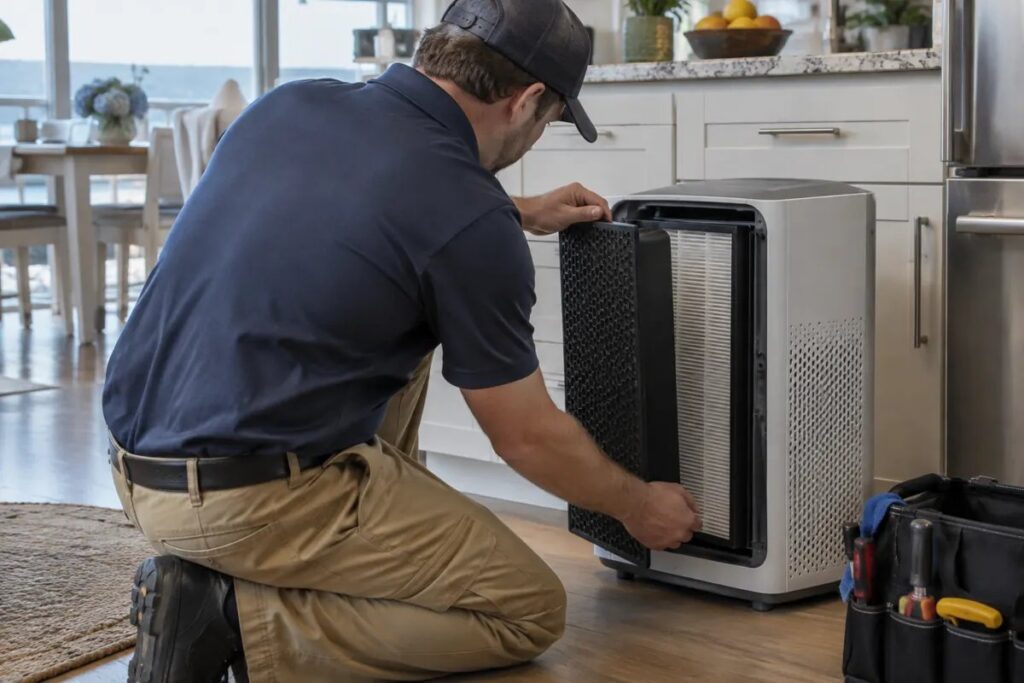
Clean air delivery rate, or CADR, measures how quickly a unit filters a given pollutant from a test chamber, and it is the most useful number for comparing models. The EPA recommends choosing a portable air cleaner with a smoke CADR that is at least two-thirds of your room’s square footage, and Consumer Reports gives the same two-thirds benchmark in its buying advice.
New Jersey has its own backstop on this. Beginning January 18, 2023, New Jersey’s Appliance Standards Law prohibited the sale, offer for sale, or lease of covered nonindustrial air purifiers that do not meet minimum smoke CADR and efficiency thresholds; ozone-emitting models must also emit no more than 50 parts per billion, according to the NJDEP.
| Room Size | Minimum Recommended Smoke CADR | Typical Use Case |
|---|---|---|
| 150 sq ft (small bedroom) | Approximately 100 | Bedroom after minor smoke odor or light soot settling |
| 300 sq ft (living room) | Approximately 200 | Main living space after a contained kitchen or appliance fire |
| 500 sq ft (open floor plan) | Approximately 330 | Larger open-plan living area |
| Whole small apartment | Multiple units or a ducted HVAC filter upgrade | Consider multiple portable units or a compatible MERV 13 or higher HVAC filter |
What to Avoid: Ionizers, Ozone Generators, and Marketing Claims
Not every technology sold as an “air purifier” actually removes smoke particles. The EPA advises against ionizers and electrostatic precipitators for smoke removal because their effectiveness is uncertain and they may generate ozone. It also advises against photocatalytic oxidation devices and hydroxyl generators because they are not designed to remove smoke particles and may produce ozone or other harmful pollutants. Ozone itself is a lung irritant, and the EPA recommends using only California Air Resources Board (CARB)-certified air cleaners because they produce little to no ozone.
A few red flags worth screening out when comparing models:
- No CADR rating listed anywhere on the packaging or spec sheet.
- Marketing language that emphasizes “ionic” or “plasma” technology without a true HEPA mechanical filter stage.
- No CARB certification number, which is required for air cleaners sold or used in California and a useful independent check regardless of where you live.
- Claims to “kill mold” or “eliminate” moisture problems, since the EPA is clear that air cleaners do not address the underlying moisture source.
Air Purifiers vs. Whole-Home HVAC Filtration
If your home has forced-air heating or cooling, upgrading the HVAC filter can cover more square footage than any single portable unit. The EPA recommends a MERV 13 or higher filter for smoke when the forced-air system can accommodate it and its fan can run continuously.
| Option | Best For | Limitations |
|---|---|---|
| Portable HEPA air cleaner | Single rooms, rentals, homes without ducted HVAC | Only treats the room it sits in; needs correct CADR sizing |
| High-MERV HVAC filter (MERV 13+) | Whole-house coverage when system fan runs continuously | Requires a compatible HVAC system; may need a technician to confirm fit |
| Activated carbon add-on | Supplementing odor control alongside HEPA filtration | Limited effectiveness on some gases; needs regular replacement |
Homes along the Jersey Shore often run central air for much of the summer, which makes a filter upgrade a reasonable complement to a portable unit in a bedroom or home office. A licensed HVAC technician can confirm the highest-efficiency filter your blower motor can handle without straining the system.
When an Air Cleaner Isn’t Enough: Signs You Need Professional Remediation
Consumer-grade air cleaners are built for everyday indoor air quality maintenance, not for recovering a home after a serious fire, flood, or mold outbreak. A few situations consistently go beyond what a purifier and a filter change can fix:
- Soot has settled into HVAC ductwork, insulation, or wall cavities rather than just floating in room air.
- Mold is visible across more than a small, isolated patch, or you can smell a persistent musty odor without finding a visible source.
- The property has had standing water, a sewage backup, or sustained humidity following a storm, conditions common after coastal flooding events in Ocean County.
- Occupants have respiratory symptoms, allergies, or asthma that worsen indoors despite running an air cleaner continuously.
- The affected area is large enough that multiple portable units, filter changes, and weeks of operation are not producing a noticeable improvement.
In these cases, a straightforward air cleaner purchase is not the fix. PuroClean of Toms River, serving Toms River, Berkeley Township, Bayville, Seaside Heights, Brick, Point Pleasant Beach, and surrounding Ocean County communities, works with professional-grade equipment such as high-velocity air movers, dehumidifiers, and EPA-registered disinfectants to address contamination at its source rather than just filtering the air around it. You can review our residential restoration services or commercial property damage restoration for a sense of what full-scale remediation involves, and our guide to preventing mold growth during winter covers moisture control steps that complement any air cleaning effort.
A Practical Checklist Before You Buy
Use this short checklist when comparing specific models in stores or online:
- Confirm the filter is labeled true HEPA, not just “HEPA-type” or “HEPA-like.”
- Check the smoke CADR number and match it to at least two-thirds of your room’s square footage.
- Verify CARB certification to reduce the risk of ozone exposure; certification does not mean a unit produces no ozone.
- Look for an ENERGY STAR-certified model if you plan to run the unit continuously, since it can use less energy than a noncertified model.
- Factor in ongoing filter costs and follow the manufacturer’s replacement schedule, since smoke-heavy conditions may shorten filter life.
- If odor is a concern, choose a model with a secondary activated carbon stage, understanding it has limits on certain gases.
- Decide whether the problem is actually room-sized or whole-house, since a single portable unit will not cover an entire home.
If you are weighing an air cleaner against other recovery equipment, our related guides on what to look for in a water mitigation company and the critical steps after property damage can help you see where consumer tools fit into a broader recovery plan, and when it is time to bring in qualified professional help.
Frequently Asked Questions
Can an air purifier remove smoke smell completely?
Not on its own. A HEPA filter captures smoke particles from the air, but lingering odor often comes from gas-phase compounds absorbed into carpets, drywall, and fabrics. An activated carbon stage helps with some odors, but deep-set smoke smell usually requires professional odor remediation rather than filtration alone.
Do air purifiers help with mold spores in the air?
A HEPA air cleaner can capture some airborne mold spores, but the EPA is clear that air cleaners do not solve a mold problem because mold grows from an underlying moisture source. You need to fix the moisture issue and physically clean affected materials; the purifier only reduces spore levels in room air in the meantime.
How often do I need to replace a HEPA filter?
Most true HEPA filters need replacement every six to twelve months, though heavy use after a smoke event may shorten that window. Consumer Reports notes filter indicator lights on some models help flag replacement timing, and a dirty, overloaded filter stops working effectively well before it looks visibly clogged.
Are ionizing air purifiers safe to use after a fire?
The EPA does not recommend ionizers, electrostatic precipitators, or similar electronic air cleaners for smoke removal because their particle-removal effectiveness is unclear and they can generate ozone, a lung irritant. Mechanical HEPA filters are the safer, better-supported choice for smoke particle capture.
What size air purifier do I need for one room?
Match the unit’s smoke clean air delivery rate (CADR) to at least two-thirds of the room’s square footage, a benchmark used by both the EPA and Consumer Reports. For a 300-square-foot living room, that means looking for a smoke CADR of roughly 200 or higher.
When should I call a restoration company instead of buying an air cleaner?
If soot has reached your ductwork, mold covers more than a small patch, or your home has had flooding or sewage exposure, a consumer air cleaner will not resolve the underlying contamination. At that point, a qualified restoration team with professional-grade equipment is the appropriate next step.
Sources
- NJDEP Appliance Standards
- EPA: Guide to Air Cleaners in the Home
- EPA: Indoor Air Filtration (Wildfires)
- Consumer Reports: Air Purifier Buying Guide
Reach PuroClean of Toms River Any Time
If water, fire, mold, or biohazard damage has affected your home or business, the team at PuroClean of Toms River is available 24/7 at (732) 930-2330. You can also visit our contact page to reach our local team serving Toms River and the surrounding Ocean County communities.
Written by the team at PuroClean of Toms River, an IICRC Certified and EPA Lead-Safe Certified property restoration company at 798 Fischer Blvd., Toms River, NJ, locally owned and operated by Alex Gonzalez.