


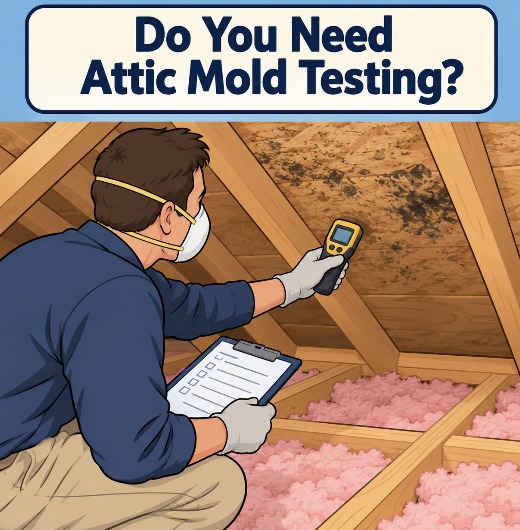
You notice black spots on the plywood inside your attic. Maybe there’s a musty smell near the attic access, or you’ve discovered discoloration after a roof leak.
Before scheduling mold removal, you wonder: Do I need to pay for mold testing first?
Attic mold testing is not always necessary, especially when visible mold is already present and the moisture problem is apparent. However, professional mold assessment can be valuable when the extent of contamination is uncertain, hidden mold is suspected, or independent documentation is needed.
The U.S. Environmental Protection Agency (EPA) explains that when visible mold growth is present, sampling is usually unnecessary simply to establish that mold cleanup is needed.[1]
Florida also regulates certain mold assessment and remediation activities. Understanding the distinction between a licensed mold assessor and a licensed mold remediator can help homeowners choose the right professional and avoid conflicts of interest.
For homeowners in Port Charlotte, Florida, attic moisture problems may develop after heavy thunderstorms, roof leaks, tropical weather, or condensation around air-conditioning equipment. The appropriate evaluation depends on the conditions—not simply whether a dark stain is visible.
This guide explains when attic mold testing is useful, when it may be unnecessary, how Florida’s assessment and remediation rules work, and what homeowners should expect before and after cleanup.
Safety note: Don’t scrape suspected mold, collect samples without understanding the risks, or enter an attic with exposed electrical hazards, structural damage, or unsafe walking surfaces. Attics can become extremely hot in Southwest Florida.
Is Attic Mold Testing Necessary Before Mold Removal?
No, attic mold testing is not automatically required before mold remediation. When mold growth is clearly visible, laboratory testing may not be necessary simply to confirm that contaminated materials need appropriate cleanup.
The EPA states that visible mold generally does not require sampling to determine whether remediation is needed.[1]
However, this does not mean that every attic should be remediated without an evaluation.
A professional assessment may help determine the extent of contamination, identify moisture sources, evaluate concealed areas, and establish an appropriate remediation scope.
The distinction matters because an inspection or assessment is not the same thing as laboratory testing.
Quick Decision Guide: Do You Need Attic Mold Testing?
| Situation | Is Laboratory Testing Usually Necessary? | Recommended Next Step |
|---|---|---|
| Visible mold growth on attic plywood | Often no | Evaluate moisture source, contamination extent, and remediation needs. |
| Dark staining that may be dust or water damage | Sometimes useful | Professional inspection to determine whether sampling would help. |
| Musty odor without visible mold | Possibly | Investigate hidden moisture and potential concealed contamination. |
| Recurring mold after previous cleanup | May be useful | Evaluate unresolved moisture conditions and remediation effectiveness. |
| Large or complex contamination | Depends on circumstances | Consider an independent assessment and written remediation protocol. |
| Insurance or property transaction documentation | May be requested | Confirm the specific documentation requirements before ordering tests. |
| Post-remediation verification | Depends on project goals and protocol | Determine whether independent clearance evaluation is appropriate. |
Important: Testing should answer a meaningful question or support a decision. A laboratory report is not automatically more useful than a thorough inspection of moisture conditions and affected building materials.
If you already have visible contamination, learn more about professional attic mold removal in Port Charlotte, FL.
What’s the Difference Between a Mold Inspection and Mold Testing?
Homeowners often use the terms mold inspection, mold assessment, and mold testing interchangeably.
However, these activities serve different purposes.
A mold inspection evaluates building conditions and potential contamination. Mold testing involves collecting samples for analysis. Testing may be one component of a professional assessment, but it is not always necessary.
Mold Inspection or Assessment
A professional assessment may involve examining visible staining, reviewing moisture history, identifying affected materials, and evaluating possible water intrusion.
Depending on the circumstances, the assessor may use moisture meters, infrared imaging, visual observations, or other investigative methods.
Infrared imaging can help identify temperature differences that warrant further investigation, but it does not directly detect mold or prove that moisture is present.
Assessment findings may help establish whether remediation is needed and what areas should be addressed.
Mold Testing or Sampling
Mold testing involves collecting samples that may be examined by a laboratory.
Depending on the testing method, samples may provide information about fungal particles or material collected from a particular location.
However, test results have limitations and must be interpreted alongside the building’s actual conditions.
Mold Remediation
Mold remediation involves addressing contamination using methods appropriate to the affected materials and conditions.
Depending on the project, remediation may include containment, removal of contaminated porous materials, cleaning of suitable surfaces, and coordination with contractors responsible for correcting moisture problems.
For example, mold-contaminated attic insulation may require removal, while structurally sound roof decking may be suitable for professional cleaning.
| Service | Primary Purpose | Typical Activities |
|---|---|---|
| Mold inspection or assessment | Evaluate conditions and determine the scope of a problem | Visual examination, moisture investigation, documentation, and recommendations |
| Mold testing | Analyze collected samples | Air, surface, or material sampling when appropriate |
| Mold remediation | Address contamination | Containment, cleaning, material removal, and related remediation work |
| Moisture-source repair | Correct the condition that allowed moisture intrusion | Roofing, HVAC, plumbing, or building-envelope repairs |
When Does Attic Mold Testing Make Sense?
Attic mold testing may be useful when the presence, location, or extent of contamination is uncertain and sampling results could meaningfully influence the next decision.
Testing may also be requested for documentation, independent verification, or specific project requirements.
The EPA recommends considering the purpose of sampling and having results interpreted by professionals with appropriate experience.[1]
1. Suspected Hidden Mold
A homeowner may notice a persistent musty odor without seeing obvious mold.
Possible sources may include concealed roof decking, insulation, or materials affected by a previous leak.
A qualified assessment should first investigate likely moisture sources and accessible materials. Targeted sampling may be considered if it could help resolve a specific uncertainty.
2. Uncertain Discoloration
Dark stains on attic plywood may resemble mold but could also involve ordinary wood discoloration or previous water staining.
Similarly, fiberglass insulation can become dark from dust accumulation caused by air movement.
When the distinction affects whether materials will be removed or retained, professional assessment and potentially targeted sampling may be useful.
Our visual guide to attic mold colors and warning signs explains why appearance alone isn’t always reliable.
3. Recurring Mold After Previous Remediation
If suspected mold returns after cleanup, the original moisture problem may not have been fully corrected.
Testing may help answer certain questions, but investigating roof leaks, condensation, and other moisture sources is essential.
Repeating laboratory tests without addressing moisture may not solve the underlying problem.
4. Complex or Extensive Contamination
Large or complicated attic projects may benefit from an independent mold assessment and written remediation protocol.
This can help define which materials are affected, what work is required, and how completion will be evaluated.
Laboratory testing may be included when the assessor determines it will provide useful information.
5. Insurance Claims or Property Transactions
Some insurers, buyers, sellers, lenders, or other parties may request specific documentation related to suspected mold.
Requirements vary, so homeowners should confirm exactly what information is needed before paying for testing.
A mold test does not determine insurance coverage. Coverage depends on policy terms, the cause of damage, exclusions, and applicable limits.
When Might Attic Mold Testing Be Unnecessary?
Laboratory testing may be unnecessary when mold growth is already clearly visible, the affected materials can be evaluated, and sampling results would not change the remediation plan.
For example, if a roof leak has visibly contaminated porous insulation that requires removal, identifying the exact mold species may not change the recommended work.
Similarly, if visible mold is present on attic plywood, a qualified professional may be able to establish an appropriate remediation approach without routine species identification.
Visible Mold Usually Doesn’t Require Species Identification
Homeowners sometimes believe they must determine whether a dark patch is toxic black mold before taking action.
However, the CDC advises that identifying the specific type of mold generally isn’t necessary when deciding whether to remove mold and correct moisture problems.[2]
The practical priorities are addressing contamination and preventing materials from remaining wet.
For additional context, read our guide to black mold in Port Charlotte attics.
Testing Isn’t a Substitute for Finding the Moisture Source
An air sample cannot repair damaged roof flashing.
A surface sample cannot correct a leaking condensate drain.
Even when testing identifies fungal material, the homeowner still needs to understand why moisture accumulated and which building materials require attention.
Testing should support an investigation—not replace one.
What Types of Attic Mold Tests Are Available?
Several sampling methods may be used during a professional mold assessment.
The appropriate method depends on the question being investigated. No single test can reliably describe every mold condition in an attic or prove that an entire home is free of mold.
Air Sampling
Air sampling collects airborne particles for laboratory analysis.
Results may provide information about fungal particles present in the sampled air during the collection period.
However, airborne concentrations can vary with ventilation, weather, occupant activity, and other conditions.
A single air sample should not be treated as a definitive measurement of all mold contamination within a building.
Surface Sampling
Surface sampling may involve collecting material from a specific location using an appropriate sampling method.
This can help characterize material present on a sampled surface.
However, results describe the sampled location and do not automatically establish conditions throughout the attic.
Bulk Material Sampling
Bulk sampling involves collecting a portion of a material for laboratory examination.
This approach may be considered when the condition of a particular material needs additional investigation.
Sampling should be performed with appropriate precautions because disturbing insulation or other materials can create exposure and safety hazards.
Moisture Measurements and Infrared Imaging
Moisture meters and infrared cameras are useful investigative tools, but they are not mold tests.
Moisture meters may help evaluate the moisture condition of certain materials.
Infrared cameras show temperature patterns that may indicate areas requiring additional investigation.
Neither method identifies mold species or confirms contamination by itself.
| Method | What It May Help Evaluate | Important Limitation |
|---|---|---|
| Air sampling | Airborne fungal particles at the time of sampling | Results vary with conditions and do not reveal every hidden source. |
| Surface sampling | Material collected from a specific surface | Does not represent the entire attic. |
| Bulk sampling | Characteristics of a collected material sample | Requires appropriate collection and interpretation. |
| Moisture meter | Moisture conditions in compatible materials | Does not directly detect mold. |
| Infrared imaging | Temperature differences that warrant investigation | Does not directly detect mold or confirm water intrusion. |
What Can Attic Mold Test Results Actually Tell You?
Mold test results can provide information about the specific samples collected, but they cannot independently establish the full extent of contamination, identify every hidden moisture problem, or determine whether a building is safe for every occupant.
Interpretation requires considering the sampling method, collection location, building conditions, and the question the test was intended to answer.
There Is No Universal Federal Indoor Mold Exposure Limit
The EPA notes that federal limits for airborne mold or mold spores have not been established.[1]
This means homeowners should be cautious about treating a single numerical result as a universal pass-or-fail threshold.
Professional interpretation may consider multiple observations and sample results rather than relying on one number.
Mold Species Identification Doesn’t Always Change the Solution
Laboratory analysis may identify fungal groups or types present in a sample.
However, the appropriate response to visible mold contamination generally focuses on addressing affected materials and correcting moisture conditions.
Knowing the species doesn’t automatically determine whether plywood must be replaced or insulation can be retained.
A Negative Test Doesn’t Guarantee an Entire Attic Is Mold-Free
Sampling captures information from particular locations and times.
Concealed contamination may remain undetected if the sampled areas do not represent the affected materials.
For that reason, a thorough investigation of moisture and building conditions remains important.
Florida Mold Assessor vs. Mold Remediator: What’s the Difference?
Florida distinguishes between mold assessment and mold remediation under its mold-related services licensing framework.
A mold assessor evaluates mold-related conditions, while a mold remediator performs work intended to remove or address mold contamination.
Both activities may be regulated under Florida law, subject to applicable definitions, exemptions, and licensing requirements.[3]
What Does a Florida Mold Assessor Do?
A mold assessor may investigate suspected contamination, evaluate building conditions, collect samples when appropriate, and document findings.
Depending on the project, an assessor may prepare a written report or remediation protocol describing the affected areas and recommended work.
An independent assessment can be particularly valuable when contamination is extensive, disputed, concealed, or associated with a property transaction.
What Does a Florida Mold Remediator Do?
A mold remediator performs remediation work intended to address contamination.
Depending on the project, this may include containment, cleaning suitable materials, removing contaminated porous materials, and coordinating with other contractors.
For attic projects, remediation may involve affected roof decking, framing, insulation, or other building components.
Why Independent Assessment Can Matter
Separating assessment from remediation can provide an additional layer of independence when determining the scope of work and evaluating completion.
For example, an independent assessor may identify affected materials and establish a remediation protocol, while a separate remediation company performs the cleanup.
This distinction is particularly important because Florida has statutory restrictions intended to address conflicts of interest between mold assessment and remediation.[4]
Florida Mold Licensing and Conflict-of-Interest Rules: What Homeowners Should Know
Florida regulates mold-related services under Chapter 468, Part XVI of the Florida Statutes. The law establishes licensing requirements for mold assessors and mold remediators, defines regulated activities, and includes restrictions intended to prevent conflicts of interest.[3][4]
For Port Charlotte homeowners, understanding these requirements can help you distinguish between a company evaluating suspected mold and a company performing the remediation work.
However, Florida’s licensing framework should not be confused with a universal requirement to purchase laboratory mold testing before every cleanup project.
Does Florida Require Mold Testing Before Remediation?
Florida does not impose a blanket requirement that every residential mold remediation project begin with laboratory mold testing.
Whether testing is appropriate depends on the circumstances, including the extent of contamination, the need for independent assessment, contractual requirements, and whether sampling results would influence the remediation plan.
For example, visible mold growth associated with a documented roof leak may not require laboratory species identification before appropriate remediation can begin.
On the other hand, a complex attic contamination problem involving concealed materials, disputed conditions, or an insurance claim may benefit from an independent assessment and written remediation protocol.
The EPA similarly explains that sampling is usually unnecessary when visible mold is already present.[1]
Can the Same Company Perform Mold Assessment and Remediation?
Florida law contains restrictions designed to separate mold assessment from remediation in certain circumstances.
Under Florida Statute §468.8419, a mold assessor generally may not perform or offer to perform mold remediation on a structure where the assessor or assessor’s company provided a mold assessment within the preceding 12 months.
The statute also generally restricts a mold remediator from performing or offering mold assessment on a structure where the remediator or remediator’s company provided remediation within the preceding 12 months.[4]
These restrictions are subject to the statute’s specific language and applicable exceptions. Homeowners should review the current law or consult the Florida Department of Business and Professional Regulation (DBPR) when questions arise.
Why Does the 12-Month Restriction Matter?
The separation helps reduce situations in which a company could evaluate a property, recommend extensive remediation, perform the work, and then independently judge its own results.
For example, if a Port Charlotte homeowner hires an independent mold assessor to develop a remediation protocol, a separate qualified remediation company can perform the specified work.
When post-remediation verification is appropriate, an independent assessor can evaluate whether the agreed completion criteria have been satisfied.
Homeowner takeaway: Ask whether the professional is providing assessment, remediation, or another service, and verify that the proposed arrangement complies with Florida law.
Are There Exceptions to Florida Mold Licensing Requirements?
Yes. Florida law includes exemptions and qualifications that can affect whether particular activities require a mold-related services license.
For example, the statutory framework includes an exemption involving certain mold-related activities affecting less than 10 square feet, along with other exemptions described in the law.[3]
That does not mean every small mold problem is safe for DIY removal or that all work below that threshold is automatically exempt from other applicable requirements.
Homeowners should avoid relying on a single square-footage number without considering the actual statutory definitions, circumstances, and safety concerns.
How Do You Verify a Florida Mold Professional’s License?
The Florida Department of Business and Professional Regulation provides an online license verification system.
Before hiring a professional for regulated mold assessment or remediation, homeowners can verify the applicable license and review its status.
Visit the Florida DBPR website to access licensing information and available verification resources.
When contacting a company, ask for the name and license number of the professional or business responsible for the regulated work.
What Happens During a Professional Attic Mold Assessment in Port Charlotte?
A professional attic mold assessment typically begins with a review of the property’s moisture history, followed by an evaluation of accessible building materials and suspected contamination.
Depending on the findings, the assessor may recommend additional investigation, targeted sampling, or a written remediation protocol.
Not every assessment requires every step described below. The scope should reflect the actual conditions and the questions that need to be answered.
Step 1: Review the Home’s Moisture History
The assessor may ask when discoloration or odors were first noticed and whether the property has experienced previous water damage.
For Port Charlotte homeowners, relevant history may include:
- Roof leaks following heavy summer thunderstorms.
- Water intrusion associated with tropical storms or hurricanes.
- Previous roof repairs or replacement.
- Air-conditioning condensation or condensate drainage problems.
- Bathroom exhaust ducts terminating inside the attic.
- Past attic mold remediation or insulation replacement.
- Recurring ceiling stains or unexplained musty odors.
This information helps narrow the investigation to likely moisture sources.
Step 2: Examine Accessible Attic Materials
When safe access is available, an assessor may evaluate roof decking, framing, insulation, ductwork, and other accessible components.
Dark discoloration on plywood does not automatically establish that the material is mold-contaminated.
Likewise, blackened fiberglass insulation may contain ordinary dust deposited by air movement rather than fungal growth.
For more information about these differences, read our guide to mold on attic plywood and guide to mold in attic insulation.
Step 3: Investigate Moisture Conditions
Moisture measurements may help determine whether certain building materials are damp or have experienced water intrusion.
Infrared imaging may also help identify temperature patterns that warrant further investigation.
However, infrared cameras do not directly identify mold, and a temperature difference alone does not prove that a material is wet.
The purpose is to understand the moisture problem rather than simply identify a suspicious stain.
Step 4: Determine Whether Sampling Would Be Useful
After examining the building conditions, the assessor may determine that laboratory sampling is unnecessary.
If testing is recommended, ask what specific question the results are expected to answer.
For example, sampling may help evaluate uncertain surface material or support documentation required by another party.
Sampling should not be treated as a substitute for identifying the source of unwanted moisture.
Step 5: Document Findings and Recommended Next Steps
Depending on the engagement, an assessor may provide photographs, observations, moisture findings, sampling results, and recommendations.
For more complex projects, a written remediation protocol may define the affected areas, materials requiring treatment or removal, and criteria for evaluating completion.
Homeowners should understand what documentation is included before hiring the assessor.
Is Mold Testing Necessary After Attic Mold Remediation?
Post-remediation mold testing is not automatically required for every attic cleanup project, but independent verification may be valuable when contamination was extensive, a written protocol establishes completion criteria, or documentation is required.
The purpose of post-remediation evaluation is to determine whether the agreed remediation objectives have been achieved.
However, post-remediation verification and laboratory air testing are not necessarily the same thing.
What Is Post-Remediation Verification?
Post-remediation verification, sometimes called clearance evaluation, is an assessment performed after remediation work to determine whether specified completion criteria have been satisfied.
Depending on the project, this may include:
- Reviewing the completed remediation scope.
- Visually evaluating previously affected materials.
- Checking for remaining visible contamination or debris.
- Evaluating moisture conditions where appropriate.
- Reviewing whether the moisture source has been corrected.
- Collecting samples when required by the assessment protocol.
Specific verification procedures should be established by an appropriately qualified professional based on the project.
Does Every Attic Need a Clearance Air Test?
No. A clearance air test is not universally necessary for every attic remediation project.
Whether air sampling is useful depends on the project scope, applicable protocol, contractual requirements, and what the testing is intended to demonstrate.
For example, an independent assessor may determine that visual evaluation and moisture measurements are appropriate for a particular project, while another project may call for additional sampling.
Can a Mold Remediation Company Certify Its Own Work?
A remediation company can document the work it performed, including photographs, materials removed, cleaning procedures, and other project records.
However, independent mold assessment activities must comply with Florida’s licensing and conflict-of-interest requirements.[4]
When a project requires independent post-remediation assessment, homeowners should use an appropriately qualified assessor who is not prohibited from performing the evaluation.
What Does Passing Mold Clearance Mean?
A successful post-remediation evaluation generally means the project met the completion criteria established for that assessment.
It does not guarantee that a building contains no mold spores or that future moisture problems cannot occur.
Mold spores are naturally present in indoor and outdoor environments.
Long-term prevention still depends on keeping building materials dry.
How Much Does Attic Mold Testing Cost in Port Charlotte, Florida?
The cost of attic mold testing in Port Charlotte depends on whether you need a basic inspection, a comprehensive mold assessment, laboratory sampling, a written remediation protocol, or post-remediation verification.
These are different services, and homeowners should not assume they are included in one advertised inspection price.
A limited evaluation of visible staining may involve substantially less work than an extensive assessment of concealed contamination throughout a large attic.
Because local pricing and project requirements vary, the most reliable way to establish cost is to request an itemized quote from a qualified provider.
Attic Mold Testing Cost Factors
| Service or Cost Factor | What Affects the Price? | Questions to Ask |
|---|---|---|
| Visual mold assessment | Property size, accessibility, inspection scope, and documentation | Is a written report included? |
| Moisture investigation | Number of affected areas and complexity of the suspected water source | Will moisture findings be documented? |
| Air sampling | Number of samples, laboratory analysis, and reporting requirements | How many samples are included, and why? |
| Surface sampling | Number of locations sampled and laboratory methods | What decision will the sample help answer? |
| Bulk material sampling | Material type, collection requirements, and laboratory analysis | Is collecting this material necessary? |
| Remediation protocol | Project complexity and level of written detail | Will the protocol identify affected areas and completion criteria? |
| Post-remediation verification | Project size, inspection requirements, and whether sampling is specified | What constitutes successful completion? |
| Attic accessibility | Headroom, safe access, temperature, and structural conditions | Are there additional access or safety charges? |
Should You Pay for Mold Testing Before Getting a Remediation Estimate?
Not necessarily.
If visible contamination is present, a qualified remediation company may be able to discuss the apparent conditions and potential remediation needs without requiring laboratory species identification.
However, a complex project may benefit from an independent assessment before the remediation scope is finalized.
For homeowners comparing estimates, an independent written protocol may also provide a consistent scope against which remediation proposals can be evaluated.
How to Avoid Paying for Unnecessary Testing
Before agreeing to sampling, ask the assessor:
- What specific question are we trying to answer?
- Will the results change the remediation recommendation?
- Is the suspected contamination already visible?
- Could a moisture investigation answer the question without laboratory sampling?
- How many samples are necessary, and why?
- What does the written report include?
- Will the findings help establish a remediation protocol?
- Is post-remediation verification included or quoted separately?
The best value is not necessarily the cheapest test or the largest number of samples. It’s an assessment that helps you make an informed decision.
How Do You Choose a Qualified Mold Professional in Port Charlotte?
Choosing a mold professional involves more than comparing prices.
Look for appropriate Florida licensing, a clear explanation of the proposed services, experience with attic moisture problems, and written documentation of the recommended work.
For Port Charlotte homeowners, familiarity with Southwest Florida’s roofing systems, humid climate, and attic HVAC configurations can also be useful.
Verify the Appropriate Florida License
Ask whether the company is providing regulated mold assessment, regulated mold remediation, or another service.
Verify the relevant license through the Florida Department of Business and Professional Regulation.
Licensing requirements depend on the activity and applicable statutory exemptions.
Ask About Experience With Attic Mold
Attic mold projects can involve different materials and moisture sources.
Ask whether the professional has experience evaluating or remediating:
- Mold contamination on plywood roof decking.
- Mold-affected fiberglass or cellulose insulation.
- Moisture problems caused by roof leaks.
- Condensation associated with attic HVAC systems.
- Vented and unvented attic assemblies.
- Water intrusion following tropical storms.
Request a Clear Written Scope
For remediation projects, ask which areas and materials are included in the proposed work.
A clear scope should explain whether affected insulation will be removed, whether suitable wood surfaces will be cleaned, and which moisture-related repairs must be completed by other contractors.
Be cautious about recommendations that call for replacing all attic insulation or roof decking without explaining the extent of damage or contamination.
Understand Who Will Correct the Moisture Problem
Mold remediation and moisture-source repair are related but distinct tasks.
A roofing contractor may need to repair flashing or damaged roofing materials.
An HVAC contractor may need to correct condensation or condensate drainage problems.
The remediation plan should account for these issues so that cleaned or replaced materials are not exposed to the same moisture problem again.
Be Careful With Absolute Claims
Be cautious if a company promises to eliminate every mold spore, guarantees that mold can never return, or claims that a single test result proves an entire home is completely mold-free.
Those claims oversimplify the relationship between mold, moisture, building conditions, and sampling limitations.
A more useful approach is to identify affected materials, address contamination appropriately, correct moisture sources, and document the completed work.
Frequently Asked Questions About Attic Mold Testing in Port Charlotte
Do I need mold testing if I can already see mold in my attic?
Not necessarily. The EPA explains that sampling is usually unnecessary when visible mold growth is already present. However, a professional assessment may still help determine the extent of contamination and appropriate remediation scope.[1]
Does Florida require a mold test before remediation?
Florida does not impose a universal laboratory testing requirement before every residential mold remediation project. However, certain mold assessment and remediation activities are regulated, and applicable licensing requirements must be followed.[3]
What is the difference between a mold assessor and a mold remediator in Florida?
A mold assessor evaluates mold-related conditions and may collect samples or prepare reports. A mold remediator performs work intended to address contamination. Florida regulates these activities and restricts certain assessment and remediation arrangements involving the same property.[3][4]
Can the same company test for mold and remove it?
Florida has conflict-of-interest restrictions affecting mold assessment and remediation performed on the same structure within a specified period. The precise requirements and exceptions are described in Florida Statute §468.8419.[4]
Is black mold testing necessary?
Not always. The CDC explains that identifying the specific mold type generally isn’t necessary to decide whether visible mold should be addressed. Correcting moisture and appropriately remediating contamination are more important than identifying a particular species.[2]
Can an air test detect hidden attic mold?
Air sampling may provide information about airborne fungal particles at the time of collection, but it cannot reliably identify every concealed mold source. A thorough moisture investigation and evaluation of building materials remain important.
Does a mold test tell you whether your attic is safe?
No single mold test can guarantee that an attic is safe for every person or that no contamination exists. Results must be interpreted in context, and there are no universal federal airborne mold limits that establish a simple pass-or-fail standard.[1]
Should I get mold clearance testing after remediation?
Independent post-remediation verification may be useful for extensive projects, projects with written protocols, or situations requiring documentation. Laboratory sampling may or may not be part of that verification, depending on the established completion criteria.
Can mold grow back after passing a clearance test?
Yes. A successful clearance evaluation does not prevent future moisture intrusion. If roof leaks, condensation, or other moisture problems recur, mold may develop again on susceptible materials.
Who should I call first if I find attic mold in Port Charlotte?
If you discover suspected attic mold, contact an appropriately qualified professional to discuss the visible conditions, moisture history, and next steps. Depending on the circumstances, you may need an independent mold assessor, a mold remediation company, or a contractor to address the underlying moisture source.
Found Suspected Attic Mold in Port Charlotte? Contact PuroClean of Venice.
Finding black spots on attic plywood, suspicious discoloration on insulation, or a persistent musty odor can leave homeowners uncertain about what to do next.
Should you order laboratory testing? Hire an independent assessor? Contact a remediation company? Replace the insulation?
The right next step depends on the condition of the attic, the extent of suspected contamination, and whether the moisture source has been identified.
For Port Charlotte homeowners, common moisture concerns include roof leaks following heavy thunderstorms, water intrusion after tropical weather, and condensation associated with attic HVAC equipment.
PuroClean of Venice provides mold remediation and restoration services for homeowners in Port Charlotte and surrounding Southwest Florida communities.
Our team can discuss your concerns, explain available remediation services, and help you understand whether an independent assessment may be appropriate for your situation.
Learn more about our attic mold removal and remediation services in Port Charlotte, FL.
References
The following resources provide guidance on mold sampling, health considerations, Florida mold licensing, and professional remediation.
- U.S. Environmental Protection Agency. Mold Testing or Sampling. Guidance on when mold sampling is appropriate, its limitations, and the absence of federal airborne mold limits.
- Centers for Disease Control and Prevention. About Mold. Information about mold exposure, mold types, and health considerations.
- Florida Legislature. Florida Statutes, Chapter 468, Part XVI — Mold-Related Services. Statutory framework governing mold assessment and remediation activities.
- Florida Legislature. Florida Statute §468.8419 — Prohibitions; Penalties. Restrictions related to mold assessment, remediation, and potential conflicts of interest.
- Florida Department of Business and Professional Regulation. DBPR — License Information and Verification. Official Florida professional licensing resources.
- U.S. Environmental Protection Agency. Mold Cleanup in Your Home. Guidance on mold cleanup, contaminated materials, and moisture correction.
- U.S. Environmental Protection Agency. A Brief Guide to Mold, Moisture and Your Home. Guidance on moisture control and mold prevention.