


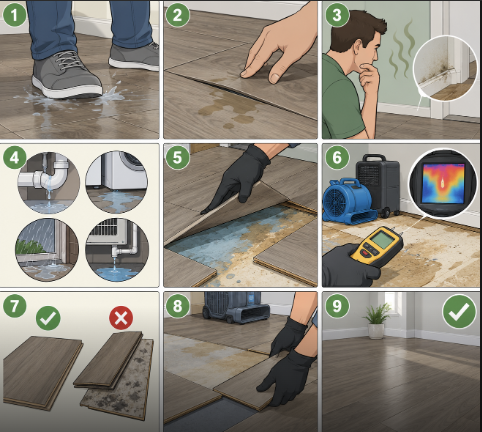
Luxury vinyl plank flooring is popular in Southwest Florida because it is durable, attractive, and often marketed as waterproof. But what happens when water gets underneath it?
For homeowners in Port Charlotte, Florida, hidden water beneath vinyl plank flooring can become a serious concern after a plumbing leak, appliance failure, heavy rainfall, or flooding. Even when the planks look completely normal, moisture may remain trapped between the flooring and the concrete slab or wood subfloor.
The most important distinction is that waterproof vinyl planks do not automatically make the entire flooring system waterproof. Water can reach the subfloor through plank joints, perimeter gaps, transitions, or adjacent building materials. Depending on the installation, it may then remain concealed beneath the finished surface.
This guide explains how to recognize hidden moisture, what happens when water gets underneath vinyl plank flooring, when flooring may need to be removed, how professionals evaluate the subfloor, and what Port Charlotte homeowners should know about drying, mold prevention, and insurance.
Quick Answer: What Happens When Water Gets Under Vinyl Plank Flooring?
Water beneath vinyl plank flooring can remain trapped against the underlayment or subfloor, even if the vinyl itself does not swell or absorb water. The consequences depend on the water source, how much water entered, how long it remained, and what materials are underneath the flooring.
A small spill that is immediately cleaned up may not cause damage. A burst pipe, dishwasher leak, or flooded room can introduce enough water beneath a floating floor to require professional moisture evaluation and potentially partial or complete flooring removal.
| Situation | Potential Concern | Recommended Response |
|---|---|---|
| Small surface spill, cleaned immediately | Usually limited if water did not penetrate the flooring system | Dry the surface and monitor for recurring moisture. |
| Water emerging from plank seams | Liquid water may be present beneath the flooring | Stop the source and arrange moisture evaluation. |
| Floor makes squishing or sloshing sounds | Water may be moving beneath floating planks | Limit traffic and investigate promptly. |
| Musty odor near baseboards | Possible persistent moisture or microbial growth | Identify the source and evaluate concealed materials. |
| Vinyl planks lifting or separating | Possible subfloor, installation, or moisture-related problem | Inspect the flooring assembly before repairs. |
| Water entered from a burst pipe or appliance | Potential widespread moisture beneath the floor | Address the leak and assess the affected area. |
| Storm surge or floodwater entered the home | Potential contamination and damage beneath flooring | Avoid contact with suspect water and obtain professional guidance. |
Bottom line: A dry-looking vinyl floor does not prove that the subfloor is dry. The condition of the materials beneath the planks matters more than the appearance of the finished surface.
In This Guide
- Is Vinyl Plank Flooring Really Waterproof?
- 7 Signs Water May Be Trapped Under Vinyl Plank Flooring
- Common Causes of Water Beneath Vinyl Floors
- Concrete Slabs vs. Wood Subfloors
- What to Do Immediately
- How Professionals Detect Hidden Moisture
- Can Water Under Vinyl Plank Flooring Be Dried?
- When Must Vinyl Plank Flooring Be Removed?
- Mold and Hidden Moisture Concerns
- Why This Matters in Port Charlotte, Florida
- Florida Homeowners Insurance Considerations
- How to Prevent Future Damage
- Frequently Asked Questions
- Water Damage Restoration in Port Charlotte
- References
Is Vinyl Plank Flooring Really Waterproof?
Many luxury vinyl plank products are designed to resist water without experiencing the swelling associated with certain wood-based flooring materials.
However, the term waterproof usually describes the flooring product’s resistance to water—not a guarantee that water cannot reach the materials underneath it.
Flooring manufacturer guidance makes this distinction. For example, DuraLux states that its waterproof vinyl plank flooring is not intended to function as a moisture barrier.[1]
Waterproof Planks vs. a Waterproof Flooring System
Think of a vinyl plank floor as a collection of individual components rather than one solid waterproof surface.
- Vinyl planks: The finished walking surface.
- Click-lock joints or adhesive: The system connecting or securing the planks.
- Attached pad or underlayment: Material that may provide cushioning, sound reduction, or other installation benefits.
- Moisture-control layer: A vapor retarder or other product when specified by the flooring manufacturer.
- Subfloor: Usually concrete or wood-based material supporting the installation.
- Adjacent building materials: Baseboards, drywall, cabinets, and wall framing that may also become wet.
Water can enter at the edges of the room, beneath cabinets, through transitions, around plumbing penetrations, or through damaged flooring joints.
Once underneath the planks, water may spread laterally without immediately becoming visible.
Can Water Pass Through Click-Lock Vinyl Plank Seams?
Yes, depending on the product, installation, water exposure, and condition of the joints.
Some flooring products have water-resistant locking systems, but not every installation is designed to withstand standing water, flooding, or water entering from below.
Water may also bypass the plank seams entirely by entering around the perimeter of the floor.
That is why a floor can appear intact while moisture remains underneath it.
Does Waterproof Vinyl Flooring Prevent Mold?
No. A water-resistant or waterproof plank does not eliminate mold concerns in the surrounding flooring assembly.
Mold can grow on susceptible materials such as wood, paper-faced drywall, certain underlayments, adhesives, or accumulated organic debris when sufficient moisture is present.
The EPA identifies moisture control as the central strategy for preventing indoor mold growth.[2]
Consequently, the important question is not simply whether the vinyl plank is waterproof. It is whether the materials beneath and around it have become wet.
7 Signs Water May Be Trapped Under Vinyl Plank Flooring
Hidden moisture is not always obvious. Some warning signs appear immediately after a leak, while others develop after water has remained beneath the flooring.
1. Water Comes Up Between the Planks When You Walk
Water emerging from plank seams under foot pressure is one of the clearest indications that liquid water may be present beneath the flooring.
Walking across a floating floor can temporarily compress the flooring assembly and force water toward openings between planks.
What to do: Avoid repeatedly walking over the affected area to force water out. Stop the water source, limit access, and arrange an assessment.
2. Squishing, Sloshing, or Clicking Sounds
Unusual sounds beneath vinyl planks can indicate movement within the flooring assembly.
When associated with a recent leak, squishing or sloshing may suggest water beneath the floor.
However, clicking or hollow sounds can also result from uneven subfloors, insufficient expansion space, or installation problems. Sound alone does not establish water damage.
3. Musty Odors Near Floors or Baseboards
A persistent musty odor may indicate damp materials or microbial activity in a concealed area.
Pay particular attention to odors near baseboards, cabinets, closets, and rooms where a previous leak occurred.
Odor alone cannot confirm mold or identify its location, but it is a reason to investigate possible hidden moisture.
4. Planks Begin Lifting, Buckling, or Separating
Water-related damage can sometimes contribute to changes in a vinyl floor’s appearance or stability.
Possible signs include lifted edges, separated joints, uneven sections, or planks that no longer lie flat.
These symptoms are not unique to water damage. Improper installation, temperature changes, subfloor irregularities, and insufficient expansion space can also produce similar problems.
A flooring inspection should distinguish moisture-related damage from installation or product issues.
5. Discoloration Appears Along Baseboards or Walls
Water moving beneath flooring may also reach the perimeter of a room.
Look for swelling baseboards, peeling paint, damp drywall, or discoloration near the bottom of walls.
These signs can indicate that the moisture problem extends beyond the flooring itself.
6. Moisture Reappears After the Surface Is Dried
If you repeatedly wipe up water only to see it return around plank edges or transitions, moisture may be entering from an active leak or moving out of concealed areas.
Possible sources include plumbing, appliances, exterior water intrusion, or moisture associated with the slab.
Repeated surface drying will not resolve an ongoing water source.
7. A Recent Leak Occurred, but the Floor Looks Normal
One of the most easily overlooked warning signs is a recent water incident with no visible flooring damage.
For example, a dishwasher supply line may leak overnight. By morning, the visible water has been removed, and the vinyl floor looks unaffected.
However, water may already have traveled beneath the floating floor and into nearby cabinets or wall cavities.
If substantial water entered the room, do not use the floor’s appearance alone to determine whether restoration is necessary.
Common Causes of Water Beneath Vinyl Plank Flooring
Understanding how water entered the flooring system helps determine whether the problem is isolated, ongoing, or likely to recur.
| Water Source | How It Reaches the Flooring | Important Consideration |
|---|---|---|
| Burst or leaking supply pipe | Water spreads across the room and enters floor edges or joints. | May affect multiple rooms before the leak is discovered. |
| Dishwasher or refrigerator leak | Water escapes beneath appliances and cabinets. | Damage may remain concealed behind cabinetry. |
| Washing machine failure | Supply or drain water spreads beyond the laundry area. | Water may reach adjacent flooring and walls. |
| Toilet overflow or drain backup | Water moves across bathroom floors and into nearby rooms. | Potential contamination changes cleanup requirements. |
| Roof leak or wind-driven rain | Water travels through walls or other building materials to the floor. | Roof and interior moisture problems may both require attention. |
| Storm surge or exterior flooding | Floodwater enters the building and reaches flooring assemblies. | Contamination and flood insurance considerations may apply. |
| Concrete slab moisture | Moisture vapor or liquid water migrates from the slab or below it. | May require testing and correction before new flooring is installed. |
| HVAC condensate leak | Overflowing water reaches floors, walls, or nearby rooms. | Drainage or equipment repairs may be necessary. |
Kitchen Appliance Leaks
Dishwashers, refrigerators with water connections, and kitchen plumbing are common sources of unexpected water intrusion.
Because leaks may occur behind cabinets or beneath appliances, water can reach the edge of vinyl flooring before the homeowner notices a problem.
If kitchen flooring, cabinetry, or adjacent walls become wet, see our guide to kitchen water damage cleanup in Port Charlotte.
Burst Pipes and Plumbing Leaks
A failed plumbing supply line can release a substantial amount of water before it is discovered.
Even if the visible water is removed quickly, moisture may remain beneath flooring, inside cabinets, and behind baseboards.
Learn more about burst pipe water damage cleanup in Port Charlotte.
Slab Leaks and Moisture From Below
In homes built on concrete slabs, moisture may originate beneath the finished flooring rather than from a spill on top.
A plumbing line beneath or within the slab may leak. Moisture may also migrate through concrete because of site drainage, groundwater conditions, or inadequate moisture control beneath the slab.
These are different problems and require different corrective measures.
A plumber may be needed to investigate a suspected slab leak, while a qualified flooring or building professional may be needed to evaluate persistent slab moisture conditions.
For related guidance, see slab leak water damage cleanup in Port Charlotte.
Water Under Vinyl Plank Flooring: Concrete Slabs vs. Wood Subfloors
The type of subfloor is one of the most important factors in determining the potential consequences of hidden water.
Vinyl Plank Flooring Over Concrete
Concrete slab foundations are common in Port Charlotte and throughout Southwest Florida.
Concrete does not rot like wood, but it is porous and can contain or transmit moisture. Water may also remain between the concrete surface and the vinyl flooring assembly.
Potential concerns include:
- Water trapped between the slab and floating planks.
- Wet attached pads or separate underlayment.
- Moisture affecting adhesives in glue-down installations.
- Recurring moisture related to plumbing or drainage problems.
- Damage to nearby baseboards, drywall, and cabinets.
- Flooring performance problems when subfloor moisture exceeds product requirements.
Manufacturer requirements matter. Some vinyl flooring products specify moisture-control membranes or other installation conditions over concrete. For example, DuraLux identifies a polyethylene moisture barrier requirement for certain concrete subfloor installations.[3]
Important: A vapor barrier designed to control moisture vapor is not necessarily a solution for standing water, a broken pipe, hydrostatic pressure, or active water intrusion.
Vinyl Plank Flooring Over Wood
Wood-based subfloors may be more vulnerable to physical deterioration when exposed to prolonged moisture.
Depending on the material and extent of wetting, possible effects include swelling, loss of dimensional stability, deterioration, or damage to fasteners and flooring joints.
Oriented strand board (OSB), plywood, and other wood-based products do not all respond identically to water exposure.
A qualified professional should evaluate whether the subfloor can be dried and retained or whether damaged sections require replacement.
Which Subfloor Is More Vulnerable?
| Consideration | Concrete Subfloor | Wood Subfloor |
|---|---|---|
| Rot | Concrete itself does not rot. | Prolonged wetting can contribute to deterioration. |
| Moisture retention | Can hold and transmit moisture. | Can absorb and retain moisture. |
| Dimensional changes | Generally more stable under ordinary wetting. | May swell or change shape. |
| Hidden mold concerns | Organic debris, adhesives, pads, and adjacent materials may support growth. | Wood and associated materials may support growth. |
| Assessment | Appropriate concrete moisture evaluation. | Wood moisture measurements and condition assessment. |
| Replacement decision | Usually based on flooring, underlayment, adhesive, and slab condition. | May also require evaluation of structural subfloor damage. |
Neither subfloor should be assumed dry simply because the finished vinyl surface looks normal.
What to Do Immediately if Water Gets Under Vinyl Plank Flooring
Prompt action can help limit the amount of water entering concealed spaces and reduce the risk of additional damage.
Step 1: Stop the Water Source
If a plumbing line or appliance is leaking, stop using the affected fixture and shut off the appropriate water valve when safe.
If the water came from an HVAC system, roof leak, or exterior flooding, address the source through the appropriate professional.
Do not enter standing water if electrical equipment may be energized. Contact qualified emergency assistance when necessary.
Step 2: Identify Whether the Water May Be Contaminated
Water from a clean supply line presents different concerns from sewage, drain backups, or storm-related flooding.
If wastewater, floodwater, or unknown contamination is involved, avoid direct contact and obtain professional guidance before attempting cleanup.
Do not assume water is sanitary based on its appearance.
Step 3: Remove Accessible Standing Water
If the area is safe and the water is known to be sanitary, remove accessible surface water using appropriate equipment.
Do not use an ordinary household vacuum to collect water.
Removing water from the visible surface is useful, but it does not establish that water beneath the planks has been removed.
Step 4: Document the Damage
Photograph the affected flooring, water source, nearby cabinets, baseboards, and any visible water emerging from the joints.
Record when the water was discovered, the apparent source, and which rooms were affected.
Keep receipts for emergency measures and necessary repairs.
Step 5: Avoid Sealing Moisture Beneath the Floor
Do not apply caulk, adhesive, or sealant to plank joints in an attempt to trap water underneath.
Do not install additional flooring over a suspected wet assembly.
These actions can conceal the problem without correcting the moisture source.
Step 6: Arrange a Moisture Assessment When Necessary
If substantial water entered the room, water is emerging from seams, the floor feels unstable, or moisture may have reached concealed spaces, professional evaluation may be appropriate.
The EPA’s water damage guidance specifically notes that the materials beneath vinyl flooring should be checked and dried when necessary.[4]
That is the central issue: removing visible water does not necessarily remove water beneath the flooring.
How Professionals Detect Hidden Moisture Under Vinyl Plank Flooring
Detecting moisture beneath vinyl plank flooring requires more than checking whether the surface feels dry.
Because water may travel beneath a floating floor, the visibly affected area may be smaller than the actual moisture-affected area.
A professional assessment may include a review of the water source, flooring construction, moisture readings, and conditions in adjacent walls, cabinets, and baseboards.
1. Moisture Meters
Moisture meters can help identify areas where building materials may contain elevated moisture.
Depending on the instrument and material, a professional may use noninvasive scanning or direct-contact measurements to investigate suspected wet areas.
However, moisture readings taken through vinyl flooring have limitations. Attached pads, metallic components, flooring thickness, and the underlying material can affect the results.
A meter reading taken on top of vinyl does not necessarily establish the moisture content of the concrete or wood beneath it.
When necessary, measurements should be confirmed using methods appropriate for the specific subfloor.
2. Thermal Imaging
Thermal imaging cameras may help identify temperature differences associated with suspected moisture.
For example, evaporative cooling can sometimes create a temperature pattern that suggests an area deserves closer investigation.
But thermal cameras detect surface temperature differences—not water itself.
Sun exposure, air conditioning, insulation, and differences in flooring materials can produce similar patterns.
Thermal imaging is therefore a screening tool, not definitive proof that water is trapped beneath vinyl flooring.
3. Inspection of Flooring Edges and Transitions
Moisture may be visible near door thresholds, floor transitions, or the perimeter of a room.
Professionals may inspect these locations for standing water, wet underlayment, damaged trim, or signs of moisture migration.
Baseboards and adjacent drywall may also require evaluation if water reached the room perimeter.
4. Targeted Removal of Flooring
In some cases, the most reliable way to determine whether water is trapped beneath vinyl flooring is to expose a representative section of the flooring assembly.
For floating click-lock floors, this may involve removing planks from an accessible edge.
For glue-down flooring, access may be more complicated and may damage the flooring during removal.
Before removing materials, the professional should consider the installation method, possible contamination, flooring condition, and whether the affected planks could be reused.
Targeted inspection can help answer important questions:
- Is liquid water present beneath the planks?
- Is the attached pad or underlayment wet?
- Has moisture reached the concrete or wood subfloor?
- Has water migrated beneath cabinets or into wall cavities?
- Is the flooring assembly contaminated?
- Can the materials be dried and retained?
- Is the original water source still active?
5. Concrete Slab Moisture Testing
When moisture beneath vinyl flooring appears related to the concrete slab, additional testing may be necessary.
Concrete moisture evaluation may involve methods such as in-situ relative humidity testing or other procedures specified by the flooring manufacturer.
Common industry test methods include ASTM F2170 for relative humidity in concrete floor slabs and ASTM F1869 for moisture vapor emission testing where applicable.
These tests serve different purposes, and not every flooring product accepts every method. The manufacturer may establish specific limits and procedures for installation.
Important: A concrete slab moisture test does not automatically identify a broken plumbing pipe. Suspected slab leaks require an appropriate plumbing investigation.
Can Water Under Vinyl Plank Flooring Be Dried Without Removing the Floor?
Sometimes, but not every flooring assembly can be dried effectively while the planks remain installed.
The decision depends on the amount of water, its source, the installation method, the underlayment, the subfloor, and how long the materials have been wet.
The EPA recommends checking beneath vinyl and other hard-surface flooring and drying the underflooring when necessary.[4]
For a floating vinyl plank installation, lifting or removing sections of flooring may be necessary to expose wet materials and allow effective drying.
Why Surface Fans May Not Dry Water Beneath Vinyl Planks
Placing a fan above a wet floor can help dry exposed surfaces, but the airflow may not reach moisture trapped beneath the planks.
Vinyl flooring can restrict evaporation from the materials below it.
As a result, the walking surface may become dry while moisture remains against the underlayment or subfloor.
Fans and dehumidifiers may be part of an appropriate drying strategy, but their use does not eliminate the need to assess concealed moisture.
Can a Dehumidifier Remove Moisture From Beneath Vinyl Flooring?
A dehumidifier removes moisture from the surrounding air and can support structural drying.
However, its effectiveness depends on whether moisture in the affected materials can evaporate into the air.
If water is trapped beneath a relatively impermeable flooring layer, operating a dehumidifier in the room may not provide an adequate drying pathway.
Opening the flooring assembly may be necessary to expose wet materials.
Can Professional Drying Equipment Save Vinyl Plank Flooring?
In some circumstances, professional drying methods may help preserve flooring materials.
However, there is no universal guarantee that specialized equipment can dry every vinyl flooring installation without removal.
Factors that influence the decision include:
- Whether the water is sanitary or potentially contaminated.
- How long moisture has remained beneath the flooring.
- The presence of wet attached pads or separate underlayment.
- Whether the flooring is floating or glued down.
- The condition of the plank locking mechanisms.
- The condition of the subfloor.
- Whether the flooring manufacturer permits the proposed restoration method.
- Whether drying progress can be measured and verified.
Some flooring may be reusable after controlled removal and drying. Other flooring may be damaged during disassembly or may no longer meet the manufacturer’s installation requirements.
How Long Does It Take to Dry Water Beneath Vinyl Flooring?
There is no reliable universal drying time.
A small amount of water affecting an accessible concrete surface may be resolved differently from widespread moisture beneath a floating floor with an absorbent underlayment.
Drying time depends on the affected materials, temperature, humidity, water volume, available evaporation pathways, and the effectiveness of the drying system.
Professional drying should be evaluated through appropriate moisture measurements rather than an arbitrary number of days.
The EPA recommends drying wet materials within approximately 24–48 hours when possible to help prevent mold growth.[2]
That is a recommended response window, not a guarantee that every flooring assembly can be completely dried within two days.
When Must Vinyl Plank Flooring Be Removed or Replaced After Water Damage?
Not every water incident requires complete flooring replacement.
The appropriate response depends on the condition of the flooring system and whether affected materials can be cleaned, dried, and safely retained.
Situations Where Flooring Removal May Be Necessary
- Standing water is trapped beneath floating planks.
- The underlayment is saturated and cannot be dried adequately in place.
- Water has reached a wood subfloor that requires direct evaluation.
- The floor was exposed to sewage or potentially contaminated floodwater.
- Moisture has remained concealed for an extended period.
- There is evidence of mold or deterioration beneath the flooring.
- Planks or locking mechanisms have been damaged.
- Adhesive failure has occurred in a glue-down installation.
- Drying cannot be verified without exposing the underlying materials.
Removal may involve only a portion of the flooring or a larger connected installation.
The flooring layout, available transitions, manufacturer requirements, and extent of damage can affect the final scope.
Can Click-Lock Vinyl Planks Be Reinstalled?
Possibly.
Some floating vinyl plank systems can be disassembled and reinstalled if the planks remain undamaged and the manufacturer permits reuse.
However, locking edges may break during removal, particularly if the installation has aged, the planks are brittle, or disassembly is difficult.
Before reinstallation, the subfloor must meet applicable moisture and installation requirements.
Never reinstall flooring over a subfloor that has not been adequately evaluated and dried.
What About Glue-Down Vinyl Plank Flooring?
Glue-down vinyl flooring presents different challenges.
Moisture can affect the bond between the flooring, adhesive, and subfloor. Removing glued planks may damage them or leave adhesive residue that requires additional preparation.
Whether the flooring can be retained depends on the condition of the adhesive system and the manufacturer’s requirements.
Should You Replace the Underlayment?
That depends on the underlayment material and its condition.
Some underlayments may be cleanable and dryable. Others may retain water, become contaminated, or deteriorate after prolonged exposure.
If the flooring has an attached pad, the pad’s condition may affect whether the plank can be reused.
Manufacturer guidance should be reviewed before deciding to reinstall previously wet flooring materials.
Repair or Replace? A Practical Decision Table
| Condition | Potential Approach | Key Requirement |
|---|---|---|
| Minor spill with no evidence of penetration | Surface cleaning and monitoring may be sufficient. | Confirm that the incident was limited to the surface. |
| Clean water beneath removable floating planks | Targeted removal, drying, and possible reinstallation. | Evaluate subfloor, pad, and plank condition. |
| Wet underlayment | Dry or replace based on material and condition. | Verify that retained materials are suitable for reuse. |
| Damaged click-lock joints | Replace affected planks. | Maintain flooring system compatibility. |
| Failed glue-down adhesive | Evaluate removal and replacement. | Correct moisture conditions before new installation. |
| Wood subfloor swelling or deterioration | Evaluate repair or replacement of damaged sections. | Confirm structural condition and moisture levels. |
| Sewage or contaminated floodwater beneath flooring | Professional evaluation and potentially extensive removal. | Address contamination and affected materials. |
| Persistent moisture from concrete slab | Investigate and correct the underlying moisture condition. | Meet manufacturer installation requirements. |
Can Mold Grow Under Vinyl Plank Flooring?
Yes. Mold can develop beneath vinyl flooring when moisture reaches susceptible materials and remains available long enough.
Although many vinyl planks are designed to resist water, the flooring assembly may contain materials that support microbial growth.
Potentially affected materials include wood subfloors, certain underlayments, paper-faced drywall, adhesives, and accumulated dust or debris.
The EPA recommends controlling moisture and drying affected materials promptly to help prevent mold growth.[2]
What Does Mold Under Vinyl Flooring Look Like?
Possible signs include visible growth on exposed subfloor materials, discoloration, deterioration, or a persistent musty odor.
However, these observations are not sufficient to identify a particular mold species.
Not every dark mark is mold, and not every concealed mold problem produces visible discoloration on the finished flooring.
Can Mold Grow Between Vinyl Flooring and Concrete?
Yes, under certain conditions.
Concrete itself is not an organic food source, but dust, adhesive residue, underlayment, and other materials at the flooring interface may support growth when sufficiently damp.
Persistent moisture beneath the flooring should be investigated even when the underlying surface is concrete.
Does Every Wet Vinyl Floor Develop Mold?
No.
Mold development depends on moisture availability, exposure time, temperature, and the materials present.
Promptly correcting the water source and drying affected materials can substantially reduce the risk.
However, when water has remained trapped for an unknown period, the condition of the concealed materials should not be assumed.
Florida Mold Remediation Requirements
Florida regulates certain mold assessment and remediation services.
Florida Statute 468.8411 defines regulated mold assessment and mold remediation activities involving mold growth affecting more than 10 square feet, subject to the statute’s definitions and applicable exemptions.[5]
Homeowners should verify whether the proposed work requires an appropriately licensed mold professional.
For additional information, visit our Port Charlotte mold remediation resource.
Why Water Under Vinyl Plank Flooring Is a Concern in Port Charlotte, Florida
Port Charlotte homeowners face several moisture-related conditions that make concealed flooring damage worth understanding.
Southwest Florida’s humid climate, seasonal thunderstorms, tropical weather, and prevalence of slab-on-grade construction can create different pathways for water to reach flooring systems.
Concrete Slab Foundations
Many Port Charlotte homes are built on concrete slabs.
When vinyl flooring is installed directly over a slab or over an approved underlayment, moisture conditions in the concrete can influence flooring performance.
Before installing replacement flooring, the slab should be evaluated according to the flooring manufacturer’s requirements.
A floor that appears dry at the surface may still require moisture testing before reinstallation.
Summer Rainfall and Exterior Water Intrusion
Heavy rainfall can expose drainage problems, vulnerable exterior openings, and other building-envelope defects.
Water may enter near exterior doors, walls, or other openings and migrate beneath vinyl flooring.
Correcting the source may require improvements to drainage, waterproofing, exterior openings, or other building components.
Hurricane and Storm Surge Exposure
Coastal Southwest Florida can experience significant water intrusion during hurricanes and tropical storms.
When storm surge or other floodwater enters a home, water can move beneath flooring, behind baseboards, and into wall cavities.
Floodwater may contain contaminants that change how affected materials should be handled.
EPA and FEMA guidance emphasizes safety, prompt drying, and appropriate cleanup after flooding.[6]
Do not assume waterproof vinyl planks can simply be washed and reinstalled after contaminated flooding. The entire affected flooring assembly must be evaluated.
High Humidity Can Complicate Drying
When outdoor humidity is high, opening windows does not always improve indoor drying conditions.
In some circumstances, introducing humid outdoor air can increase the moisture load inside the home.
Appropriate temperature control, dehumidification, and moisture monitoring may be necessary to establish effective drying conditions.
The EPA recommends maintaining indoor relative humidity below 60% when possible, ideally between 30% and 50%.[2]
Does Florida Homeowners Insurance Cover Water Damage Under Vinyl Plank Flooring?
Florida homeowners insurance may cover water damage beneath vinyl plank flooring when the damage results from a covered event. However, coverage depends on the cause of the water intrusion, the policy’s terms, exclusions, deductibles, and the circumstances of the loss.
A sudden plumbing failure may be evaluated differently from long-term slab moisture or storm surge flooding.
Potential Insurance Coverage by Water Source
| Cause of Damage | Potential Coverage | Important Distinction |
|---|---|---|
| Sudden burst plumbing pipe | May be covered. | Resulting water damage may qualify, while pipe repair may be treated separately. |
| Sudden appliance supply-line failure | May be covered. | Coverage depends on the policy and cause of the failure. |
| Sudden HVAC condensate overflow | May be covered. | Policy provisions and circumstances matter. |
| Long-term plumbing seepage | Often excluded or limited. | Repeated leakage provisions may apply. |
| Persistent slab moisture | Often excluded or limited. | Groundwater, seepage, and maintenance exclusions may apply. |
| Covered wind damage allowing rain inside | May be covered. | Wind and rain-entry requirements must be satisfied. |
| Storm surge or rising floodwater | Generally excluded from standard homeowners policies. | Separate flood insurance may apply. |
| Sewer or drain backup | Depends on the policy. | A specific water-backup endorsement may be necessary. |
The Florida Department of Financial Services explains that homeowners policies may exclude sewer or drain backup unless applicable coverage has been added. It also distinguishes standard homeowners insurance from flood insurance.[7]
Does Insurance Pay to Remove Vinyl Flooring to Dry the Subfloor?
Potentially, when the underlying loss is covered and removal is reasonably necessary to address covered damage.
However, whether an insurer pays for flooring removal, drying, replacement, or related work depends on the policy and documented circumstances.
Homeowners should ask for a written explanation of the insurer’s determination and preserve documentation showing why particular work was recommended.
What if Matching Vinyl Planks Are Discontinued?
Matching and replacement disputes can arise when only part of a connected floor is damaged.
The availability of matching planks, installation requirements, extent of physical damage, and applicable policy provisions may affect the repair scope.
Do not assume that discontinued flooring automatically requires the insurer to replace every room.
Document the product name, manufacturer, color, dimensions, installation layout, and availability of replacement materials.
If the proposed repair scope is disputed, request the insurer’s explanation in writing and seek appropriate professional guidance.
Flood Insurance vs. Homeowners Insurance
For Port Charlotte homeowners, the distinction between internal water damage and flooding is especially important.
Most standard homeowners insurance policies do not cover flooding caused by rising water, storm surge, or qualifying surface-water inundation.
The National Flood Insurance Program provides separate flood insurance coverage, subject to policy terms, limits, and exclusions.[8]
For example, water damage caused by a burst pipe inside the home is generally evaluated under homeowners insurance, while storm surge damage is generally a flood insurance issue.
When both wind damage and flooding occur during the same storm, identifying and documenting the different causes of damage becomes particularly important.
Florida Property Insurance Claim Deadlines
Florida Statute 627.70132 establishes notice deadlines for property insurance claims.[9]
- Initial claims: Notice generally must be provided within one year after the date of loss.
- Reopened claims: Generally subject to the same one-year notice deadline.
- Supplemental claims: Notice generally must be provided within 18 months after the date of loss.
Specific statutory provisions, exceptions, and policy requirements may apply.
For weather-related claims, Florida law includes specific rules for determining the date of loss.
Homeowners should report potentially covered damage promptly rather than waiting until the statutory deadline approaches.
What Documentation Should You Keep?
If you may submit an insurance claim, maintain an organized record of the water intrusion and resulting damage.
- Photographs and videos of the original water incident.
- The date and time the damage was discovered.
- Documentation identifying the water source.
- Plumbing, HVAC, or roofing inspection findings.
- Photographs of water emerging from flooring joints.
- Moisture assessment records.
- Photographs of the flooring assembly after any necessary removal.
- Records of wet underlayment, subfloor, or adjacent materials.
- Drying equipment records and moisture monitoring documentation.
- Invoices for necessary emergency work.
- Flooring product information and replacement estimates.
- Correspondence with the insurance company.
Accurate documentation helps distinguish observed physical damage from assumptions about what may have occurred beneath the floor.
Should You Wait for Insurance Approval Before Addressing Water Beneath the Floor?
Not necessarily.
Water damage may require timely protective measures to limit additional deterioration.
Notify your insurer promptly, document the condition, and ask about emergency mitigation and any managed repair provisions.
Keep records of necessary work and avoid making unsupported assumptions about reimbursement.
A restoration company can document affected materials and explain its proposed work. It cannot guarantee insurance coverage or payment.
How to Prevent Water Damage Beneath Vinyl Plank Flooring
Although not every water incident can be prevented, homeowners can reduce the likelihood of concealed flooring damage by maintaining plumbing, appliances, drainage systems, and appropriate indoor moisture conditions.
Inspect Plumbing and Appliance Connections
Periodically inspect accessible supply lines, valves, and appliance connections for corrosion, dripping, or other signs of deterioration.
Pay particular attention to refrigerators with water dispensers, dishwashers, washing machines, and water heaters.
Have questionable connections evaluated by a qualified plumber or appliance professional.
Consider Water Leak Detection Devices
Water sensors can alert homeowners when moisture appears near vulnerable appliances or plumbing fixtures.
Some systems can also shut off the water supply when a leak is detected.
These devices do not prevent every leak, but they may help reduce the time between water release and discovery.
Address Slab Moisture Before Installing New Flooring
When installing vinyl plank flooring over concrete, follow the manufacturer’s requirements for subfloor preparation and moisture control.
Depending on the product, this may involve moisture testing, an approved vapor retarder, or another specified installation system.
Do not assume that every waterproof vinyl plank product has identical installation requirements.
Maintain Exterior Drainage
Keep gutters, downspouts, and drainage paths functioning properly.
Address areas where rainwater repeatedly accumulates near the foundation or enters through exterior openings.
Persistent drainage or groundwater problems may require evaluation by an appropriately qualified professional.
Control Indoor Humidity
Maintain appropriate indoor humidity through properly functioning air conditioning, ventilation, and moisture control.
The EPA recommends keeping indoor relative humidity below 60%, ideally between 30% and 50% when practical.[2]
High humidity alone does not prove that liquid water is trapped beneath vinyl flooring, but persistent moisture conditions can contribute to broader indoor moisture problems.
Investigate Recurring Flooring Problems
Do not repeatedly replace planks, apply sealant, or cover damaged areas without determining why the problem is occurring.
If moisture continues returning, the underlying cause may involve plumbing, drainage, the concrete slab, or another building component.
Correcting the cause is essential to preventing repeated damage.
Frequently Asked Questions About Water Under Vinyl Plank Flooring
What happens if water gets underneath waterproof vinyl plank flooring?
Water may become trapped against the underlayment or subfloor. Even if the vinyl planks remain undamaged, concealed moisture can affect adhesives, underlayment, wood subfloors, and adjacent building materials. The water source and extent of wetting should be evaluated.
How do I know if water is trapped under vinyl flooring?
Possible signs include water emerging from plank seams, squishing sounds, musty odors, wet baseboards, and recurring moisture near flooring edges. However, water may also be present without visible symptoms. Professional moisture assessment may be necessary after a significant leak.
Can water get through vinyl plank seams?
Yes, depending on the flooring product and installation. Water may also enter beneath the flooring around walls, thresholds, cabinets, and plumbing penetrations without passing directly through the plank seams.
Will water under vinyl plank flooring dry on its own?
It may in limited circumstances, but homeowners should not assume that trapped moisture will dry adequately without intervention. Vinyl flooring can restrict evaporation from the materials beneath it. Significant or persistent moisture may require flooring removal and controlled drying.
Can I use fans to dry water underneath vinyl flooring?
Fans may help dry exposed surfaces, but they may not reach moisture trapped beneath the planks. The flooring assembly may need to be opened so that wet underlayment or subfloor materials can dry.
Will a dehumidifier dry water under vinyl planks?
A dehumidifier can support drying by reducing moisture in the surrounding air. However, it may not adequately dry concealed water if the flooring prevents moisture from evaporating into the room.
Do I have to remove vinyl plank flooring after a flood?
Removal may be necessary, particularly when floodwater has reached the underlayment or subfloor. Potential contamination, exposure duration, and material condition affect the decision. Professional evaluation is especially important after storm surge or sewage-related flooding.
Can vinyl plank flooring be saved after a water leak?
Sometimes. Some floating vinyl planks may be reusable if they remain undamaged, the locking system is intact, and the manufacturer permits reinstallation. The subfloor and other affected materials must also be properly evaluated and dried.
Can mold grow underneath waterproof vinyl flooring?
Yes. Mold may grow on susceptible materials beneath or around the vinyl flooring when sufficient moisture is present. Waterproof planks do not eliminate mold risks associated with wet wood, underlayment, drywall, or organic debris.
How long does it take for mold to grow under vinyl flooring?
There is no universal timeline. Mold growth depends on moisture, temperature, and available materials. The EPA recommends drying wet materials within approximately 24–48 hours when possible to help prevent mold growth.[2]
Can water under vinyl flooring damage concrete?
Concrete does not rot like wood, but it can contain and transmit moisture. Water beneath vinyl flooring can affect underlayment, adhesives, and adjacent materials. Persistent moisture may also interfere with flooring installation requirements.
Can a slab leak cause water beneath vinyl plank flooring?
Yes. A leaking plumbing line beneath or within a concrete slab may allow water to migrate into surrounding materials. A licensed plumber can investigate a suspected plumbing leak, while restoration professionals can evaluate resulting water damage.
Why does water come up between my vinyl planks when I walk?
Pressure from walking may force trapped liquid water toward openings between planks. This is a strong indication that the flooring assembly needs evaluation. Avoid repeatedly walking over the area to push water out.
Why does my vinyl plank flooring smell musty?
A musty odor may indicate moisture or microbial activity beneath the flooring or in nearby building materials. Odor alone cannot confirm mold, but persistent odors following a water incident warrant investigation.
Should I seal vinyl plank seams to keep water out?
Do not apply sealants unless they are approved by the flooring manufacturer. Improper sealing can interfere with the flooring system and will not correct water already trapped beneath the planks.
Does homeowners insurance cover water under vinyl plank flooring in Florida?
It may, depending on the cause. Sudden accidental plumbing or appliance failures may qualify under some policies, while long-term seepage, slab moisture, or flooding may be excluded or require separate coverage. The insurer determines coverage under the applicable policy.
Does flood insurance cover vinyl plank flooring?
Flood insurance may cover qualifying direct physical flood damage to flooring and other insured building components, subject to policy terms and limits. Coverage depends on the policy and the circumstances of the flood.[8]
Can I install new vinyl plank flooring over a damp concrete slab?
Do not install flooring until the slab meets the manufacturer’s moisture and installation requirements. Some products require specific moisture testing or moisture-control systems. Covering an unresolved moisture problem may lead to recurring damage.
How much does it cost to repair water damage under vinyl plank flooring?
Costs vary substantially based on the affected square footage, water source, contamination, flooring installation method, subfloor condition, drying requirements, and whether flooring can be reused. A limited clean-water incident may require less work than a widespread flood affecting multiple rooms, cabinets, and walls. An on-site evaluation is the most reliable way to develop an appropriate scope and estimate.
Who should I call if water is trapped beneath my vinyl flooring in Port Charlotte?
Contact the appropriate professional to correct the water source, such as a plumber, HVAC technician, or roofing contractor. A water damage restoration provider can evaluate moisture in the flooring assembly and surrounding building materials and determine what mitigation or drying work may be necessary.
Water Damage Restoration for Vinyl Plank Flooring in Port Charlotte, Florida
Water beneath vinyl plank flooring can be difficult to recognize because the finished surface may remain intact while moisture spreads underneath.
Whether the water came from a burst pipe, leaking appliance, slab leak, or storm-related intrusion, identifying the source and evaluating concealed materials are essential first steps.
PuroClean of Venice provides water damage restoration services for homeowners and businesses in Port Charlotte and surrounding Southwest Florida communities.
How Professional Water Damage Restoration Can Help
Depending on the circumstances, restoration services may include:
- Evaluating the source and visible extent of water damage.
- Identifying potentially affected flooring, underlayment, and subfloor materials.
- Assessing moisture in adjacent walls, baseboards, and cabinets.
- Extracting accessible water when appropriate.
- Determining whether flooring removal is necessary.
- Establishing a structural drying plan.
- Monitoring moisture conditions during drying.
- Documenting affected areas and restoration activities.
- Coordinating the restoration sequence with necessary plumbing, HVAC, roofing, or flooring repairs.
The appropriate scope depends on the source of the water, exposure duration, contamination concerns, and condition of the affected materials.
Not every wet vinyl floor requires complete replacement. The objective is to identify the actual damage and determine which materials can be retained and which require removal.
Related Water Damage Resources
- Water Damage Restoration in Port Charlotte — local restoration services for residential and commercial water damage.
- Burst Pipe Water Damage Cleanup — sudden plumbing failures and resulting interior damage.
- Kitchen Water Damage Cleanup — dishwasher, refrigerator, sink, and other kitchen-related leaks.
- Slab Leak Water Damage Cleanup — moisture associated with plumbing beneath concrete foundations.
- Mold Remediation in Port Charlotte — guidance for moisture-related mold concerns.
Concerned About Water Beneath Your Vinyl Plank Flooring?
If water is coming through plank seams, your flooring has developed a musty odor, or a recent leak may have reached concealed areas, contact PuroClean of Venice to discuss the affected materials and appropriate water damage restoration services.
Remember: Waterproof flooring does not guarantee a dry subfloor. The condition beneath the planks is what matters.
References
- Floor & Decor — How Long Can DuraLux Performance Resist Water? Manufacturer-related guidance distinguishing waterproof vinyl flooring from a moisture barrier.
- U.S. Environmental Protection Agency — A Brief Guide to Mold, Moisture and Your Home. Moisture control, indoor humidity recommendations, and prompt drying guidance.
- Floor & Decor — DuraLux Flooring Installation Over Existing Surfaces. Concrete subfloor preparation and moisture barrier requirements for applicable products.
- U.S. Environmental Protection Agency — Mold Course, Chapter 4: General Remediation Issues. Guidance on drying water-damaged flooring and evaluating wet underflooring.
- Florida Statutes § 468.8411 — Definitions. Definitions applicable to regulated mold assessment and remediation services.
- U.S. Environmental Protection Agency — Mold Cleanup in Your Home. Guidance on water damage, mold prevention, and appropriate cleanup. See also EPA guidance on professional cleanup after disasters.
- Florida Department of Financial Services — Homeowners Insurance Overview. Consumer information about water damage, sewer backup, flood exclusions, and policy coverage.
- National Flood Insurance Program — Flood Insurance Policy Coverage. Flood insurance coverage, limitations, and distinctions from homeowners insurance.
- Florida Statutes § 627.70132 — Notice of Property Insurance Claim. Property insurance claim notice requirements and deadlines.
This article provides general homeowner education and reflects guidance and Florida statutes reviewed in October 2026. Water damage conditions vary by property, flooring product, installation method, and water source. Insurance coverage depends on the applicable policy and circumstances of the loss. This article is not legal advice, an insurance coverage determination, or a substitute for an evaluation by an appropriately qualified professional.