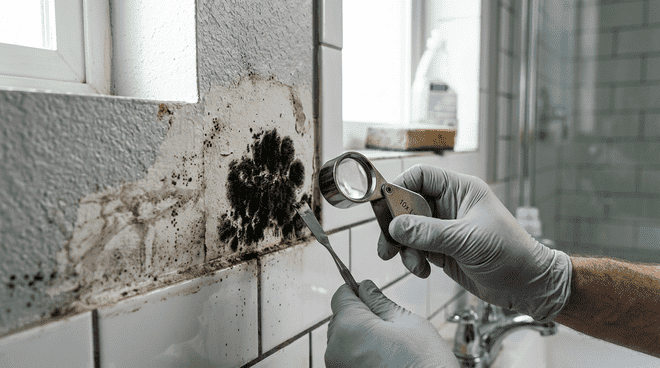
Color is the least useful thing about a patch of mold. Several of the molds that grow in ordinary homes are dark green or black, and the species people mean by “black mold” can’t be confirmed by eye. What matters more is how much is there, what it’s growing on, and where the water is coming from. This is how to read what you’re looking at, when a test is worth paying for, and when a patch is too big to clean yourself.
TL;DR
- EPA says most patches under about ten square feet are a do-it-yourself job; past that, plan on professional mold remediation.
- Color can’t confirm the species: plenty of ordinary household molds look dark green or black.
- CDC says you don’t need to know the type; all mold gets the same caution and the same removal.
- Address the source of moisture first. The EPA warns that mold can return after cleaning if the underlying cause is not resolved.
- Skip testing mold you can see; EPA says sampling is unnecessary in most of those cases.
- Renters in Virginia must report moisture and visible mold to the landlord promptly; state law sets duties for both sides.
What “black mold” actually means, and what it doesn’t
“Black mold” is a nickname, not a diagnosis. It usually refers to Stachybotrys chartarum, which CDC’s facts about Stachybotrys describe as a greenish-black mold that grows on cellulose-rich materials such as gypsum board, fiberboard and paper, and only where moisture is constant. That detail matters more than the color: Stachybotrys points to a water problem that has been going on for a while, such as a slow leak inside a wall.
Dark color, on the other hand, proves very little. EPA’s guide to mold and moisture notes that molds come in many colors, and several common indoor molds turn dark green, gray or black. Only a lab can name a species, and the CDC says it isn’t necessary to know which type you have, because all molds should be treated the same for health risk and removal.
That’s why black mold identification is the wrong goal. Any mold can trigger allergic reactions in sensitive people and irritate the nose, eyes, throat, skin, and lungs, according to the EPA. The questions that decide what happens next are how much is there, what it’s growing on, and where the water is coming from.
Read the clues that matter more than color
Where mold grows, what it’s growing on, and how it smells tell you more than its color ever will.
Location tells you where the water is
Growth on shower grout or a window sill is usually fed by everyday moisture and stays on the surface. Growth on drywall under a window, along a baseboard, or across a ceiling usually means water got into the structure, and what you see is the edge of it. Peeling paint, staining, and warped trim nearby are the usual companions, and they’re covered in our guide to signs of long-term water damage.
Porous materials hold mold you can’t scrub out
Tile, glass, metal, and sealed wood can be cleaned. Drywall paper, ceiling tiles, carpet, and insulation are another matter: EPA notes that mold can fill the spaces in porous materials, so they suggest you throw them away rather than clean them.
A musty smell with nothing visible means look harder
When a building smells different or moldy, but you can’t pinpoint the source, EPA suggests suspecting hidden mold in the building. Common hiding places include the back of drywall and wallpaper, the carpet’s lower surface, and the top of ceiling tiles. Don’t peel back wallpaper or open a wall to look; EPA warns that disturbing hidden growth can release a burst of spores.
Know the types of household mold you’re likely to see
A handful of genera account for much of the mold found indoors, and several of them can look dark.
- Cladosporium: often olive-green to black, and common both outdoors and on damp indoor surfaces such as window frames.
- Penicillium: usually blue-green, found on water-damaged materials and spoiled food.
- Aspergillus: many species in many colors, common in household dust and on damp building materials.
- Alternaria: dark green to brown, often near showers, sinks, and window frames where moisture lingers.
- Stachybotrys chartarum: greenish-black, growing on wet cellulose-rich materials like gypsum board, per the CDC.
Knowing the types of household mold won’t let you diagnose a wall. It shows the limit of black mold identification by eye: several of the five can look dark, and only a lab can tell them apart.
Decide whether a mold test is worth paying for
When you can already see mold, a test rarely changes what happens next. According to the EPA, testing is often unnecessary when mold is already visible. Since federal agencies have not established acceptable indoor mold levels, test results cannot determine whether a home meets a specific safety standard.
Testing earns its fee in a few situations:
- You smell mold but can’t find it, and opening walls blindly would cost more than a test.
- You need to confirm that remediation worked before rebuilding or moving back in.
- A lease, sale, or dispute depends on documentation.
EPA advises that sampling be done by professionals with specialised experience in designing it and comprehending and interpreting results. At PuroClean of Alexandria, we recommend independent clearance testing by a third party after remediation where the situation calls for it, so the company that did the work isn’t the one grading it. If a home sale is involved, our post on mold issues when buying or selling covers what to expect.
Size up the job before you pick up a sponge
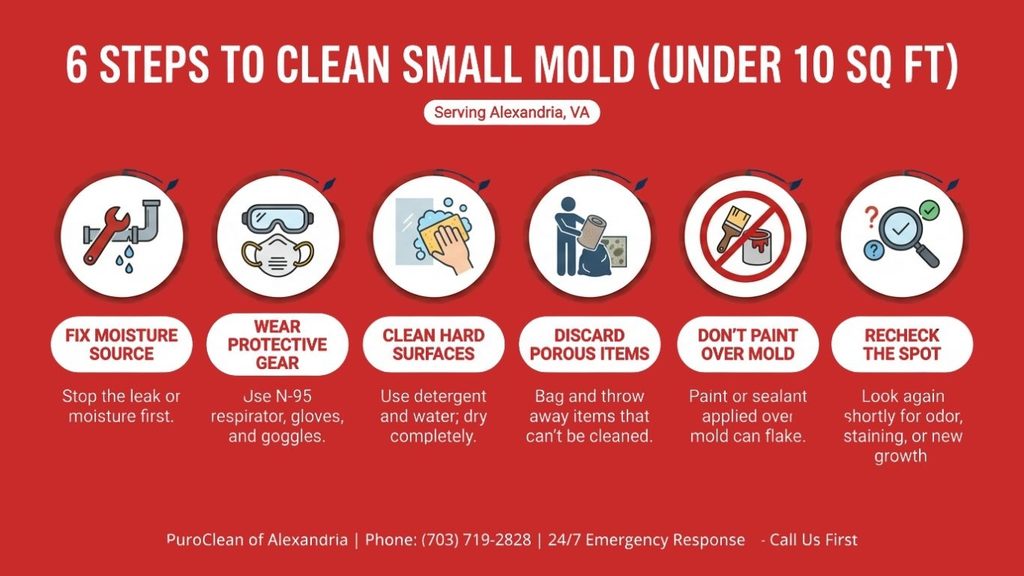
Small growth on a hard surface is a do-it-yourself job; anything bigger, wetter, or hidden isn’t. EPA’s rule of thumb is around ten square feet, similar in size to a three-by-three-foot section. For mold-affected areas smaller than this, homeowners can generally manage the cleanup themselves:
- Find and fix the leak or moisture source before you clean anything.
- Wear an N-95 respirator, long gloves, and goggles with no ventilation openings, as EPA recommends.
- Clean affected hard surfaces using detergent mixed with water, then remove any remaining moisture.
- Bag and throw away moldy porous items, such as carpet or ceiling tiles, that can’t be cleaned.
- Painting or sealing a surface without first removing mold can lead to poor adhesion and flaking, a concern highlighted by the EPA.
- Check the spot again shortly after for odor, staining, or new growth.
If the source was a leak that soaked drywall or flooring, water damage mitigation and drying has to happen before any cleanup will hold.
Who handles mold in a Virginia rental?
Both sides do, and Virginia law spells out each one’s part. Under Virginia Code § 55.1-1215, the landlord’s move-in inspection report has to say whether there’s visible evidence of mold in readily accessible areas. If it says there’s none and you disagree, object in writing within five days. If mold is disclosed and you choose to stay, the landlord must remediate it within five business days and reinspect.
During the tenancy, tenants must promptly tell the landlord about moisture buildup or visible mold, and landlords must respond and remediate visible mold according to professional standards that the law ties to guidance from EPA, HUD, industrial hygienists, and the IICRC. If remediation requires a temporary move, the landlord provides a comparable unit or hotel room at no cost to the tenant. The City of Alexandria’s mold guide for landlords and tenants summarizes these rules and names the city’s Office of Housing as a contact.
Whichever side you’re on, put notices in writing and keep photos. We document what we find and what we remove, which gives the landlord and tenant the same record.
Cleaning it yourself, testing and professional remediation compared
| Option | Works when | Falls short when | What it costs you |
|---|---|---|---|
| Scrubbing it yourself | Under about ten square feet on a hard surface, per EPA | Growth is on drywall, carpet, or inside a wall | Regrowth if the moisture source is missed |
| Testing by an independent professional | Hidden growth is suspected, or a lease or sale needs proof | Mold is already visible, and the plan won’t change | A fee for an answer you may already have |
| A handyman or general contractor | The area is dry, clean, and only needs new materials | Growth is still active, or the water source is unknown | Mold sealed behind new drywall |
| A mold remediation company | Growth is large, hidden, or follows a leak or flood | Nobody fixes the water source | A remediation bill, which insurance may or may not cover |
Where this does not apply
The 10-square-foot rule assumes clean water, an uncontaminated heating and cooling system, and healthy occupants. EPA points you to a professional instead when:
- The water came from sewage or another contaminated source.
- You suspect mold in the heating or cooling system; don’t run it, because it can spread mold through the house.
- There’s been a lot of water damage, even if the visible patch is small.
- Someone in the home has health concerns; EPA advises talking to a health professional before cleanup starts.
Final Verdict
If the patch is small, on a hard surface, and you know where the moisture came from, clean it yourself with EPA’s precautions and fix the source. If it’s larger than about ten square feet, keeps coming back, or sits on drywall below a leak, black mold identification by color won’t help you; have it assessed and removed properly, and the types of household mold involved won’t change that. If you rent, tell your landlord in writing first. Mold work often overlaps with water damage, and our residential restoration services cover both.
If you’d like a second opinion before deciding, call us at (703) 719-2828 or ask for a mold assessment.
FAQs
Q: Is black mold more dangerous than other mold?
A: Not in a way that changes what you should do. 2. The CDC advises taking the same approach to mold cleanup and health precautions, regardless of the variety found, and that no test exists to prove a link between Stachybotrys and particular symptoms. According to EPA, any mold can cause allergic reactions in sensitive people and irritate the nose, eyes, throat, skin, and lungs. If someone in your home has health concerns, talk to their doctor.
Q: What’s the difference between mold and mildew?
A: Mildew is the everyday name for mold growing flat on a surface, the kind that shows up on shower grout or a damp windowsill. It’s still mold, usually caught early on a hard surface where it can be scrubbed off. For damp rooms like bathrooms, EPA’s advice is more ventilation and more frequent cleaning, which usually keeps it from coming back.
Q: Does bleach kill black mold?
A: Bleach is less useful than its reputation. EPA doesn’t recommend chlorine bleach or other biocides as a regular part of mold cleanup, and it notes that dead mold can still cause some difficulties or allergic reactions, so mold has to be removed, not just killed. On hard surfaces, EPA recommends water and detergent. Never mix bleach with cleaners consist of ammonia; the combination can produce toxic fumes.
Q: Does homeowners insurance cover mold removal?
A: It depends on your policy and on what caused the mold, and only your insurer can tell you. Review your insurance coverage for moisture-related damage and mold issues, photograph the damage before anything is removed, and keep records of any leak or repair. During remediation, we keep you and your insurance agent updated at every step and document what we find and remove.
Q: Can I stay in my home while mold is removed?
A: Often you can, because crews seal off the work area and filter the air to keep spores from spreading. Whether you should depends on the size and location of the job and the health of the people living there; anyone with asthma, allergies, or a weakened immune system should ask their doctor. In a Virginia rental, the landlord may require a temporary move and must provide housing at no cost.