


Published: October 8, 2026
Quick answer: Mold does not show up the day of the storm — it shows up weeks later. Loganville knows wet weather: the Big Haynes Creek gauge at nearby Milstead crested at 22.46 feet during the September 2009 floods, nearly double its 12-foot flood stage, and the Alcovy River at Lawrenceville topped 13.87 feet that same week. After a wet stretch, saturated ground and humid air leave moisture trapped in attics and crawl spaces, and Georgia homes offer mold everything it needs for much of the year: warmth, darkness, and something to eat. If you smell something musty or spot dark growth after a wet spell, call PuroClean of East Cobb at (770) 627-0900. We answer 24/7 with a live person and respond in 60 minutes or less.
About PuroClean of East Cobb
Who is PuroClean of East Cobb?
PuroClean of East Cobb provides 24/7 water, fire and mold restoration in Marietta, GA, with a 60-minute-or-less response. Since 2022, the team has completed more than 4,000 restoration jobs across metro Atlanta. Technicians hold IICRC certifications in water restoration (WRT), fire and smoke restoration (FSRT), applied structural drying (ASD), and applied microbial remediation (AMRT), plus EPA Lead-Safe certification.
What does restoration cost?
National averages run $1,300–$5,600 for water damage restoration and about $12,900 for fire damage restoration (Forbes). Every job is documented with photos and video, and you approve the restoration plan before work begins — no fine print.
Who answers when I call?
A live person, 24 hours a day, 7 days a week. One project manager owns your job from assessment and stabilization through restoration, finishing with a final walkthrough together. Call (770) 627-0900 any time.
Here is the part nobody warns you about after a big storm: the water you can see is only half the problem. The roof stops dripping, the yard drains, everything feels back to normal — and then, three or four weeks later, a musty smell starts coming through the vents. Storm moisture hides. It sits in attic insulation, under crawl space vapor barriers, inside wall cavities where a window leaked for one afternoon. And in Georgia’s humidity, “it will dry out on its own” is usually wishful thinking.
Why wet weather turns into mold weeks later
Mold needs three things: moisture, warmth, and food. A Loganville home after a wet stretch offers all three for much of the year:
- Moisture arrives silently. Wind-driven rain forces water under flashing and through attic vents. Saturated ground wicks moisture up through crawl space floors. None of this shows up as a puddle you can see.
- It gets trapped. Attics without adequate ventilation hold humid air for days. Crawl spaces with torn or missing vapor barriers stay damp long after the yard dries. Wall cavities that took on water through a leaky window stay wet inside while the room looks fine.
- Georgia warmth does the rest. Mold can start growing within 24 to 48 hours of moisture arriving, and it does not stop just because the sun came out. By the time you smell it, the colony has been established for weeks.
This is why “we dried everything we could see” is not the same as actually being dry.
Where post-storm mold hides
When we get called weeks after a storm, the growth is almost always in one of these places:
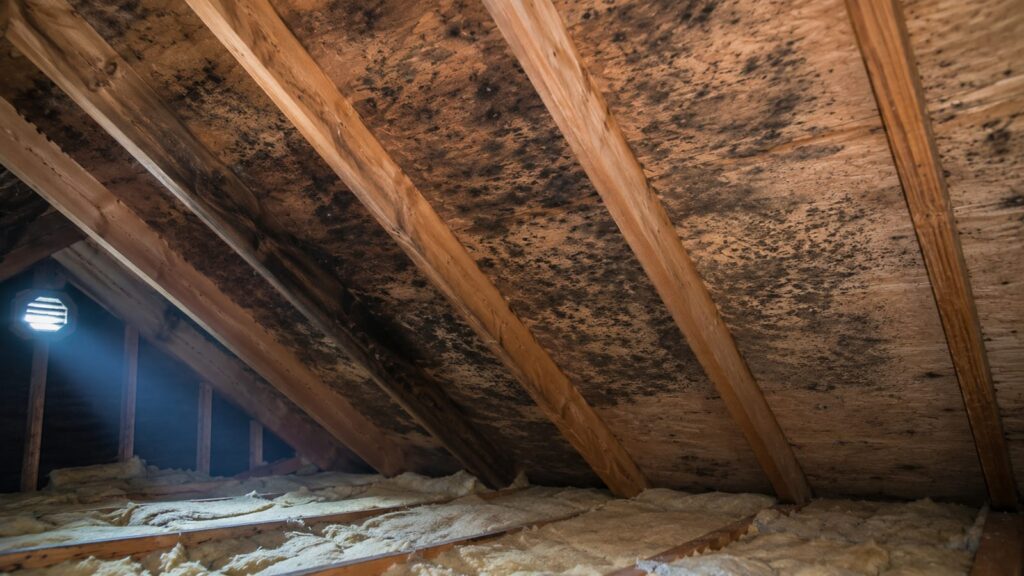
- Attics. Roof sheathing and rafters are the classic spot — dark, warm, and fed by every bit of moisture that gets past the roofing. A small roof leak or wind-driven rain through a vent can seed an entire roof deck.
- Crawl spaces. The floor joists, subfloor, and insulation in a damp crawl space are a buffet. Musty smells in the house often trace back here, carried up through gaps and ductwork.
- Inside wall cavities. One afternoon of water through a window or a failed caulk line can soak insulation and drywall from the inside. The wall looks normal until the paint starts bubbling or the smell arrives.
- Behind and under appliances. Dishwashers, washing machines, and ice makers that sat in an inch of water nobody noticed keep feeding moisture into the floor around them.
What not to do
- Do not just spray bleach on it. Bleach can discolor mold on hard, non-porous surfaces, but it does not kill mold roots in porous materials like wood or drywall — and the water in bleach can feed the problem.
- Do not paint over it. Paint seals the surface and hides the growth while it keeps spreading behind the coating.
- Do not ignore the musty smell. A musty odor with no visible growth is a classic sign of hidden mold. It is your house telling you where to look.
When to call a professional
A small surface patch — less than about ten square feet, on a hard surface, with the moisture source already fixed — is a cleaning job with proper protection (mask, gloves, ventilation). Anything bigger, anything inside walls, attics, or HVAC, or anything after flooding is remediation territory. Our technicians hold IICRC applied microbial remediation certification (AMRT): we find the moisture source with thermal imaging and meters, contain the area so spores do not spread through the house, remove the growth, and fix the conditions that grew it. Everything is photo- and video-documented, and one project manager owns the job through the final walkthrough together.
If something smells musty or looks dark and fuzzy after the last wet stretch, call (770) 627-0900. The earlier we look, the smaller the job. We’re based in Marietta and available 24/7.
Learn more about our service areas and mold remediation services. Related reading: Damp Basements on Sugar Hill’s Hillsides: When Hillside Seepage Turns to Mold.