Published: September 28, 2026
Appliance leak in Dallas? Supply lines are a common cause of kitchen and laundry floods, so check the hoses behind your washer and fridge. Quick answer: The most common culprits are washing-machine supply hoses, ice-maker lines, dishwasher connections, toilet supply lines, and aging water heaters. If water is flowing, shut the valve at the fixture — or the main water valve if you can’t isolate it — kill power if water is near outlets, move what you can, and call PuroClean of East Cobb at (770) 627-0900. We answer 24/7 with a live person and respond in 60 minutes or less.
About PuroClean of East Cobb
Who is PuroClean of East Cobb?
PuroClean of East Cobb provides 24/7 water, fire and mold restoration in Marietta, GA, with a 60-minute-or-less response. Since 2022, the team has completed more than 4,000 restoration jobs across metro Atlanta. Technicians hold IICRC certifications in water restoration (WRT), fire and smoke restoration (FSRT), applied structural drying (ASD), and applied microbial remediation (AMRT), plus EPA Lead-Safe certification.
What does restoration cost?
National averages run $1,300–$5,600 for water damage restoration and about $12,900 for fire damage restoration (Forbes). Every job is documented with photos and video, and you approve the restoration plan before work begins — no fine print.
Who answers when I call?
A live person, 24 hours a day, 7 days a week. One project manager owns your job from assessment and stabilization through restoration, finishing with a final walkthrough together. Call (770) 627-0900 any time.
Dallas is the seat of Paulding County, with the Silver Comet Trail running through town and a housing mix that tells the county’s growth story: older homes near downtown alongside 1990s–2000s subdivisions built during Paulding’s boom years. Thousands of those subdivision homes are still running their original appliance supply lines — rubber washer hoses, plastic ice-maker tubing, original toilet valves — and those components don’t age gracefully.
The usual suspects
Appliance leaks rarely announce themselves. The failure points we see most often:
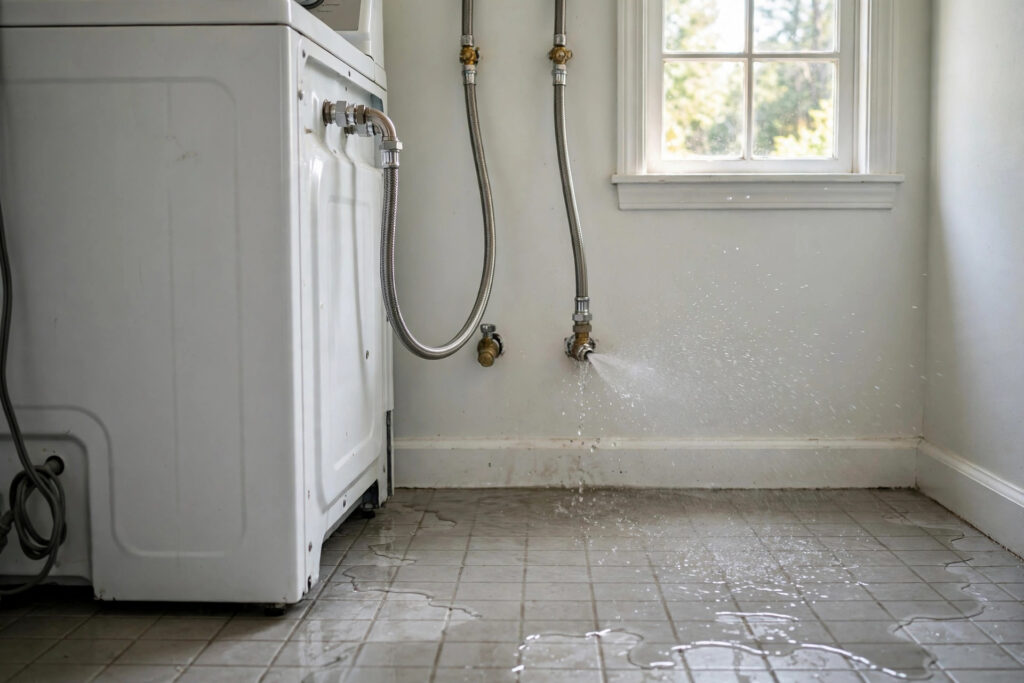
Washing-machine supply hoses. Standard rubber hoses weaken with constant water pressure and heat. A burst washer hose doesn’t drip — it delivers the full flow of your home’s water supply onto the laundry room floor until someone shuts it off.
Ice-maker and water-dispenser lines. Thin plastic tubing running through cabinets and behind the refrigerator gets brittle with age. The leak often starts as a slow seep inside a cabinet, discovered only when the flooring swells.
Dishwasher supply and drain connections. A loose supply connection or a cracked drain hose leaks with every cycle, soaking the subfloor under the dishwasher where nobody looks.
Toilet supply lines and fill valves. A failed supply line can run silently into the floor, and a stuck fill valve can overflow the tank for hours.
Water heaters. A standard tank lasts roughly 8 to 12 years. When the tank itself fails, it releases its full contents at once — and many sit in garages, closets, or attics where the water spreads before anyone notices.
Why it happens when you’re not home
Supply lines live under constant pressure, 24 hours a day, whether anyone is watching or not. Age does the rest: rubber dries and cracks, plastic embrittles, metal corrodes, valves seize. The failure almost always picks the worst moment — a workday, a vacation, the middle of the night — because that’s when hours pass before anyone sees the water. A failed washer hose can release hundreds of gallons while you’re at the office. That’s the difference between a mop-up and a restoration job.
Warning signs worth checking
You can catch most of these before they fail. Once a year, pull the washer out and look:
- Washer hoses that are bulging, cracked, or feel brittle — replace them now, not later
- Green or white corrosion on supply valves and connections
- Water around the base of the toilet or a fill valve that runs too long
- Rust on the water heater tank, moisture at its base, or rumbling during heating cycles
- A musty smell in the laundry room or under the kitchen sink that wasn’t there before
- Swelling or discoloration on flooring near any appliance
One bulging washer hose is a weekend project. A burst one is an insurance claim.
What to do right now
- Shut the fixture valve — there’s usually one behind the toilet, under the sink, and behind the washer. Turn it clockwise to close.
- If you can’t isolate it, shut the main water valve. Know where yours is before you need it — usually near the street, in the garage, or on an exterior wall.
- Kill power to the area if water is near outlets or appliances.
- Move what you can — and photograph everything before you start cleaning up.
- Call (770) 627-0900. We answer 24/7 with a live person and respond in 60 minutes or less.
Prevention that actually works
- Replace rubber washer hoses with braided stainless-steel lines, and consider a single-lever shutoff valve you can close when the washer isn’t running.
- Automatic shutoff valves with leak sensors sit on the floor behind the washer and close the water when they detect moisture — inexpensive insurance for laundry rooms.
- Replace the water heater on schedule, not on failure. Past the 10-year mark, you’re on borrowed time.
- Check every visible supply valve yearly. If a valve won’t turn, have a plumber replace it before it’s the valve you desperately need.
How we restore it
Every job follows the same four steps: assess, stabilize, document, restore. We use thermal imaging and moisture meters to map how far the water traveled — behind cabinets, under flooring, into wall cavities and subfloor — because appliance leaks soak far beyond the visible puddle. Then we extract standing water, remove unsalvageable materials, dry the structure with controlled dehumidification, and photograph and video-document the whole job for your insurance claim. One project manager stays with you from the first call through the final walkthrough. No fine print.
One plain note on scope: a plumber handles the failed line or valve itself — we handle the water damage and the dry-out, and we’ll tell you clearly where our work ends and theirs begins.
Suspect an appliance leak in the Dallas area? Call (770) 627-0900 now — we’re based nearby in Marietta and available around the clock.
PuroClean of East Cobb has completed 4,000+ restoration jobs since 2022 — 54% water damage, 30% reconstruction, 7% mold. Learn more about PuroClean of East Cobb — our company facts, certifications, and track record.
Learn more about our service areas and our water damage restoration services.